What Is a Medicare Savings Program? Lower Costs
What Is a Medicare Savings Program? A Simple Way to Lower Medicare Costs
Medicare helps cover health care, but it does not make every bill disappear. A Medicare Savings Program, often called an MSP, may help eligible people with limited income and resources pay certain Medicare costs.
Application handled by state Medicaid offices
Independent informational guide
Important: This website is an independent informational resource. It is not Medicare.gov, CMS, Medicaid, Social Security, or any government agency. We do not process applications or guarantee eligibility.
Quick Answer: What is a Medicare Savings Program?
A Medicare Savings Program is a state-run Medicaid program for people who have Medicare and meet income and resource rules. Depending on the program, it may help pay the Part B premium, Part A premium, deductibles, coinsurance, copayments, and may connect you to Extra Help for prescription drug costs.
For the full site hub, see our core Medicare Savings Program guide.
Medicare Savings Program: What It May Help Pay For
A Medicare Savings Program helps eligible Medicare beneficiaries reduce what they pay for Medicare. The program is handled through Medicaid, but it is specifically connected to Medicare costs.
Premium help
Part B Premium
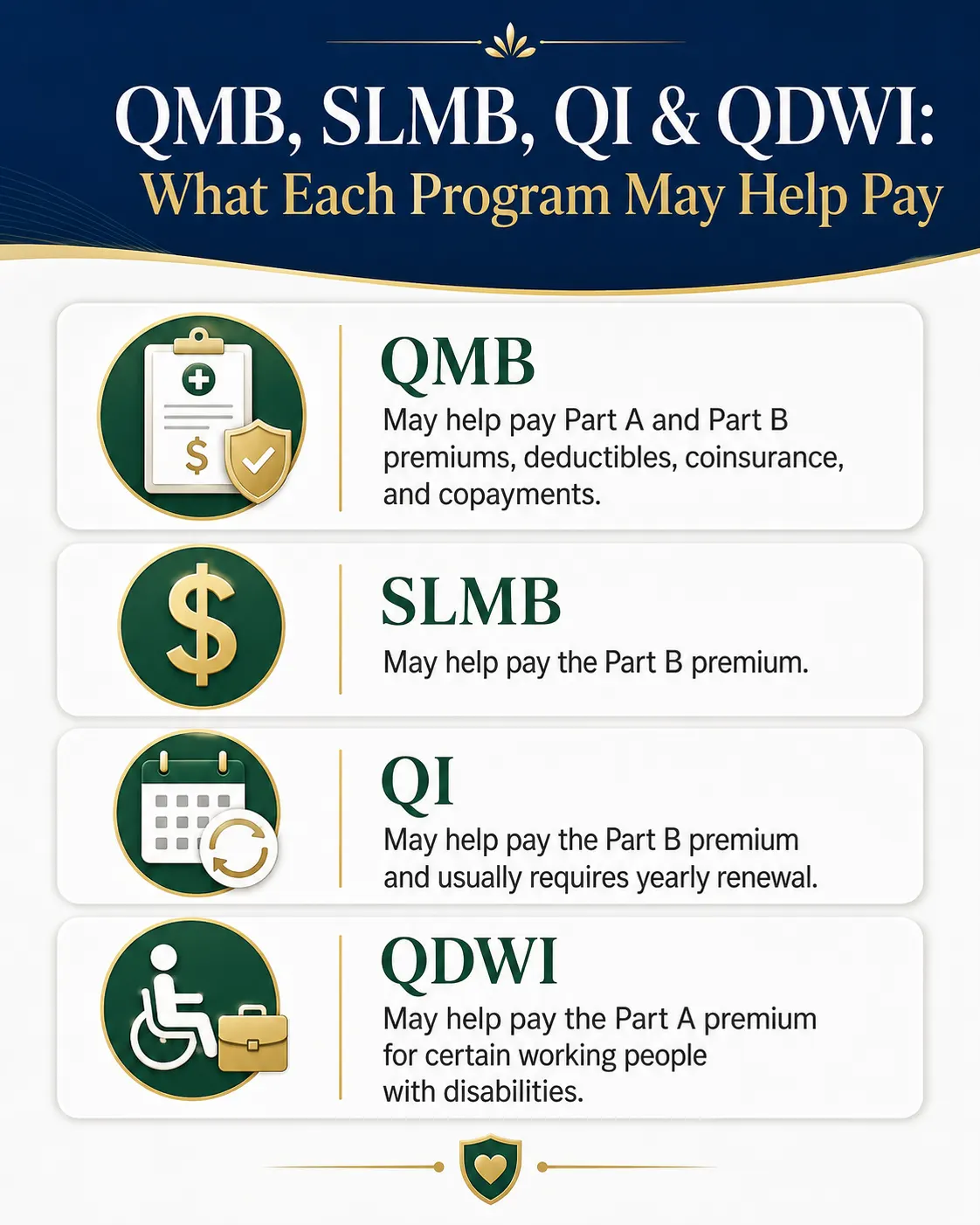
QMB, SLMB, and QI may help pay the monthly Medicare Part B premium.
Possible help
Part A Premium
QMB may help if you owe a Part A premium. QDWI may help certain working people with disabilities pay the Part A premium.
QMB protection
Cost Sharing
QMB may help with Medicare deductibles, coinsurance, and copayments for Medicare-covered services.
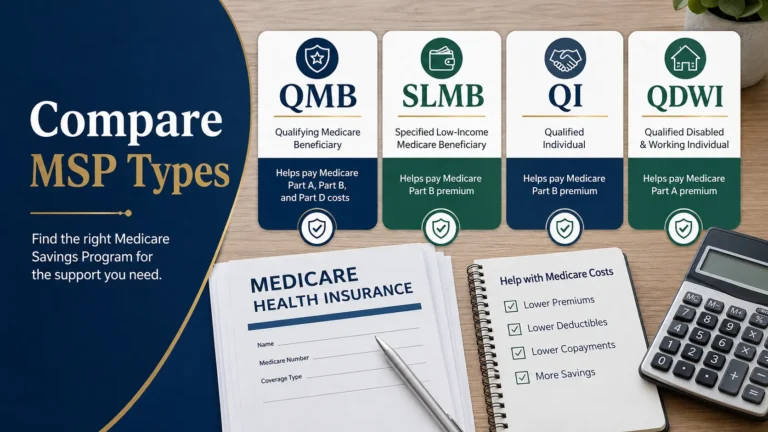
The four main Medicare Savings Programs are QMB, SLMB, QI, and QDWI. You apply through your state Medicaid office, not through a private insurance company.
Official information is available from Medicare.gov’s Medicare Savings Programs page.

Why the Medicare Savings Program Matters
For many Medicare beneficiaries, the problem is not one huge bill. It is the steady pressure of smaller costs.
A Part B premium comes out every month. A specialist visit creates another charge. A prescription refill costs more than expected. A lab bill may show up weeks after an appointment. Then a renewal notice or insurance letter arrives, and it is not always clear what needs action.
That is why an MSP can matter. If the state starts paying your Part B premium, your Social Security payment may increase after processing. If you qualify for QMB, you may also get protection from many Medicare-covered deductibles, coinsurance, and copayments.
The Four Medicare Savings Programs
There are four main Medicare Savings Programs. They all help with Medicare costs, but they do not all pay for the same things.
| Program | Best described as | What it may help pay for |
|---|---|---|
| QMB | The broadest MSP | Part A premium, Part B premium, deductibles, coinsurance, and copayments |
| SLMB | Part B premium help | Part B premium |
| QI | Another Part B premium program | Part B premium |
| QDWI | A special work-related program | Part A premium for certain working people with disabilities |
Your state Medicaid office decides which program you qualify for after reviewing your application.
Which Medicare Savings Program Gives Which Type of Help?
The four Medicare Savings Programs do not all work the same way. Some only help with a monthly premium. One program gives broader protection from Medicare bills. Another is only for a specific group of working people with disabilities.
QMB: Help With the Most Medicare Costs
The Qualified Medicare Beneficiary Program, commonly called QMB, is the Medicare Savings Program that usually offers the broadest assistance.
QMB is mainly for people who have Medicare but cannot afford the premiums and out-of-pocket costs that can come with doctor visits, hospital care, tests, and other Medicare-covered services.
- ✓Medicare Part A premium, if you owe one
- ✓Medicare Part B premium
- ✓Medicare deductibles
- ✓Medicare coinsurance
- ✓Medicare copayments for Medicare-covered services
SLMB: Help Paying the Monthly Part B Premium
The Specified Low-Income Medicare Beneficiary Program, or SLMB, is more limited than QMB, but it can still be very helpful.
SLMB is designed for people who need help paying the Medicare Part B premium. It usually does not pay Medicare deductibles, coinsurance, or copayments.
QI: Help With Yearly Renewal Rules
The Qualifying Individual Program, or QI, also helps pay the Medicare Part B premium. QI is similar to SLMB because both programs focus on the Part B premium.
The main difference is that QI has slightly higher income limits, but it also has stricter yearly rules. QI must be applied for every year and is generally approved on a first-come, first-served basis.
QDWI: Help With Working People With Disabilities
The Qualified Disabled and Working Individual Program, or QDWI, is different from QMB, SLMB, and QI. It is for a specific group of people with disabilities who returned to work and lost premium-free Medicare Part A.
- ✓Have a disability
- ✓Are working
- ✓Lost premium-free Part A because they returned to work
- ✓Meet income and resource rules
- ✓Do not already receive certain Medicaid benefits
Simple Way to Remember the Difference
QMB
May help with most Medicare costs.
SLMB
Helps with the Part B premium.
QI
Also helps with the Part B premium, but yearly renewal matters.
QDWI
Helps certain working people with disabilities pay the Part A premium.
Your state Medicaid office decides which program you qualify for, so you do not need to choose the right one by yourself. The most important step is to apply and let the state review your situation.
Medicare Savings Program Income and Resource Limits
The federal government lists income and resource limits for Medicare Savings Programs. These are useful starting points, but they are not always the final answer because states may count income and resources differently.
| Program | Individual monthly income | Married couple monthly income | Resource limit |
|---|---|---|---|
| QMB | $1,350 | $1,824 | $9,950 individual / $14,910 couple |
| SLMB | $1,616 | $2,184 | $9,950 individual / $14,910 couple |
| QI | $1,816 | $2,455 | $9,950 individual / $14,910 couple |
| QDWI | $5,405 | $7,299 | $4,000 individual / $6,000 couple |
These limits generally do not include Alaska and Hawaii, which have higher income limits. You can review the official limits in the SSA POMS guidance for MSP income and resource limits.
What an MSP Can Change in Daily Life
A Medicare Savings Program is not just a line on a benefits chart. It can affect ordinary moments, including:
- ✓The Social Security deposit you check each month
- ✓Whether you feel comfortable scheduling a follow-up visit
- ✓What happens when a bill arrives from a provider
- ✓The price you pay at the pharmacy counter
- ✓Your confidence using the Medicare coverage you already have
You can learn more from Medicare.gov’s Help With Drug Costs page.
How to Apply for a Medicare Savings Program Without Getting Lost
You apply through your state Medicaid office. You may be able to apply online, by phone, by mail, or in person. Every state has its own process.
Start with Medicaid.gov’s state Medicaid contact page, or use our state resources hub to find state-specific starting points.
Documents You May Need
- ✓Medicare card
- ✓Proof of income
- ✓Social Security award letter
- ✓Bank statements
- ✓Identification
- ✓Proof of address
- ✓Health insurance cards
- ✓Recent medical bills, if requested
Common Mistakes That Cost People Money
- ✓Applying through a private sales page instead of an official state source.
- ✓Assuming income is too high without checking state rules.
- ✓Ignoring renewal letters, especially for QI.
- ✓Paying a bill too quickly after QMB approval without calling the provider’s billing office.
- ✓Missing a document deadline after the Medicaid office asks for proof.
FAQs About Medicare Savings Programs
Is a Medicare Savings Program the same as Medicaid?
Not exactly. Medicare Savings Programs are run through Medicaid, but they are specifically designed to help with Medicare costs. Some people get full Medicaid too, but others only get MSP help.
Does a Medicare Savings Program pay the Part B premium?
Yes. QMB, SLMB, and QI may pay the Medicare Part B premium if you qualify.
Which Medicare Savings Program gives the most help?
QMB usually gives the broadest help because it may pay premiums, deductibles, coinsurance, and copayments for Medicare-covered services.
Can I qualify if my income is slightly over the limit?
Possibly. Some states count income and resources differently, so it may be worth applying even if you think you may be over the limit.
Does MSP help with prescription drugs?
Yes. If you qualify for QMB, SLMB, or QI, you generally also qualify for Extra Help with Medicare prescription drug costs.
Can I have Medicare Advantage and still qualify for MSP?
Yes. Medicare Advantage is still Medicare. If you qualify for an MSP, it may help with certain Medicare costs, such as the Part B premium.
Do I apply through Medicare?
No. You apply through your state Medicaid office. Medicare.gov gives information, but the state Medicaid office reviews and decides MSP applications.
Do I have to renew every year?
QI must be applied for every year. Other MSPs may also require renewal depending on your state. Always respond to renewal mail.
What if I get a bill after QMB approval?
Call the provider’s billing office and tell them you have QMB. Give them your Medicare and Medicaid information before paying the bill.
Can MSP increase my Social Security check?
It can. If your Part B premium is being deducted from Social Security and your state starts paying it, your monthly Social Security payment may increase after processing.
Conclusion
A Medicare Savings Program can make Medicare easier to afford. It may help pay your Part B premium, reduce certain out-of-pocket costs, protect you from some Medicare bills if you qualify for QMB, and connect you to Extra Help for prescriptions.
The most important step is checking. If Medicare premiums, doctor bills, or prescription costs are making your budget tight, contact your state Medicaid office and ask about Medicare Savings Programs. You can also speak with a free SHIP counselor for help understanding your options.