QMB Medicare Savings Program: Benefits & Billing Help
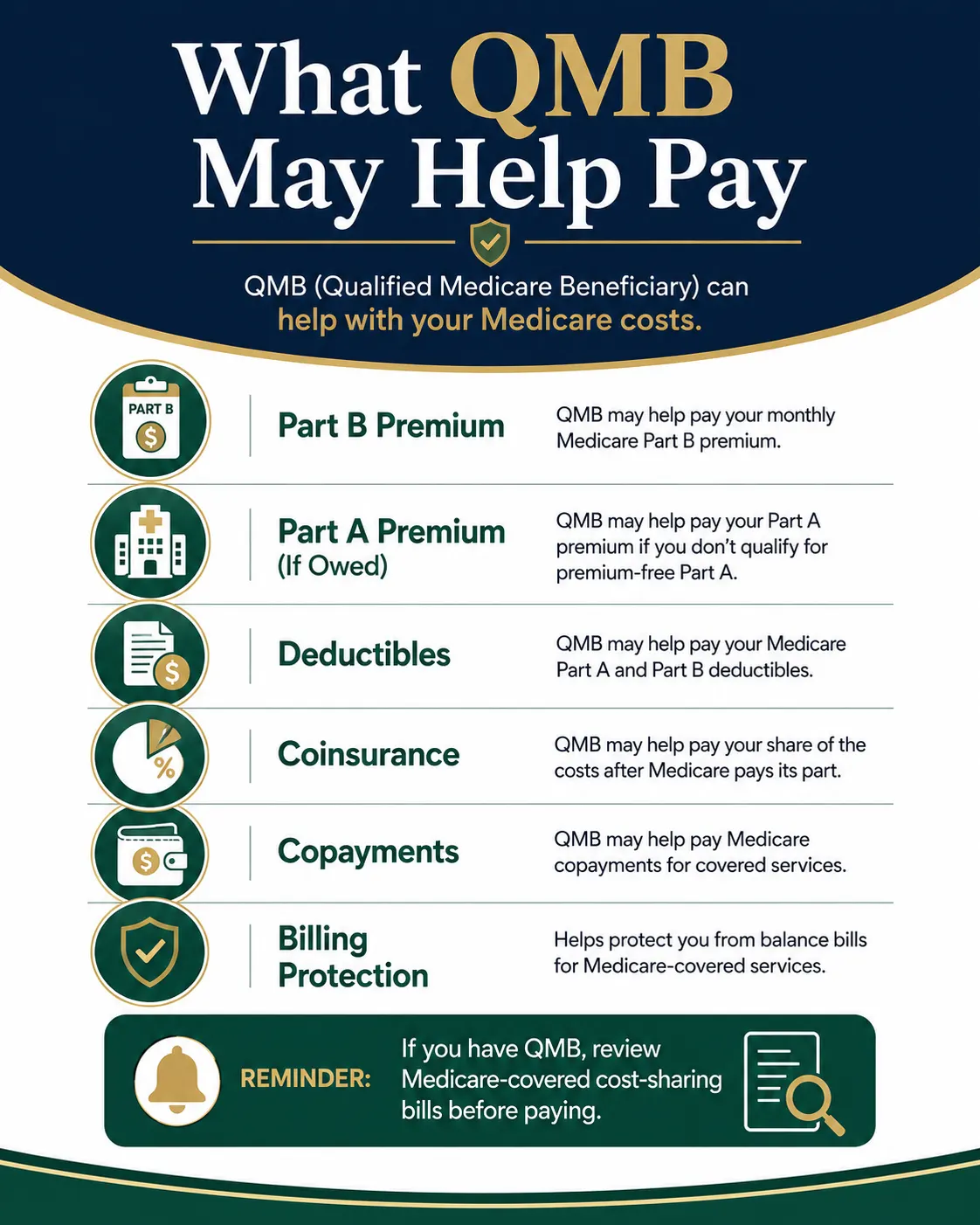
QMB stands for Qualified Medicare Beneficiary. It is one of the Medicare Savings Programs, and it usually gives the strongest help. If you qualify, QMB may help pay your Medicare Part A premium if you owe one, your Medicare Part B premium, and Medicare-covered deductibles, coinsurance, and copayments.
But QMB does not only help with premiums. It can also protect you from certain Medicare bills. If you have QMB and receive a bill, do not panic and do not assume the bill is correct. It may need to be reviewed.
Extra protection: Medicare cost-sharing bills
Final decision: state Medicaid office
Important: QMB billing protection generally applies to Medicare-covered Part A and Part B cost sharing. If a bill appears after QMB approval, review it before paying.
Quick Answer: What does QMB help with?
The QMB Medicare Savings Program may help pay the Medicare Part A premium if you owe one, the Part B premium, and Medicare-covered deductibles, coinsurance, and copayments. It also gives important billing protection for Medicare-covered cost sharing.
For the full MSP overview, visit our main Medicare Savings Program resource.

What Is the QMB Medicare Savings Program?
The QMB Medicare Savings Program is a state-run program that helps eligible Medicare beneficiaries pay Medicare costs.
It is connected to Medicaid, but it is not always the same as full Medicaid. Your state Medicaid office reviews your application and decides whether you qualify.
QMB may help with:
| Medicare cost | QMB help |
|---|---|
| Medicare Part A premium | Yes, if you owe one |
| Medicare Part B premium | Yes |
| Medicare deductibles | Yes, for Medicare-covered services |
| Coinsurance | Yes, for Medicare-covered services |
| Copayments | Yes, for Medicare-covered services |
This is why QMB is different from some other Medicare Savings Programs. SLMB and QI mainly help with the Part B premium. QMB can help with the Part B premium and Medicare-covered cost sharing.
For someone living on a fixed income, that difference can be huge. If you need the broader MSP explanation, read our guide on what a Medicare Savings Program is.
Why QMB Matters
A lot of people first look up QMB because something has already gone wrong. Maybe the Part B premium is making their Social Security check smaller. Maybe they got a doctor bill they did not expect. Maybe a provider told them they owe a copay even though they thought Medicaid was helping. Maybe they have Medicare Advantage and are not sure whether QMB still protects them.
If you qualify, QMB may reduce your monthly costs by paying the Part B premium. It may also stop certain Medicare cost-sharing bills from becoming your responsibility.
2026 QMB Income and Resource Limits
For 2026, Medicare.gov lists these QMB limits for most states:
| Situation | Monthly income limit | Resource limit |
|---|---|---|
| Individual | $1,350 | $9,950 |
| Married couple | $1,824 | $14,910 |
These limits are slightly higher in Alaska and Hawaii.
But do not stop reading just because your income looks a little higher. Medicare.gov says you may still qualify in your state even if your income or resources are higher than the federal limits listed, because states can use different counting rules.
So always check with your state Medicaid office or apply and let the state decide. You can compare the full chart here: Medicare Savings Program income limits.
What Counts as Income for QMB?
Income usually means money you receive regularly. This may include:
- ✓Social Security
- ✓Retirement income
- ✓Pensions
- ✓Wages
- ✓Disability benefits
- ✓Other regular payments
If you are near the limit, applying can still be worth it. You can also review our plain English eligibility guide: who qualifies for a Medicare Savings Program.
What Counts as Resources?
Resources are assets that may be counted when your state reviews your QMB application. They may include money in:
- ✓Checking accounts
- ✓Savings accounts
- ✓Stocks
- ✓Bonds
- ✓Some retirement funds
Some things usually do not count, such as the home you live in, one car, personal belongings, household items, and certain burial funds. Medicare.gov also says income and resource limits vary by state, and some states do not count resources at all.
What Does QMB Cover?
QMB can help with the Medicare costs that often create the most stress.
Medicare Part B Premium
This is one of the main reasons people apply. The Part B premium is often taken out of a person’s Social Security payment. If QMB is approved, the state may pay that premium for you.
The change may not appear immediately. It can take time for the state, Medicare, and Social Security systems to update. But once the payment is handled, it can make your monthly check easier to manage.
Medicare Part A Premium
Most people do not pay a monthly Part A premium. But some people do. If you owe a Part A premium, QMB may help pay it.
Medicare Deductibles
QMB may help pay Medicare deductibles for Medicare-covered services and items.
A deductible can be stressful because it may come before Medicare pays its full share. QMB can help reduce that burden when the service is covered by Medicare.
Coinsurance and Copayments
QMB may also help with Medicare coinsurance and copayments. These are the bills people often receive after doctor visits, outpatient care, hospital services, lab work, medical equipment, or other Medicare-covered services.
CMS says providers and suppliers must not bill QMB members for Medicare Part A or Part B cost sharing, including deductibles, coinsurance, and copayments.
QMB Billing Protection: The Rule Every Member Should Know
The most important QMB rule is this:
This protection applies to Medicare-covered Part A and Part B cost sharing.
It can apply whether you have Original Medicare or a Medicare Advantage plan, as long as the service is Medicare-covered. CMS also reminds Medicare Advantage plans that they must educate providers, suppliers, and pharmacies about QMB billing rules.
A billing office may not see your QMB status. A provider may process the claim incorrectly. A Medicare Advantage plan may need to fix the way the cost sharing was handled. A pharmacy or supplier may not understand the rule.
What To Do If You Get a Bill With QMB
If you receive a bill, first look at what the bill is for. If it is for a Medicare-covered service or item, contact the provider’s billing office and tell them you are enrolled in QMB. Ask them to review the bill under QMB billing rules.
1
Tell the billing office you have QMB.
2
Explain that the bill appears to be for Medicare-covered cost sharing.
3
Ask them to review the bill under QMB billing rules.
Keep the bill while the issue is being reviewed. Also keep notes from every phone call.
Write down:
- ✓The date you called
- ✓The phone number
- ✓The name of the person you spoke with
- ✓What they said
- ✓Whether they agreed to review or correct the bill
If the provider does not fix the bill, call 1-800-MEDICARE. TTY users can call 1-877-486-2048. Medicare.gov lists these numbers for Medicare questions, including billing and claims issues.
If you have Medicare Advantage, also call your plan. The plan may need to help correct the billing problem.
Show Your Cards Every Time You Get Care
One simple step can prevent many billing problems: show the right cards.
If you have QMB, show your Medicare card and your Medicaid or QMB card when you receive care. If you have Medicare Advantage, show your Medicare Advantage plan card too.
Even if you have been to the same doctor before, show the cards again. Billing systems change. Staff members change. Your QMB status needs to be visible when the claim is processed.
If you receive a Medicare Summary Notice that shows your QMB status, keep it. It may help if a provider later questions whether you should be billed.
QMB Only vs QMB Plus
| QMB Only | QMB Plus |
|---|---|
| Helps with Medicare premiums and Medicare-covered cost sharing | Includes QMB help and full Medicaid benefits |
| Usually does not include full Medicaid health coverage | Includes full Medicaid health coverage |
| Mainly focuses on Medicare costs | Can cover more health services through Medicaid |
| May not cover extra Medicaid services | May help with extra benefits like dental, transportation, long-term care, or other state-covered Medicaid services |
| Best for people who only qualify for Medicare cost help | Best for people who qualify for both QMB and full Medicaid |
QMB Only and QMB Plus can sound similar, but they are not always the same. To understand the Medicaid difference, see our guide: Is a Medicare Savings Program the same as Medicaid?
Does QMB Help With Prescription Drugs?
QMB is not a separate prescription drug plan. But QMB can connect you to Extra Help, which helps with Medicare Part D drug costs.
- ✓Medicare.gov says that if you qualify for QMB, SLMB, or QI, you automatically qualify for Extra Help paying Medicare drug coverage costs.
- ✓Extra Help can lower Medicare drug plan premiums, deductibles, and prescription costs.
So QMB can help beyond doctor bills. It can also lead to prescription drug savings through Extra Help.
Does QMB Work With Medicare Advantage?
Yes, QMB can work with Medicare Advantage. If you have a Medicare Advantage plan and QMB, QMB billing protection can still apply to Medicare-covered services.
- ✓The billing process may feel more confusing because the provider, the plan, and Medicaid may all be involved.
- ✓If you get a bill while on QMB and Medicare Advantage, contact the provider first. Then contact your Medicare Advantage plan. Ask them to review the charge because you have QMB.
Do not assume the bill is correct just because it came from a provider.
How To Apply for QMB
You apply for QMB through your state Medicaid office.
There is no single national QMB application that works the same way in every state. Each state handles its own Medicare Savings Program applications.
Medicaid.gov says people must contact their state Medicaid agency to apply, check eligibility, check an application, get a replacement card, check claims, or find Medicaid providers.
Most states allow at least one of these application methods:
| Method | What it usually means |
|---|---|
| Online | Apply through your state benefits or Medicaid portal |
| Paper form | Download or request a Medicare Savings Program application |
| Mail or fax | Send the completed form and copies of documents |
| Phone | Apply or request help through Medicaid customer service |
| In person | Visit a local Medicaid, county, or benefits office |
| SHIP help | Get free Medicare counseling before or during the application |
The documents may vary by state, but you may need proof of Medicare, proof of income, bank statements, identification, proof of address, and insurance information.
After applying, watch your mail. If Medicaid asks for more information, answer before the deadline. A missed letter can delay your application or cause a denial.
Ready to check the application steps?
QMB applications are handled by your state Medicaid office. Use a safe application path and respond quickly if the state asks for documents.
Official Websites and Contact Details
For QMB information, use official sources first.
| Need | Official source |
|---|---|
| QMB benefits and 2026 limits | Medicare.gov Medicare Savings Programs page |
| QMB billing protection | CMS QMB Program information |
| Applying for QMB | Your state Medicaid agency |
| Finding your state Medicaid agency | Medicaid.gov state contact page |
| Medicare billing help | 1-800-MEDICARE |
| Medicare TTY | 1-877-486-2048 |
| Free local Medicare counseling | SHIPHelp.org |
SHIP can be useful if you want free help understanding Medicare Savings Programs, Extra Help, Medicare Advantage, or your state’s application process. SHIP says it connects people with trusted local Medicare counselors for help with enrollment, coverage, and costs.
FAQs
What does QMB pay for?
QMB may pay your Medicare Part A premium if you owe one, your Part B premium, and Medicare-covered deductibles, coinsurance, and copayments.
Does QMB pay the Part B premium?
Yes. QMB may pay your Medicare Part B premium if you qualify.
Can doctors bill you if you have QMB?
For Medicare-covered Part A and Part B cost sharing, generally no. CMS says providers and suppliers cannot bill people in the QMB group for Medicare cost sharing.
What should I do if I get a bill?
Contact the provider’s billing office and ask them to review your QMB status. If the bill is not corrected, call Medicare at 1-800-MEDICARE or contact your Medicare Advantage plan if you have one.
Can I get a refund if I already paid?
You may be able to get a refund if you paid Medicare-covered cost sharing that should have been protected by QMB. CMS has said providers must refund improper charges to QMB members.
Is QMB the same as Medicaid?
Not always. QMB is connected to Medicaid, but QMB only is not the same as full Medicaid. QMB Plus usually means you have QMB and full Medicaid.
Does QMB cover prescriptions?
QMB can automatically qualify you for Extra Help with Medicare Part D drug costs.
Does QMB work with Medicare Advantage?
Yes. QMB billing protection can apply with Medicare Advantage for Medicare-covered services.
Where do I apply for QMB?
Apply through your state Medicaid office. Medicaid.gov says people should contact their state Medicaid agency to apply or check eligibility.
Conclusion
The QMB Medicare Savings Program can make Medicare much easier to afford for people with limited income. It may pay the Part B premium, help with the Part A premium if you owe one, and protect you from Medicare-covered deductibles, coinsurance, and copayments.
The most important thing to remember is this: if you have QMB and receive a bill for Medicare-covered cost sharing, the bill may be wrong. Check it before you pay. To apply, contact your state Medicaid office.
To check official QMB rules and limits, use Medicare.gov. For billing problems, call Medicare or your Medicare Advantage plan. For free local help, contact SHIP.