Medicare Savings Program Resource Limits: 2026 Assets
Medicare Savings Program resource limits can feel confusing, especially when you are living on a fixed income and trying to protect a small emergency cushion.
Many people worry that savings, a car, or a home will stop them from getting help with Medicare costs. In many cases, that is not true. Some assets may count, but everyday essentials such as your main home, one car, household belongings, and certain burial funds are often excluded.
This guide explains the 2026 limits for QMB, SLMB, QI, and QDWI, so you can understand the rules clearly before applying.
QDWI: $4,000 individual / $6,000 couple
State rules may be more generous
Important: Resource limits are not the same as income limits. Income is money you receive. Resources are assets you already own. Your state Medicaid office decides what counts.
Quick Answer: What are the 2026 MSP resource limits?
For 2026, the federal resource limit for QMB, SLMB, and QI is $9,950 for an individual and $14,910 for a married couple. For QDWI, the federal resource limit is $4,000 for an individual and $6,000 for a married couple.
For the main site overview, visit our Medicare Savings Program resource center.
2026 Medicare Savings Program Resource Limits
For 2026, the federal Medicare Savings Program resource limits are:
| Medicare Savings Program | Individual Resource Limit | Married Couple Resource Limit | What It May Help Pay |
|---|---|---|---|
| QMB | $9,950 | $14,910 | Part A and/or Part B premiums, plus Medicare deductibles, coinsurance, and copayments |
| SLMB | $9,950 | $14,910 | Medicare Part B premium |
| QI | $9,950 | $14,910 | Medicare Part B premium |
| QDWI | $4,000 | $6,000 | Medicare Part A premium for certain working people with disabilities |
These are federal baseline limits listed by Medicare.gov for 2026. But there is one very important detail: your state may use different or more generous rules. Some states have higher resource limits. Some states do not count certain assets the same way. A few states may have no asset limit for some Medicare Savings Programs.
Medicare.gov explains that people may still qualify in their state even when income or resources are higher than the federal limits, because some states do not count certain types or amounts of income or resources. You can review the official details on the Medicare.gov Medicare Savings Programs page.
For the full income chart, see our Medicare Savings Program income limits guide.
What Are Medicare Savings Program Resource Limits?
A Medicare Savings Program, often called an MSP, is a state-run program that may help people with Medicare pay certain Medicare costs. Depending on the program, it may help pay:
- ✓Your Medicare Part B premium
- ✓Your Medicare Part A premium, if you owe one
- ✓Medicare deductibles
- ✓Medicare coinsurance
- ✓Medicare copayments
To qualify, your state usually looks at your income and, in many states, your resources.
Income
Income is money you receive regularly, such as Social Security, wages, pension payments, or retirement payments.
Resources
Resources are things you already own, such as money in a bank account, stocks, bonds, mutual funds, or certain other assets.
So, if you receive Social Security each month, that is income. If you have money sitting in a savings account, that is usually considered a resource.
For a plain English overview of how the program works, read what a Medicare Savings Program is.
Why Resource Limits Matter
Resource limits matter because they can affect whether you qualify for help with Medicare costs.
For example: Someone may have a low monthly income but still have a few thousand dollars saved for emergencies. That person may wonder if their savings account will stop them from getting help with the Medicare Part B premium.
Medicare Savings Program rules are not as simple as you own something, so you do not qualify. States usually separate countable resources from excluded resources.
If your main concern is the Part B premium, see our guide: Does the Medicare Savings Program pay the Part B premium?
What Usually Counts as a Resource?
Rules can vary by state, but some assets are commonly reviewed when you apply for a Medicare Savings Program.
Checking and Savings Accounts
Money in checking and savings accounts usually counts as a resource. This is one of the first things your state may ask about. You may need to provide bank statements when you apply.
- ✓For many people, this is the most emotional part of the application. A small savings balance may not feel like wealth. It may be money set aside for rent, food, utilities, a funeral, a dental bill, or a car repair.
- ✓Still, if the money is available to you, your state may count it unless a specific rule excludes it.
Cash
Cash you keep at home may also count as a resource.
You should answer application questions honestly. If you are unsure how to report something, ask your state Medicaid office, SHIP counselor, or benefits counselor.
Stocks, Bonds, and Mutual Funds
Stocks, bonds, and mutual funds are usually countable resources because they have financial value and may be available to use.
If you own investment accounts, your state may ask for statements showing their current value.
Retirement Accounts
Retirement accounts can be more complicated.
- ✓Some states may count certain retirement accounts, such as IRAs, annuities, or trusts.
- ✓Other states may treat accounts differently depending on whether you can access the money, whether you are receiving payments, or how the account is structured.
- ✓Do not assume your IRA, 401(k), annuity, or pension-related account is automatically ignored. Also, do not assume it automatically disqualifies you.
The safest step is to ask your state Medicaid office how your specific account will be treated.
Extra Property
The home you live in is often excluded, but extra property may be reviewed differently.
For example, your state may look more closely at:
- ✓A second home
- ✓Rental property
- ✓Land you do not live on
- ✓Property you recently transferred
- ✓A home you own but do not currently live in
If your situation involves property beyond your primary home, it is worth asking for help before assuming the answer.
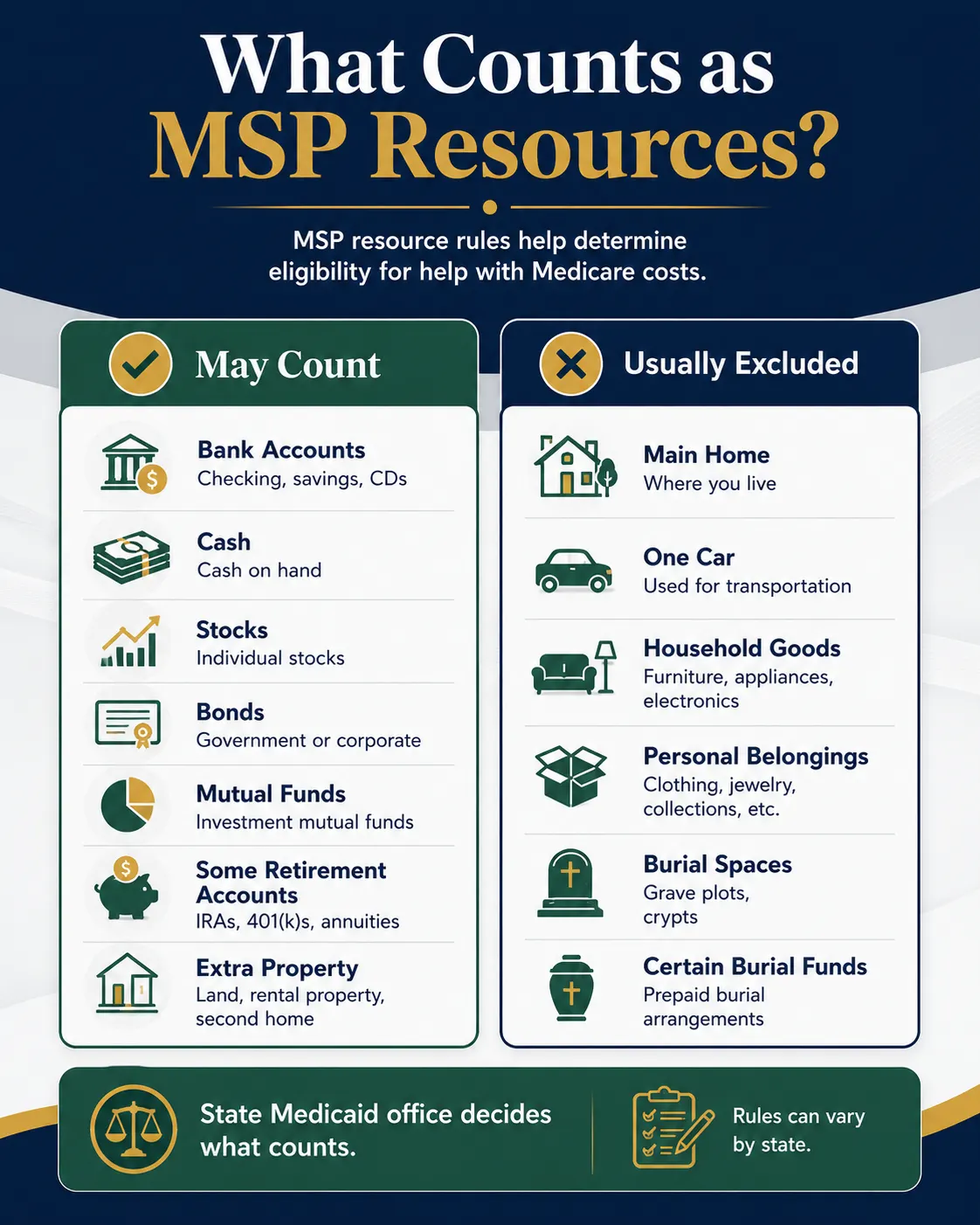
What Usually Does Not Count?
Many people are relieved to learn that some everyday assets usually do not count against the Medicare Savings Program resource limit.
Rules vary by state, but commonly excluded resources may include:
- ✓The home you live in
- ✓One car
- ✓Household goods
- ✓Personal belongings
- ✓Burial spaces
- ✓Certain burial funds
- ✓Some small life insurance policies
These exclusions matter because they protect basic stability. Medicare Savings Programs are not designed to punish someone for having a place to live, a car to get to appointments, or normal household belongings.
Why QMB, SLMB, and QI Have the Same Resource Limit
QMB, SLMB, and QI are the Medicare Savings Programs most people ask about because they can help with the Medicare Part B premium. For 2026, all three have the same federal resource limit:
- ✓$9,950 for an individual
- ✓$14,910 for a married couple
The difference between these programs is not the federal resource limit. The difference is mainly the income limit and the type of help each program provides.
QMB usually provides the broadest help. It may help pay Medicare Part A and/or Part B premiums, plus Medicare deductibles, coinsurance, and copayments for Medicare-covered services. SLMB and QI are more limited. They mainly help pay the Medicare Part B premium.
This means a person may not qualify for QMB but may still qualify for SLMB or QI if their income fits those programs and they meet the state’s rules.
For more detail, read our QMB Medicare Savings Program guide and our QMB, SLMB, QI, and QDWI comparison.
Why QDWI Has a Lower Resource Limit
QDWI is different from QMB, SLMB, and QI. QDWI stands for Qualified Disabled and Working Individuals. It helps certain working people with disabilities pay the Medicare Part A premium.
For 2026, the federal QDWI resource limit is:
- ✓$4,000 for an individual
- ✓$6,000 for a married couple
QDWI applies to a smaller group of people. It is usually for certain people who have a disability, have returned to work, and have lost premium-free Medicare Part A.
Most people researching Medicare Savings Program resource limits are usually asking about QMB, SLMB, or QI because those programs are more commonly connected to help with the Medicare Part B premium.
State Resource Rules Can Be Different
This is one of the most important things to understand: Medicare.gov gives federal limits, but your state may be more generous.
Some states follow the federal resource limits closely. Other states use higher limits, disregard certain resources, or remove the asset test for some MSP categories.
SSA explains that states can effectively raise the QMB, SLMB, and QI limits above federal statutory limits by disregarding certain income or resources. SSA also notes that some states have used this authority to effectively eliminate resource tests for these MSP groups. You can review the official SSA MSP income and resource limits guidance.
That is why two people with the same savings balance may get different answers in different states.
For example, one state may count certain assets that another state excludes. One state may have a higher asset limit than the federal baseline. Another state may not require a resource test for a certain MSP category.
This is why you should not rely only on a national chart, a forum answer, or another person’s experience in a different state.
To understand the difference between MSP help and full Medicaid, see Is a Medicare Savings Program the same as Medicaid?
How to Check Your Resources Before Applying
Before you apply, make a simple list of what you own.
Start with the things that may count:
- ✓Checking account balance
- ✓Savings account balance
- ✓Cash
- ✓Mutual funds
- ✓Retirement accounts
- ✓Annuities
- ✓Life insurance cash value
- ✓Extra property
You do not need to figure everything out perfectly before applying. The state will review your information and decide what counts. But having the list ready can make the application less stressful.
How to Apply for a Medicare Savings Program
You apply through your state Medicaid office.
Depending on your state, you may be able to apply:
- Online through your state benefits portal
- By paper application
- By phone
- In person at a local Medicaid or human services office
- With help from a SHIP counselor or benefits counselor
You may be asked for documents such as a Medicare card, proof of identity, proof of address, Social Security number, proof of income, bank statements, retirement account statements, life insurance policy information if applicable, and property or vehicle information if requested.
If you do not have every document right away, ask your Medicaid office what you can submit first and what can be provided later.
Ready to check your next step?
Applications are handled by state Medicaid offices. If you are close to the resource limit, it may still be worth applying and letting your state decide.
Helpful Official Places to Start
| Need Help With | Official Place to Start |
|---|---|
| General Medicare Savings Program information | Medicare.gov Medicare Savings Programs |
| Federal income and resource guidance | SSA MSP income and resource limits |
| Find your state Medicaid agency | Medicaid.gov state help page |
| Free local Medicare counseling | SHIP Help |
These sources are better starting points than random lead forms or unofficial websites because Medicare Savings Program eligibility is handled by your state.
If you are comparing this with other Medicare cost-help topics, see our guides on Medicare Shared Savings Program vs Medicare Savings Program and Medicare Savings Program vs Medicaid.
FAQs
What is the Medicare Savings Program resource limit in 2026?
For 2026, the federal resource limit for QMB, SLMB, and QI is $9,950 for an individual and $14,910 for a married couple. For QDWI, the federal resource limit is $4,000 for an individual and $6,000 for a married couple.
Are resource limits the same as income limits?
No. Income is money you receive, such as Social Security, wages, or pension payments. Resources are assets you already own, such as money in a bank account, stocks, bonds, or certain retirement accounts.
Does money in my savings account count?
Usually, yes. Money in checking and savings accounts is commonly counted as a resource.
Does my house count as a resource?
The home you live in usually does not count. Extra property, rental property, or property you do not live in may be treated differently.
Does my car count?
One car usually does not count. If you own more than one vehicle, your state may review the extra vehicle.
Do retirement accounts count?
They may. Some states count certain retirement accounts, IRAs, annuities, or trusts. Ask your state Medicaid office how your specific account is treated.
Can I qualify if I have more resources than the federal limit?
Possibly. Some states have higher limits or count resources differently. It is still worth checking with your state Medicaid office.
Should I spend down or move money before applying?
Do not move, give away, or transfer assets without qualified advice. Talk to your state Medicaid office, SHIP counselor, legal aid office, or elder law attorney first.
Who decides if I qualify?
Your state Medicaid office makes the final decision.
Conclusion
Medicare Savings Program resource limits can feel intimidating at first, especially if you have worked hard to keep a small savings cushion. But having some assets does not automatically mean you cannot qualify. For 2026, the federal resource limit for QMB, SLMB, and QI is $9,950 for one person and $14,910 for a married couple.
But those numbers are only part of the story. Your main home, one car, household items, burial spaces, and certain burial funds are often not counted. Some states also use more generous rules than the federal baseline.
Check your state Medicaid office, gather your basic income and resource information, and apply if you may qualify.