Medicare Savings Program vs Medicaid: 2026 Differences
A Medicare Savings Program is a Medicaid-run program that helps people with Medicare pay certain Medicare costs. But getting approved for a Medicare Savings Program does not always mean you have full Medicaid health coverage.
Some people have both full Medicaid and a Medicare Savings Program. Others only get help with a Medicare cost, such as the monthly Medicare Part B premium.
Programs: QMB, SLMB, QI, QDWI
Final decision: state Medicaid office
Important: The difference between full Medicaid and Medicare Savings Program help can affect what bills are covered, whether you get a Medicaid card, what doctors can bill you for, and what benefits you can actually use.
Quick Answer: Is a Medicare Savings Program the same as Medicaid?
Not always. A Medicare Savings Program is handled through Medicaid and helps with Medicare costs, but it may not give you the full Medicaid benefit package. Some people have MSP-only help, while others have MSP plus full Medicaid.
For broader background, visit our main Medicare Savings Program resource.
Is MSP the Same as Medicaid?
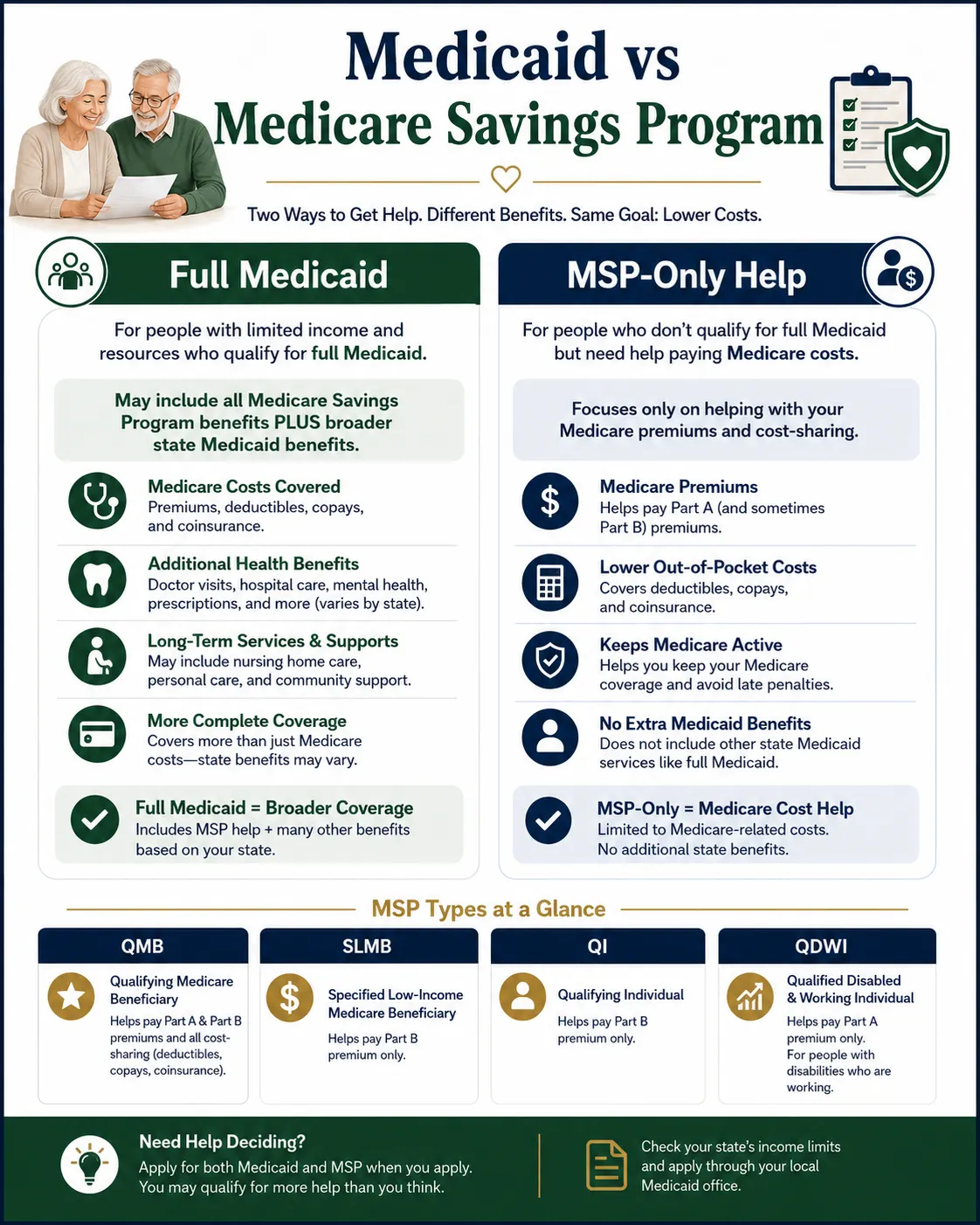
A Medicare Savings Program, often called an MSP, is connected to Medicaid because your state Medicaid office handles it. But it is not always the same as full Medicaid.
Think of it this way: Medicaid is the larger health coverage program for people with limited income.
A Medicare Savings Program is a more specific type of help for people who already have Medicare and need help paying Medicare-related costs.
According to Medicare.gov’s Medicare Savings Program guide, MSPs may help pay Medicare Part A and Part B premiums. Depending on the program, they may also help with deductibles, coinsurance, and copayments.
If you are still learning the basics, you can read our simple explainer on what a Medicare Savings Program is.
Why People Confuse Medicare Savings Programs With Medicaid
The confusion is understandable.
You usually apply for a Medicare Savings Program through your state Medicaid office. Your approval letter may come from Medicaid. Your state may use words like:
- ✓Medicaid
- ✓Medical assistance
- ✓Medicare cost-sharing
- ✓Medicare buy-in
- ✓QMB, SLMB, QI, or QDWI
- ✓Partial Medicaid
- ✓Full Medicaid
That paperwork can make it sound like every MSP approval is the same as Medicaid. But the actual benefit depends on which program you qualify for.
For example, one person may qualify only for QMB, which helps with Medicare premiums and cost-sharing. Another person may qualify for QMB plus full Medicaid, which can include broader Medicaid benefits depending on the state.
Both people may be connected to Medicaid, but they do not have the same coverage.
Medicaid vs. Medicare Savings Program: The Main Difference
Medicaid can cover a wider range of health services for eligible people. Depending on your state and eligibility category, full Medicaid may help with services that Medicare does not fully cover, such as some long-term care, transportation, or other state-covered benefits.
A Medicare Savings Program is narrower. It focuses on Medicare costs.
Here is the clearest way to compare them:
| Program | Main Purpose | What It May Help With |
|---|---|---|
| Medicaid | Broader health coverage for eligible people with limited income | State Medicaid benefits, which may include services beyond Medicare |
| Medicare Savings Program | Help for people with Medicare who have limited income or resources | Medicare premiums and, for some programs, Medicare deductibles, coinsurance, and copayments |
To understand who may qualify for this type of help, see our guide on Medicare Savings Program eligibility.
Medicaid vs. MSP-Only Help
Some Medicare beneficiaries are full-benefit dual-eligible. That means they have Medicare and full Medicaid benefits. Others are partial-benefit dual-eligible. That means they have Medicare and receive help through a Medicare Savings Program, but they do not get the full Medicaid benefit package.
MACPAC explains that people who receive help only through MSPs, without full Medicaid benefits, are considered partial-benefit dually eligible beneficiaries.
QMB-Only vs QMB-Plus and SLMB-Only vs SLMB-Plus
One useful way to understand Medicare Savings Programs and Medicaid is to check whether your state considers you a partial-benefit or full-benefit dual eligible.
- QMB-only: QMB help with Medicare premiums and Medicare-covered cost sharing, without the full Medicaid benefit package.
- QMB-plus: QMB help plus full Medicaid benefits through another Medicaid eligibility pathway.
- SLMB-only: SLMB help with the Medicare Part B premium, without full Medicaid.
- SLMB-plus: SLMB premium help plus full Medicaid benefits.
- QI: Federal Medicare guidance says QI is for people who do not qualify for other Medicaid coverage or benefits, so QI should not be treated as full Medicaid.
This is why two people who both say they have a Medicare Savings Program may have different Medicaid coverage. The exact program name on the approval notice matters.
Full-Benefit vs Partial-Benefit Dual Eligibility
A person with Medicare and full Medicaid is generally called a full-benefit dual eligible. Full Medicaid can cover services beyond Medicare, depending on the state and eligibility category.
A person who has Medicare and only Medicare Savings Program help is generally considered a partial-benefit dual eligible. Medicaid may pay certain Medicare premiums or cost sharing, but the person does not receive the full Medicaid benefit package.
How to Tell What Coverage You Actually Have
Use your eligibility notice rather than relying only on a Medicaid card or the fact that the state Medicaid office handled your application.
- Find the exact eligibility category on the notice.
- Check whether it says QMB-only, QMB-plus, SLMB-only, SLMB-plus, QI, QDWI, or full Medicaid.
- Check which Medicare costs the notice says the state will pay.
- If the wording is unclear, ask the state whether you have full Medicaid benefits or Medicare Savings Program help only.
For current figures, see our 2026 Medicare Savings Program income limits guide.
What the Four Medicare Savings Programs Cover
There are four main Medicare Savings Programs. They do not all pay the same costs.
| Medicare Savings Program | What It May Pay |
|---|---|
| Qualified Medicare Beneficiary | Medicare Part A premium, Part B premium, deductibles, coinsurance, and copayments for Medicare-covered services |
| Specified Low-Income Medicare Beneficiary | Medicare Part B premium only |
| Qualifying Individual | Medicare Part B premium only |
| Qualified Disabled and Working Individuals | Medicare Part A premium for certain working people with disabilities |
QMB usually gives the broadest help. SLMB and QI are more limited because they generally help with the Part B premium. QDWI is for a more specific group of people who need help paying the Part A premium.
You can read more about these programs on Medicare.gov’s MSP page.
For current income and resource figures, review our Medicare Savings Program income limits chart.
Does QMB Mean You Have Full Medicaid?
If your notice says QMB, it may mean Medicaid will help pay your Medicare premiums and Medicare cost-sharing. But QMB by itself does not always mean you have full Medicaid coverage.
CMS uses separate categories because the benefits can be different. For example, QMB-only is not the same as QMB Plus. QMB Plus generally means the person qualifies for QMB and also qualifies for full Medicaid through another Medicaid eligibility pathway.
CMS explains these categories in its dual eligible categories guidance.
Can You Have Medicare, Medicaid, and a Medicare Savings Program?
Yes.
Some people have all three:
- ✓Medicare
- ✓Full Medicaid
- ✓A Medicare Savings Program
This is often called being dual eligible because the person has both Medicare and Medicaid.
But dual eligibility has levels. One person may have full Medicaid benefits. Another person may only have MSP help paying the Part B premium or Medicare cost-sharing.
KFF explains that eligibility for a Medicare Savings Program does not automatically provide access to full Medicaid. A person must also qualify through another Medicaid eligibility pathway to receive full Medicaid benefits.
Does a Medicare Savings Program Give You Extra Help?
Often, yes.
If you qualify for QMB, SLMB, or QI, you usually also qualify for Extra Help, the Medicare program that helps with Medicare Part D prescription drug costs.
Medicare explains this in its publication, Get Help With Your Medicare Costs.
Extra Help may reduce prescription drug premiums, deductibles, and copays. But Extra Help is not the same as full Medicaid. It is a separate type of help for Medicare drug costs.
This is another reason people get confused. One approval can connect you to more than one kind of help, but each program has its own job.
What Card Will You Get?
This depends on your state and your exact eligibility.
You may have:
- ✓Your red, white, and blue Medicare card
- ✓A Medicare Advantage card, if you are enrolled in a Medicare Advantage plan
- ✓A Medicaid card, if your state issues one
- ✓A notice showing QMB, SLMB, QI, or QDWI approval
- ✓A separate notice about Extra Help for prescription drug costs
If you only have an MSP, you may not have the same Medicaid card or benefits as someone with full Medicaid.
Need to check your next step?
If you are not sure whether you have full Medicaid, MSP-only help, or both, your approval notice and state Medicaid office are the best places to confirm.
FAQs
Is a Medicare Savings Program Medicaid?
A Medicare Savings Program is Medicaid-related help for Medicare costs. It is handled by your state Medicaid office. But it is not always the same as full Medicaid health coverage.
Can I have a Medicare Savings Program but not full Medicaid?
Yes. Many people receive partial Medicaid help through a Medicare Savings Program. This may help with Medicare premiums or cost-sharing, but it may not include the full Medicaid benefit package.
Can I have full Medicaid and a Medicare Savings Program?
Yes. Some people qualify for both. They may have Medicare, full Medicaid, and a Medicare Savings Program that helps with Medicare premiums or cost-sharing.
Does QMB cover more than SLMB or QI?
Yes. QMB usually covers more. QMB can help with Part A and Part B premiums and Medicare-covered deductibles, coinsurance, and copayments. SLMB and QI generally help with the Part B premium only.
Does QI mean I have Medicaid?
QI is a Medicare Savings Program handled through Medicaid, but it is not full Medicaid. In general, QI helps pay the Medicare Part B premium for people who qualify.
Why do I apply through Medicaid if the program helps with Medicare?
States run Medicare Savings Programs through Medicaid. That is why you usually apply through your state Medicaid office, even though the help is for Medicare costs.
Who decides if I qualify for a Medicare Savings Program?
Your state Medicaid office decides which Medicare Savings Program you qualify for based on your income, resources, Medicare status, and state rules.
Will MSP help with prescription drugs?
If you qualify for QMB, SLMB, or QI, you usually also qualify for Extra Help with Medicare Part D prescription drug costs. Extra Help is useful, but it is not the same as full Medicaid.
Conclusion
A Medicare Savings Program is not the same as full-benefit Medicaid. It is best understood as Medicaid-run help for Medicare costs. Some people get MSP help only. Others get MSP help plus full Medicaid. That is why it is important to look at the exact program name on your notice.
If your notice says QMB, SLMB, QI, or QDWI, read what that program covers. If it says full Medicaid or full-benefit Medicaid, you may have broader coverage. If you are unsure, call your state Medicaid office and ask whether you have full Medicaid or only Medicare Savings Program help.
The difference can affect your bills, your benefits, and your next steps. Knowing the exact answer can help you avoid paying bills you may not owe and make better use of the help available to you.