New York Medicare Savings Program 2026: Income Limits
New York Medicare Savings Program Income Limits and Application
If you have Medicare and live in New York, a Medicare Savings Program may help pay the premium deducted from your Social Security benefit. QMB may also protect you from Medicare-covered deductibles, coinsurance and copayments.
Independent information notice: This website is an educational resource. It is not Medicare, the New York State Department of Health, NYC HRA, a county Department of Social Services or a government application processor. The appropriate New York agency makes the final eligibility decision.
Quick Answer
In 2026, New York’s Medicare Savings Program may help eligible residents pay Medicare premiums and other costs.
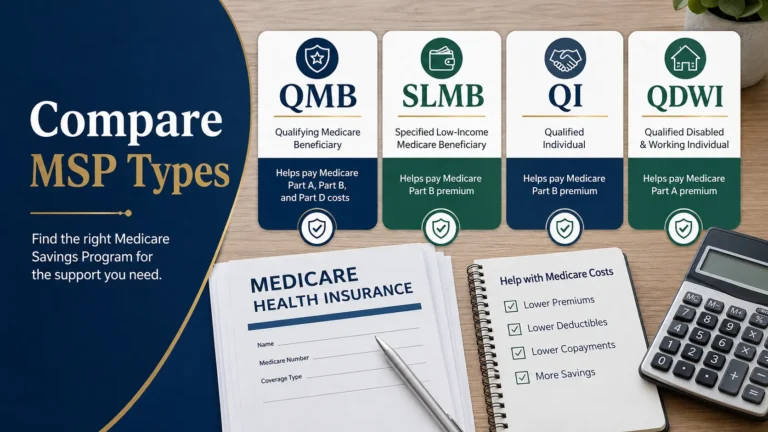
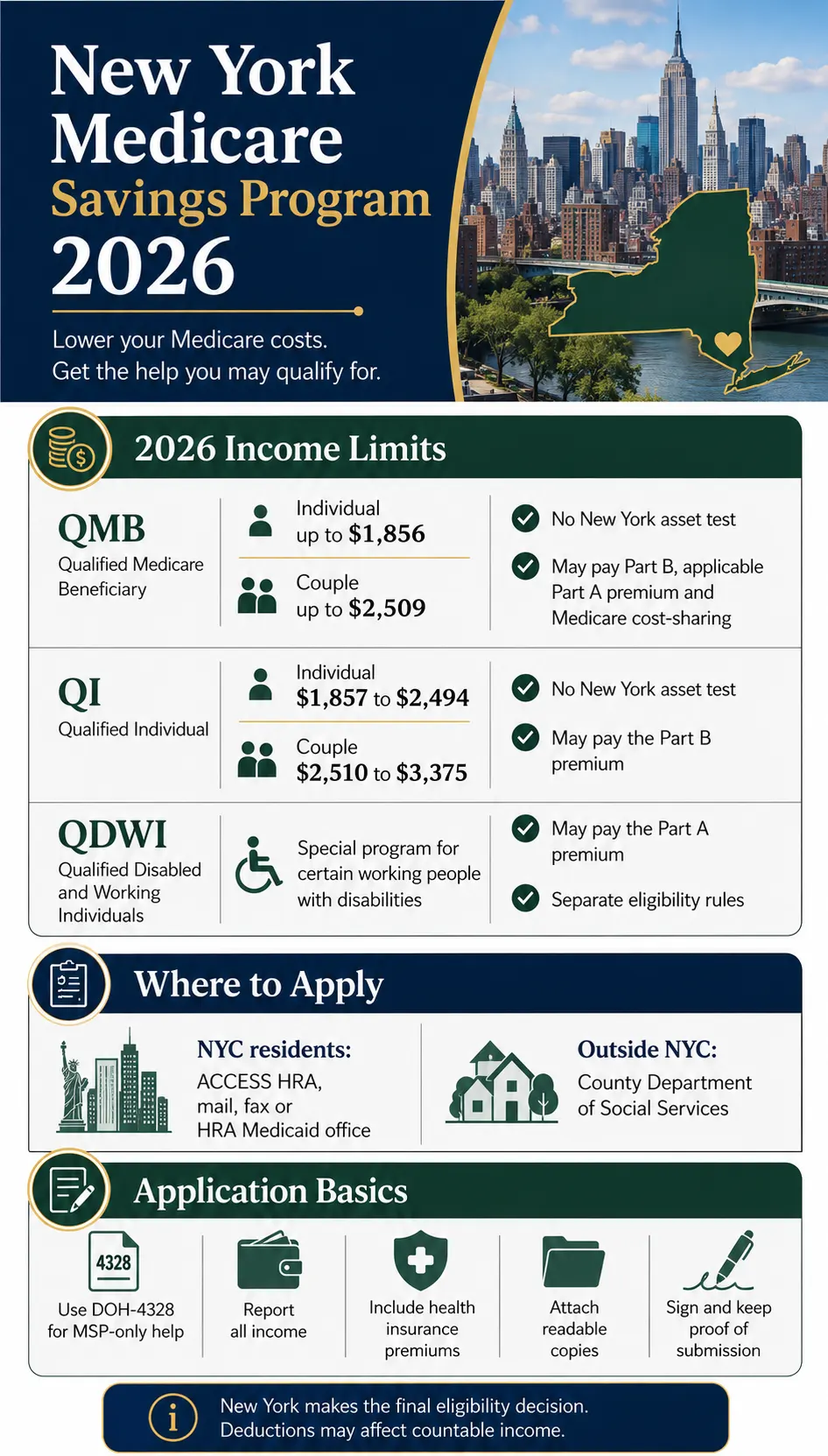
QMB may pay the Part B premium, a Part A premium when owed, and Medicare-covered deductibles, coinsurance and copayments. QI generally pays the Part B premium. QDWI may pay the Part A premium for certain working people with disabilities.
New York does not apply an asset test to its commonly used QMB and QI categories. NYC residents may apply through ACCESS HRA, by mail or at an HRA Medicaid office. Residents outside NYC generally apply through their county Department of Social Services.
Table of Contents
- What New York MSP may pay
- 2026 income and resource limits
- Who may qualify
- Income deductions and insurance premiums
- Which application to use
- Documents to prepare
- How to apply in New York City
- How to apply outside NYC
- What happens after applying
- When benefits may start
- Renewal
- Denials and fair hearings
- Official help and contacts
- Frequently asked questions
What Can You Get From New York’s Medicare Savings Program?
A Medicare Savings Program, or MSP, is a Medicaid-administered benefit that helps qualified Medicare beneficiaries with certain Medicare costs. You apply through New York rather than through a private insurance company.
New York commonly uses three MSP categories:
- Qualified Medicare Beneficiary, or QMB
- Qualifying Individual, or QI
- Qualified Disabled and Working Individual, or QDWI
New York no longer uses SLMB as a separate income category for most applicants. When New York expanded its MSP thresholds, the income range that would otherwise fall within SLMB became part of New York’s expanded QMB structure.
The standard Medicare Part B premium is $202.90 per month in 2026, although some beneficiaries pay a different amount because of income, a late-enrollment penalty or other circumstances.
Official federal descriptions of the four MSP categories are available on the Medicare.gov Medicare Savings Programs page. Current Medicare premiums and deductibles are listed on the official Medicare costs page.
For a general explanation before comparing New York’s rules, see our guide to what a Medicare Savings Program is and the complete Medicare Savings Programs information center.
| Program | What It May Pay | Key Rule |
|---|---|---|
| QMB | Part B premium, Part A premium when owed, and Medicare-covered deductibles, coinsurance and copayments | Offers the broadest MSP protection |
| QI | Medicare Part B premium | Cannot generally be received at the same time as full Medicaid and must be renewed yearly |
| QDWI | Medicare Part A premium only | Limited to certain working people with disabilities who lost premium-free Part A |
You do not normally need to select QMB or QI before applying. Report your circumstances accurately and allow HRA or the county Department of Social Services to determine the category.
Our Medicare Savings Program types comparison explains the benefit differences in more detail.
Important QMB Billing Protection
Medicare providers and suppliers generally may not bill a QMB member for Medicare Part A or Part B deductibles, coinsurance or copayments for Medicare-covered services and items.
If you receive an improper bill:
- Tell the provider that you are enrolled in QMB.
- Show your Medicare card and Medicaid or QMB documentation.
- Ask the billing office to correct the account.
- Call 1-800-MEDICARE if the provider continues billing you.
If you already paid Medicare cost-sharing that QMB should have covered, ask the provider about a refund. Our QMB Medicare Savings Program guide explains this protection further.
New York Medicare Savings Program Income Limits for 2026
The following figures are useful 2026 screening limits for New York. The QMB and QI amounts reflect New York’s expanded thresholds and the standard $20 monthly income disregard.
| New York MSP | Individual Monthly Income | Couple Monthly Income | Resource Rule |
|---|---|---|---|
| QMB | Up to $1,856 | Up to $2,509 | No asset test in New York |
| QI | $1,857 to $2,494 | $2,510 to $3,375 | No asset test in New York |
| QDWI | Up to $2,680 in countable monthly income under New York’s screening method | Up to $3,627 in countable monthly income under New York’s screening method | Generally $4,000 individual and $6,000 couple for this specialized category |
Do not reject yourself based only on gross income.
New York may apply the $20 general income disregard and other allowable deductions. Health insurance premiums you pay may also affect countable income. Someone slightly above a listed figure may still qualify after the agency completes its calculation.
The New York State Office for the Aging lists the 2026 maximum MSP income level as $2,494 per month for an individual and $3,375 for a couple. Review the official New York Medicare Savings Program information for current state guidance.
For broader context on how state thresholds differ from the standard federal table, see our Medicare Savings Program income limits guide.
Does New York Have an Asset Limit?
New York does not apply an asset or resource test to its commonly used QMB and QI categories. This means a person should not assume that savings, a retirement account or ownership of a home automatically prevents QMB or QI eligibility.
QDWI is a specialized program for certain working people with disabilities and may use separate federal resource standards. Applicants seeking QDWI should confirm current treatment with HRA or their county DSS rather than relying only on the general QMB and QI no-resource-test rule.
Read our separate explanation of Medicare Savings Program resource limits for the difference between federal limits and state-specific policies.
Who May Qualify for a New York Medicare Savings Program?
The exact requirements depend on the program category. New York generally reviews residence, Medicare status, income, citizenship or eligible immigration status, household circumstances and the information shown on the application.
QMB Eligibility
QMB may be available to a New York resident who is entitled to Medicare Part A, or qualifies through an applicable Part A conditional enrollment or Buy-In process, and has countable income within New York’s QMB limit.
QMB may be received together with full Medicaid when the person qualifies for both programs.
QI Eligibility
QI may be available to a person who has Medicare Part A, falls above New York’s QMB income range but within the QI limit, and does not qualify for other full Medicaid coverage.
QI funding is limited and eligibility must be renewed each year. Prior-year QI recipients generally receive priority.
QDWI Eligibility
QDWI is designed for certain people under age 65 who have a disability, returned to work and lost premium-free Medicare Part A because of their return to work.
An applicant generally must:
- Have a qualifying disability
- Be working
- Have lost premium-free Part A because of returning to work
- Meet the applicable income and resource rules
- Not otherwise receive Medicaid coverage that conflicts with QDWI eligibility
QDWI calculations can be different from ordinary QMB and QI screening because earned-income exclusions may apply. Submit wage records and allow the agency to complete the calculation.
Our guide explaining who may qualify for a Medicare Savings Program covers the general federal requirements.
Report Health Insurance Premiums You Pay
New York’s application asks about health insurance premiums paid by the applicant or spouse. These expenses may reduce the income New York counts.
Provide proof when you personally pay premiums for:
- Medigap coverage
- Medicare Advantage coverage
- Medicare Part D coverage
- Dental insurance
- Vision insurance
- Employer, union or retiree health coverage
- Other health insurance
Useful proof may include a premium bill, plan statement, employer letter, pension deduction statement or pay stub showing the amount you actually pay.
Do not subtract premiums yourself and report only the remaining income. Report the requested gross income and submit premium proof so HRA or the county DSS can calculate countable income correctly.
Practical example: A person whose gross monthly income appears slightly above the QMB or QI limit may still be eligible if allowable insurance-premium deductions reduce countable income. The agency, not the applicant, makes that calculation.
Which New York Medicare Savings Program Application Should You Use?
The correct application depends on whether you want only help with Medicare costs or also want full Medicaid benefits.
Applying for the Medicare Savings Program Only
Use Form DOH-4328, Medicare Savings Program Application, when you are applying only for help with Medicare premiums and cost-sharing.
Official resources:
Complete every applicable section, sign and date the form, and include the documents requested by the current instructions. An unsigned application can be treated as incomplete.
Applying for MSP and Full Medicaid
DOH-4328 is mainly intended for MSP-only assistance. It does not function as a complete application for all Medicaid services.
You may need a full Medicaid application if you also want benefits such as:
- Dental coverage
- Medicaid-covered transportation
- Home care
- Long-term care
- Other services available through full Medicaid
DOH-4220 is commonly used for many aged, blind, disabled and other non-MAGI Medicaid applications, but the correct full Medicaid form can depend on age, disability, household status, residence and the services requested.
Use the official DOH-4220 Medicaid application only after checking the current instructions or confirming the form with HRA or your county DSS.
Tell the agency that you want to be evaluated for both full Medicaid and a Medicare Savings Program.
QMB may be combined with full Medicaid when a person qualifies for both. QI generally cannot be received at the same time as full Medicaid.
Our guide to Medicare Savings Programs versus Medicaid explains why the two types of coverage should not be treated as identical.
Documents to Gather Before Applying
Send readable copies rather than original identity documents, immigration records or benefit cards. Follow the current form instructions and any later document request from HRA or your county DSS.
Medicare and Identity Documents
Depending on the application and verification results, prepare copies of:
- Front and back of the Medicare card
- Proof of date of birth
- Driver’s license, state identification, birth certificate or passport, when requested
- Citizenship or immigration documents, when applicable and requested
- A document explaining a name difference, when necessary
Proof of New York Residence
Examples of residence proof may include a recent:
- Lease or rent receipt
- Utility bill
- Telephone or cable bill
- Mortgage statement
- Property-tax record
- Landlord statement
- Official or postmarked mail showing the residential address
Use a current document and check the latest DOH-4328 instructions for any date requirement.
Proof of Income
Include proof for each income source that applies to you or an applying spouse.
| Income Source | Possible Proof |
|---|---|
| Social Security | Current benefit or award letter |
| Employment | Recent consecutive pay stubs or an employer statement |
| Self-employment | Recent tax return, Schedule C and current business income or expense records when requested |
| Pension or veterans benefits | Current award letter, payment statement or tax form |
| Annuity income | Payment statement, bank statements or tax form |
| Retirement distributions | Plan statement, bank statements or Form 1099 |
If retroactive QI or QDWI eligibility is being considered, the agency may request income information for earlier months. Provide the exact period listed in the document request.
Proof of Health Insurance Premiums
Include bills, statements, employer letters, pension statements or pay stubs showing what you personally pay for Medigap, Medicare Advantage, Part D, dental, vision or other health coverage.
How to Apply for a Medicare Savings Program in New York City
New York City residents apply through the NYC Human Resources Administration, or HRA. Eligible residents may apply online, by mail or in person.
Option 1: Apply Online Through ACCESS HRA
Eligible New York City residents may use the official ACCESS HRA portal.
The NYC HRA health-assistance page confirms that people who receive Medicare and fall within HRA’s application categories may apply online through ACCESS HRA.
Online Application Steps
- Open ACCESS HRA and log in or create an account.
- Start the appropriate health-assistance or Medicare Savings Program application.
- Enter your legal name, address and contact information.
- Enter your Medicare and Social Security information.
- Report Social Security, wages, pension and other income.
- Report health insurance premiums you pay.
- Review every answer before signing.
- Submit the application and save the confirmation number.
- Follow ACCESS HRA instructions for submitting supporting documents.
- Check the account and postal mail for notices or document requests.
Document-upload methods may change. Follow the current ACCESS HRA instructions instead of relying on an older upload procedure.
Option 2: Mail the Application in NYC
NYC HRA currently lists the following mailing address for Medicaid and related applications handled by its Initial Eligibility Unit:
Initial Eligibility Unit
HRA/Medical Assistance Program
P.O. Box 24390
Brooklyn, NY 11202
For an MSP-only paper application, complete and sign DOH-4328 and attach copies of the requested documents.
Use postal tracking or certified mail when practical and keep a complete copy. Confirm the address on the current application or NYC HRA public health insurance page before mailing time-sensitive documents.
Option 3: Fax the Application in NYC
NYC HRA currently lists 917-639-0732 for faxed applications. An authorized representative may be directed to a different fax number.
Verify the current number before sending. Use a cover sheet, include identifying information permitted by HRA, state the total number of pages and keep the transmission report.
Option 4: Apply in Person in NYC
You may request help or submit an application at an HRA Medicaid office. Offices are available in the Bronx, Brooklyn, Manhattan, Queens and Staten Island.
Use the official HRA Medicaid office directory to confirm the current address, telephone number and opening hours before visiting.
For NYC application questions or to request an application kit, call the HRA Medicaid Helpline at 1-888-692-6116.
NYC Application Reminder
Use the current HRA route that fits your case, keep proof of submission and watch both ACCESS HRA and postal mail for follow-up notices.
How to Apply Outside New York City
People living outside New York City’s five boroughs generally submit the application to the Local Department of Social Services, or LDSS, in the county where they live.
New York does not use one statewide mailing address for all county applications. Each county can have its own mailing address, office location, telephone number and submission procedure.
Step 1: Get the Application
Download the current:
You may also ask the county DSS to mail an application.
Step 2: Complete and Sign the Form
Enter all applicable information, including:
- Legal and previous names
- Home and mailing addresses
- County of residence
- Date of birth
- Social Security and Medicare information
- Marital status and spouse information when applicable
- Social Security, pension and retirement income
- Wages and self-employment income
- Other income
- Health insurance premiums you pay
Answer every applicable question, then sign and date the form.
Step 3: Attach the Required Documents
Include readable copies of the Medicare, residence, date-of-birth, income and insurance-premium documents required by the current instructions or requested by the county.
Do not mail your only original Medicare card, passport, immigration document or identification document.
Step 4: Find and Confirm the County Office
Use the official New York LDSS county directory.
Before submitting, confirm:
- The correct MSP mailing address
- Whether an attention line is required
- Whether applications are accepted in person
- Whether fax or another submission method is available
- Whether an appointment is required
Step 5: Keep Proof of Submission
Keep:
- A copy of the signed application
- Copies of every supporting document
- Postal tracking or a certified-mail receipt
- A fax transmission report
- A stamped receipt for an in-person submission
- The name, date and summary of any conversation with a county worker
What Happens After You Apply?
HRA or the county DSS reviews the application and verifies the information provided. The agency may approve the case, deny it or request additional documents.
A request for information is not necessarily a denial. However, failure to respond by the stated deadline can delay or close the application.
Watch:
- ACCESS HRA notices, if applicable
- Email or text alerts connected to the account
- Regular postal mail
- Telephone messages from the agency
The decision notice should explain:
- Whether the application was approved or denied
- Which MSP category was approved
- The effective date
- Whether further action is needed
- How to request a fair hearing if you disagree
Processing time depends on the completeness of the application and whether additional verification is required. Do not rely on a guaranteed processing date from an unofficial source.
When Do New York MSP Benefits Start?
The effective-date rules depend on the program and the facts of the case. The approval notice is the controlling document.
| Program | General Effective-Date Rule |
|---|---|
| QMB | Generally begins prospectively and does not provide the same three-month retroactive coverage available under some other Medicaid categories |
| QI | May cover up to three previous months when eligibility requirements were met, but not months in a prior calendar year |
| QDWI | May include retroactive eligibility when the specialized requirements were met during the applicable period |
Retroactive eligibility and premium reimbursement are not automatic guarantees. The applicant may need to provide income and eligibility proof for each earlier month.
Keep the approval notice and confirm the exact effective date before assuming that a previous premium or bill will be refunded.
What If the Part B Deduction Continues?
The Part B premium may continue to be deducted temporarily after approval while New York, Medicare and Social Security update their records.
Keep:
- The approval notice
- The MSP effective date
- Social Security payment records
- Bank statements showing benefit deposits
- Any letter describing a premium adjustment or refund
If deductions continue beyond the approved period, contact HRA or your county DSS and ask whether the Medicare Buy-In information was processed. HIICAP may also help you review the notice and follow up.
Do not immediately submit duplicate applications unless the agency instructs you to do so.
Extra Help With Prescription Drug Costs
Approval for a Medicare Savings Program also generally provides automatic eligibility for Extra Help with Medicare Part D costs.
Extra Help may reduce a person’s Part D premium, deductible and prescription copayments, depending on current federal rules and plan coverage.
A separate New York MSP application is not normally required for Extra Help after MSP eligibility becomes active. However, a person who is not yet approved for an MSP may still apply separately for Extra Help through Social Security.
Do You Have to Renew a New York Medicare Savings Program?
Yes. Eligibility is reviewed periodically, and QI must be renewed each year.
HRA or the county DSS may renew a case using information already available or may send a renewal form and request updated proof.
To reduce the risk of losing assistance:
- Keep your mailing address and telephone number current
- Read every agency notice
- Respond before the stated deadline
- Submit updated income and insurance-premium proof when requested
- Keep submission confirmations
Use our detailed Medicare Savings Program renewal guide to prepare for the review.
What If New York Denies the Application?
Read the denial notice before filing a duplicate application. It should explain the reason for the decision and how to challenge it.
Common issues may include:
- Income calculated above the limit
- Missing income or premium proof
- An unsigned application
- Unreadable documents
- Medicare enrollment requirements
- Residence or identity verification
- A missed document deadline
If you believe the decision is wrong, follow the fair-hearing instructions and deadline printed on the notice. Do not assume that calling the local office automatically files an appeal.
New York’s Office of Temporary and Disability Assistance allows fair-hearing requests online, by telephone, by mail or by fax. Review the official New York fair-hearing request options.
The statewide fair-hearing telephone number is 1-800-342-3334. Deadlines and possible aid-continuing rights depend on the notice, so act promptly.
Our guide on what to do when a Medicare Savings Program application is denied explains how to review the calculation and organize supporting evidence.
Does New York MSP Assistance Cause Estate Recovery?
Medicare premiums and Medicare cost-sharing paid for MSP beneficiaries are generally excluded from optional Medicaid estate recovery under federal rules.
However, a person may receive both an MSP and other Medicaid coverage. Long-term care, nursing facility care, home and community-based services or other full Medicaid benefits can involve separate estate-recovery rules.
Review the exact Medicaid coverage and notices rather than assuming that every Medicaid-funded service is treated like limited MSP assistance.
Free New York MSP Help and Official Contacts
| Help Needed | Official Contact |
|---|---|
| Free statewide Medicare and MSP counseling | HIICAP: 1-800-701-0501 |
| NYC application questions | HRA Medicaid Helpline: 1-888-692-6116 |
| Apply online in NYC | ACCESS HRA |
| Find an NYC Medicaid office | HRA Medicaid office directory |
| Find an office outside NYC | New York LDSS county directory |
| Request a fair hearing | OTDA Fair Hearings: 1-800-342-3334 |
| Medicare or QMB billing problem | 1-800-MEDICARE, 1-800-633-4227 |
| Medicare TTY | 1-877-486-2048 |
HIICAP provides free and objective Medicare counseling through trained counselors across New York. Counselors may help screen for eligibility, explain the application, organize documents and review delayed premium or QMB billing issues.
New York and Florida Use Different Application Systems
The MSP categories are federal, but application systems and income policies vary by state. New York uses HRA in New York City and county social services districts elsewhere. Florida uses the Florida Department of Children and Families and its Medicare Buy-In form.
For the latest state guide in this content series, read Medicare Savings Program Florida 2026 eligibility and application guidance.
Final New York MSP Application Checklist
- ☐ Used DOH-4328 for an MSP-only application
- ☐ Confirmed the correct form when also applying for full Medicaid
- ☐ Reported every income source
- ☐ Reported health insurance premiums you pay
- ☐ Attached readable copies of requested documents
- ☐ Signed and dated the application
- ☐ Confirmed the current mailing, fax or online route
- ☐ Kept a complete copy
- ☐ Saved proof of submission
- ☐ Started checking notices and postal mail
New York Medicare Savings Program FAQs
Does New York have an asset limit for Medicare Savings Programs?
New York does not apply an asset test to its commonly used QMB and QI categories. QDWI is a specialized program for certain working people with disabilities and may use separate federal resource standards, so applicants seeking QDWI should confirm the current rule with HRA or their county DSS.
Should I apply if my income is slightly above the New York limit?
Yes, applying may still be worthwhile. New York applies a standard income disregard, and health insurance premiums or other allowable deductions may reduce countable income. Submit accurate income and premium proof and let HRA or the county DSS make the calculation.
Do I have to choose QMB or QI on the application?
No. Complete the Medicare Savings Program application and report your circumstances accurately. New York determines which MSP category, if any, matches your Medicare status and countable income.
Can I receive QI and full Medicaid together?
Generally, no. QI is intended for people who do not qualify for other Medicaid coverage. QMB may be combined with full Medicaid when a person qualifies for both.
Can New York City residents apply online?
Yes. Eligible NYC residents may apply through ACCESS HRA. Paper, fax and in-person options are also available through NYC HRA.
Where do residents outside New York City apply?
Residents outside NYC generally submit DOH-4328 to the Local Department of Social Services in the county where they live. Use the official LDSS directory and confirm the submission address before sending the form.
Can New York MSP benefits be retroactive?
QMB is generally prospective. QI and QDWI may provide retroactive eligibility for earlier months when all requirements were met, subject to program and calendar-year rules. The approval notice controls the effective date.
Do I have to renew my New York Medicare Savings Program?
Yes. MSP eligibility is reviewed periodically, and QI must be renewed each year. Read every renewal notice and submit requested information before the deadline.
Take the Next Step
Compare your monthly income with New York’s 2026 screening limits, but do not assume that savings or income slightly above a listed amount automatically makes you ineligible.
For MSP-only assistance, complete DOH-4328. NYC residents may use ACCESS HRA, mail, fax or an HRA Medicaid office. Residents outside NYC should submit the form through the DSS office serving their county.
Before submitting, make sure the application is signed, every income source is reported, insurance premiums are listed and readable copies of requested documents are attached.
Keep a complete copy and proof of submission. Watch for notices, respond before every deadline and contact HIICAP if you need free, objective help understanding the process.
Use the Official New York Application
New York makes the final eligibility decision. Applying is free, and approval is not guaranteed.