Florida Medicare Savings Program 2026: Eligibility & Limits
Florida Medicare Savings Program Eligibility, Limits and Application Steps
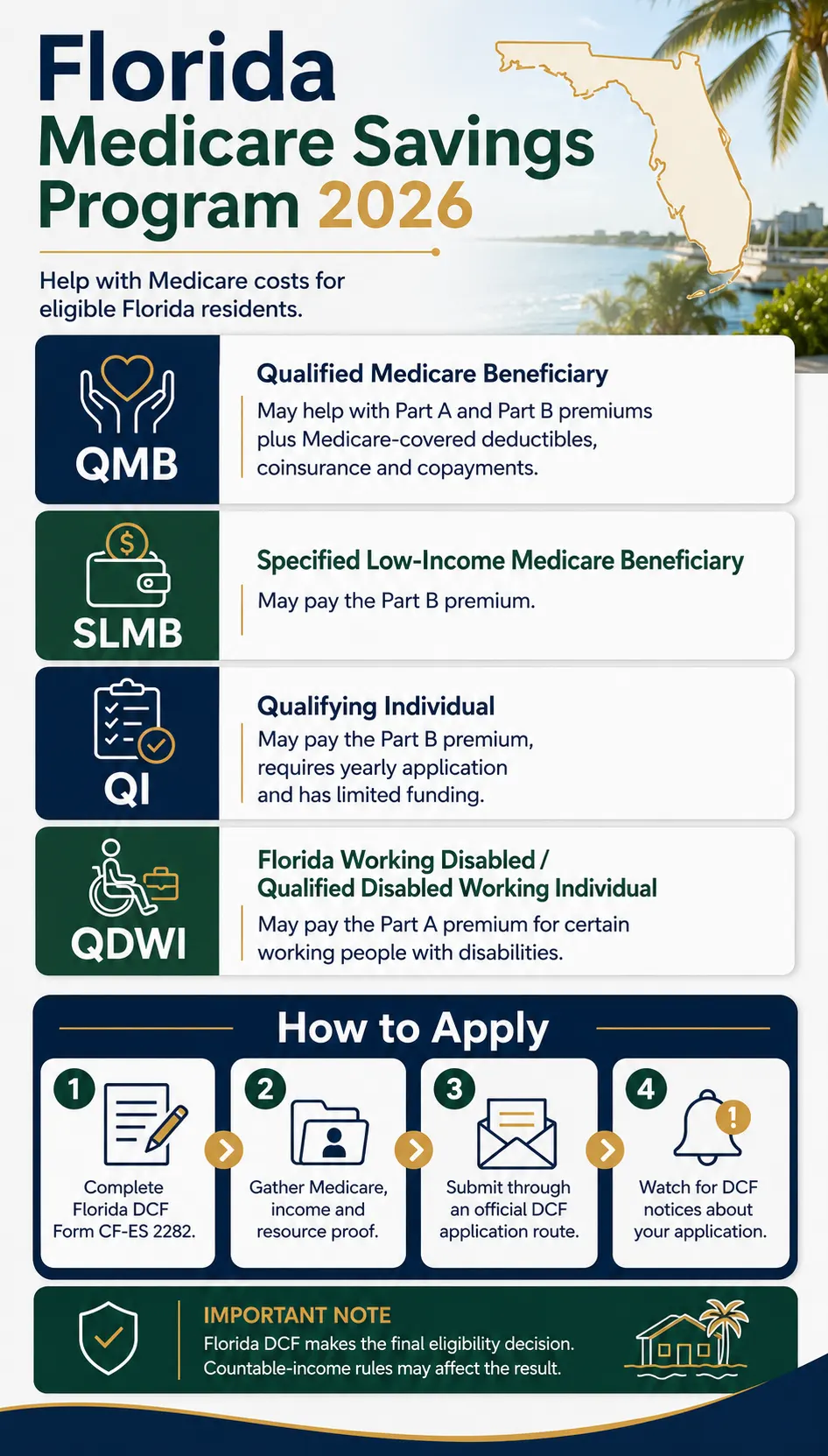
Florida’s Medicare Savings Programs, often called Medicare Buy-In, may help eligible Medicare beneficiaries pay Part A or Part B premiums and, through QMB, certain Medicare deductibles, coinsurance and copayments. This guide explains the 2026 screening limits, what Florida may count, and how to submit the correct state application.
Important: This website is an independent educational resource. It is not Medicare, CMS, Florida Medicaid, the Florida Department of Children and Families, or an application processor. Florida DCF makes the final eligibility decision. Eligibility, approval, effective dates and premium adjustments are not guaranteed.
Quick Answer
In 2026, a Florida resident may qualify for a Medicare Savings Program if the person meets the Medicare, income, resource, residency and citizenship or qualified-noncitizen rules for a program level.
The main levels are QMB, SLMB, QI and QDWI. QMB offers the broadest Medicare cost help. SLMB and QI generally pay the Part B premium. QDWI may pay the Part A premium for certain working people with disabilities. Florida DCF uses Form CF-ES 2282 for Medicare Buy-In-only applications.
Table of Contents
- How Florida Medicare Buy-In works
- What each MSP level pays
- Basic eligibility rules
- 2026 income and asset limits
- What may count as an asset
- How income may be counted
- Where and how to apply
- Documents to prepare
- Submission methods
- What happens after applying
- Renewal and changes
- Denials and appeals
- Official contacts
- Frequently asked questions
What Is the Medicare Savings Program in Florida?
Florida’s Medicare Savings Program can help eligible Medicare beneficiaries pay costs that would otherwise come from their Social Security payments or personal budgets. Florida commonly calls this assistance Medicare Buy-In.
The Florida Department of Children and Families, or DCF, determines eligibility for Florida Medicare Buy-In. Medicare.gov explains the federal program, but a private Medicare plan, insurance agent or this website cannot approve an application.
For a broader introduction, read our guide to what a Medicare Savings Program is. You can also use the Medicare Savings Programs information center to explore related eligibility, premium-help and application topics.
Are Florida rules statewide? Yes. DCF applies statewide program standards. A Family Resource Center may help locally, but the same Florida DCF eligibility system handles the decision. Your household facts, Medicare status, income and resources still determine the result.
What Do QMB, SLMB, QI and QDWI Pay in Florida?
Florida DCF reviews one Medicare Buy-In application and determines which level, if any, fits the applicant. The four federal program categories do not provide identical benefits.
| Program | Main Help | Important Point |
|---|---|---|
| QMB | Part A premium when applicable, Part B premium, and Medicare-covered deductibles, coinsurance and copayments | Medicare providers generally may not bill a QMB member for Medicare-covered Part A or Part B cost-sharing. |
| SLMB | Medicare Part B premium | It does not provide QMB’s broader Medicare cost-sharing protection. |
| QI, also called QI-1 | Medicare Part B premium | Funding is limited, the program requires yearly application, and prior-year recipients receive priority. |
| QDWI | Medicare Part A premium only | Florida policy uses the term Working Disabled for this limited Part A premium assistance group. |
See our detailed comparison of the four Medicare Savings Program types. People mainly seeking relief from the Part B deduction can also review the guide to help paying the Medicare Part B premium.
Official federal benefit descriptions and current limits are available on the Medicare.gov Medicare Savings Programs page.
Who May Qualify for a Florida Medicare Savings Program?
Eligibility depends on the specific program level. Florida DCF generally reviews whether the applicant:
- Is a Florida resident
- Meets the Medicare enrollment requirements for the requested program
- Is a U.S. citizen or qualified noncitizen under the applicable rules
- Has countable monthly income within the program standard
- Has countable resources within the applicable limit
- Provides requested identity, residence, income, resource and Medicare information
QMB may accept a person enrolled or conditionally enrolled in Medicare Part A. SLMB and QI generally require Medicare Part A and Part B. QDWI has additional disability, work and premium-free Part A loss requirements.
Do not reject yourself based only on gross income or a bank balance. DCF applies countable-income and countable-resource rules, which may exclude certain amounts and property. Our separate guide explains who may qualify for a Medicare Savings Program.
2026 Florida Medicare Savings Program Income and Asset Limits
The following 2026 amounts are the current federal screening limits published by Medicare.gov. Florida DCF makes the official determination after applying Florida’s countable-income and resource rules.
| Florida MSP Level | Individual Monthly Income | Married Couple Monthly Income | Individual Resource Limit | Married Couple Resource Limit |
|---|---|---|---|---|
| QMB | $1,350 | $1,824 | $9,950 | $14,910 |
| SLMB | $1,616 | $2,184 | $9,950 | $14,910 |
| QI | $1,816 | $2,455 | $9,950 | $14,910 |
| Florida Working Disabled, corresponding to QDWI | $2,660 countable income | $3,607 countable income | $5,000 | $6,000 |
Why is Florida’s Working Disabled figure different from Medicare.gov’s QDWI table?
Medicare.gov’s general 2026 QDWI screening table lists $5,405 for an individual and $7,299 for a married couple, with resource limits of $4,000 and $6,000. Florida’s April 2026 financial standards instead publish a countable-income standard of $2,660 for an individual and $3,607 for a couple, with asset limits of $5,000 and $6,000 for Florida’s Working Disabled group.
These figures are not interchangeable. Earned-income exclusions can make countable income lower than gross wages, and Florida applies its own eligibility methodology. A working applicant should submit actual wage and resource records and let DCF calculate the case.
Screening limits are not a guaranteed decision.
DCF may disregard certain income and resources. Household composition, spouse information, Medicare enrollment and verification can change the result. If you are near a limit, filing the application is usually more reliable than trying to decide eligibility from gross figures alone.
Florida publishes current state standards in its April 2026 SSI-related financial eligibility chart and provides program guidance through the official Florida DCF Medicaid page. For more context, see our explanation of Medicare Savings Program income limits.
QI Applicants Should Apply Early
QI pays the Medicare Part B premium, but annual funding is limited. Applications are generally handled on a first-come, first-served basis, with priority for people who received QI benefits during the previous year.
QI also requires a new eligibility determination each year. Do not wait until the end of the year if your income appears to fall within the QI range.
Who May Qualify for QDWI?
QDWI is the federal name for Part A premium assistance for certain people with disabilities who returned to work and lost premium-free Medicare Part A. Florida policy calls its corresponding coverage group Working Disabled and uses Florida countable-income and resource standards.
It may help pay the Medicare Part A premium if the applicant:
- Has a qualifying disability
- Is working
- Lost premium-free Part A because of returning to work
- Meets the special Medicare enrollment requirements
- Meets the QDWI income and resource limits
QDWI does not pay the Medicare Part B premium and does not provide QMB’s broader cost-sharing protection.
What May Florida Count as an Asset?
DCF generally focuses on resources that are owned, accessible and capable of being converted to cash for support. Countable resources may include:
- Checking and savings accounts
- Cash on hand
- Certificates of deposit
- Stocks and bonds
- Mutual funds and other investment accounts
- Certain non-home real estate
- Other accessible financial resources
Your primary home, one vehicle, household goods, personal belongings and certain burial funds or arrangements may be excluded under applicable rules. The treatment of jointly owned property, trusts, life insurance, additional vehicles and transferred assets can be more complicated.
If you are close to the resource limit, disclose the property and let DCF classify it. Hiding or omitting an account can create verification problems. Our Medicare Savings Program resource limits guide explains the difference between countable and commonly excluded resources.
How Does Florida Count Income?
DCF may start with gross income and then apply exclusions or disregards allowed under SSI-related rules. This means the amount deposited into a bank account is not always the figure DCF needs.
Common income sources may include:
- Social Security retirement or disability benefits
- Pensions and retirement payments
- Wages and self-employment earnings
- Veterans benefits when countable under the applicable rule
- Annuity payments
- Other recurring income
Working Part-Time Does Not Automatically Disqualify You
Florida’s SSI-related standards may apply a $65 earned-income disregard and then exclude one-half of the remaining earned income. A separate $20 general disregard may also apply, depending on the other income in the case and how the disregard is allocated.
Simplified example:
Assume the $20 general disregard has already been used against another income source. A person earns $485 from a part-time job. After the $65 earned-income disregard, $420 remains. One-half of $420 is $210, so about $210 of the wages may be countable in this simplified illustration.
This is not an eligibility calculation. Spousal income, other benefits, self-employment expenses and the use of the $20 disregard can change the result. Submit current records and allow the eligibility specialist to calculate the case.
Where Do You Apply for a Medicare Savings Program in Florida?
Florida does not use Medicare.gov to approve Medicare Buy-In applications. Medicare.gov provides federal information, while Florida DCF determines eligibility.
Use Form CF-ES 2282 for Medicare Buy-In Only
Florida DCF specifically directs people seeking only Medicare Buy-In coverage to complete:
CF-ES 2282 – Medicaid/Medicare Buy-In Application
Use the official Florida DCF Form CF-ES 2282 link. If the direct form does not open, use the Florida DCF forms search and search for CF-ES 2282.
Applying through Florida DCF is free. You do not need to pay a private website, insurance agent or broker to obtain the form.
How MyACCESS Fits Into the Process
MyACCESS is Florida’s online public-benefits account system. It can be used to manage an account, review notices, report changes and upload documents when the account or DCF request provides that option.
For a Medicare Buy-In-only application, do not skip CF-ES 2282. DCF’s current Medicaid page instructs applicants to print, complete and submit that form by mail or fax. MyACCESS may still be useful for supporting documents and later case management.
What Should You Attach to Form CF-ES 2282?
DCF may verify some information electronically, but it can request proof of identity, Florida residence, Medicare status, income and resources. Follow the form and any later DCF notice. Do not send original documents unless DCF specifically requests them.
Identity, Florida Residence and Medicare Status
- Medicare card
- Driver’s license or state photo identification, when available
- Social Security number or requested identifying information
- Lease, utility bill or official mail showing the Florida address, if requested
- Medicare or Social Security premium notice, when relevant
Income Proof
- Social Security award or benefit letter
- Pension or retirement payment statement
- Veterans benefit letter, when applicable
- Recent consecutive pay stubs
- Self-employment income and expense records
- Other recurring benefit or payment statements
Do not report only the net amount deposited into a bank account when deductions are taken first. DCF may need the gross benefit or wage amount.
Resource Proof
- Complete checking and savings account statements
- Certificate of deposit statements
- Stock, bond and mutual-fund statements
- Annuity or investment records
- Proof relating to other property when requested
A balance screenshot may not show the account owner, statement period or transaction details DCF needs. Complete statements are safer, especially when the balance is near the resource limit.
How to Submit the Florida Medicare Buy-In Application
Before sending the application, confirm that every required page is readable, signed and dated. Keep a complete copy of the form and all supporting documents.
Option 1: Mail the Application
Florida DCF currently lists this public-benefits mailing address:
Office of Economic Self Sufficiency Mail Center
P.O. Box 1770
Ocala, FL 34478-1770
Check the current form and Florida DCF contact page before mailing because government contact details can change. Use copies unless the agency specifically requests an original. Consider a trackable mailing method when a deadline is close.
Option 2: Fax the Application
Florida DCF currently lists the public-benefits fax number as 1-866-886-4342. Verify the number on the current form or official contact page before sending.
Place the applicant’s name and identifying case or confirmation information on a cover page when available. Keep the fax transmission report and a complete copy of everything sent. Do not repeatedly fax the same documents unless DCF asks you to resend them.
Option 3: Get In-Person Help
A Florida DCF Family Resource Center may help with public-benefit services. Use the official Family Resource Center locator to check nearby locations, hours and available services before visiting.
Option 4: Upload Requested Documents Through MyACCESS
If DCF asks for additional verification or your linked account offers document upload, scan or photograph every page clearly, make sure nothing is cut off, use understandable file names and save the submission confirmation. Upload access does not replace the requirement to use CF-ES 2282 for a Buy-In-only application unless DCF provides different instructions for your case.
Official Application Step
Download the current Florida DCF Buy-In form, complete it carefully and submit it using an official DCF method. Approval is not guaranteed, but a complete application gives DCF the information needed to make a decision.
What Happens After You Submit the Application?
DCF may approve the application, deny it or request more information. A request for verification is not an approval or denial, but missing its deadline can delay or close the case.
Check:
- MyACCESS notices linked to the case
- Email alerts connected to the account
- Regular postal mail
- Every deadline printed on a DCF request or notice
Processing time can vary based on completeness, verification and case circumstances. Do not rely on an unofficial estimate. If you send additional proof, keep evidence of when and how it was submitted.
If the Part B Premium Continues to Be Deducted
Keep the DCF approval notice and check the effective date. Updating records across Florida Medicaid, Medicare and Social Security may take time. If the deduction continues after the effective date, contact DCF to confirm the Buy-In information and contact Medicare when necessary.
- Florida DCF: 850-300-4323
- Medicare: 1-800-MEDICARE, 1-800-633-4227
- Medicare TTY: 1-877-486-2048
Do not immediately file duplicate applications unless DCF advises you to. First determine whether the approved case is still being updated.
If You Receive QMB and Are Billed
QMB provides more than premium help. Medicare providers and suppliers generally may not bill QMB members for Medicare Part A or Part B deductibles, coinsurance and copayments for Medicare-covered services and items.
- Tell the provider that you have QMB.
- Show your Medicare card and Medicaid or QMB documentation.
- Ask the provider to correct the bill.
- Call 1-800-MEDICARE if improper billing continues.
A QMB member who paid an improper Medicare cost-sharing bill may be entitled to a refund. Learn more in our QMB Medicare Savings Program guide.
Is Florida QMB Coverage Retroactive?
Do not assume that QMB will cover earlier months or automatically refund every prior Part B deduction. Florida’s current SSI-related policy manual states that there is no retroactive Medicaid coverage for QMB. The approval notice controls the effective date for the case.
If a premium was deducted after the approved effective date, keep the notice and ask DCF or Medicare to review the record. A refund may depend on the effective date and system update, so it should not be promised in advance.
Extra Help With Medicare Prescription Drug Costs
People approved for a Medicare Savings Program also receive automatic eligibility for Extra Help with Medicare Part D costs. Florida DCF states that Medicaid or MSP eligibility triggers Extra Help for the remainder of the year.
You do not need a separate Florida MSP application for Extra Help after Medicare Buy-In becomes active. A person who has not yet received an MSP decision may also use the official Social Security Extra Help application. Extra Help and Medicare Savings Programs are related but separate benefits, and an Extra Help approval alone does not guarantee Florida MSP approval.
Do You Have to Renew a Florida Medicare Savings Program?
Medicare Savings Program eligibility is reviewed periodically. QI must be applied for again each year, and other MSP cases may also require renewal or updated verification.
Read every DCF notice, keep your address and contact information current, and submit requested income or resource proof by the stated deadline. A person should not assume that continued Medicare enrollment automatically renews the Florida Buy-In benefit.
Use our step-by-step guide to Medicare Savings Program renewal to prepare for the review.
What If Florida DCF Denies the Application?
Read the Notice of Case Action before filing a duplicate application. The notice should explain whether the issue involved:
- Income or resources
- Missing verification
- An unsigned or incomplete application
- Unreadable records
- Medicare enrollment requirements
- A missed deadline
- Information DCF could not verify
If you believe the decision is wrong, follow the appeal instructions and deadline printed on the notice. Florida DCF’s general Medicaid fair-hearing page says a fair hearing must be requested within 90 days of the Notice of Case Action, but acting earlier may be necessary when continued benefits are at issue. Do not assume that an informal call automatically preserves appeal rights.
Review the official Florida DCF Appeal Hearings information and our guide on what to do when a Medicare Savings Program application is denied.
Free, Unbiased Medicare Counseling in Florida
SHINE, Florida’s State Health Insurance Assistance Program, provides free, unbiased and confidential Medicare counseling through the Florida Department of Elder Affairs and local Area Agencies on Aging.
SHINE: 1-800-963-5337. You can also visit the official Florida SHINE website.
Does Florida MSP Assistance Cause Medicaid Estate Recovery?
Federal Medicaid rules exclude Medicare cost-sharing paid for Medicare Savings Program beneficiaries from optional estate recovery. This means the MSP premium and Medicare cost-sharing assistance itself is not treated the same way as recoverable long-term care Medicaid costs.
However, a person may receive both an MSP and other Medicaid coverage. Nursing facility services, home and community-based services and related Medicaid costs can involve separate estate-recovery rules. Read the specific Medicaid notices and seek qualified legal advice for an estate or long-term care case.
The distinction between limited MSP help and broader Medicaid coverage is explained in our guide to Medicare Savings Programs versus Medicaid. Federal background is available on the Medicaid.gov estate recovery page.
Florida and Texas Use Different State Application Processes
Medicare Savings Programs are federal categories, but each state operates its own application and eligibility system. Florida applicants work with Florida DCF and Form CF-ES 2282. Someone applying in another state should use that state’s official agency and instructions.
For a state-by-state comparison and our newest related guide, see Medicare Savings Program Texas eligibility and application guidance.
Official Florida Medicare Savings Program Contacts
| Purpose | Official Resource |
|---|---|
| Apply for Medicare Buy-In only | Form CF-ES 2282 |
| Florida DCF Medicaid and Buy-In information | Florida DCF Medicaid page |
| Search DCF forms | Florida DCF forms search |
| Manage account, notices and requested documents | MyACCESS |
| DCF public-benefits help | 850-300-4323, Monday through Friday, 8:00 a.m. to 5:00 p.m. |
| Florida Relay / TTY | Relay 711, TTY 1-800-955-8771 |
| Office of Economic Self Sufficiency Mail Center, P.O. Box 1770, Ocala, FL 34478-1770 | |
| Fax | 1-866-886-4342 |
| In-person DCF help | Family Resource Center locator |
| Free Medicare counseling | SHINE, 1-800-963-5337 |
| QMB billing problems and Medicare questions | 1-800-MEDICARE, 1-800-633-4227; TTY 1-877-486-2048 |
Contact details can change. Confirm mailing, fax and telephone information on the current CF-ES 2282 form or Florida DCF website before submitting time-sensitive documents.
Final Florida MSP Application Checklist
- ☐ Used the current Form CF-ES 2282
- ☐ Entered complete income and resource information
- ☐ Signed and dated the application
- ☐ Attached clear copies of requested proof
- ☐ Added identifying information to supporting pages when appropriate
- ☐ Kept a complete copy of the form and attachments
- ☐ Saved mailing or fax proof
- ☐ Confirmed current DCF submission details
- ☐ Started checking MyACCESS and postal mail for DCF notices
Florida Medicare Savings Program FAQs
Can I apply for a Florida Medicare Savings Program online?
For Medicare Buy-In-only coverage, Florida DCF instructs applicants to complete Form CF-ES 2282 and submit it by mail or fax. MyACCESS can help manage an account, review notices and upload requested documents when that option is available, but it should not be treated as a replacement for the required Buy-In form unless DCF gives different instructions for your case.
Do I need separate applications for QMB, SLMB, QI and QDWI?
No. You do not normally submit a different Florida application for each program level. DCF reviews the information on the Medicare Buy-In application and determines which level, if any, the applicant qualifies for.
How long does Florida DCF take to process an MSP application?
Processing time varies based on whether the application is complete and whether DCF needs more proof. Check MyACCESS and postal mail regularly, respond by every stated deadline, and contact DCF if the case appears delayed. Do not rely on an unofficial guaranteed processing time.
Can I qualify if I own a house or car?
Possibly. A primary home, one vehicle and certain personal property may be excluded from the resource calculation. DCF may focus more on accessible resources such as cash, bank accounts and investments. The agency makes the final decision for each item.
Will my Social Security payment increase immediately after approval?
Not always. It may take time for Florida Medicaid, Medicare and Social Security records to update. Keep the approval notice, check its effective date and contact DCF if the Part B premium continues to be deducted after the case should be active.
Do I have to renew my Florida Medicare Savings Program?
Yes, eligibility is reviewed periodically, and QI requires yearly application. Read every renewal notice, keep contact information current and provide requested income or resource proof before the deadline.
Is Florida QMB coverage retroactive?
Florida’s SSI-related policy manual states that QMB does not receive retroactive Medicaid coverage. Use the effective date on the DCF approval notice and do not assume that earlier premiums or bills will automatically be reimbursed.
Does Florida Medicare Buy-In trigger Medicaid estate recovery?
Federal rules exclude Medicare cost-sharing paid for Medicare Savings Program beneficiaries from optional estate recovery. However, a person who also receives long-term care or other full Medicaid benefits may face separate estate-recovery rules. Review the specific Medicaid coverage and notices.
Take the Next Step
If Medicare premiums, deductibles or copayments are making your monthly budget harder to manage, compare your circumstances with the 2026 screening limits and prepare the official Florida application.
Download Form CF-ES 2282, gather your Medicare, income and resource records, and submit the signed form through an official Florida DCF route. Keep a complete copy and proof of submission. Then watch MyACCESS and postal mail for verification requests or a Notice of Case Action.
If you need help understanding Medicare coverage or the DCF process, contact SHINE for free, unbiased counseling. If DCF denies the application, review the notice immediately and protect the appeal deadline stated in that notice.
Use the Official Florida Application
Florida DCF makes the final decision. Applying is free, and eligibility is not guaranteed.