Medicare Savings Program Texas 2026: Limits & Apply
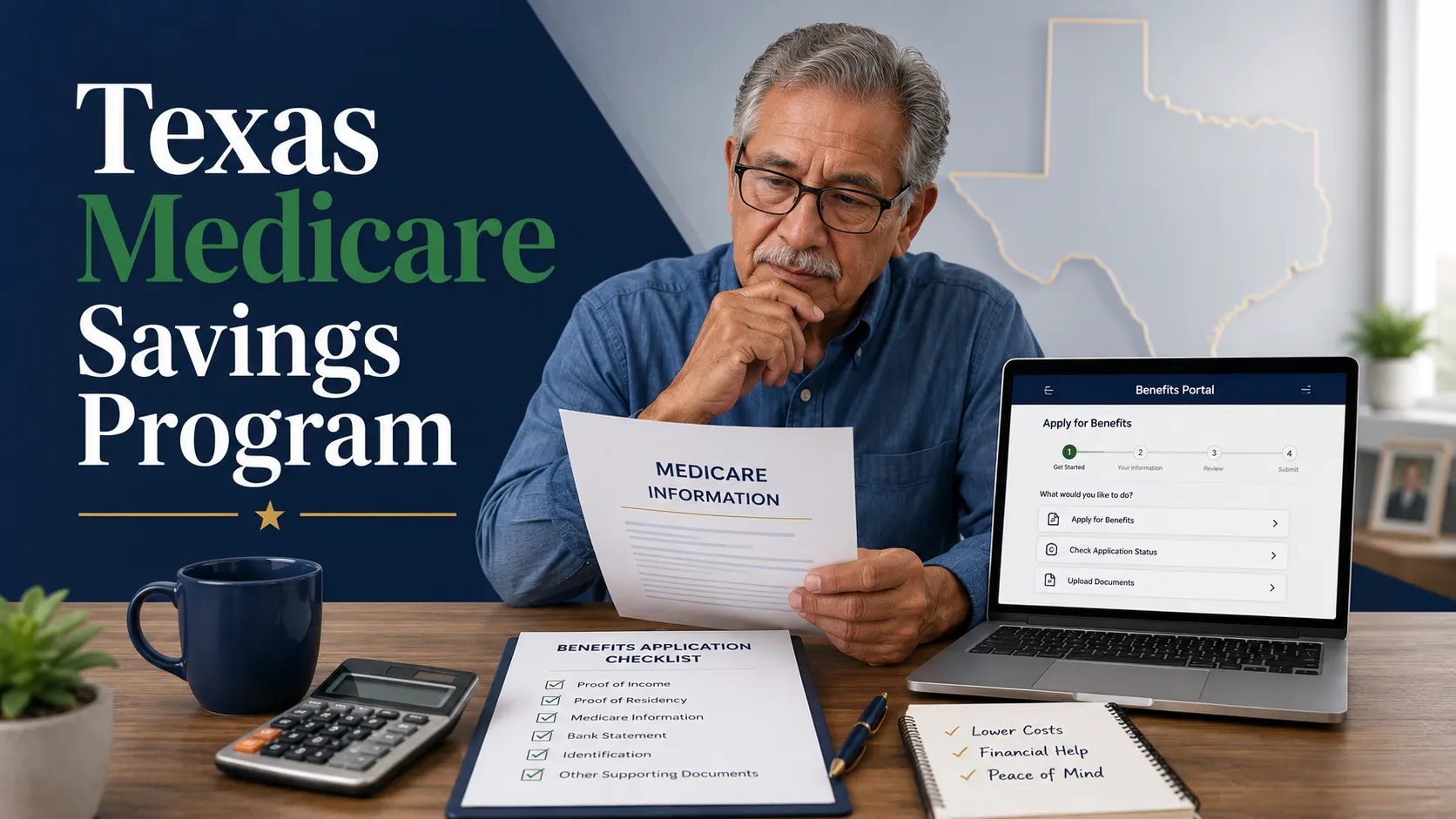
If you live in Texas and have Medicare, you may be able to get help paying Medicare costs through a Medicare Savings Program, often called an MSP.
In Texas, applications and eligibility decisions are handled by the Texas Health and Human Services Commission, commonly called Texas HHSC. The official online benefits portal is Your Texas Benefits.
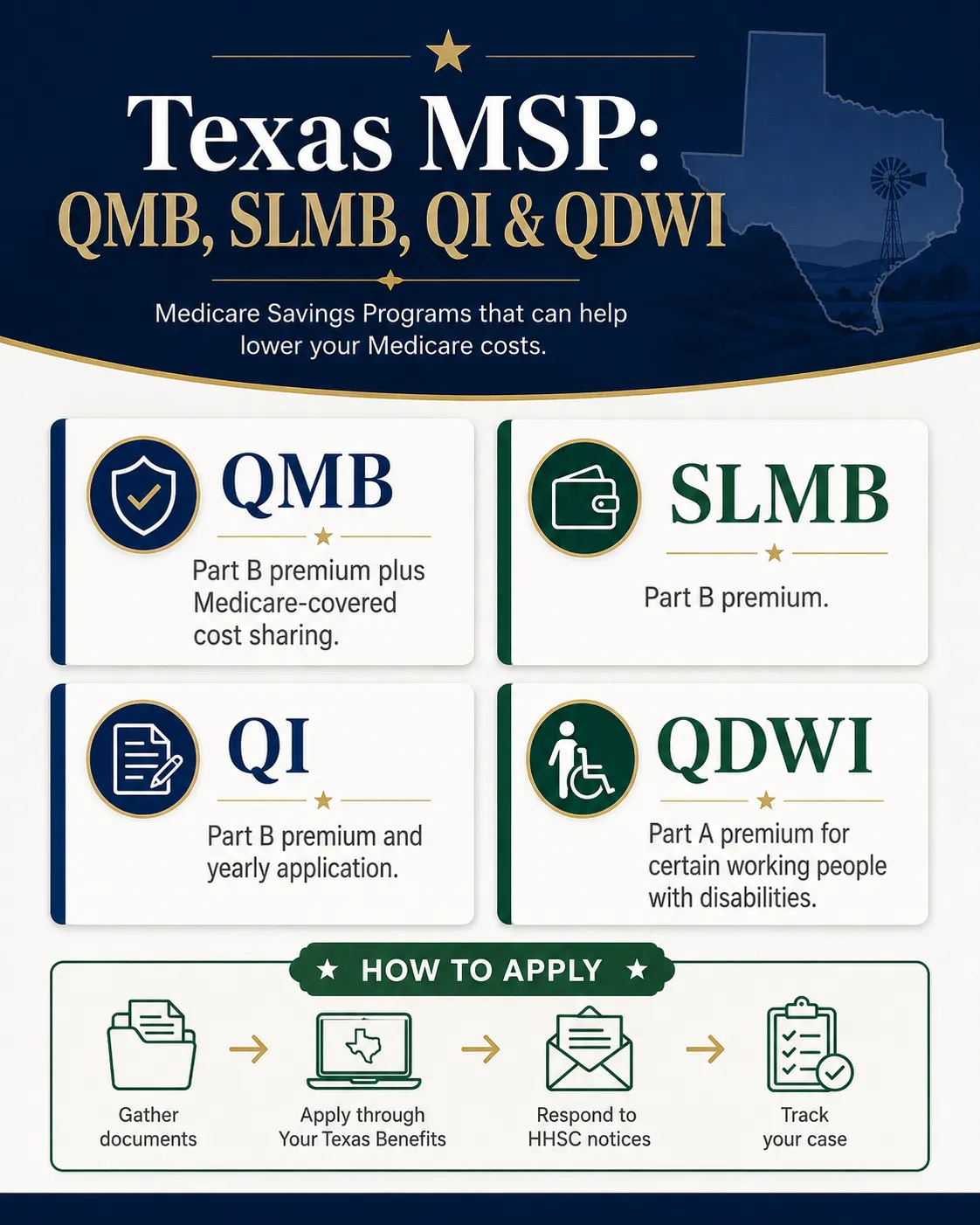
Texas offers the four main Medicare Savings Program categories: QMB, SLMB, QI, and QDWI. The program you may qualify for depends on your Medicare status, countable income, resources, work status, and other state rules.
Official portal: Your Texas Benefits
Programs: QMB, SLMB, QI, QDWI
Important: Texas HHSC makes the final eligibility decision. This page explains the general rules, but it cannot approve an application or guarantee that a person will qualify.
Quick Answer: How does the Texas MSP work?
The Texas Medicare Savings Program may help eligible residents pay the Medicare Part B premium. QMB may also help with Medicare-covered deductibles, coinsurance, and copayments. Applications are filed through Texas HHSC, including through the official Your Texas Benefits portal.
For the main site overview, visit our Medicare Savings Program resource center.
Which Texas Medicare Savings Program Fits Your Problem?
Most people do not know whether they need QMB, SLMB, QI, or QDWI. That is completely normal.
Use this screening table to understand which program may be connected to your main concern.
| Main Problem | Texas MSP Path to Ask About |
|---|---|
| Your Part B premium is reducing your monthly Social Security payment | QMB, SLMB, or QI |
| You also need help with Medicare deductibles, coinsurance, doctor bills, or copayments | QMB |
| You have a disability, returned to work, and lost premium-free Medicare Part A | QDWI |
| You receive SSI and Medicare | Check whether Medicaid or QMB-related help is already active on your Texas case |
| You are not sure which financial category fits | Apply through Texas HHSC and let the state screen you for the available programs |
QMB provides the broadest help. SLMB and QI mainly help with the Medicare Part B premium. QDWI helps certain working people with disabilities pay the Part A premium.
For a complete comparison, read our guide to QMB, SLMB, QI, and QDWI Medicare Savings Program types.
Are Texas Medicare Savings Program Rules Different by County?
Texas does not normally use a separate Medicare Savings Program income chart for each county.
The same statewide Texas MSP framework applies whether you live in Houston, Dallas, San Antonio, Austin, El Paso, Fort Worth, a rural community, or a border county.
However, the local office, counselor, Area Agency on Aging, or support organization serving you may depend on your city, county, or service region.
Local organizations may help you:
- ✓Understand a Texas HHSC notice
- ✓Locate a benefits office
- ✓Prepare supporting documents
- ✓Understand Extra Help or Medicare Part D
- ✓Review an MSP denial or renewal problem
These local services help people navigate the statewide program. They do not create separate county eligibility limits.
Texas Medicare Help Programs You Should Know
Texas Medicare Benefits Counseling
Texas offers free Medicare benefits counseling through its State Health Insurance Assistance Program network. In Texas, this counseling is commonly connected with HICAP, Area Agencies on Aging, and trained benefits counselors.
A counselor may help you understand:
- ✓Medicare Parts A and B
- ✓Medicare Advantage
- ✓Medicare Part D prescription coverage
- ✓Medigap policies
- ✓Medicare Savings Programs
- ✓Extra Help with drug costs
- ✓Medicare bills, rights, complaints, and appeals
You can also use the national SHIP locator to find free Medicare counseling in Texas.
Area Agencies on Aging
Area Agencies on Aging serve older adults in local Texas regions. They may offer benefits counseling, legal assistance referrals, caregiver resources, nutrition programs, transportation information, and help connecting with other aging services.
A counselor cannot formally approve your Texas MSP application, but they may help you understand what to apply for, what documents to gather, and which office to contact.
Aging and Disability Resource Centers
Texas Aging and Disability Resource Centers help older adults, people with disabilities, family members, and caregivers locate long-term services and community support.
An ADRC may be useful when a person needs MSP help along with transportation, meals, caregiver assistance, housing information, or long-term care planning.
Texas Medicare Savings Program Income Limits for 2026
The following table shows the 2026 federal Medicare Savings Program income and resource limits used as the main starting point.
Texas HHSC makes the final decision after applying the income-counting, exclusion, household, and resource rules that apply to your case.
| Program | Individual Monthly Income | Married Couple Income | Individual Resources | Couple Resources | Main Help |
|---|---|---|---|---|---|
| QMB | $1,350 | $1,824 | $9,950 | $14,910 | Part A premium if owed, Part B premium, and Medicare-covered cost sharing |
| SLMB | $1,616 | $2,184 | $9,950 | $14,910 | Part B premium |
| QI | $1,816 | $2,455 | $9,950 | $14,910 | Part B premium; yearly application required |
| QDWI | $5,405 | $7,299 | $4,000 | $6,000 | Part A premium for certain working people with disabilities |
The standard Medicare Part B premium is $202.90 per month in 2026. If QMB, SLMB, or QI begins paying that premium, the monthly value is approximately $2,434.80 per year.
Approval does not always cause the Social Security deduction to stop immediately. The state, Medicare, and Social Security records may need time to update.
You can verify the national limits and program benefits on the official Medicare.gov Medicare Savings Programs page. Medicare’s official cost page also lists the 2026 Part B premium and deductible.
For a broader national comparison, see our 2026 Medicare Savings Program income limits guide.
What Assets May Count for a Texas MSP?
Texas HHSC may review countable resources when deciding Medicare Savings Program eligibility.
Resources that may be reviewed include:
- ✓Checking accounts
- ✓Savings accounts
- ✓Certificates of deposit
- ✓Stocks and bonds
- ✓Mutual funds
- ✓Some retirement accounts
- ✓Property that is not your principal residence
- ✓Other liquid or accessible investments
Your principal home, one vehicle used for transportation, personal belongings, household goods, and certain burial arrangements are commonly excluded, but the treatment of a specific asset depends on the facts and Texas eligibility rules.
Do not transfer, give away, or move money simply to qualify without getting qualified advice. For a more complete explanation, read our Medicare Savings Program resource limits and assets guide.
If You Work, Texas May Not Count Your Entire Paycheck
Do not assume that a part-time job automatically makes you ineligible.
Texas may apply income exclusions when calculating countable earned income. Under the commonly used SSI-style method, a general income exclusion may be applied first when it has not already been used against other income. The first $65 of earned income may then be excluded, followed by one-half of the remaining earnings.
Example: $605 in Monthly Job Earnings
| Calculation Step | Illustrative Amount |
|---|---|
| Monthly gross earnings | $605 |
| Possible unused general income exclusion | -$20 |
| Earned income exclusion | -$65 |
| Remaining earnings | $520 |
| One-half potentially countable | $260 |
This is an illustration, not a guaranteed Texas eligibility calculation. If the $20 general exclusion has already been used against Social Security, pension, or other unearned income, the result may differ.
Texas HHSC must calculate the actual countable amount using your complete income situation.
Who May Qualify for a Medicare Savings Program in Texas?
You may qualify if you:
- ✓Live in Texas
- ✓Have Medicare Part A or meet the Medicare requirement for the relevant MSP
- ✓Have countable monthly income within the applicable limit
- ✓Have countable resources within the applicable limit
- ✓Meet citizenship or qualified immigration requirements
- ✓Provide the documents Texas HHSC requests
SLMB and QI generally require both Medicare Part A and Part B. QDWI has separate disability, work, and Medicare Part A requirements.
If your income is only slightly over a listed number, do not give up before applying. Review our guide on who qualifies for a Medicare Savings Program.
How To Apply for a Medicare Savings Program in Texas
Texas HHSC handles Medicare Savings Program applications.
1. Gather Your Documents
Documents may include:
- ✓Medicare card
- ✓Proof of Texas residence
- ✓Identity documents
- ✓Social Security benefit letter
- ✓Pension or retirement statements
- ✓Recent pay stubs if working
- ✓Complete bank statements
- ✓Information about other resources if requested
Bank statements should normally show your name, financial institution, statement dates, account information, and complete page sequence. Do not send only the first page if the notice asks for a full statement.
2. Add an Authorized Representative if Needed
If a spouse, adult child, caregiver, attorney, or trusted person will communicate with Texas HHSC for you, ask HHSC which current authorized representative form is required.
Texas commonly uses Form H1003 for appointment of an authorized representative, but always download the current version from Texas HHS or Your Texas Benefits rather than using an old saved copy.
3. Choose an Application Method
| Method | What To Do |
|---|---|
| Online | Create or use your account at Your Texas Benefits, submit the application, check notices, and upload documents. |
| Phone | Call 2-1-1 in Texas or 1-877-541-7905 and ask how to apply for Medicare Savings Program assistance. |
| Paper | Request or download the current Texas MSP application form. Follow the current form’s mailing or fax instructions. |
| In person | Use Texas HHSC resources or 2-1-1 to locate a benefits office serving your area. |
4. Use the Correct Texas Form
Texas may use a shorter application for people seeking help with Medicare premiums and cost sharing, while a broader application may be used when someone also wants a full Medicaid or long-term care eligibility review.
Form names and versions can change. Use the version currently provided by Texas HHSC or Your Texas Benefits.
5. Submit the Application and Verification Documents
If you apply online, return to the Your Texas Benefits dashboard and check whether your documents appear as received.
If you submit by mail, fax, or in person:
- ✓Follow the current form or notice
- ✓Keep a copy of the complete packet
- ✓Keep fax confirmation or mailing tracking
- ✓Copy both sides of double-sided documents
- ✓Use the identifying information requested by Texas HHSC
Do not rely on an address copied from an old article or old form. Use the mailing address or fax number printed on your current Texas application, upload request, or verification notice.
6. Respond Carefully to Follow-Up Notices
Texas HHSC may send a request for additional proof after receiving your application.
A follow-up notice may use a different submission address or upload method from the original application. Follow the instructions printed on the new notice.
7. Monitor Your Case
Check your Your Texas Benefits account or call Texas benefits support after submitting your application.
Ask:
- ✓Was my application received?
- ✓Are any documents missing?
- ✓What is my case or application number?
- ✓Was I screened for QMB, SLMB, QI, and QDWI where applicable?
Ready to start the Texas application?
Use the official Texas benefits portal, gather complete documents, and keep confirmation of everything you submit.
What Happens After You Apply in Texas?
Texas HHSC reviews the application, Medicare information, income, resources, residency, and supporting documents.
Processing time can vary based on whether the application is complete, whether verification is needed, and whether HHSC requests more information.
If approved for QMB, SLMB, or QI, the state begins the process of paying the applicable Medicare premium or cost sharing.
The Part B premium may continue to appear as a Social Security deduction for a period while government records update. Keep the approval notice and monitor your Social Security payment.
If denied, read the notice carefully. The issue may involve missing bank pages, income verification, Medicare status, resources, or an unanswered document request.
For denial help, read why Medicare Savings Program applications are denied.
After approval, watch for annual review or renewal notices. See our latest guide on the Medicare Savings Program renewal process.
If You Already Receive SSI or Full Texas Medicaid
Some Texans who receive Supplemental Security Income and Medicare may already have Medicaid-related premium assistance or QMB-type help connected to their case.
Before filing a duplicate application:
- ✓Check your Texas HHSC notices
- ✓Review your Social Security payment information
- ✓Check your Your Texas Benefits account
- ✓Call Texas benefits support to ask what coverage is active
A Medicare Savings Program is administered through Medicaid, but MSP-only assistance is not always the same as full Medicaid health coverage. See our guide on Medicare Savings Program vs Medicaid.
The Extra Help Prescription Drug Benefit
People approved for QMB, SLMB, or QI also qualify for Extra Help with Medicare prescription drug coverage.
Extra Help may reduce:
- ✓Medicare Part D premiums
- ✓Drug deductibles
- ✓Prescription copayments
- ✓Other covered Part D costs
Medicare.gov says people with QMB, SLMB, or QI pay no more than $12.65 in 2026 for each drug covered by their Medicare drug plan. Actual costs may be lower depending on the drug, plan, pharmacy, and level of Extra Help.
Will Texas Take Your House if You Only Receive MSP Help?
This fear stops some people from applying.
Federal Medicaid rules allow estate recovery for certain Medicaid services, especially specified long-term care services. However, Medicare cost-sharing paid for Medicare Savings Program beneficiaries is excluded from optional estate recovery.
This does not mean every type of Medicaid service is exempt. A person receiving nursing facility care, home and community-based long-term care, or other recoverable Medicaid services may be subject to different estate recovery rules.
You can review the federal exception on the official Medicaid.gov Estate Recovery page.
Where To Get Texas MSP Help
| If You Need Help With | Start Here |
|---|---|
| Applying online or checking a Texas case | Your Texas Benefits or call 2-1-1 |
| Finding the Texas Medicaid agency or official state path | Medicaid.gov State Contact Page |
| Understanding Medicare or Extra Help | SHIP Help |
| General Medicare questions | 1-800-MEDICARE / 1-800-633-4227; TTY 1-877-486-2048 |
| Texas benefits questions | 2-1-1 or 1-877-541-7905 |
Related Medicare Savings Program Guides
FAQs About the Texas Medicare Savings Program
Is the Medicare Savings Program the same as Medicaid in Texas?
Not necessarily. Medicare Savings Programs are administered through Texas Medicaid, but MSP-only help may be limited to Medicare premiums and cost sharing. It does not always provide full Texas Medicaid health coverage.
Are Texas MSP rules different by county?
Texas generally uses statewide Medicare Savings Program rules. Local offices and counselors may differ by service area, but they do not create separate county income limits.
How much is the Medicare Part B premium in 2026?
The standard Medicare Part B premium is $202.90 per month in 2026. QMB, SLMB, or QI may pay this premium if Texas approves you.
Does my Texas home count as an MSP asset?
Your principal residence is commonly excluded from the MSP resource calculation. Extra property or property you do not live in may be treated differently.
Does my car count as an asset?
One vehicle used for personal transportation is commonly excluded. Additional vehicles may be reviewed differently.
Where do I apply for an MSP in Texas?
Apply through Texas HHSC. You can use YourTexasBenefits.com, call 2-1-1 or 1-877-541-7905, request a paper application, or contact a local benefits office.
Does QMB cover old medical bills in Texas?
QMB coverage is generally prospective and normally does not pay Medicare cost sharing from before the QMB effective date. Check your Texas approval notice for the exact start date.
What is the $20 income disregard?
A general income exclusion may reduce the amount of certain income counted for MSP eligibility. Whether it applies to your earnings or other income depends on your full income situation and Texas HHSC’s calculation.
Can Texas recover MSP costs from my estate?
Federal Medicaid rules exclude Medicare cost-sharing paid for Medicare Savings Program beneficiaries from optional estate recovery. Other Medicaid services, particularly long-term care services, may follow different estate recovery rules.
How long does a Texas MSP application take?
Processing time varies. A complete application may be decided faster than a case with missing documents or verification problems. Check Your Texas Benefits or contact HHSC for your current case status.
Conclusion
The Texas Medicare Savings Program may help eligible residents pay the Medicare Part B premium, and QMB may also provide protection from Medicare-covered deductibles, coinsurance, and copayments.
If your income or resources are close to the limits, do not rule yourself out. Texas HHSC must calculate your countable income and assets under the rules that apply to your case.
Gather your Medicare card, income proof, full bank statements, identity documents, and Texas residency proof. Apply through the official portal or contact Texas benefits support. Keep copies and track every submission.