Medicare Shared Savings vs Savings Program Help
The Medicare Shared Savings Program and the Medicare Savings Program sound almost the same, but they are not. This difference matters because many people are trying to lower Medicare costs.
They may want help with the Part B premium, doctor bills, deductibles, copays, coinsurance, or prescription drug costs. The program that directly helps with those bills is usually the Medicare Savings Program, not the Medicare Shared Savings Program.
Medicare Savings Program: help with Medicare costs
Final MSP decision: state Medicaid office
Important: The Medicare Shared Savings Program may help your providers coordinate care, but it does not pay your Part B premium, deductible, coinsurance, or copays. If you need help paying Medicare bills, look at Medicare Savings Programs.
Quick Answer: Which one helps pay Medicare bills?
A Medicare Savings Program may help pay Medicare bills if you qualify. The Medicare Shared Savings Program is about ACO care coordination and provider payment. It does not directly pay your Medicare premiums, deductibles, coinsurance, or copayments.
For the main site guide, visit our Medicare Savings Program resource center.
So this guide explains both programs, what they offer, who is eligible, how to apply, and what a person needs to know when struggling to pay Medicare bills.
Medicare Shared Savings Program vs Medicare Savings Program
| Feature | Medicare Shared Savings Program | Medicare Savings Program |
|---|---|---|
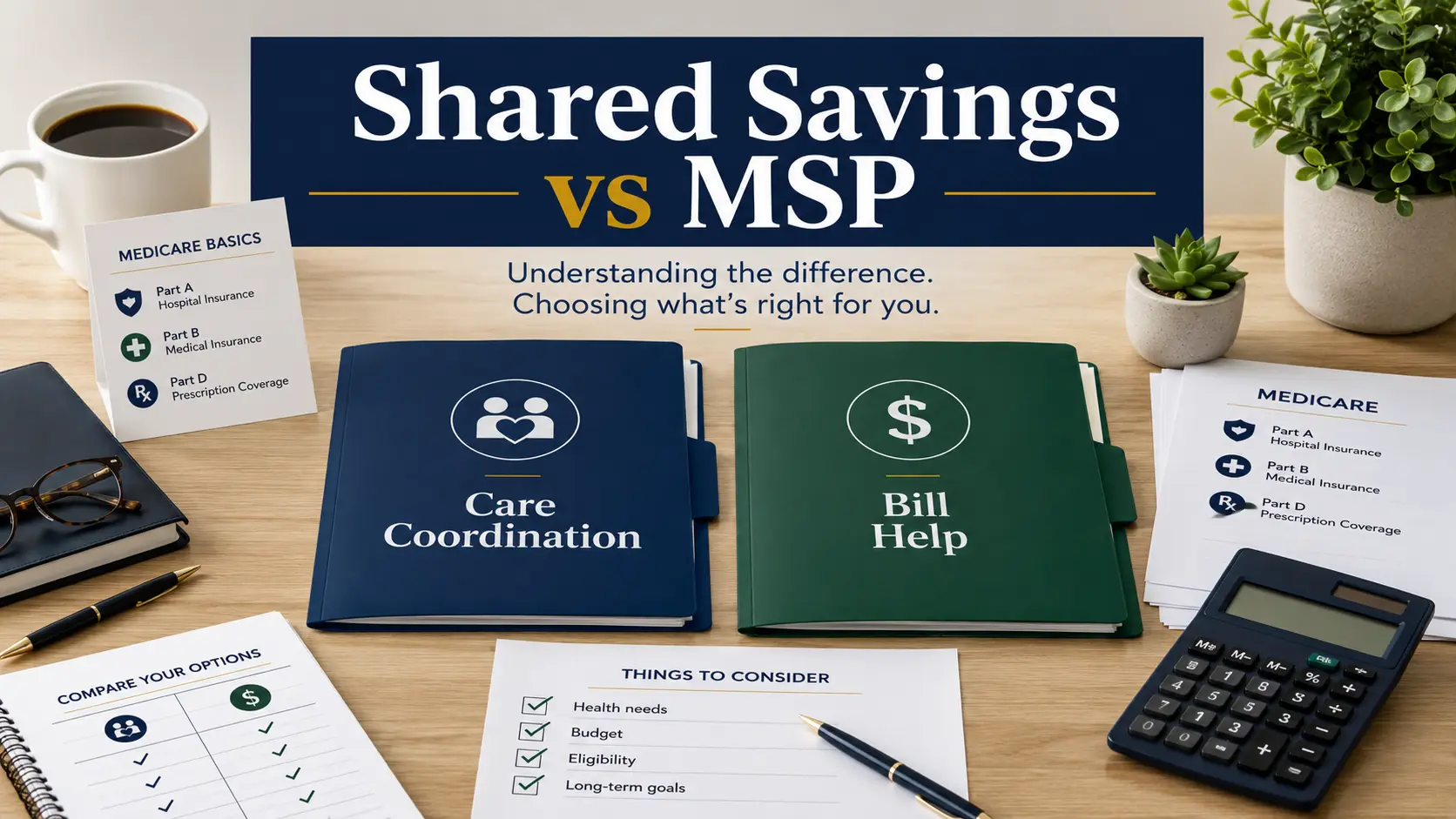
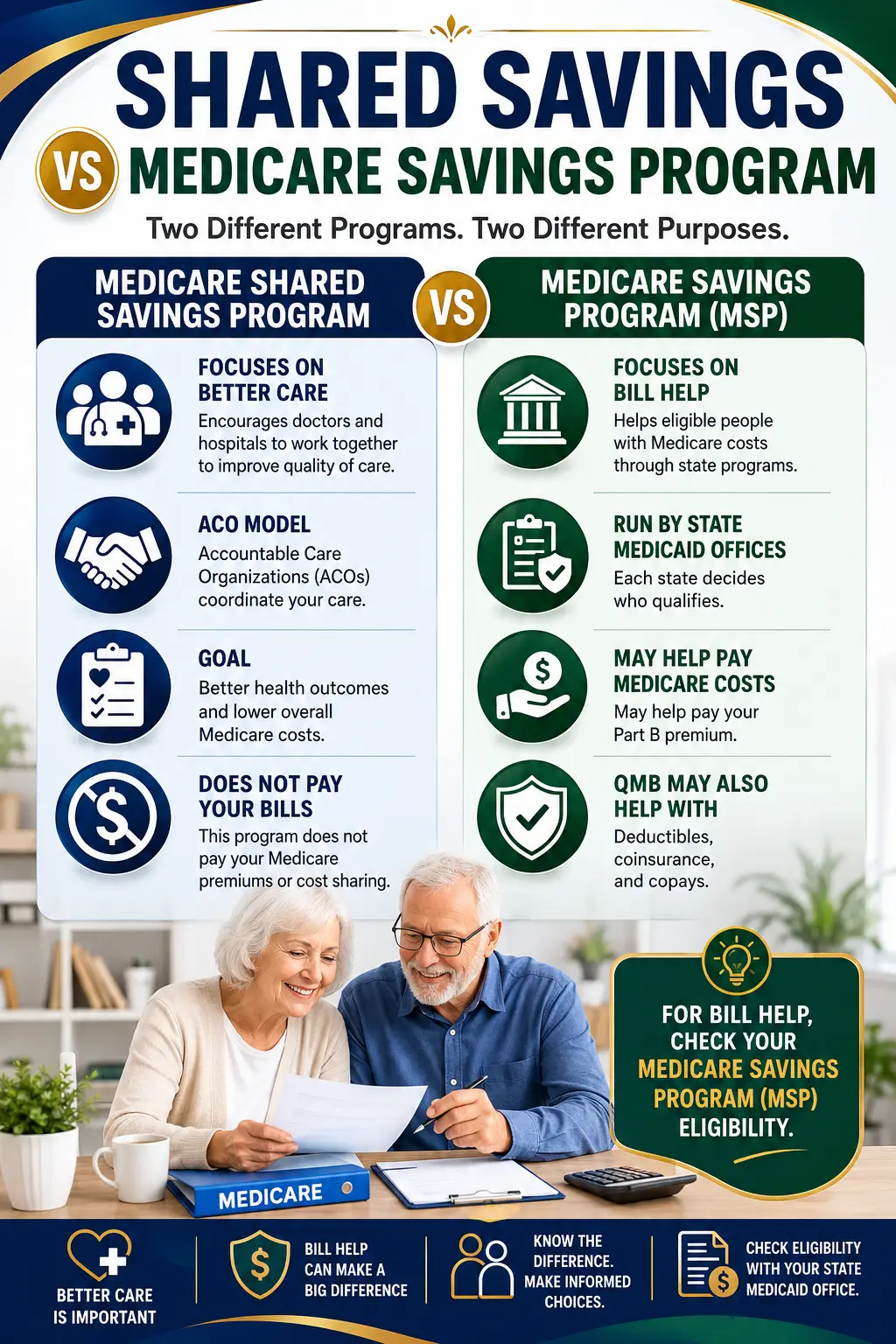
| Main purpose | Helps organize care through ACOs | Helps eligible people pay Medicare costs |
| Main benefit | Better care coordination between providers | Help with premiums and sometimes deductibles, coinsurance, and copayments |
| Who runs it? | CMS and participating ACOs | State Medicaid offices |
| Do patients apply? | Usually no | Yes |
| Does it pay the Part B premium? | No | Yes, if approved for QMB, SLMB, or QI |
| Does it pay deductibles or copays? | No | QMB may help with Medicare-covered deductibles, coinsurance, and copayments |
| Is it based on low income? | No, not for the patient | Yes, income and resource rules usually apply |
| Can you have both? | Yes | Yes |
What Changes for You if Your Doctor Is in a Medicare ACO?
If your doctor participates in a Medicare Accountable Care Organization, that does not turn the Medicare Shared Savings Program into a separate cash benefit or bill-payment program for you. Medicare explains that your Medicare coverage, costs, and rights do not change just because your provider is in an ACO.
- You keep your choice of Medicare providers. With Original Medicare, you can still use doctors, hospitals, and other providers that accept Medicare.
- You do not file a low-income benefit application for the Shared Savings Program. It is an ACO care-coordination and payment model for participating providers.
- Your care team may coordinate more closely. The goal is better communication, fewer unnecessary repeated services, and more organized follow-up.
- If you need help with premiums or cost sharing, look at a Medicare Savings Program. Eligibility is decided by your state.
Shared Savings Program vs Medicare Savings Program vs MSA Plan
Three Medicare terms sound similar but describe different things:
- Medicare Shared Savings Program (MSSP): an Accountable Care Organization program for coordinated Original Medicare care and provider payment incentives.
- Medicare Savings Program (MSP): state-administered help for eligible people with limited income or resources. QMB, SLMB, QI, and QDWI can help with specific Medicare premiums or other Medicare costs.
- Medicare Medical Savings Account (MSA) Plan: a type of Medicare Advantage plan that combines a high-deductible health plan with a medical savings account. It is not the same as a Medicare Savings Program.
If your goal is help paying the Part B premium, review our Medicare Savings Program types guide.
What Is a Medicare Savings Program?
A Medicare Savings Program, often called an MSP, is a state-run program that helps eligible people with limited income and resources pay certain Medicare costs.
Medicare.gov says Medicare Savings Programs can help people get help from their state to pay Medicare Part A and Part B premiums. Some programs may also help pay deductibles, coinsurance, and copayments. Read the official overview on Medicare.gov’s Medicare Savings Programs page.
These programs are handled through your state Medicaid office. When you apply, your state reviews your situation and decides which Medicare Savings Program you may qualify for.
For a beginner-friendly explanation, see our guide: What Is a Medicare Savings Program?
The 4 Types of Medicare Savings Programs
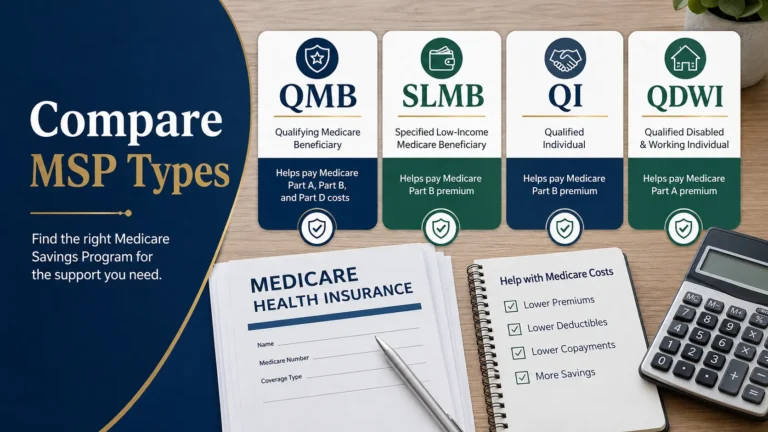
There are four main Medicare Savings Programs: QMB, SLMB, QI, and QDWI.
| Program | What It May Help Pay | Best For |
|---|---|---|
| Qualified Medicare Beneficiary Program | Part A premium, if owed, Part B premium, deductibles, coinsurance, and copayments for Medicare-covered services | People who need the most help with Medicare bills |
| Specified Low-Income Medicare Beneficiary Program | Part B premium | People who mainly need monthly Part B premium help |
| Qualifying Individual Program | Part B premium | People who need Part B premium help and qualify under QI rules |
| Qualified Disabled and Working Individual Program | Part A premium | Certain working people with disabilities who lost premium-free Part A |
For a full comparison of these four programs, see our guide on Medicare Savings Program types. For QMB billing protection specifically, see the QMB Medicare Savings Program guide.
Which Program Is Better?
The Medicare Shared Savings Program may help your doctors work together. It may reduce the need for repeated tests, improve communication, and support better follow-up care. But it does not pay your Part B premium. It does not pay your deductible. It does not protect you from copays. If the problem is care coordination, MSSP may matter.
A Medicare Savings Program can directly reduce Medicare costs if you qualify. For someone on a fixed income, QMB, SLMB, or QI can be much more useful than the Shared Savings Program because these programs target actual monthly and out-of-pocket costs. If the problem is medical bills, MSP is the stronger program.
Can You Have Both Programs?
Yes, you may be connected to both because they do different things.
For example, you may have Original Medicare and see a primary care doctor who participates in an ACO under the Medicare Shared Savings Program. At the same time, you may also qualify for QMB, SLMB, QI, or QDWI through your state Medicaid office. In that case:
- ✓The ACO may help coordinate your care.
- ✓The Medicare Savings Program may help pay your Medicare costs.
One does not automatically give you the other. Being connected to an ACO does not mean your Part B premium will be paid.
Being approved for a Medicare Savings Program does not mean your doctor is part of an ACO. They are separate programs, but they can work side by side.
Who Is Eligible for a Medicare Savings Program?
Medicare Savings Program eligibility is different. It is usually based on:
- ✓Having Medicare Part A or being eligible for Part A
- ✓Income
- ✓Resources
- ✓State rules
- ✓Which MSP type fits your situation
For more detail, read our guide on who qualifies for a Medicare Savings Program and our Medicare Savings Program income limits chart.
If You Got an ACO Letter, What Does It Mean?
If you received a letter about an ACO or the Medicare Shared Savings Program, it usually means one of your doctors or providers participates in an Accountable Care Organization.
- If your provider is in an ACO, you still have the right to visit any doctor, hospital, or other provider that accepts Medicare.
- The letter may explain how your providers coordinate care or share health information. Read it carefully, especially if it mentions data sharing, your rights, or how to ask questions.
An ACO letter is usually about care coordination. It is not the same as an approval letter for QMB, SLMB, QI, QDWI, Medicaid, or Extra Help.
Where To Apply and Get Official Help
| Need Help With | Official Place to Start |
|---|---|
| Learn about Medicare Savings Programs | Medicare.gov Medicare Savings Programs |
| Apply for MSP or Medicaid help | Medicaid.gov: Contact Your State Medicaid Agency |
| Medicare phone support | 1-800-MEDICARE / 1-800-633-4227 |
| TTY support | 1-877-486-2048 |
| Free Medicare counseling | SHIP: Find Local Medicare Help |
| Learn about ACO care coordination | Medicare.gov: Coordinating Your Care |
| Learn about the Shared Savings Program | CMS Medicare Shared Savings Program |
| CMS ACO/Shared Savings contact path | CMS Shared Savings Program Contact Information |
Medicare.gov says you can call 1-800-MEDICARE, also written as 1-800-633-4227, for Medicare questions. TTY users can call 1-877-486-2048. Medicare.gov also offers live chat support.
Need help paying Medicare costs?
If your problem is the Part B premium, deductibles, copays, coinsurance, or other Medicare bills, start with Medicare Savings Program eligibility through your state Medicaid office.
Common Mistakes To Avoid
Thinking “Shared Savings” pays you directly: It rewards ACOs, not patients, for coordinated Medicare care.
Ignoring Medicare Savings Programs: If you need bill help, apply through your state Medicaid office.
Misreading an ACO letter: It usually means provider coordination, not changed benefits or approved cost help.
Assuming your income is too high: State rules vary, so apply and let Medicaid decide.
Using unofficial lead forms first: Start with Medicare, Medicaid, CMS, or SHIP before sharing personal information.
FAQs
Is the Medicare Shared Savings Program the same as a Medicare Savings Program?
No. The Medicare Shared Savings Program is about ACOs, coordinated care, quality, and provider payment. A Medicare Savings Program is state-run help for eligible people who need help paying Medicare costs.
Which program helps pay my Medicare bills?
A Medicare Savings Program helps pay Medicare bills if you qualify. The Medicare Shared Savings Program does not pay your premiums, deductibles, coinsurance, or copayments.
Does the Medicare Shared Savings Program pay the Part B premium?
No. It does not pay the Part B premium. QMB, SLMB, and QI are the Medicare Savings Programs that may help pay the Part B premium.
Which Medicare Savings Program gives the most help?
QMB usually gives the most help because it may pay the Part A premium if owed, Part B premium, deductibles, coinsurance, and copayments for Medicare-covered services.
Can I have the Medicare Shared Savings Program and a Medicare Savings Program together?
Yes. You may be connected to an ACO through your provider and also qualify for a Medicare Savings Program through your state Medicaid office. One helps with care coordination. The other may help with costs.
Do I apply for the Medicare Shared Savings Program?
Usually, no. Patients do not normally apply. Providers join or form ACOs, and Medicare beneficiaries may be connected based on where they receive care.
Do I apply for a Medicare Savings Program?
Yes. You apply through your state Medicaid office. Your state reviews your income, resources, Medicare status, and other rules to decide which MSP you may qualify for.
What should I do if I got an ACO letter?
Read the letter carefully. It probably explains that your provider is part of an ACO. If you have questions, call your doctor’s office or Medicare at 1-800-MEDICARE / 1-800-633-4227. TTY users can call 1-877-486-2048.
Does a Medicare Savings Program help with drug costs?
Yes, indirectly. Medicare.gov says people who qualify for QMB, SLMB, or QI automatically qualify for Extra Help with Medicare drug coverage costs.
Where should I apply if I need help paying Medicare costs?
Start with your state Medicaid office. You can also use Medicare.gov’s Medicare Savings Program page, Medicaid.gov’s state agency contact page, or SHIP for free counseling.
Conclusion
The Medicare Shared Savings Program and Medicare Savings Program are easy to confuse, but their benefits are completely different. The Medicare Shared Savings Program may help your doctors coordinate your care through an ACO. It can support better communication, fewer repeated tests, better follow-up, and more organized care. But it does not pay your Medicare bills.
A Medicare Savings Program is the real cost-help program. If you qualify, it may pay your Part B premium, and QMB may also help with Medicare-covered deductibles, coinsurance, and copayments.
For bill help, start with your state Medicaid office, Medicare.gov, or SHIP. Even if you are not sure you qualify, it is worth checking because state rules can vary.