Medicare Savings Program Types: QMB, SLMB, QI & QDWI
There are four main Medicare Savings Program types: QMB, SLMB, QI, and QDWI.
They all help people with limited income pay certain Medicare costs. But they do not all pay for the same things.
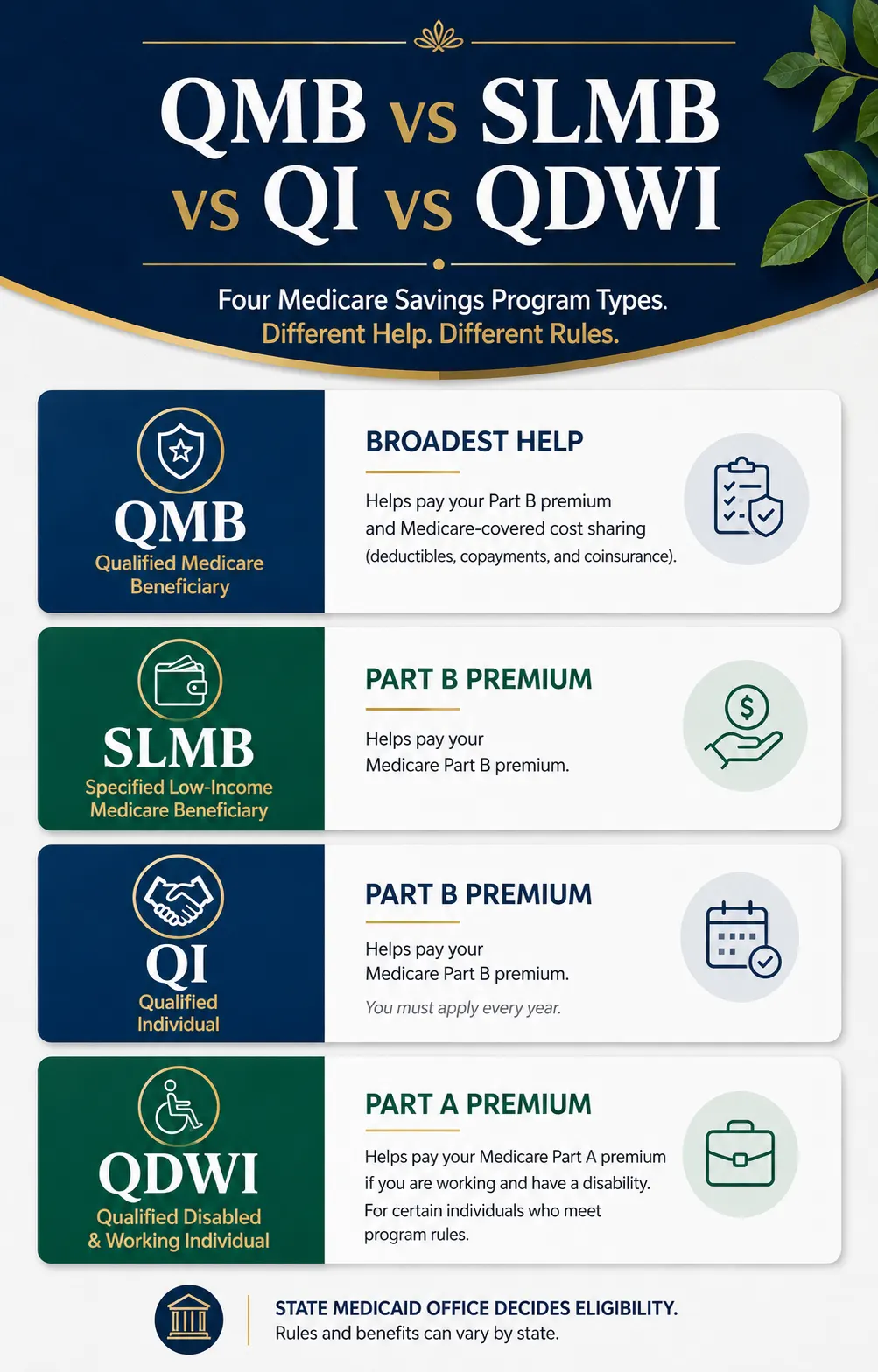
The simple difference is this: QMB gives the broadest help. SLMB and QI help pay the Medicare Part B premium. QDWI helps certain working people with disabilities pay the Medicare Part A premium.
Main difference: what each program pays
Final decision: state Medicaid office
Important: You do not usually choose the program yourself. You apply through your state Medicaid office, and your state reviews your income, resources, Medicare status, and other eligibility rules.
Quick Answer: What are the Medicare Savings Program types?
The four Medicare Savings Program types are QMB, SLMB, QI, and QDWI. QMB may help with premiums and Medicare-covered cost sharing. SLMB and QI mainly help with the Part B premium. QDWI helps certain working people with disabilities pay the Part A premium.
For the full site overview, visit our main Medicare Savings Program resource.
Then the state decides which Medicare Savings Program you may qualify for.
This guide explains each type in plain English, so you can compare QMB, SLMB, QI, and QDWI before you apply. If you need the basic definition first, read our guide on what a Medicare Savings Program is.
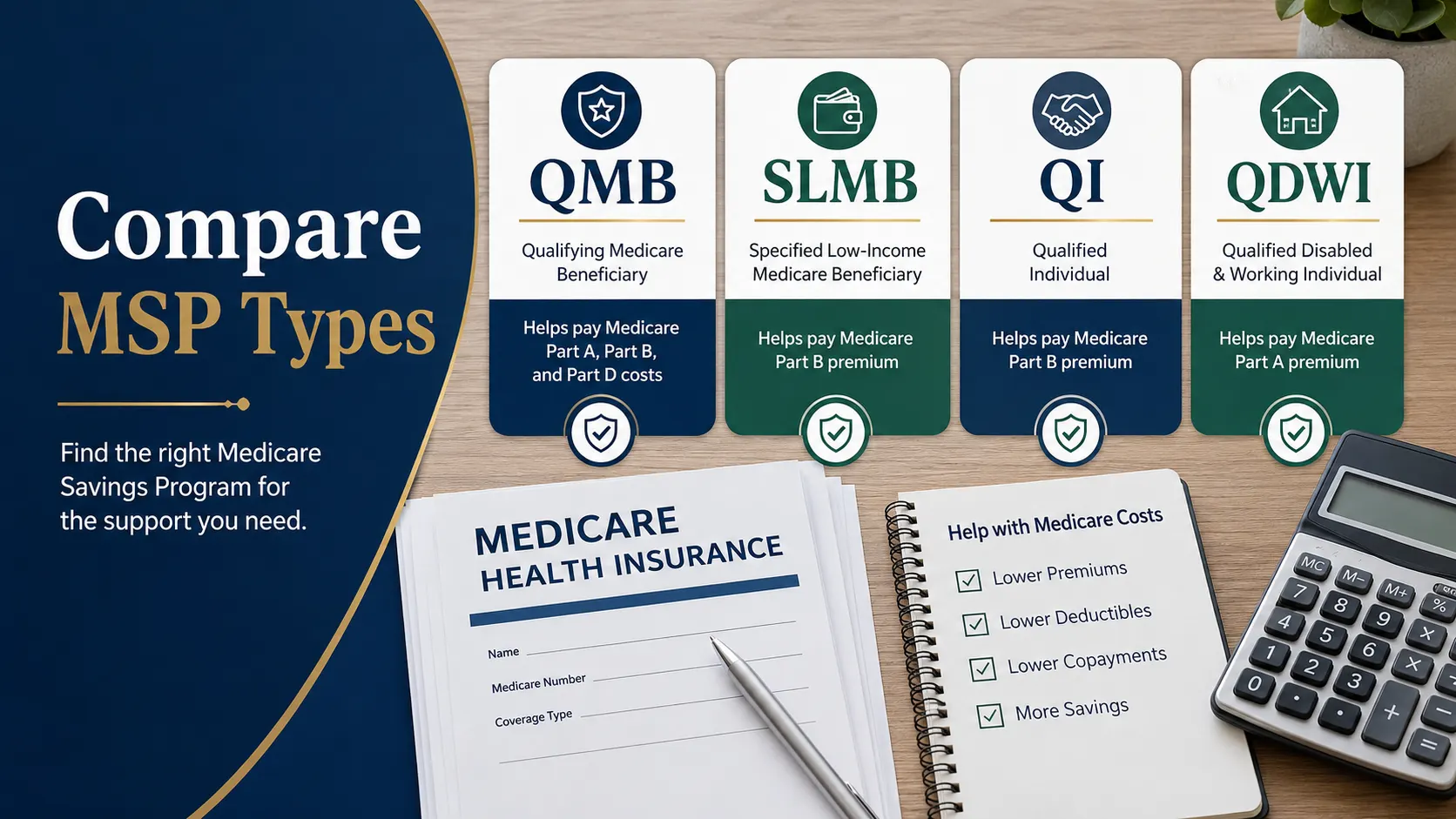
Medicare Savings Program Types at a Glance
| Program | Full Name | Main Help |
|---|---|---|
| QMB | Qualified Medicare Beneficiary | Helps pay Part A premium if owed, Part B premium, deductibles, coinsurance, and co-payments for Medicare-covered services |
| SLMB | Specified Low-Income Medicare Beneficiary | Helps pay the Medicare Part B premium |
| QI | Qualifying Individual | Helps pay the Medicare Part B premium |
| QDWI | Qualified Disabled and Working Individual | Helps pay the Medicare Part A premium only |
The biggest difference is cost sharing.
QMB may help with Medicare deductibles, coinsurance, and co-payments. SLMB and QI usually help only with the Part B premium. QDWI is different because it helps with the Part A premium for a smaller group of working people with disabilities.
1. QMB: Qualified Medicare Beneficiary Program
The Qualified Medicare Beneficiary Program, usually called QMB, gives the broadest help of all four Medicare Savings Program types.
QMB is often the most important program to understand first because it can help with both monthly Medicare premiums and certain out-of-pocket Medicare costs.
What QMB Helps Pay
QMB may help pay:
- ✓Medicare Part A premium, if you owe one
- ✓Medicare Part B premium
- ✓Medicare deductibles
- ✓Medicare coinsurance
- ✓Medicare co-payments
This help applies to services and items that Medicare covers.
That makes QMB different from SLMB and QI. SLMB and QI mainly help with the Part B premium. QMB may also help with the cost-sharing bills that can come after you receive care.
QMB Billing Protection
QMB also has an important billing protection.
This is one of the strongest protections under any Medicare Savings Program.
This matters because many people with Medicare are not only worried about the Part B premium. They are also worried about doctor bills, specialist bills, hospital bills, tests, and other Medicare-covered costs.
QMB can help reduce that pressure.
When QMB May Help Most
QMB may be the most helpful Medicare Savings Program if your main concern is not just the monthly Part B premium, but also Medicare co-pays, deductibles, or coinsurance.
It may also be important if you keep receiving bills after Medicare has already paid its share.
If you qualify for QMB, you may also qualify for Extra Help with Medicare prescription drug costs.
For a deeper guide, see our full article on the QMB Medicare Savings Program.
2. SLMB: Specified Low-Income Medicare Beneficiary Program
The Specified Low-Income Medicare Beneficiary Program, usually called SLMB, helps pay the Medicare Part B premium.
This is the main purpose of SLMB.
SLMB is more limited than QMB because it does not usually pay Medicare deductibles, coinsurance, or co-payments.
What SLMB Pays For
SLMB helps pay the monthly Medicare Part B premium.
For many people, the Part B premium is taken out of their Social Security payment. If SLMB starts paying that premium, the monthly deduction may stop after the state payment begins.
This can make a real difference in someone’s monthly budget.
How SLMB Differs From QMB
The main difference between SLMB and QMB is the level of help.
QMB may help pay the Part B premium and Medicare cost sharing. SLMB usually helps only with the Part B premium.
So if your main problem is the Part B premium, SLMB may still be useful. But if your main problem is also doctor bills, hospital bills, co-pays, or deductibles, QMB provides broader help if you qualify.
When SLMB May Apply
SLMB may apply if your income is too high for QMB but still within the SLMB limit.
You do not need to know this before applying. Your state Medicaid office will review your information and decide whether you qualify for QMB, SLMB, QI, or another type of help.
People who qualify for SLMB may also get Extra Help with Medicare Part D prescription drug costs.
3. QI: Qualifying Individual Program
The Qualifying Individual Program, usually called QI, also helps pay the Medicare Part B premium.
QI is similar to SLMB because both programs focus on the Part B premium. The difference is that QI usually has a higher income limit than SLMB.
What QI Pays For
QI helps pay the Medicare Part B premium.
It does not usually pay Medicare deductibles, coinsurance, or co-payments. Like SLMB, its main value is helping with the monthly Part B premium.
If your Part B premium is being taken out of your Social Security payment, QI may help increase the amount you receive after the state starts paying the premium.
Annual Application Requirement
QI has an important rule: you must apply every year.
States approve QI applications on a first-come, first-served basis. People who received QI benefits the previous year may get priority, but you still need to renew.
Because of this, QI is not a program to delay. If you think you may qualify, it is better to apply as early as possible.
How QI Differs From SLMB
SLMB and QI both help with the Part B premium, but QI generally has a higher income limit.
A simple way to understand it:
- ✓SLMB may help if your income is above QMB limits but still within SLMB limits.
- ✓QI may help if your income is above SLMB limits but still within QI limits.
- ✓Both programs focus mainly on the Part B premium.
People who qualify for QI may also get Extra Help with Medicare drug costs.
4. QDWI: Qualified Disabled and Working Individual Program
The Qualified Disabled and Working Individual Program, usually called QDWI, is different from QMB, SLMB, and QI.
QDWI helps pay the Medicare Part A premium only.
It does not pay the Part B premium. It also does not pay Medicare deductibles, coinsurance, or co-payments.
What QDWI Pays For
QDWI may help pay the Medicare Part A premium.
This is different from SLMB and QI, which help with the Part B premium. It is also different from QMB, which may help with both premiums and Medicare cost sharing.
Who QDWI Is Designed For
QDWI is mainly for certain people with disabilities who returned to work and lost premium-free Part A.
You may hear about QDWI if you:
- ✓Have a disability
- ✓Are working
- ✓Lost Social Security disability benefits because you returned to work
- ✓Lost premium-free Medicare Part A
- ✓Need help paying the Part A premium
This program applies to a much smaller group than QMB, SLMB, or QI.
Why QDWI Is Different
Most people looking for Medicare Savings Program help are trying to reduce the Part B premium or Medicare cost-sharing bills. That is why QMB, SLMB, and QI are more commonly discussed.
QDWI solves a different problem. It helps certain working people with disabilities keep Medicare Part A by helping pay the Part A premium.
2026 Medicare Savings Program Income and Resource Limits
These are the 2026 federal Medicare Savings Program limits for most states.
| Program | Individual Monthly Income Limit | Married Couple Monthly Income Limit | Individual Resource Limit | Married Couple Resource Limit |
|---|---|---|---|---|
| QMB | $1,350 | $1,824 | $9,950 | $14,910 |
| SLMB | $1,616 | $2,184 | $9,950 | $14,910 |
| QI | $1,816 | $2,455 | $9,950 | $14,910 |
| QDWI | $5,405 | $7,299 | $4,000 | $6,000 |
These limits are a starting point, not the final answer for every person.
Limits may be higher in Alaska and Hawaii. Some states may also use different rules or more generous counting methods. That means you may still qualify even if your income or resources seem slightly above the federal amounts.
Your state Medicaid office makes the final decision. For a full breakdown, see our Medicare Savings Program income limits chart.
What Counts as Income and Resources?
When you apply for a Medicare Savings Program, your state may review both income and resources.
Income
Income may include money you receive each month, such as Social Security, retirement income, pension payments, or other regular payments.
States may not count every dollar the same way. Some states use deductions or disregards, which can make a person eligible even if their gross income looks too high at first.
Resources
Resources usually mean money or assets you can use.
They may include:
- ✓Checking accounts
- ✓Savings accounts
- ✓Stocks
- ✓Bonds
Some things usually do not count, such as the home you live in, one car, personal belongings, household items, and certain burial funds.
Because state rules can differ, do not assume you are ineligible only because you are close to the limit. You can also read our guide on who qualifies for MSP help.
Which Medicare Savings Program Pays the Most?
QMB usually pays the most.
QMB may help pay the Part B premium, the Part A premium if you owe one, and Medicare cost sharing such as deductibles, coinsurance, and co-payments.
SLMB and QI are more limited because they mainly help with the Part B premium.
QDWI is limited in a different way because it helps with the Part A premium for certain working people with disabilities.
| If Your Main Concern Is… | Program to Ask About |
|---|---|
| Part B premium plus Medicare co-pays, coinsurance, and deductibles | QMB |
| Part B premium only | SLMB or QI |
| Part A premium after returning to work with a disability | QDWI |
You do not need to diagnose your own eligibility perfectly. Apply through your state Medicaid office and let the state review which program fits your situation.
Medicare Savings Program vs Full Medicaid
A Medicare Savings Program is connected to Medicaid, but it is not always the same as full Medicaid.
This is an important distinction.
Medicare Savings Programs are run by state Medicaid offices. But some people only receive partial Medicaid help through an MSP. That means Medicaid helps pay certain Medicare costs, but the person may not have full Medicaid health coverage.
Other people qualify for full Medicaid and a Medicare Savings Program. That may give broader benefits, depending on the state.
What To Ask After Approval
If you are approved and your notice is unclear, ask your state Medicaid office:
This question can help you understand what benefits you actually have and what bills may or may not be covered.
For a full comparison, see our guide: Is a Medicare Savings Program the same as Medicaid?
Medicare Savings Programs and Extra Help
Medicare Savings Programs can also connect some people to help with prescription drug costs.
If you qualify for QMB, SLMB, or QI, you may also qualify for Extra Help with Medicare Part D drug costs.
Extra Help can lower prescription drug costs, including certain Part D premiums, deductibles, coinsurance, and co-payments.
This is important because many people focus only on the Part B premium and forget about drug costs. If prescriptions are a major part of your monthly budget, ask about both Medicare Savings Program help and Extra Help.
QDWI is different because it helps with the Part A premium only and does not work the same way as QMB, SLMB, or QI for Extra Help.
How To Apply for a Medicare Savings Program
You apply for a Medicare Savings Program through your state Medicaid office.
The exact process depends on your state. Some states allow online applications. Others may allow paper, phone, or in-person applications.
Application Methods
Depending on where you live, you may be able to apply:
- ✓Online through your state Medicaid portal
- ✓By downloading and mailing a paper application
- ✓By calling your state Medicaid office
- ✓In person at a local Medicaid or benefits office
- ✓With help from a SHIP counselor or benefits counselor
You can also call 1-800-MEDICARE and ask for your state Medicaid office contact information. TTY users can call 1-877-486-2048.
Documents You May Need
Your state may ask for documents such as:
- ✓Medicare card
- ✓Proof of income
- ✓Social Security benefit information
- ✓Bank account information
- ✓Identification
- ✓Proof of address
- ✓Information about resources or assets
The exact document list can vary by state.
Safe Application Tip
Use official sources when applying. Start with Medicare.gov, Medicaid.gov, your state Medicaid agency, or your local SHIP program.
Be careful with websites that promise “guaranteed approval” or ask for sensitive personal information before clearly showing an official state application path.
Need the next step?
Applications are handled by state Medicaid offices. Use a safe path and let the state decide which MSP type fits your situation.
Common Mistakes To Avoid
Assuming All MSPs Cover Co-pays
All Medicare Savings Programs do not cover the same costs.
QMB may help with Medicare deductibles, coinsurance, and co-payments. SLMB and QI usually focus on the Part B premium. QDWI helps with the Part A premium only.
Thinking MSP Always Means Full Medicaid
A Medicare Savings Program is Medicaid-run help, but it may only provide partial Medicaid benefits.
If you are approved, ask whether you have full Medicaid or only Medicare Savings Program help.
Forgetting That QI Must Be Renewed
QI requires a yearly application. Since states approve QI applications on a first-come, first-served basis, it is better not to wait too long.
Using Old Income Limits
Medicare Savings Program income and resource limits can change each year. If you are applying in 2026, use 2026 limits and confirm your state’s current rules.
Not Applying Because You Think You Are Slightly Over the Limit
Some states count income and resources differently. If you are close to the limit, applying may still be worth it.
FAQs About Medicare Savings Program Types
What are the four Medicare Savings Program types?
The four Medicare Savings Program types are QMB, SLMB, QI, and QDWI. Each one helps eligible Medicare beneficiaries with certain Medicare costs.
Which Medicare Savings Program pays the most?
QMB usually pays the most because it may help pay Medicare premiums, deductibles, coinsurance, and co-payments for Medicare-covered services.
Which Medicare Savings Programs pay the Part B premium?
QMB, SLMB, and QI may help pay the Medicare Part B premium.
What is the difference between QMB and SLMB?
QMB may help pay Medicare premiums and Medicare cost sharing, such as deductibles, coinsurance, and co-payments. SLMB usually helps only with the Part B premium.
What is the difference between SLMB and QI?
Both SLMB and QI help pay the Medicare Part B premium. QI generally has a higher income limit, but you must apply every year, and approvals may depend on available state funding.
Does QDWI pay the Medicare Part B premium?
No. QDWI helps pay the Medicare Part A premium only for certain working people with disabilities.
Do Medicare Savings Programs help with prescriptions?
QMB, SLMB, and QI can connect eligible people to Extra Help for Medicare Part D prescription drug costs.
Does QMB stop Medicare bills?
QMB can protect you from being billed for Medicare-covered deductibles, coinsurance, and co-payments. If you still receive a bill, contact your provider, Medicare, or your state Medicaid office for help.
Where do I apply for a Medicare Savings Program?
Apply through your state Medicaid office. You can also call 1-800-MEDICARE and ask for your state Medicaid office contact information. TTY users can call 1-877-486-2048.
Final Takeaway
The four Medicare Savings Program types are not the same.
QMB gives the broadest help and may protect you from many Medicare-covered cost-sharing bills. SLMB and QI help with the Medicare Part B premium. QDWI helps certain working people with disabilities pay the Medicare Part A premium.
If you are not sure which program fits your situation, do not guess. Apply through your state Medicaid office and let the state review your eligibility.
Even if your income looks a little too high, applying may still be worth it because some states use more generous rules.