Medicare Savings Program Income Limits 2026
Medicare costs can feel heavy when most of your income comes from Social Security, a small pension, disability benefits, or part-time work. Even one monthly premium can make it harder to pay for groceries, rent, prescriptions, or transportation to doctor visits.
A Medicare Savings Program may help eligible people with limited income pay certain Medicare costs. The income limits below can help you understand where QMB, SLMB, QI, and QDWI may fit.
Main help: Part B premium and other Medicare costs
Final decision: state Medicaid office
Important: These limits are a starting point, not a final eligibility decision. Some states count income and resources differently, and Alaska and Hawaii have higher income limits.
Quick Answer: Medicare Savings Program income limits
In most states, the monthly income limits are $1,350 for QMB, $1,616 for SLMB, $1,816 for QI, and $5,405 for QDWI for an individual. Married couple limits are higher.
For the full background, visit our main Medicare Savings Program hub or read what a Medicare Savings Program is.
For 2026, the standard Medicare Part B premium is $202.90 per month, and the Part B deductible is $283. That means help from a Medicare Savings Program can make a real difference, especially if the Part B premium is being taken out of your Social Security check every month.
Medicare Savings Program Income Limits
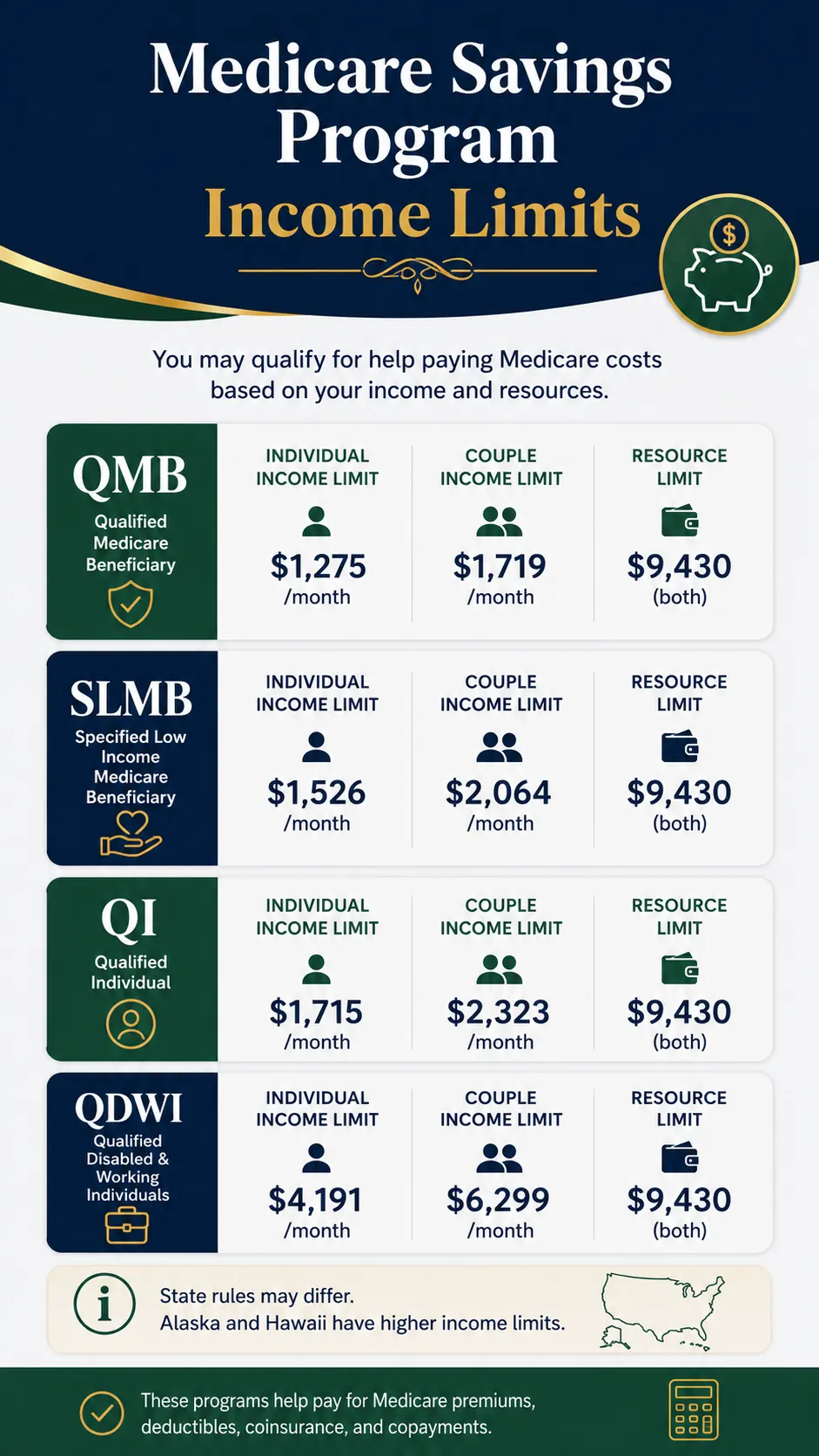
In most states, the 2026 monthly income limits are:
| Program | Individual monthly income limit | Married couple monthly income limit | Resource limit |
|---|---|---|---|
| QMB | $1,350 | $1,824 | $9,950 individual / $14,910 couple |
| SLMB | $1,616 | $2,184 | $9,950 individual / $14,910 couple |
| QI | $1,816 | $2,455 | $9,950 individual / $14,910 couple |
| QDWI | $5,405 | $7,299 | $4,000 individual / $6,000 couple |
These limits apply to most states and Washington, D.C. Alaska and Hawaii have higher income limits, which are listed later in this guide.
What Is a Medicare Savings Program?
A Medicare Savings Program is a state-run Medicaid program that helps eligible Medicare beneficiaries pay certain Medicare costs.
There are four Medicare Savings Programs:
- QMB: Qualified Medicare Beneficiary
- SLMB: Specified Low-Income Medicare Beneficiary
- QI: Qualifying Individual
- QDWI: Qualified Disabled and Working Individual
Each program has a different income limit and pays for different Medicare costs. If you are new to this topic, start with our plain English guide on how Medicare Savings Programs work.
Why the 2026 MSP Limits Matter
Many people with Medicare do not realize they may qualify for help.
For example, if your Medicare Part B premium is taken from your Social Security payment each month, qualifying for QMB, SLMB, or QI may stop that deduction after your state approval is processed. That could leave more money in your monthly benefit.
For someone living on a fixed income, that extra amount can help with:
- ✓Utility bills
- ✓Groceries
- ✓Prescription costs
- ✓Transportation to medical appointments
- ✓Rent or housing costs
- ✓Other basic monthly needs
QMB Income Limits 2026
QMB stands for Qualified Medicare Beneficiary.
In most states, the 2026 QMB income limit is:
| Household situation | Monthly income limit | Resource limit |
|---|---|---|
| Individual | $1,350 | $9,950 |
| Married couple | $1,824 | $14,910 |
QMB usually gives the broadest help of the four Medicare Savings Programs.
What QMB May Help Pay
QMB may help pay:
- ✓Medicare Part A premium, if you owe one
- ✓Medicare Part B premium
- ✓Medicare deductibles
- ✓Medicare coinsurance
- ✓Medicare copayments for Medicare-covered services
QMB also includes important billing protection. If you are approved for QMB, Medicare providers generally are not allowed to bill you for Medicare-covered deductibles, coinsurance, or copayments.
You may still be responsible for a small Medicaid copayment if your state allows one.
SLMB Income Limits 2026
SLMB stands for Specified Low-Income Medicare Beneficiary.
In most states, the 2026 SLMB income limit is:
| Household situation | Monthly income limit | Resource limit |
|---|---|---|
| Individual | $1,616 | $9,950 |
| Married couple | $2,184 | $14,910 |
SLMB helps pay the Medicare Part B premium.
It does not offer the same broad cost-sharing protection as QMB. That means it usually does not pay Medicare deductibles, coinsurance, or copayments. But it can still be valuable because the Part B premium is a monthly cost.
SLMB may be a good fit if your income is too high for QMB but still low enough to need help with Medicare costs.
QI Income Limits 2026
QI stands for Qualifying Individual.
In most states, the 2026 QI income limit is:
| Household situation | Monthly income limit | Resource limit |
|---|---|---|
| Individual | $1,816 | $9,950 |
| Married couple | $2,455 | $14,910 |
QI helps pay the Medicare Part B premium.
QI is often for people whose income is above the QMB and SLMB limits but still within the QI limit.
There is one important rule: you must apply for QI every year. States approve QI applications on a first-come, first-served basis, with priority often given to people who had QI the previous year.
If your state sends renewal paperwork, do not ignore it. A missed renewal can cause your Part B premium help to stop.
QDWI Income Limits 2026
QDWI stands for Qualified Disabled and Working Individual.
In most states, the 2026 QDWI income limit is:
| Household situation | Monthly income limit | Resource limit |
|---|---|---|
| Individual | $5,405 | $4,000 |
| Married couple | $7,299 | $6,000 |
QDWI is different from QMB, SLMB, and QI.
QDWI helps certain working people with disabilities pay the Medicare Part A premium. It is not the main program most Medicare beneficiaries use for Part B premium help.
You may qualify for QDWI if you:
- ✓Have a disability
- ✓Are working
- ✓Lost premium-free Medicare Part A because you returned to work
- ✓Meet your state’s income and resource rules
Because QDWI is for a more specific situation, many Medicare beneficiaries should first look at QMB, SLMB, or QI.
Alaska and Hawaii Income Limits 2026
Alaska and Hawaii have higher income limits because federal poverty guidelines are higher in those states.
| Program | Alaska individual | Alaska couple | Hawaii individual | Hawaii couple |
|---|---|---|---|---|
| QMB | $1,683 | $2,275 | $1,550 | $2,095 |
| SLMB | $2,015 | $2,725 | $1,856 | $2,509 |
| QI | $2,265 | $3,064 | $2,086 | $2,821 |
| QDWI | $6,735 | $9,102 | $6,205 | $8,382 |
The resource limits are generally the same as the federal resource limits listed earlier, but you should still check with your state Medicaid office before deciding you are over or under the limit.
What Counts as Income for a Medicare Savings Program?
Income usually means money you receive each month.
This may include:
- ✓Social Security benefits
- ✓Pension payments
- ✓Wages from work
- ✓Disability benefits
- ✓Retirement income
- ✓Annuity payments
- ✓Other regular monthly income
The safest approach is simple: if your income is close to the limit, apply or ask your state Medicaid office to screen you.
How to Apply for a Medicare Savings Program
Medicare Savings Programs are handled by your state Medicaid office. You do not apply directly through Social Security for MSP approval.
Use the official Medicaid.gov state contact tool to find your state agency.
Gather documents your state may request, such as Medicare, income, identity, and address proof.
Ask for help if the application feels confusing.
Your state may ask for documents such as:
- ✓Medicare card
- ✓Social Security award letter
- ✓Proof of income
- ✓Pension or retirement statements
- ✓Pay stubs, if you work
- ✓Bank statements
- ✓Proof of address
- ✓Identification
- ✓Information about other health insurance
Do not wait until everything is perfect before asking for help. Your state can tell you exactly what documents are needed.
Ask for help if the application feels confusing
If the application feels overwhelming, contact your local SHIP program. SHIP stands for State Health Insurance Assistance Program. SHIP counselors provide free Medicare counseling and can help you understand your options.
You can find local help through SHIPHelp.org.
You can also use our Apply Now guide to understand the next step before contacting your state Medicaid office.
FAQs
What are the Medicare Savings Program income limits for 2026?
In most states, the 2026 monthly income limits are $1,350 for QMB, $1,616 for SLMB, $1,816 for QI, and $5,405 for QDWI for an individual. Married couple limits are higher.
What is the QMB income limit in 2026?
The 2026 QMB monthly income limit is $1,350 for an individual and $1,824 for a married couple in most states. Alaska and Hawaii have higher limits.
What is the SLMB income limit in 2026?
The 2026 SLMB monthly income limit is $1,616 for an individual and $2,184 for a married couple in most states. SLMB helps pay the Medicare Part B premium.
What is the QI income limit in 2026?
The 2026 QI monthly income limit is $1,816 for an individual and $2,455 for a married couple in most states. QI helps pay the Part B premium, but you usually must apply every year.
What is the QDWI income limit in 2026?
The 2026 QDWI monthly income limit is $5,405 for an individual and $7,299 for a married couple in most states. QDWI helps certain working people with disabilities pay the Medicare Part A premium.
Which Medicare Savings Program has the highest income limit?
For most Medicare beneficiaries, QI has the highest income limit among the main Part B premium assistance programs. QDWI has a higher income limit, but it is only for a specific group of working people with disabilities who need help paying the Part A premium.
Do Medicare Savings Programs have asset limits?
Yes, many states use resource or asset limits. In 2026, the resource limit for QMB, SLMB, and QI is $9,950 for an individual and $14,910 for a married couple. QDWI has a lower resource limit of $4,000 for an individual and $6,000 for a married couple.
Does my house count as a resource?
Your primary home usually does not count as a resource for Medicare Savings Program purposes. One car, household goods, personal items, burial plots, and some burial funds may also be excluded.
Can I qualify if my income is slightly over the limit?
Possibly. Some states count income and resources differently or use more generous rules. If your income is close to the limit, you should still contact your state Medicaid office or apply.
Do Medicare Savings Programs pay for prescriptions?
QMB, SLMB, and QI do not directly replace Medicare Part D, but if you qualify for one of those programs, you automatically qualify for Extra Help with Medicare drug costs.
Conclusion
The 2026 Medicare Savings Program income limits can help you quickly estimate whether you may qualify for help with Medicare costs. But the chart should not be treated as the final answer. In most states, the individual monthly limits are $1,350 for QMB, $1,616 for SLMB, $1,816 for QI, and $5,405 for QDWI. Married couple limits are higher, and Alaska and Hawaii have higher income limits.
A short application may help with your Part B premium, stronger protection from Medicare bills, and automatic Extra Help with prescription drug costs. For many people on Medicare, that support can make monthly health care costs much easier to manage.