Medicare Savings Program Denied? Reasons & Next Steps
Getting a Medicare Savings Program denial can feel upsetting, especially if you were hoping for help with your Medicare Part B premium, deductibles, copayments, or other Medicare costs.
But a denial does not always mean you are completely ineligible. Sometimes the problem is simple. A missing bank statement. An old address. A form that arrived late. A Medicare card that was not verified. Or income counted in a way you did not expect.
Do not ignore the denial notice. That notice should tell you why your Medicare Savings Program application was denied, what deadline applies, and whether you can appeal, send missing documents, or reapply.
Next step: read the notice
Deadline: act quickly
Important: A denial reason can sound final, but it may be fixable. Ask what was counted, what was missing, what deadline applies, and whether you can appeal, submit documents, or reapply.
Quick Answer: Why was my MSP application denied?
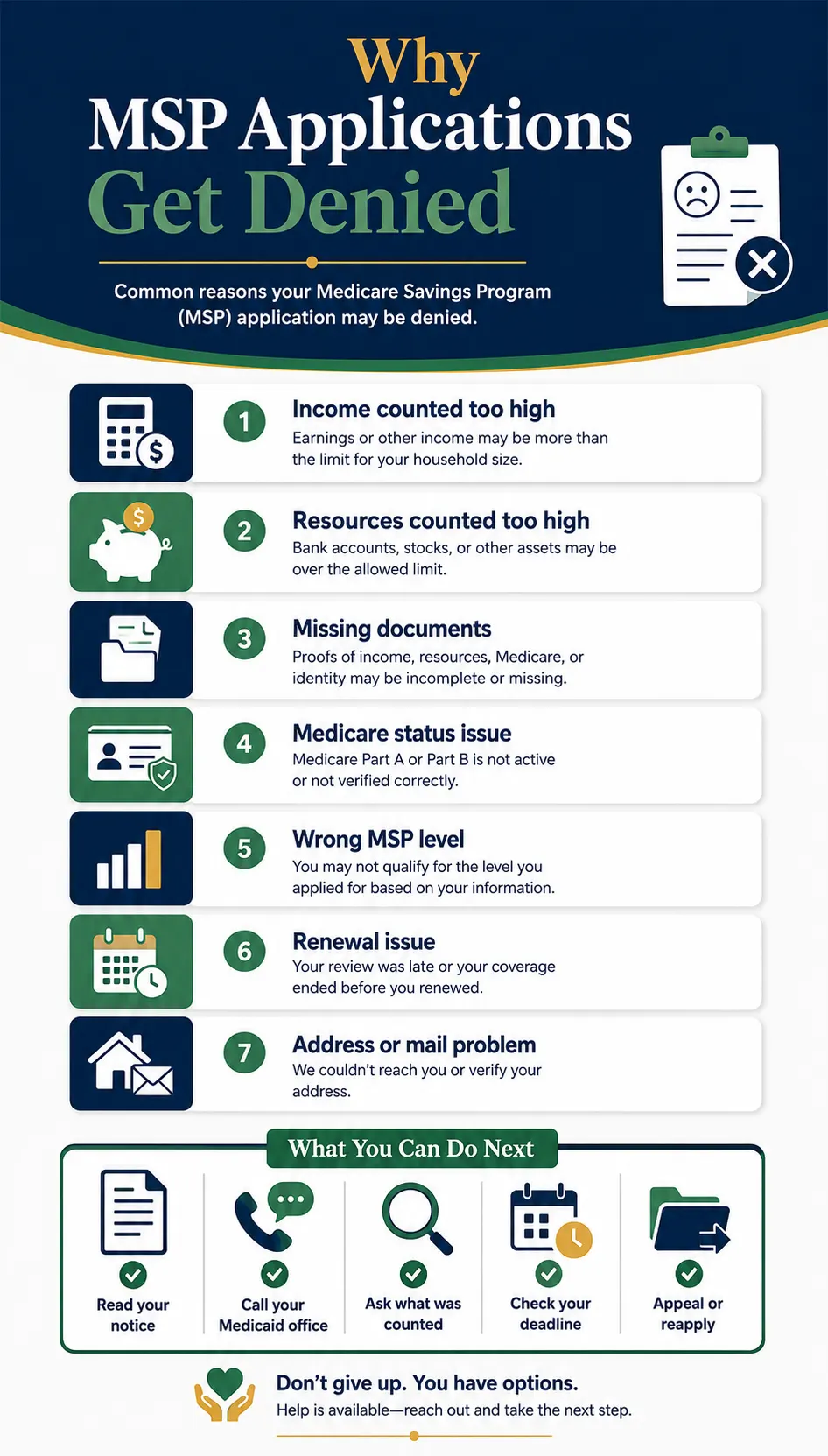
A Medicare Savings Program application may be denied because income was counted too high, resources were over the limit, documents were missing, Medicare status could not be verified, renewal paperwork was incomplete, or notices went to the wrong address.
For the main overview, visit our Medicare Savings Program resource center.

Read the Denial Notice Carefully
Before you panic, look closely at the notice. It should explain:
- ✓The reason for the denial
- ✓The date of the decision
- ✓The rule or eligibility reason used
- ✓How to appeal
- ✓How many days you have to respond
- ✓Where to call or send documents
Do not read only the first line. Denial notices can use formal language, and the most useful information may be lower on the page or on the back of the notice.
Medicare.gov says Medicare Savings Programs are run by states, and when you apply, your state determines which program or programs you qualify for. That is why the state notice is the first document to review. You can also review the official Medicare.gov Medicare Savings Programs page.
Common Reasons Medicare Savings Program Applications Are Denied
Here is a quick, practical table to help you understand what may have happened.
| Denial Reason | What It Usually Means | What To Do Next |
|---|---|---|
| Income too high | The state counted your monthly income above the limit | Ask what income amount was used |
| Resources too high | Savings or assets were counted above the limit | Ask which assets were counted |
| Missing documents | Proof was not received or processed | Ask exactly what document is missing |
| Medicare status issue | Part A or Part B could not be verified | Check your Medicare card and records |
| Wrong MSP level | QMB may be denied, but SLMB or QI may still be possible | Ask if all MSP types were reviewed |
| Renewal issue | Your yearly review was late or incomplete | Ask if the case can be reopened |
| Address problem | Notices may have gone to the wrong address | Update your address and request details |
A denial reason can sound final, but it is not always the end of the process. That is why you should always ask how the decision was made before you give up.
1. Your Income Was Counted Too High
Income is one of the biggest reasons people are denied for the Medicare Savings Program. Your state may look at income such as:
- ✓Social Security benefits
- ✓Pension payments
- ✓Wages
- ✓Disability income
- ✓Retirement income
- ✓Other regular payments
But here is where many people get confused. The amount you receive in your bank account may not be the same amount the state uses. The state may count your income before certain deductions. It may also use older records if your income changed recently.
Check for These Problems
Your denial may be wrong or fixable if:
- ✓Your income recently dropped
- ✓The state used old income records
- ✓A one-time payment was counted as regular monthly income
- ✓The wrong Social Security amount was used
- ✓Your spouse’s income was counted incorrectly
- ✓Your work hours changed
- ✓Your pension or retirement income was reported incorrectly
- ✓You were not screened for all MSP types
If your income is slightly above the QMB limit, do not assume you are out of options. Ask whether you may qualify for SLMB or QI.
For current figures, see our Medicare Savings Program income limits guide and who qualifies for a Medicare Savings Program.
2. Your Resources Were Counted Too High
Resources are assets you already own. They are different from monthly income. Resources may include things like:
- ✓Checking accounts
- ✓Savings accounts
- ✓Stocks
- ✓Bonds
- ✓Certain life insurance cash values
- ✓Other countable assets
But not everything you own is usually counted. Medicare says resources generally do not include your home, one car, burial plot, up to $1,500 set aside for burial expenses, furniture, household items, and personal items. Medicare also notes that some states may count income and resources differently.
Check for These Problems
Look for mistakes such as:
- ✓The same bank account counted twice
- ✓A closed account still counted
- ✓Old bank balances used
- ✓A joint account was counted incorrectly
- ✓Burial funds counted incorrectly
- ✓A home or car counted when it should not have been
- ✓Money counted even though it was already spent on rent, utilities, food, or medical bills
- ✓Life insurance cash value counted without explanation
Do not quickly transfer money, give away assets, or move property after a denial. Medicaid-related rules can be complicated. Get advice first from your state Medicaid office, SHIP counselor, legal aid, or a qualified elder law professional.
For more detail, see our Medicare Savings Program resource limits guide.
3. Documents Were Missing
This is one of the most common and most fixable denial reasons. Sometimes the state does not deny you because you are truly ineligible. It denies the application because it could not finish the review without proof.
The office may have asked for documents, but you may not have received the letter. Or you may have sent the documents after the deadline. Sometimes paperwork is sent but not matched to your case.
CMS’s model Medicare Savings Program application shows that states may need information related to income, resources, Medicare, residence, and other eligibility factors to determine whether the state can pay Medicare premiums or cost sharing. You can review the official CMS Medicare Savings Program model application.
Helpful Tip
This may help the office match the documents to your case.
4. Your Medicare Status Could Not Be Verified
Some Medicare Savings Programs require certain Medicare coverage.
For example:
| Program | Medicare Connection |
|---|---|
| QMB | Usually connected to Medicare Part A and Part B |
| SLMB | Helps with the Part B premium |
| QI | Helps with the Part B premium |
| QDWI | Helps certain working people with disabilities pay Part A premium |
If the state could not verify your Medicare information, your application may be denied or delayed.
This does not always mean you are ineligible. It may simply mean your Medicare record did not match what the state had.
What To Check
Look at your Medicare card and check:
- ✓Your Medicare number
- ✓Your name spelling
- ✓Your Part A start date
- ✓Your Part B start date
- ✓Whether you have Part A, Part B, or both
If your name changed recently, or if your records have different spellings, mention that when you call.
5. You Were Denied for QMB but May Still Qualify for SLMB or QI
This is a very important point.
A denial for one Medicare Savings Program does not always mean you are denied for every MSP.
QMB gives the broadest help, but it also has stricter limits. SLMB and QI mainly help pay the Part B premium and may have different income limits.
Medicare lists four Medicare Savings Programs: QMB, SLMB, QI, and QDWI. QMB can help with Part A and Part B premiums and Medicare-covered deductibles, coinsurance, and copayments. SLMB and QI help with Part B premiums. QDWI helps certain working people with disabilities pay the Part A premium.
You can compare them in our QMB, SLMB, QI, and QDWI guide. For QMB specifically, see our QMB Medicare Savings Program guide.
Simple Difference
| If You Were Denied For | Ask About |
|---|---|
| QMB | SLMB or QI |
| SLMB | QI |
| QI | Whether your state has availability or renewal priority |
| QDWI | Whether you meet the working disability rules |
If your main issue is the Part B premium, see our guide: Does the Medicare Savings Program pay the Part B premium?
6. Your Renewal Was Late or Incomplete
Sometimes the denial is not about your first application. It may be connected to a renewal or yearly review. If your Medicare Savings Program was active before and then stopped, ask whether the state closed the case because renewal paperwork was missing or late.
This can happen when a person misses a letter, sends documents after the deadline, forgets to report a change, or does not understand that a yearly review was required.
7. Your Address or Mail Was the Problem
This is easy to overlook. If Medicaid mailed a document request to an old address, you may never have seen it. Then your application may be denied because you did not respond.
This can happen if you moved, changed mailing addresses, or use a family member’s address for official mail.
It can also happen if your mail is delayed, your name is not on the mailbox, or different agencies have different addresses for you.
Why This Can Cause a Denial
Many applications are denied not because the person failed the rules, but because the office says the person did not respond.
If a letter went to the wrong address, the state may still treat the request as unanswered unless you contact them and explain the problem.
Appeal or Reapply: Which One Should You Do?
After a Medicare Savings Program denial, people often wonder whether they should appeal or start over.
The answer depends on the reason for the denial and the deadline on your notice.
Quick Guide
| Situation | Better Next Step |
|---|---|
| State counted income wrong | Appeal or request review |
| State counted resources wrong | Appeal or request review |
| Documents were missing | Ask if you can submit them now |
| Appeal deadline passed | Reapply may be needed |
| Your situation changed | Reapply may be faster |
| Your benefits stopped unfairly | Appeal quickly |
| You are unsure | Call before the deadline |
If you think the state made a mistake, an appeal may be important.
If your information changed or you missed the appeal deadline, a new application may be the better route.
Medicaid.gov lists Application and Fair Hearings Resources for Medicaid and CHIP application, enrollment, and fair hearing processes. You can review the official resource page here: Medicaid.gov Application and Fair Hearings Resources.
Watch the Appeal Deadline
Your denial notice should tell you how much time you have to appeal.
The deadline can vary by state and by the type of action being taken. If your benefits are being stopped or reduced, timing can be especially important.
If you request a hearing before the action date, ask whether your help can continue while the appeal is pending.
Customer Support for Help
You do not have to handle a Medicare Savings Program denial alone. Start with the agency that sent the denial notice because that office made the decision.
Here are the best official places to get help:
| Help Source | What They Can Help With | Contact or Link |
|---|---|---|
| State Medicaid Office | MSP denial reason, missing documents, appeal instructions, case status | Medicaid.gov state help page |
| Medicare | General Medicare questions, Medicare card, Part A/Part B information, Medicare cost help | Medicare.gov Contact Medicare |
| SHIP | Free local Medicare counseling, help understanding MSP notices and options | SHIP locator or 1-877-839-2675 |
| Area Agency on Aging / Local Help | Local aging support, benefits help, referrals, and possible legal aid connections | Eldercare Locator |
Medicare says people can call 1-800-MEDICARE / 1-800-633-4227, and TTY users can call 1-877-486-2048. Medicare also says help is available 24 hours a day, 7 days a week, except some federal holidays.
Medicare.gov also says SHIP can help people with Medicare understand costs, apply for Extra Help, file a complaint or appeal, and make Medicare decisions. SHIP can be a good option if you need someone to review the denial notice with you.
Need to start again or check the next step?
If your denial may be fixable, gather the notice, income proof, resource information, Medicare card, and any document request letters before calling or reapplying.
Related Medicare Savings Program Guides
If your application was denied, these related guides may help you understand what happened and what to check next:
FAQs
Why was my Medicare Savings Program application denied?
Your application may have been denied because your income was too high, your resources were above the limit, documents were missing, your Medicare status could not be verified, or your renewal paperwork was incomplete.
Can I appeal a Medicare Savings Program denial?
Yes. Many applicants have the right to request an appeal or fair hearing. Follow the instructions on your denial notice and act before the deadline.
Can I be denied QMB but still qualify for SLMB or QI?
Yes. QMB has stricter limits than SLMB or QI. If your notice only mentions QMB, ask whether you were also screened for SLMB and QI.
What if I forgot to send documents?
Call the Medicaid office quickly. Ask whether you can still send the missing proof or whether you need to appeal or reapply.
What if my MSP benefits stopped suddenly?
Call your Medicaid office and ask whether your case was closed, denied, or waiting for renewal information. Also ask what date your help ended.
Should I appeal or reapply?
An appeal may be better if you think the state made a mistake. Reapplying may make sense if your situation has changed or you missed the appeal deadline.
Conclusion
A Medicare Savings Program denial can be stressful, but it is not always the final answer. The reason may be income, resources, missing documents, Medicare status, renewal problems, or an address issue. Some of these problems can be corrected if you act quickly.
Start with the notice. Call the Medicaid office. Ask what was counted, what was missing, and what deadline applies. Then decide whether to send proof, appeal, or reapply.
The safest rule is simple: Do not ignore the denial notice. Act before the deadline.