Who Qualifies for a Medicare Savings Program?
Medicare can help cover hospital care, doctor visits, preventive services, and other medical needs. But many people still have premiums, co-pays, deductibles, lab charges, and prescription costs that are hard to manage every month.
You may qualify for a Medicare Savings Program if you have Medicare, meet your state’s income and resource rules, and your state Medicaid office approves your application.
Programs: QMB, SLMB, QI, QDWI
Final decision: state Medicaid office
Important: Do not assume you are ineligible just because your income looks slightly above the basic limit. States may count income and resources differently, and some states use more generous rules than the federal baseline.
Quick Answer: Who qualifies for a Medicare Savings Program?
People with Medicare may qualify for a Medicare Savings Program if their income and countable resources fit their state’s rules. Eligibility can also depend on Medicare Part A or Part B status, state residency, citizenship or qualifying immigration status, and the specific MSP category.
For broader background, visit our main Medicare cost help resource.
Who Qualifies for a Medicare Savings Program?
You may qualify for a Medicare Savings Program if you meet the basic rules below.
You have Medicare or are eligible for Medicare, depending on the program.
Your monthly income is within your state’s Medicare Savings Program rules.
Your countable resources, if reviewed by your state, are within the limit.
You live in the state where you apply and your state Medicaid office approves you.
- ✓You have Medicare or are eligible for Medicare.
- ✓Your monthly income is within your state’s rules.
- ✓Your countable resources, if reviewed, are within the limit.
- ✓You meet the rules for QMB, SLMB, QI, or QDWI.
- ✓You live in the state where you apply.
- ✓You meet citizenship or qualifying immigration status rules.
A Medicare Savings Program is not only for people with no income or no savings. Many people who qualify receive Social Security, have a small pension, keep money in a checking or savings account, or live on a fixed income that does not stretch far enough.
You can also read our guide on what a Medicare Savings Program does if you want the basic explanation before checking eligibility.
Official information is available from Medicare.gov’s Medicare Savings Programs page.
Medicare Savings Program Eligibility Requirements
Your state makes the final decision, but most Medicare Savings Program applications are reviewed using these main eligibility factors.
1. You must have Medicare or be eligible for Medicare
Medicare Savings Programs are for people who have Medicare or qualify for Medicare. The exact Medicare requirement depends on the program.
- ✓QMB is for people who have or are eligible for Medicare Part A.
- ✓SLMB generally requires Medicare Part A and Part B.
- ✓QI generally requires Medicare Part A and Part B.
- ✓QDWI is for certain working people with disabilities who lost premium-free Part A because they returned to work.
If you are not sure whether your Medicare status fits, you can still apply. Your state Medicaid office will review which program, if any, applies to your situation.
2. Your income must be within your state’s rules
Your state will review your monthly income. Income may include Social Security benefits, pension income, wages from work, disability benefits, retirement income, and other regular payments.
3. Your resources may need to be below the limit
Some states also review resources, sometimes called assets. Countable resources may include checking accounts, savings accounts, stocks, bonds, and certain investment accounts.
Many everyday items usually do not count. Your home, one car, household goods, personal belongings, burial plots, and some burial funds may be excluded.
4. You must meet state residency rules
Because Medicare Savings Programs are handled by state Medicaid offices, you generally need to apply in the state where you live.
5. You must meet citizenship or immigration status rules
Because MSPs are Medicaid-related programs, your state may also review citizenship or qualifying immigration status. You may be asked for proof of identity, state address, Social Security number, citizenship, or qualifying immigration status if applicable.
Medicare Savings Program Income and Resource Limits
The chart below shows federal baseline limits for Medicare Savings Programs in most states and Washington, D.C. Alaska and Hawaii have higher income limits, and some states use more generous rules.
| Program | Individual monthly income | Married couple monthly income | Resource limit |
|---|---|---|---|
| QMB | $1,350 | $1,824 | $9,950 individual / $14,910 couple |
| SLMB | $1,616 | $2,184 | $9,950 individual / $14,910 couple |
| QI | $1,816 | $2,455 | $9,950 individual / $14,910 couple |
| QDWI | $5,405 | $7,299 | $4,000 individual / $6,000 couple |
These limits are a starting point, not the final answer for every applicant. Some states count income and resources more generously. Some states may disregard certain income or resources. Some states have effectively removed resource tests for certain MSP groups.
You can review SSA’s technical explanation here: SSA Medicare Savings Program income and resource guidance.
Why Your State’s Rules Matter So Much
Medicare Savings Programs are partly federal and partly state-administered. That means federal guidelines exist, but state rules can affect the final decision.
SSA explains that states can effectively raise the limits for QMB, SLMB, and QI by disregarding certain income or resources. Some states have used this flexibility to effectively eliminate resource tests for some MSP groups.
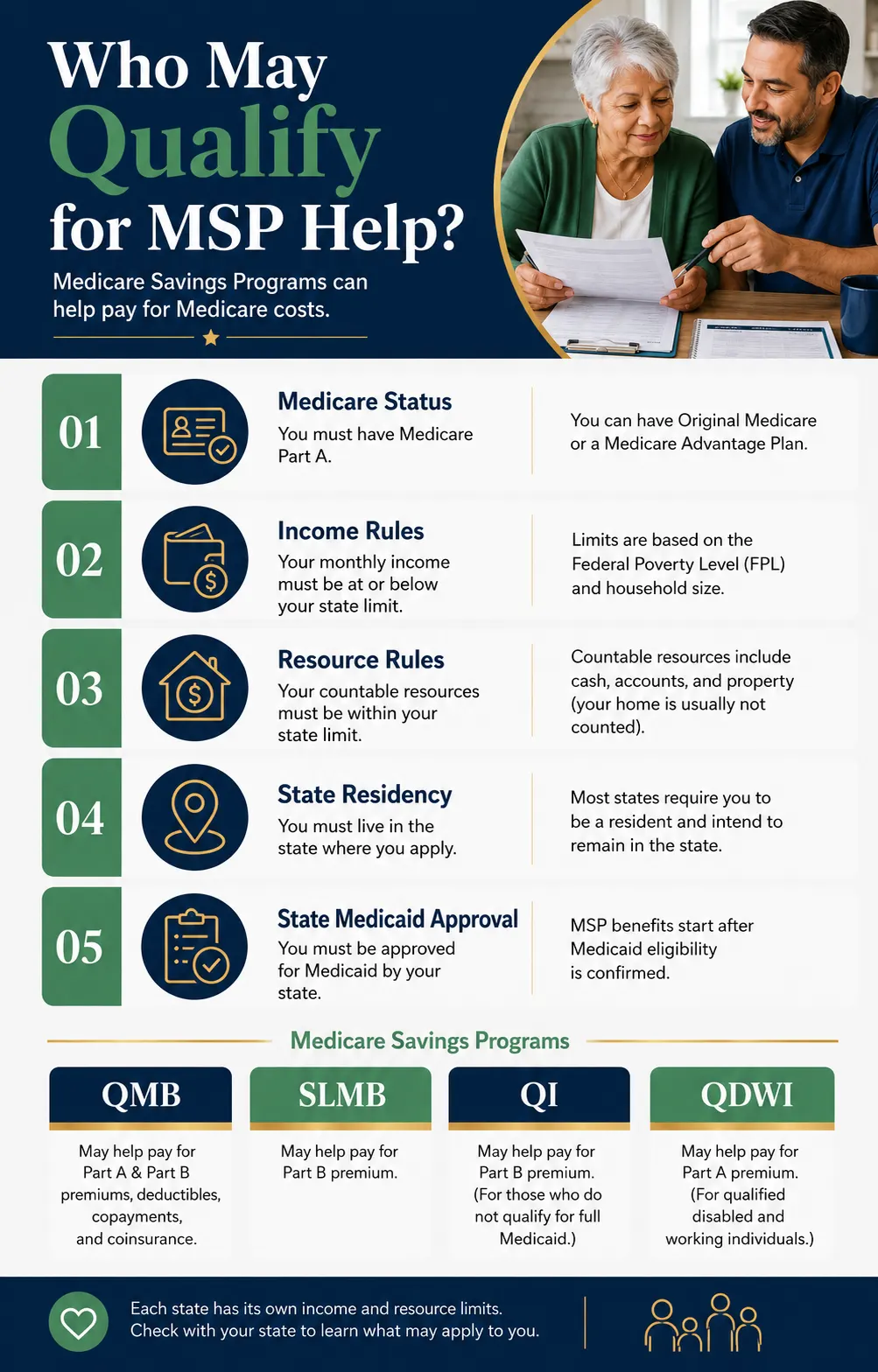
The 4 Medicare Savings Programs
There are four main Medicare Savings Programs. You usually do not choose the program yourself. When you apply, your state reviews your situation and decides whether you qualify for QMB, SLMB, QI, QDWI, or none of them.
| Program | Full name | Who it may help | What it usually helps pay |
|---|---|---|---|
| QMB | Qualified Medicare Beneficiary | People with Medicare who meet QMB rules | Part A premium, Part B premium, deductibles, coinsurance, and copayments |
| SLMB | Specified Low-Income Medicare Beneficiary | People with Part A and Part B whose income is too high for QMB but is still limited | Part B premium |
| QI | Qualifying Individual | People with Part A and Part B whose income is too high for SLMB | Part B premium |
| QDWI | Qualified Disabled and Working Individual | Certain working people with disabilities | Part A premium |
Who may qualify for QMB?
The QMB program, or Qualified Medicare Beneficiary program, usually gives the broadest help. You may qualify if you have or are eligible for Medicare Part A, your income and countable resources fit your state’s rules, and you meet your state’s Medicaid-related eligibility rules.
Who may qualify for SLMB?
The SLMB program, or Specified Low-Income Medicare Beneficiary program, helps pay the Medicare Part B premium. You may qualify if you have Medicare Part A and Part B, your income is too high for QMB, and your income is still within your state’s SLMB rules.
Who may qualify for QI?
The QI program, or Qualifying Individual program, also helps pay the Medicare Part B premium. You may qualify if you have Medicare Part A and Part B, your income is too high for QMB or SLMB, your income is still within your state’s QI rules, and you do not qualify for other Medicaid coverage.
QI must be applied for or renewed every year. QI applications are generally approved on a first-come, first-served basis, with priority usually given to people who had QI the previous year.
Who may qualify for QDWI?
The QDWI program, or Qualified Disabled and Working Individual program, is mainly for certain working people with disabilities who lost premium-free Medicare Part A because they returned to work.
Common Mistakes That Can Cost People MSP Help
Assuming they are over the limit
Being close to the limit is a reason to check, not a reason to give up.
Thinking MSP is only full Medicaid
Some people qualify for MSP help without getting full Medicaid.
Ignoring renewal letters
Programs like QI may require yearly renewal. Missing mail can interrupt benefits.
Paying QMB bills too fast
If you have QMB, question confusing bills before paying.
FAQs
Who qualifies for a Medicare Savings Program?
People with Medicare may qualify if they have limited income and meet their state’s rules. Some states also review resources, such as savings or other countable assets.
Do I need Medicare Part A and Part B?
It depends on the program. QMB is connected to Medicare Part A eligibility or enrollment. SLMB and QI generally require both Part A and Part B. QDWI is for certain working people with disabilities who lost premium-free Part A because they returned to work.
Can I qualify if my income is slightly over the limit?
Possibly. Some states disregard certain income or resources, which can effectively raise the limit. If you are close to the limit, it is usually worth applying.
Does a Medicare Savings Program pay my Part B premium?
Yes. QMB, SLMB, and QI can help pay the Medicare Part B premium if you qualify. QMB may also help with deductibles, coinsurance, and copayments.
Is a Medicare Savings Program the same as Medicaid?
No. Medicare Savings Programs are run through Medicaid, but they are designed to help with Medicare costs. Some people qualify for full Medicaid too, while others only qualify for MSP help.
Can I get MSP if I have Medicare Advantage?
Yes. People with Medicare Advantage can still apply for a Medicare Savings Program if they meet the eligibility rules.
Does MSP help with prescriptions?
If you qualify for QMB, SLMB, or QI, you automatically qualify for Extra Help with Medicare prescription drug costs.
Can I qualify if I have money in the bank?
Possibly. Some bank funds may count as resources, but certain items usually do not count, such as your home, one car, household goods, personal belongings, burial plots, and some burial funds. Your state decides what counts.
What is the resource limit for a Medicare Savings Program?
For most states, the resource limit is $9,950 for an individual and $14,910 for a married couple for QMB, SLMB, and QI. For QDWI, the resource limit is $4,000 for an individual and $6,000 for a married couple. Some states may use different or more generous resource rules.
Conclusion
You may qualify for a Medicare Savings Program if you have Medicare, your income and resources fit your state’s rules, and your state Medicaid office approves your application. The biggest mistake is assuming you do not qualify before applying.
If your Medicare Part B premium, deductibles, copays, or prescription costs are making your monthly budget harder to manage, it is worth checking your eligibility. Even limited help can make a real difference when you are living on a fixed income.