Massachusetts Medicare Savings Program 2026: Limits & Apply
Massachusetts Medicare Savings Program 2026
MassHealth may pay your Medicare Part B premium, provide QMB protection from Medicare cost-sharing, enroll you in Extra Help, and connect you with Health Safety Net assistance. Massachusetts also uses higher income limits and no MSP asset test.
Quick Answer
Massachusetts residents who have Medicare and household income at or below 225% of the federal poverty level may qualify for a Medicare Savings Program. These programs were formerly known as MassHealth Buy-In, Senior Buy-In, or simply Buy-In.
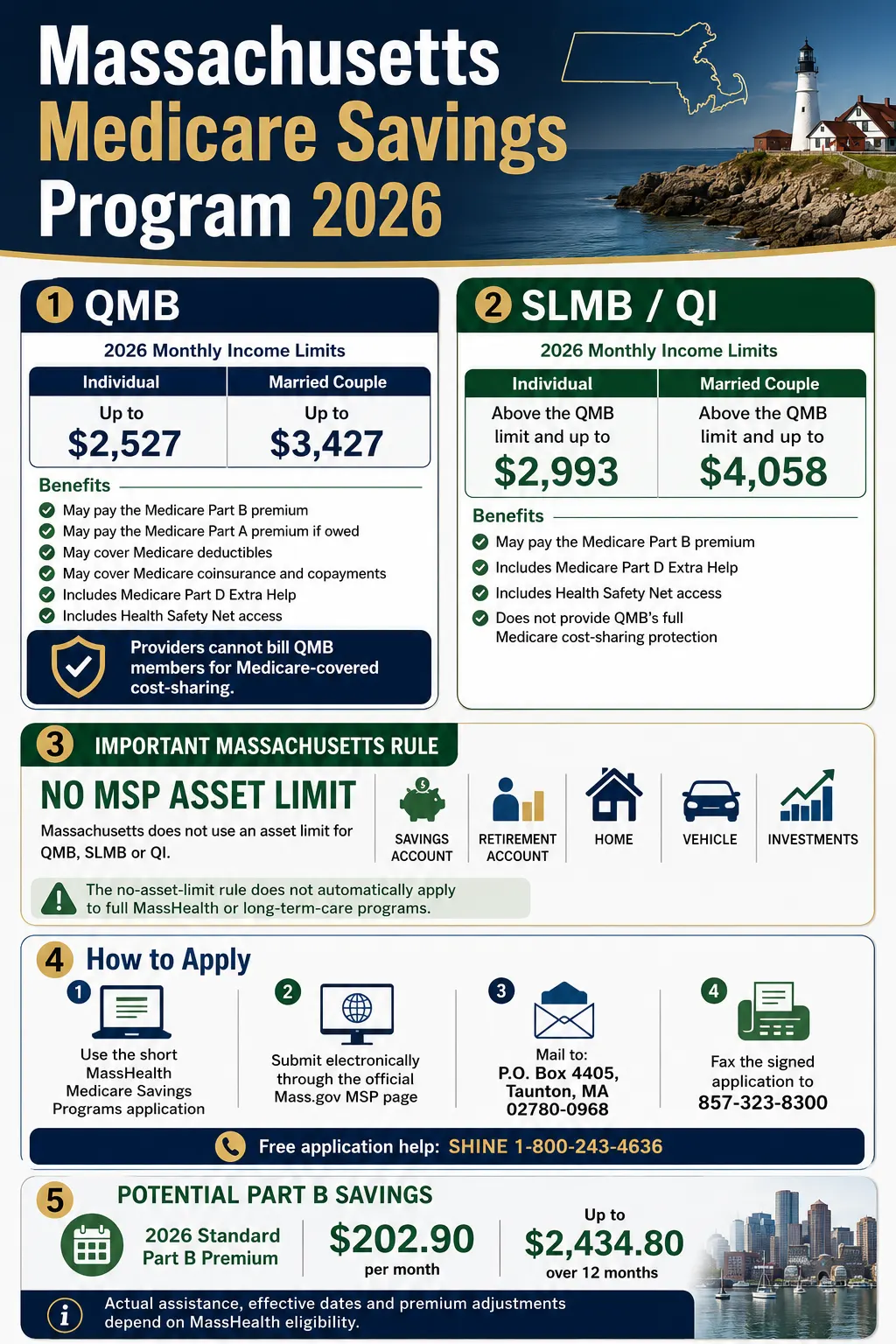
- QMB: Up to $2,527 per month for one person or $3,427 for a married couple in 2026.
- SLMB/QI: Income above the QMB range and up to $2,993 for one person or $4,058 for a married couple.
- Asset limit: None for Massachusetts Medicare Savings Programs.
- Apply: Use the short MassHealth MSP application online, by mail, by fax, or through a MassHealth Enrollment Center.
- Free help: Call MassHealth at 1-800-841-2900 or SHINE at 1-800-243-4636.
The standard Medicare Part B premium is $202.90 per month in 2026. For a person paying the standard amount, premium assistance can be worth as much as $2,434.80 over 12 months, before considering prescription savings or QMB billing protection.
Massachusetts is unusually generous compared with the basic national Medicare Savings Program framework. The state raises the maximum income ceiling to 225% of the federal poverty level and no longer imposes an asset limit for MSP eligibility. That means people who were previously told they had too much income or too much money in savings may now qualify.
For a national introduction to these programs, read what a Medicare Savings Program is and how it works. You can also compare this guide with our latest state article, Arizona Medicare Savings Program 2026.
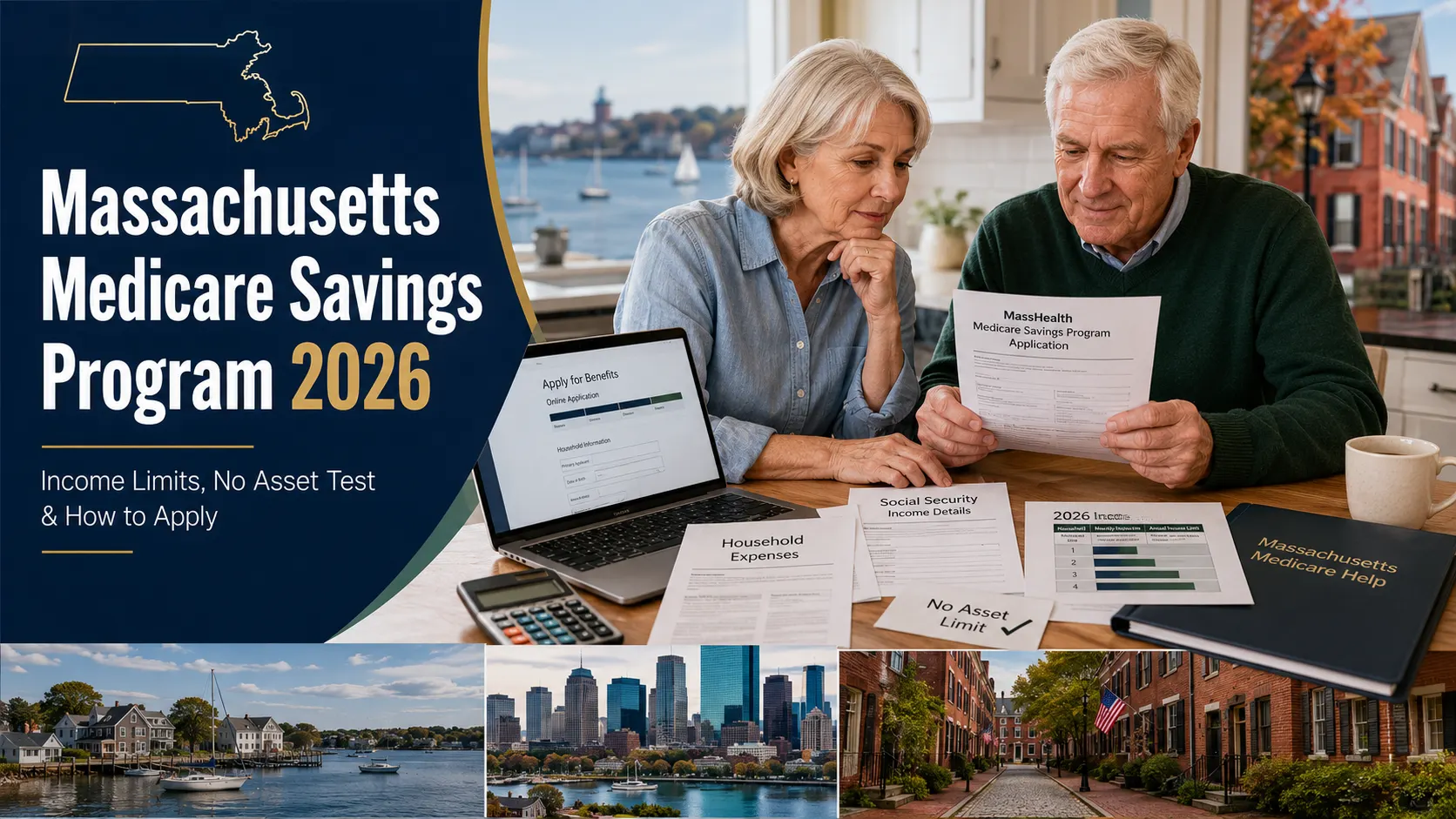
Massachusetts Medicare Savings Program Income Limits for 2026
The following monthly income limits are effective March 1, 2026. Massachusetts generally organizes its MSP benefits into two practical levels: QMB and SLMB/QI.
| Massachusetts MSP level | Individual monthly income | Married couple monthly income | Main assistance |
|---|---|---|---|
| QMB | Up to $2,527 | Up to $3,427 | Part A premium if owed, Part B premium and Medicare-covered cost-sharing |
| SLMB/QI | Above the QMB limit and up to $2,993 | Above the QMB limit and up to $4,058 | Medicare Part B premium |
| MSP asset limit | None | None | Savings and other assets are not used to impose an MSP resource ceiling |
The QMB ceiling is 190% of the federal poverty level. The maximum SLMB/QI ceiling is 225%. Massachusetts updates these amounts every year on March 1.
If your household has more than two people, or your income includes wages, self-employment, Veterans benefits, trust income, or other less common payments, ask MassHealth or SHINE for an individualized calculation.
No Asset Limit for Massachusetts MSP
Massachusetts eliminated the Medicare Savings Program asset limit on March 1, 2024. MassHealth does not impose an MSP eligibility ceiling based on the value of your savings, retirement account, investments, home, vehicle, life insurance, or burial funds.
What Each Massachusetts Medicare Savings Program Pays
| Benefit | QMB | SLMB/QI |
|---|---|---|
| Medicare Part A premium, if owed | Yes | No |
| Medicare Part B premium | Yes | Yes |
| Medicare deductibles, coinsurance and copayments | Yes, for Medicare-covered services | No |
| Health Safety Net enrollment | Yes | Yes |
| Automatic Medicare Part D Extra Help | Yes | Yes |
| MassHealth card used to show MSP status | QMB members should show Medicare and MassHealth cards | May not receive the same card-based cost-sharing protection |
QMB Provides the Broadest Protection
Qualified Medicare Beneficiary coverage may pay your Medicare Part B premium, a Part A premium if you owe one, and Medicare-covered deductibles, coinsurance, and copayments.
Doctors, hospitals, suppliers, pharmacies billing medical claims, and Medicare Advantage providers generally cannot bill a QMB member for Medicare-covered cost-sharing. This protection applies even when a provider does not participate in Medicaid.
QMB does not necessarily protect you from charges for services Medicare does not cover, optional upgrades, excluded items, or prescription copayments permitted under Part D.
SLMB and QI Pay the Part B Premium
If your countable income is above the QMB level but no more than 225% of the federal poverty level, MassHealth may approve SLMB or QI. These levels pay the Part B premium but do not provide QMB’s broad protection from Medicare deductibles and coinsurance.
QI is generally subject to annual federal funding and yearly renewal requirements. MassHealth determines whether a qualifying applicant is placed in SLMB or QI.
Health Safety Net and Extra Help Benefits
Health Safety Net
Massachusetts adds Health Safety Net access to both MSP levels. HSN may help pay for certain medically necessary services provided by Massachusetts acute-care hospitals and community health centers.
HSN is not a full insurance plan. It may act as a secondary payer or help with certain qualifying services. Hospitals and community health centers verify eligibility when processing bills, and HSN does not issue a separate member card.
Automatic Medicare Part D Extra Help
People approved for QMB, SLMB, or QI automatically qualify for Medicare Part D Extra Help. In 2026, Extra Help can provide a $0 deductible, a qualifying plan premium of $0, lower prescription copayments, and $0 covered-drug costs after the applicable annual threshold.
Read the official Medicare Extra Help cost guide for current drug copay amounts and plan rules.
Basic Massachusetts MSP Eligibility Requirements
MassHealth generally reviews whether you:
- Live in Massachusetts.
- Have Medicare or are eligible for the Medicare coverage required by the applicable MSP category.
- Meet citizenship, national-status, or qualified immigration rules that apply to the program.
- Have countable household income within the Massachusetts MSP ceiling.
- Provide spouse information when you are married and living together.
- Complete and sign the correct application.
You do not need to be enrolled in full MassHealth to receive an MSP. An MSP is limited help with Medicare expenses, although some people qualify for both MSP assistance and broader MassHealth coverage.
How to Apply for the Massachusetts Medicare Savings Program
MassHealth provides a short application specifically for people who primarily want help with Medicare premiums and cost-sharing. The official starting point is the Massachusetts Medicare Savings Program page.
| Application method | Where to start | Important record to keep |
|---|---|---|
| Electronic MSP form | Use the online application linked from the official Mass.gov MSP page | Electronic confirmation and a copy of the submitted form |
| Health Insurance Processing Center, P.O. Box 4405, Taunton, MA 02780 | Copy of the signed application and postal proof | |
| Fax | 857-323-8300 | Complete fax transmission report |
| In person | A MassHealth Enrollment Center or authorized application assister | Date-stamped receipt or copy |
| Telephone help | MassHealth Customer Service, 1-800-841-2900 | Representative name, date, and instructions provided |
Apply Online Through the Mass.gov MSP Page
MassHealth offers an electronic version of the short MSP application. The state says it can be completed and submitted using Adobe Acrobat, including the free Adobe Acrobat Reader.
- Open the official Mass.gov page for help paying Medicare costs.
- Go to the application section and choose the electronic form in your preferred language.
- Open the form with Adobe Acrobat or Adobe Acrobat Reader.
- Enter your identity, Massachusetts address, Medicare information, marital status, and household income.
- Report Social Security income before the Part B premium deduction.
- Provide information about a spouse who lives with you, even when only one spouse is applying.
- Review the certification and electronic signature sections carefully.
- Submit the form and save a complete copy and confirmation.
Gather the information you need before starting. If the electronic version cannot be completed successfully on your device, use the printable MSP application instead of repeatedly submitting incomplete forms.
Apply by Mail, Fax, or in Person
Mail the Application
Complete and sign the current Medicare Savings Programs application. Mail all required pages to:
MassHealth Application Mailing Address
Health Insurance Processing Center
P.O. Box 4405
Taunton, MA 02780
Use the exact address printed on the newest form or official MassHealth page. Keep a copy of the entire application. Tracked mail is optional but provides evidence of the submission date.
Fax the Application
Fax the completed, signed application to 857-323-8300. Keep the transmission report and verify that it shows every page was sent successfully.
Submit It in Person
MassHealth Enrollment Centers offer limited walk-in assistance, and appointments are encouraged. The current center list includes Charlestown, Chelsea, Springfield, Taunton, Tewksbury, Quincy, and Worcester.
Check the current MassHealth Enrollment Center locations and hours before traveling. Do not mail an application to a walk-in center unless MassHealth specifically directs you to do so.
Information to Prepare Before Applying
The short MSP application is simpler than a full long-term-care application, but you should still gather accurate household and income details.
Massachusetts does not use an MSP asset ceiling, so you do not need to spend down savings to meet an MSP resource test. MassHealth may still request documents when it cannot verify your identity, residency, income, Medicare status, or another application answer.
What Happens After You Apply?
MassHealth reviews the application and may verify information electronically. It may also send a Request for Information asking for documents or clarification.
- Check postal mail and any email address used on the application.
- Read the entire notice, including the response deadline.
- Send complete, readable copies of requested records.
- Include your name, date of birth, and application or member identification information.
- Keep upload, fax, mail, or hand-delivery proof.
MassHealth will issue a written decision that should identify whether you were approved, the MSP level, the effective date, and how to appeal if you disagree.
When Will the Part B Deduction Stop?
The Part B premium may continue to be deducted after approval while MassHealth, Medicare, and Social Security update their systems. Keep your approval notice and compare its effective date with later Social Security payments.
Massachusetts indicates that eligible members are reimbursed for Part B premiums paid for months covered by MSP eligibility. The system update and repayment can take several months, so do not rely on a specific refund date.
Can Coverage Start Before the Application Month?
MassHealth may consider retroactive eligibility for qualifying months under applicable Medicaid rules. The notice’s effective date controls. QMB and premium-only categories can have different federal timing rules, so applicants should not assume every MSP benefit automatically covers three prior months.
Renewal and Reporting Changes
MassHealth reviews MSP eligibility every year. It may renew coverage automatically when reliable information confirms continuing eligibility. Otherwise, it sends a Medicare Savings Programs Renewal Application.
Members age 65 or older may receive an e-Submission number that permits online renewal. Renewal can also be completed by telephone, mail, fax, or at a MassHealth Enrollment Center, depending on the notice.
- Return the exact renewal form MassHealth sends.
- Sign and date all required pages.
- Update household and gross-income information.
- Respond to any follow-up request by its deadline.
- Keep proof of submission.
Report changes to address, telephone number, email, income, or household members within 10 days. Use the official MassHealth renewal instructions or call customer service.
If the Application Is Denied
Read the eligibility notice before submitting another application. Common problems include:
- An unsigned application.
- Missing spouse or household information.
- Social Security income reported after the Part B deduction instead of before it.
- A missing response to a Request for Information.
- Incorrect Medicare or identity details.
- Use of an outdated Senior Buy-In form or old mailing address.
- Applying for only full MassHealth when the intended request was MSP assistance.
The notice should explain MassHealth fair-hearing rights, the filing deadline, and where the appeal must be sent. Follow the exact notice because deadlines and continued-benefit rules can depend on the decision and when the request is filed.
Free Massachusetts MSP Application Help
| Help needed | Official contact |
|---|---|
| MSP application, eligibility, renewal, or status | MassHealth Customer Service: 1-800-841-2900, TDD/TTY 711 |
| MassHealth service hours | Monday through Friday, 8 a.m. to 5 p.m.; automated self-service is available at other times |
| Free Medicare counseling and application help | SHINE: 1-800-243-4636 |
| SHINE TTY/ASCII | 1-800-439-2370 |
| QMB billing or Medicare issue | 1-800-MEDICARE: 1-800-633-4227 |
| Medicare TTY | 1-877-486-2048 |
| Health Safety Net billing questions | HSN Help Desk: 1-877-910-2100 |
SHINE provides free and unbiased Medicare counseling. Counselors can help screen for MSP eligibility, explain QMB billing protections, review notices, assist with an application, and explain Extra Help. They do not sell Medicare plans.
Massachusetts Medicare Savings Program FAQs
What are the Massachusetts MSP income limits for 2026?
Effective March 1, 2026, QMB allows monthly income up to $2,527 for one person or $3,427 for a married couple. The maximum SLMB/QI limit is $2,993 for one person or $4,058 for a couple.
Does Massachusetts have an MSP asset limit?
No. Massachusetts has not used an asset limit for Medicare Savings Programs since March 1, 2024. This no-asset-limit rule does not necessarily apply to full MassHealth or long-term-care programs.
Can MassHealth pay my Medicare Part B premium?
Yes. QMB, SLMB, and QI can pay the Medicare Part B premium for eligible Massachusetts residents.
Does QMB pay Medicare copays and deductibles?
QMB protects beneficiaries from Medicare-covered deductibles, coinsurance, and copayments. Medicare providers generally cannot bill a QMB member for these amounts.
Is MassHealth Buy-In the same as MSP?
MassHealth Buy-In, Senior Buy-In, and Buy-In are older Massachusetts terms for Medicare Savings Program assistance. Current materials generally use QMB and SLMB/QI.
Is an MSP the same as full MassHealth?
No. An MSP is limited assistance with Medicare costs. It does not automatically provide every benefit available under full MassHealth, although some people qualify for both.
How do I apply online?
Open the official Mass.gov page for help paying Medicare costs and choose the electronic Medicare Savings Programs application. MassHealth says the form can be completed and submitted using Adobe Acrobat or the free Adobe Acrobat Reader.
Where do I mail the application?
Mail the current signed application to Health Insurance Processing Center, P.O. Box 4405, Taunton, MA 02780, unless the newest form gives different instructions.
What is the MassHealth MSP fax number?
The current MassHealth application and renewal fax number is 857-323-8300. Keep the full fax confirmation report.
Will I receive a refund for Part B premiums taken after eligibility began?
MassHealth says eligible applicants are reimbursed for Part B premiums paid for covered months. The Medicare and Social Security update and repayment process may take several months.
Do MSP members receive Extra Help?
Yes. People approved for QMB, SLMB, or QI are automatically eligible for Medicare Part D Extra Help.
Does an MSP include Health Safety Net assistance?
Massachusetts includes Health Safety Net access with both QMB and SLMB/QI. HSN may help with qualifying services at Massachusetts acute-care hospitals and community health centers.
Do I have to renew the program?
Yes. MassHealth reviews eligibility every year. Some cases renew automatically, while others require a Medicare Savings Programs Renewal Application.
Who can help me apply for free?
Call MassHealth Customer Service at 1-800-841-2900 or SHINE at 1-800-243-4636. SHINE counseling is free and unbiased.
Start Your Massachusetts MSP Application
Massachusetts offers higher MSP income limits and no asset test. Do not assume that savings, a retirement account, or income above the basic national limits makes you ineligible.
Begin at the official Massachusetts Medicare Savings Program page. Complete the short application online or submit the current form by mail or fax. For free help, call SHINE at 1-800-243-4636.
Explore more state guides on the Medicare Savings Programs homepage, or read the previous article about the Arizona Medicare Savings Program for 2026.