Pennsylvania Medicare Savings Program 2026: Income Limits & How to Apply
Pennsylvania Medicare Savings Program Income Limits, Benefits and How to Apply
Pennsylvania Medicare Savings Programs may help eligible Medicare beneficiaries pay Medicare premiums and, through QMB, certain Medicare deductibles, coinsurance and copayments. Pennsylvania administers this help through the Department of Human Services.
Reviewed for 2026 Medicare limits and current Pennsylvania application routes
Independent educational resource: This website is not Medicare, CMS, Pennsylvania DHS, COMPASS, a County Assistance Office or a government application processor. Pennsylvania DHS makes final eligibility decisions. Approval, effective dates, premium adjustments and refunds are not guaranteed.
Quick Answer
In 2026, Pennsylvania residents with Medicare may qualify for QMB, SLMB or QI if their countable income and resources fall within the applicable limits and they meet other program rules.
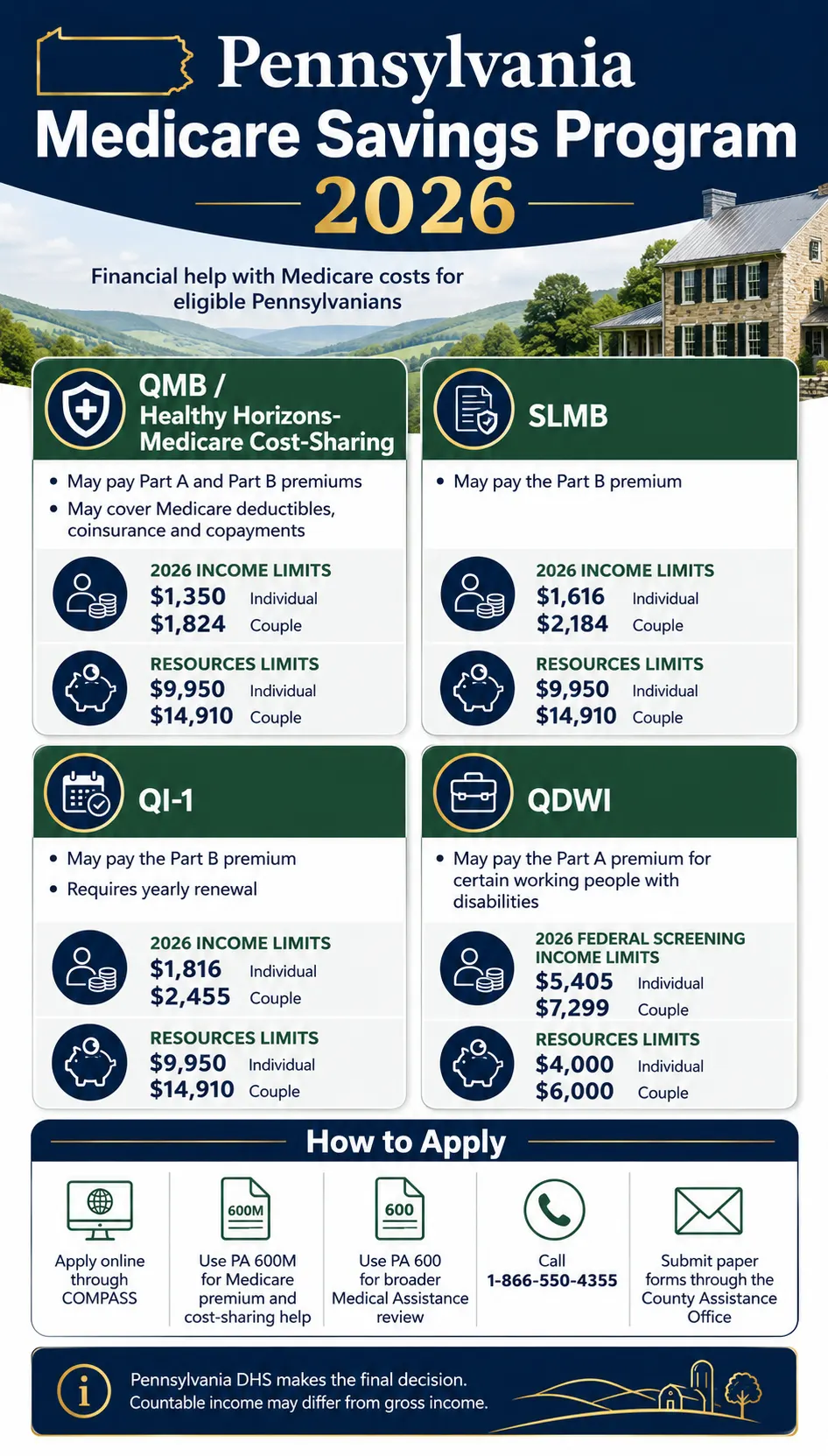
The 2026 federal screening limits used for QMB, SLMB and QI are $1,350, $1,616 and $1,816 per month for one person, with a $9,950 resource limit. For a married couple, the corresponding limits are $1,824, $2,184 and $2,455, with a $14,910 resource limit.
Pennsylvania accepts Medicare Savings Program applications through COMPASS and County Assistance Offices. The PA 600M is the state’s mail-in application for payment of the Medicare Part B premium.
Table of Contents
- What Pennsylvania MSPs are
- 2026 income and resource limits
- What QMB, SLMB, QI and QDWI may pay
- What resources may count
- How to apply in Pennsylvania
- How PA 600M works
- Documents to prepare
- What happens after applying
- Renewals and changes
- Denials and appeals
- Free Pennsylvania help
- Frequently asked questions
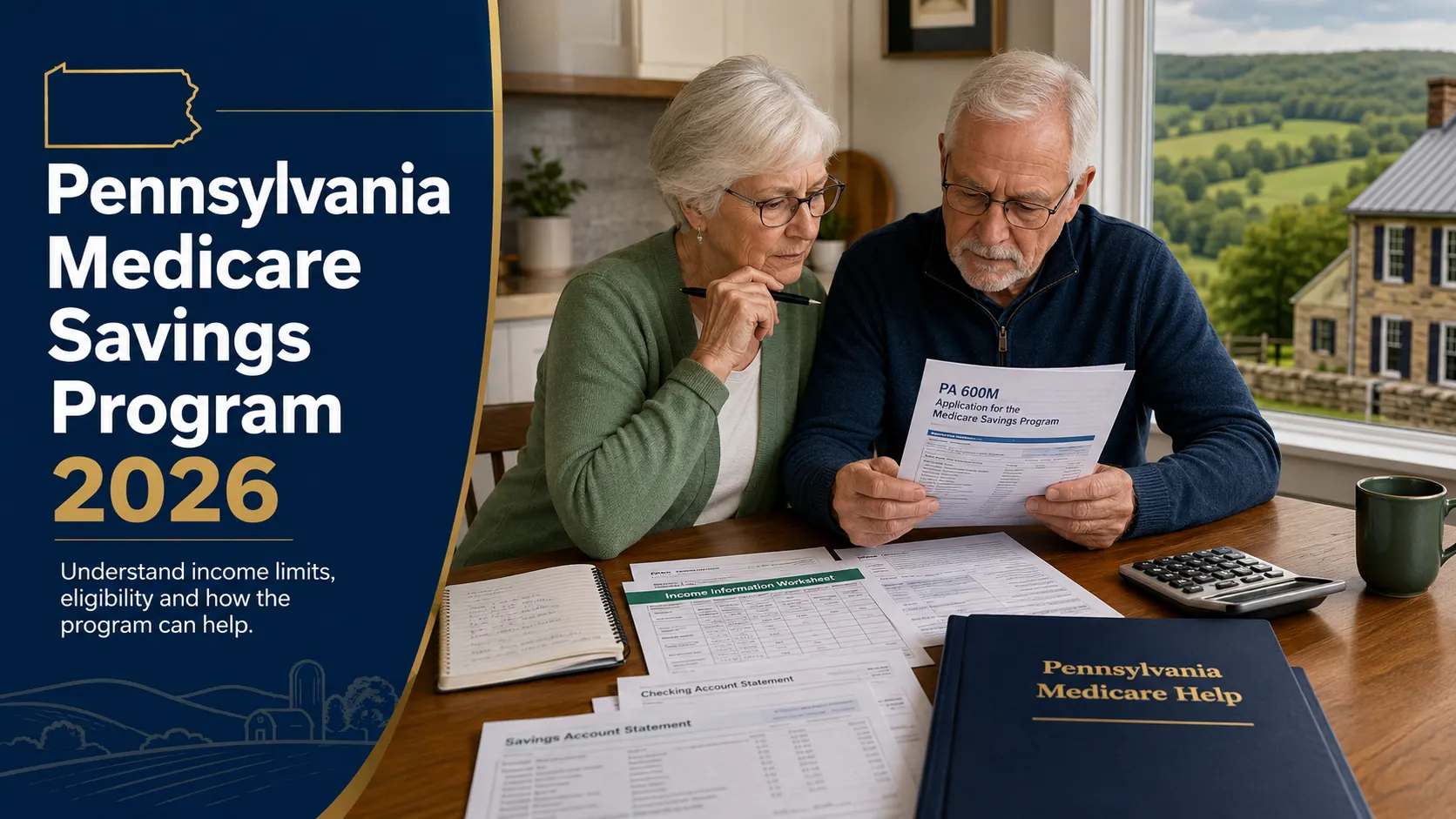
What Is a Medicare Savings Program in Pennsylvania?
Medicare Savings Programs are Medicaid-administered programs that can help people with limited income and resources pay certain Medicare costs. Pennsylvania’s Department of Human Services, or DHS, handles eligibility for these programs. You may also see Pennsylvania materials use terms such as Medicare Buy-In and Healthy Horizons.
The main Medicare Savings Program categories are QMB, SLMB, QI and QDWI. They do not all provide the same level of help. QMB can pay the broadest range of Medicare costs, while SLMB and QI primarily focus on the Medicare Part B premium. QDWI is a narrower program for certain working people with disabilities who lost premium-free Part A after returning to work.
For a general explanation before comparing Pennsylvania rules, read what a Medicare Savings Program is and our comparison of the four MSP types.
Who makes the decision? Pennsylvania DHS determines eligibility. Medicare.gov explains the federal program, but Medicare, an insurance plan, this website, or a private advertiser cannot approve a Pennsylvania MSP application.
Pennsylvania Medicare Savings Program Income Limits for 2026
The figures below are 2026 screening limits published by Medicare and reflected in Pennsylvania’s program guidance. Eligibility is based on countable income, not necessarily every dollar of gross income. Pennsylvania may apply deductions or exclusions when DHS calculates eligibility, so a person whose gross income looks slightly above a limit should not automatically assume they are ineligible.
| Program | Individual Monthly Income | Married Couple Monthly Income | Resources |
|---|---|---|---|
| QMB | $1,350 | $1,824 | $9,950 individual / $14,910 couple |
| SLMB | $1,616 | $2,184 | $9,950 individual / $14,910 couple |
| QI | $1,816 | $2,455 | $9,950 individual / $14,910 couple |
| QDWI | $5,405 | $7,299 | $4,000 individual / $6,000 couple |
Important: These figures are screening limits, not an approval calculator. DHS determines what income and resources count and whether all other requirements are met. Verify current limits with Pennsylvania DHS or Medicare before relying on them for an application.
Why Countable Income Can Differ From Gross Income
Medicare Savings Program rules allow certain income exclusions. Pennsylvania’s published QMB, SLMB and QI figures also reflect the standard $20 monthly income disregard used in the program calculations. This is one reason a person should submit an application rather than trying to make a final eligibility decision from a bank deposit total or Social Security benefit amount alone.
If you receive Social Security, pension income, wages, or another type of income, report it accurately on the application. Let DHS decide what is countable. Do not subtract expenses or exclusions yourself unless the official form specifically instructs you to do so.
What Do Pennsylvania QMB, SLMB, QI and QDWI Programs Pay?
The amount of help depends on the MSP category for which Pennsylvania finds you eligible.
| Program | Main Medicare Help | Key Point |
|---|---|---|
| QMB | Part A premium when owed, Part B premium, and Medicare-covered deductibles, coinsurance and copayments | Providers generally may not bill QMB beneficiaries for Medicare-covered Part A or Part B cost-sharing. |
| SLMB | Part B premium | You must have both Part A and Part B to qualify under the federal SLMB rules. |
| QI | Part B premium | QI requires annual application and is subject to available program funding. |
| QDWI | Part A premium only | Designed for certain working people with disabilities who lost premium-free Part A after returning to work. |
How Much Is the 2026 Medicare Part B Premium?
The standard Medicare Part B premium is $202.90 per month in 2026. If Pennsylvania pays that premium through QMB, SLMB or QI, the assistance can represent more than $2,400 over a full year at the standard premium amount. A person’s actual premium can differ, and the timing of state buy-in processing can affect when deductions change.
Read our separate guide on Medicare Part B premium help for a broader explanation of how the deduction may change after MSP approval.
QMB Billing Protection
QMB provides more than premium assistance. Federal Medicare rules prohibit Medicare providers from billing QMB beneficiaries for Medicare-covered Part A and Part B deductibles, coinsurance and copayments. If you are approved for QMB and receive an improper bill for Medicare-covered cost-sharing, do not assume you must pay it. Contact the provider, your plan if applicable, Medicare, or a qualified counselor for help correcting the billing issue.
What Resources May Pennsylvania Count?
Pennsylvania DHS says resources can matter for Medicare Buy-In programs. Examples of resources that may be counted include cash, checking accounts, savings accounts, certificates, stocks, bonds, some trust funds, life insurance, vehicles in some circumstances, revocable burial funds and non-resident real property.
Examples that Pennsylvania lists as not counted in certain Medical Assistance resource determinations include the home, burial reserves within applicable rules, burial space and marker, and one motor vehicle. Exact treatment can depend on the program and individual facts, so applicants should report resources as the form requires rather than making their own exclusions.
For QMB, SLMB and QI in 2026, Pennsylvania lists a resource limit of $9,950 for one person and $14,910 for two people. The federal QDWI resource limits are lower at $4,000 for one person and $6,000 for a married couple.
How to Apply for a Medicare Savings Program in Pennsylvania
Pennsylvania offers more than one application route. You can use the route that is most practical for you, but the final application must go through an official Pennsylvania channel.
Option 1: Apply Online Through COMPASS
COMPASS is Pennsylvania’s official benefits portal. It can be used to apply for health and human service programs and manage benefit information. If you choose the online route, enter your information carefully, report Medicare coverage, income and resources as requested, and save any confirmation provided after submission.
Because COMPASS covers multiple benefit programs, the online application may ask questions that go beyond a Medicare Savings Program. Do not assume that every question means you are applying for every benefit listed on the portal.
Option 2: Use the PA 600M Paper Application
Pennsylvania identifies PA 600M as the mail-in application for payment of the Medicare Part B premium. This shorter form is commonly used for Medicare Savings Program or Buy-In assistance. Complete the form using current information and follow its submission instructions.
A paper application can be useful if you prefer to keep a physical copy, want help from a counselor, or do not want to complete the longer COMPASS workflow. Keep a copy of the signed application and any documents you submit.
Option 3: Contact a County Assistance Office
Pennsylvania County Assistance Offices, often called CAOs, handle public-benefit eligibility work for DHS. You can contact the CAO serving your county for application instructions, document questions, case status issues or help understanding a DHS notice.
Do not mail an application to an address copied from an old blog or unofficial directory. Use the current Pennsylvania DHS office locator or the instructions on the current application form.
Option 4: Apply or Ask Questions by Phone
Pennsylvania DHS publishes the customer service number 1-866-550-4355 for benefits assistance. If you need unbiased Medicare counseling rather than a DHS eligibility decision, PA MEDI can help at 1-800-783-7067.
What Is Pennsylvania Form PA 600M?
PA 600M is Pennsylvania’s Mail-In Application for Payment for Medicare Part B Premium. It is part of the Pennsylvania PA 600 series of benefit applications. The form is intended to collect information DHS needs to evaluate Medicare premium assistance.
The form may ask about the applicant, spouse, Medicare coverage, income and resources. Answer the questions based on your actual circumstances. If a question is unclear, contact DHS or PA MEDI rather than guessing.
If you are seeking broader Medicaid coverage in addition to a Medicare Savings Program, DHS may direct you to a different or more complete Medical Assistance application. The PA 600M is not a substitute for every Pennsylvania Medicaid application.
Application safety: Submit Social Security numbers, Medicare information, financial records and other sensitive documents only through official Pennsylvania DHS channels. Do not send benefit documents to this website.
Documents to Prepare for a Pennsylvania MSP Application
DHS may need information to verify the details on your application. The exact documents can vary by household and program, but preparing common records can reduce delays.
Medicare, Identity and Residence Information
- Medicare card or other Medicare coverage information
- Government-issued identification when requested
- Social Security number for people applying when required by DHS
- Pennsylvania residence information
Income Records
- Social Security or Railroad Retirement information
- Pension or retirement income statements
- Recent wage information if working
- Other recurring income reported on the application
Resource Records
- Checking and savings account information
- Certificates of deposit, stocks, bonds or similar assets
- Retirement accounts if requested
- Information about non-home real property or other countable resources
If DHS asks for additional proof after you apply, respond by the deadline on the notice. If you cannot obtain a document immediately, contact the office handling the case and ask what alternatives are acceptable.
What Happens After You Apply?
After DHS receives the application, it reviews the information, verifies eligibility factors, and may request additional documents. The agency then issues a notice explaining the decision. Keep that notice because it may include the effective date, program category, appeal information and instructions for reporting changes.
When Will the Part B Deduction Stop?
Approval for QMB, SLMB or QI does not always make a Social Security deduction disappear immediately. Pennsylvania must transmit buy-in information through the federal Medicare system. Processing can take time. If you are approved but the Part B premium continues to be deducted, keep the approval notice and contact DHS, Social Security, Medicare or PA MEDI for help checking the status.
Do not treat a continued deduction during processing as automatic proof that your MSP was denied or cancelled.
Can Pennsylvania MSP Benefits Be Retroactive?
Retroactive treatment depends on the program and individual case. Pennsylvania counseling materials indicate that SLMB and QI benefits can include retroactive premium assistance for certain prior months, while QMB rules differ. The official DHS notice is the controlling source for your case. Do not rely on a general website date to calculate a refund or effective date.
Extra Help With Medicare Prescription Drug Costs
People who qualify for QMB, SLMB or QI generally receive Medicare Part D Extra Help automatically. Extra Help reduces prescription drug costs for eligible Medicare beneficiaries. The Extra Help program is separate from Pennsylvania’s MSP application process even though eligibility for certain MSP categories can trigger it automatically.
If prescription costs are a major concern, confirm your Extra Help status with Medicare or Social Security after the MSP decision is processed.
Does a Pennsylvania Medicare Savings Program Need to Be Renewed?
Eligibility must remain current. QI specifically requires an application each year under federal rules, and other MSP recipients may also go through Pennsylvania renewal or redetermination processes. Read every DHS renewal notice and respond by the stated deadline.
Report changes when Pennsylvania requires them. A change in income, resources, household circumstances, Medicare status or address can affect eligibility or communication from DHS.
See our general guide to Medicare Savings Program renewal for common renewal steps and document reminders.
What to Do if Pennsylvania Denies the Application
If DHS denies, reduces or ends MSP benefits, read the written notice carefully. It should explain the reason and provide information about appeal or hearing rights. Common issues can include missing verification, income or resources above the applicable limit, incomplete information, or a program-specific eligibility requirement.
Do not ignore a notice because you believe DHS made a mistake. Appeal and hearing deadlines can matter. If you disagree with the decision, follow the official instructions on the notice or contact a qualified Pennsylvania benefits counselor or legal-aid organization.
Our general article on a denied Medicare Savings Program application explains how to organize the notice, identify the stated reason and prepare questions for the agency.
Free Pennsylvania Medicare Savings Program Help
PA MEDI is Pennsylvania’s State Health Insurance Assistance Program. Its counselors provide free, unbiased Medicare information and can help people understand Medicare costs and programs that may reduce those costs. PA MEDI does not sell insurance products.
Pennsylvania DHS benefits help: 1-866-550-4355
PA MEDI Medicare counseling: 1-800-783-7067
Medicare: 1-800-MEDICARE (1-800-633-4227)
Official Pennsylvania and Federal Resources
- Pennsylvania DHS Medicaid for Older People and People with Disabilities
- Pennsylvania COMPASS
- PA MEDI Medicare Counseling
- Medicare.gov Medicare Savings Programs
- CMS 2026 Medicare Part A and Part B costs
Pennsylvania MSP Application Checklist
- Confirm that you are using an official Pennsylvania DHS or COMPASS application route.
- Gather Medicare, identity, income and resource information.
- Report income and resources accurately instead of trying to make your own final countability decision.
- Keep a copy of the application and proof of submission when possible.
- Respond promptly if DHS requests verification.
- Read the eligibility notice and save it for your records.
- If approved, allow time for Medicare premium deductions to update and ask for help if they do not.
- If denied, review the stated reason and appeal instructions before any deadline expires.
Pennsylvania MSP-Only Help Versus Full Medicaid
A Medicare Savings Program is connected to Medicaid administration, but getting an MSP does not always mean you receive the full set of Pennsylvania Medical Assistance benefits. This distinction matters because people sometimes assume that QMB, SLMB or QI automatically gives them the same coverage as full Medicaid.
In Pennsylvania, QMB cost-sharing assistance is also associated with the Healthy Horizons name. A person can receive Medicare cost-sharing help under QMB without necessarily qualifying for every full Medical Assistance benefit. Pennsylvania applies separate financial rules to some broader Medicaid categories. For example, the state publishes lower resource limits for certain full Medical Assistance groups than the $9,950 and $14,910 resource limits used for the main Medicare Buy-In categories.
If you already receive Medical Assistance, tell DHS about your Medicare coverage and ask whether your case includes Medicare Buy-In. If you are applying only because the Part B premium is difficult to afford, PA 600M or the Medicare Savings Program path may be the more focused route. If you also need broader Medical Assistance coverage, DHS may need additional information or a different application.
How to Use COMPASS Without Confusing MSP With Other Benefits
COMPASS is a multi-program portal. It is not a website dedicated only to Medicare Savings Programs. This means an applicant may see questions about household members, health coverage, income, resources and other benefits even when the main goal is Medicare premium assistance.
When using COMPASS, start with accurate household information and make sure Medicare coverage is reported. Enter gross income and resources where requested. If the system asks whether you are applying for Medical Assistance or health coverage, follow the current on-screen instructions and do not select unrelated programs just because they appear on the same website.
Before submitting, review names, dates, income amounts and contact information for obvious mistakes. After submission, save or print the confirmation page if one is provided. If DHS later sends a request for verification, use the upload or response method stated in the official notice. A COMPASS submission is not the same thing as an approval notice.
Common Pennsylvania MSP Application Mistakes
Assuming Gross Income Automatically Makes You Ineligible
The published MSP chart is a screening tool. DHS applies countable-income rules. A person should not automatically give up because a gross monthly amount appears slightly above a chart figure. Report the income and let DHS apply the official rules.
Leaving Out Accounts or Other Resources
For Medicare Buy-In programs, Pennsylvania still applies resource rules. Omitting a checking account, savings account or other requested resource can delay the case or create an accuracy problem. Report resources as requested even when you believe an exclusion may apply.
Using an Old Form or Unofficial Mailing Address
Government forms and office addresses can change. Use a current PA 600M or the current COMPASS route, and confirm where to send paper material through Pennsylvania DHS. An old PDF found in search results may not contain the latest instructions.
Sending Sensitive Documents to a Private Website
A Medicare Savings Program application may involve Social Security numbers, Medicare information and financial records. Those documents belong with Pennsylvania DHS through an official submission method. MedicareSavingPrograms.com is an educational publisher and does not accept, process or forward benefit applications.
Ignoring a DHS Verification Request
An application may be incomplete until requested evidence is provided. If DHS sends a notice asking for proof, note the due date and respond using the method stated in the notice. If the requested document is unavailable, contact the office instead of letting the deadline pass without explanation.
Expecting the Social Security Deposit to Change Immediately
There can be a gap between state approval and the federal systems reflecting Medicare premium buy-in. Keep the DHS notice and compare future Social Security or Railroad Retirement payment information. Ask DHS, Medicare, Social Security or PA MEDI for help if the premium deduction continues longer than expected.
Can You Have a Medicare Advantage Plan and Still Qualify?
Medicare Savings Program eligibility is not limited to people using Original Medicare. A Medicare beneficiary may have a Medicare Advantage plan and still potentially qualify for an MSP if the program requirements are met. The MSP helps with Medicare-related costs according to the applicable category; it does not make every extra Medicare Advantage service free.
If you have QMB and a Medicare Advantage plan, the federal QMB protection against billing for Medicare-covered Part A and Part B cost-sharing still matters. Questions about a specific plan bill should be reviewed with the plan, provider, Medicare or PA MEDI because the answer can depend on whether the service is Medicare-covered and how the claim was processed.
What If You Are Working?
Having earnings does not by itself mean you cannot qualify. Wages must be reported, and DHS applies the relevant income-counting rules. QDWI is specifically designed for certain people with disabilities who returned to work and lost premium-free Medicare Part A. QDWI has much higher income limits than QMB, SLMB and QI but lower resource limits.
If you are working and have Medicare because of disability, tell DHS or PA MEDI exactly what Medicare coverage you have and why you pay a Part A or Part B premium. This helps the counselor or eligibility worker identify which program rules may be relevant rather than assuming the standard retirement-age situation.
How Pennsylvania MSP Help Can Affect Late Enrollment Costs
PA MEDI notes that qualifying for a Medicare Savings Program can help with Medicare Part A and Part B costs and can affect certain late enrollment penalty situations. This is one reason people with limited income should ask for individualized counseling instead of assuming an old Part B penalty can never change.
Late enrollment rules are technical and depend on enrollment history. Do not cancel coverage or delay enrollment based only on a general article. PA MEDI or Medicare can review the specific enrollment dates and explain whether MSP eligibility changes the situation.
Pennsylvania Medicare Savings Program FAQs
Can I apply for a Pennsylvania Medicare Savings Program online?
Yes. COMPASS is Pennsylvania’s official online benefits portal and can be used for Medical Assistance-related applications.
What is Pennsylvania Form PA 600M?
PA 600M is Pennsylvania’s mail-in application for payment of the Medicare Part B premium and is commonly used for Medicare Savings Program or Buy-In assistance.
Where should I send a PA 600M application?
Follow the current PA 600M instructions or contact the County Assistance Office serving your county. Verify the current address through Pennsylvania DHS before mailing.
What is the QMB income limit in Pennsylvania for 2026?
The 2026 QMB screening limit is $1,350 per month for one person and $1,824 for a married couple. DHS determines countable income and final eligibility.
What is the resource limit for QMB, SLMB and QI in Pennsylvania?
Pennsylvania lists 2026 resource limits of $9,950 for one person and $14,910 for two people for the main Medicare Buy-In categories.
Can a Pennsylvania MSP pay my Part B premium?
Yes. QMB, SLMB and QI may pay the Medicare Part B premium for people Pennsylvania finds eligible.
Does QMB cover Medicare copayments and deductibles?
QMB generally protects beneficiaries from Medicare-covered Part A and Part B deductibles, coinsurance and copayments.
Can I own a home and qualify for a Pennsylvania MSP?
Possibly. Pennsylvania lists the home among resources that are not counted in certain Medical Assistance resource determinations. Report resources as required and let DHS apply the correct program rules.
What if my gross income is slightly above the MSP limit?
Applying may still be worthwhile because DHS uses countable-income rules and applicable exclusions. Report the requested income and let DHS calculate eligibility.
Is a Pennsylvania MSP the same as full Medicaid?
No. MSP-only assistance focuses on Medicare costs. Broader Pennsylvania Medical Assistance can have different eligibility rules and additional benefits.
How long does a Pennsylvania MSP application take?
Processing time depends on the case, verification needs and DHS workload. Follow official notices and contact the office handling the case for status information.
Will my Part B deduction stop immediately after approval?
Not always. State and federal records must update after approval. Keep the DHS notice and ask DHS, Medicare, Social Security or PA MEDI for help if the deduction continues.
Does MSP approval include Medicare Part D Extra Help?
QMB, SLMB and QI eligibility generally provides automatic eligibility for Medicare Extra Help with prescription drug costs.
Does a Pennsylvania Medicare Savings Program need to be renewed?
Eligibility must remain current. QI requires an application every year under federal rules, and other recipients should respond to Pennsylvania renewal or redetermination notices.
Final Takeaway
Pennsylvania’s Medicare Savings Programs can reduce Medicare costs for people who meet the applicable rules. QMB offers the broadest protection, while SLMB and QI focus mainly on the Part B premium. The safest next step is to use Pennsylvania DHS, COMPASS, a County Assistance Office or PA MEDI for current application help.
For more state-specific guides, visit our State Resources page. You can also return to the Medicare Savings Programs information center.
Use an Official Pennsylvania Application Route
This website does not process applications. Use Pennsylvania COMPASS or contact DHS for official application assistance.