California Medicare Savings Program 2026: Limits & Apply
California Medicare Savings Program Income Limits, Benefits and Application Steps
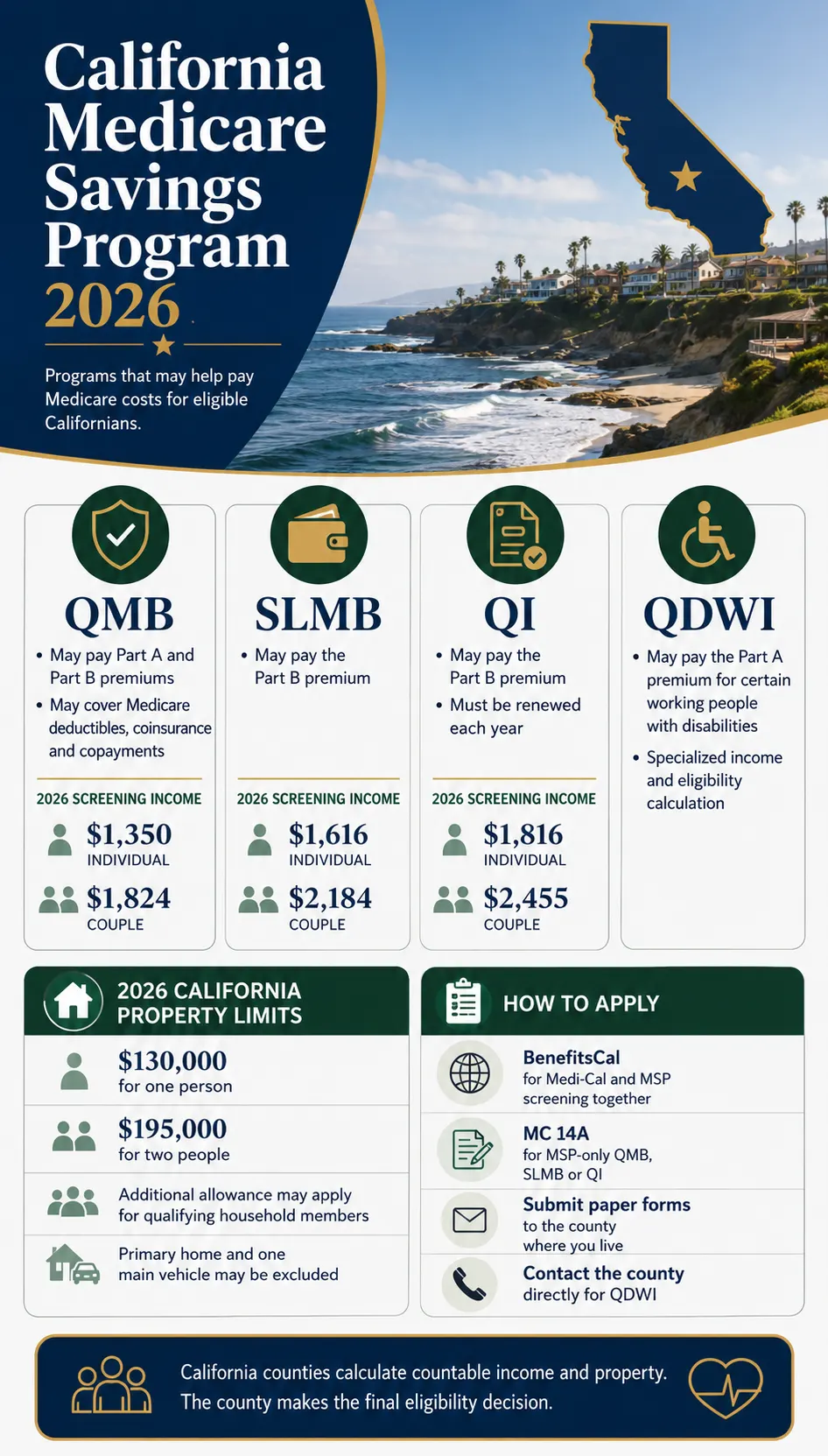
California Medicare Savings Programs may help eligible Medicare beneficiaries pay Medicare premiums and other out-of-pocket costs. QMB offers the broadest help, while SLMB and QI primarily pay the Medicare Part B premium.
Updated for 2026 California and federal program standards
Independent educational resource: This website is not Medicare, CMS, Medi-Cal, the California Department of Health Care Services, a county social services agency or a government application processor. Your California county makes the final eligibility decision. Approval, effective dates and premium refunds are not guaranteed.
Quick Answer
California residents with Medicare may qualify for QMB, SLMB, QI or QDWI based on Medicare status, countable income, resources and other program rules.
QMB may pay Medicare premiums and Medicare-covered deductibles, coinsurance and copayments. SLMB and QI generally pay the Part B premium. QDWI may pay the Part A premium for certain working people with disabilities.
Apply through BenefitsCal when seeking Medi-Cal and MSP screening together. For MSP-only QMB, SLMB or QI assistance, California provides Form MC 14A. Submit paper forms to the agency serving the county where you live.
Table of Contents
- What California MSPs cover
- 2026 income limits
- 2026 asset limits
- QMB, SLMB, QI and QDWI benefits
- MSP-only versus full Medi-Cal
- Apply through BenefitsCal
- Apply with Form MC 14A
- Documents to prepare
- Where to submit the application
- What happens after applying
- Denials and State Hearings
- Free official help
- Frequently asked questions
What Is a Medicare Savings Program in California?
A Medicare Savings Program, or MSP, is a Medicaid-administered program that may help a qualified Medicare beneficiary pay certain Medicare expenses.
In California, MSP benefits are administered through Medi-Cal and processed by county social services or human services agencies. California has 58 counties, and the county where an applicant lives generally handles the application, verification and eligibility decision.
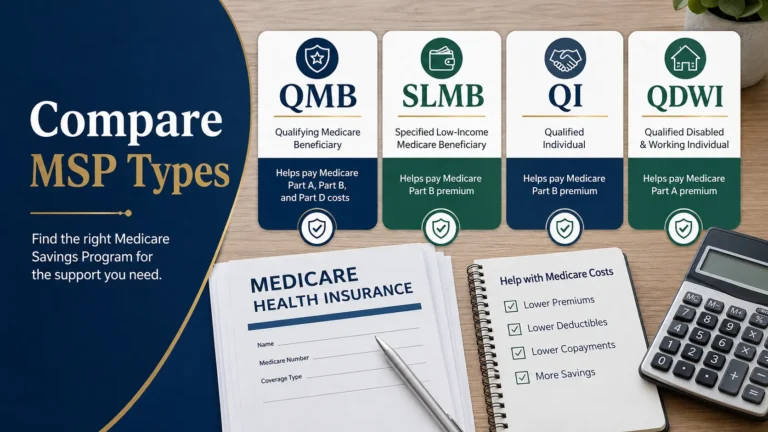
California offers four MSP categories:
- QMB: May pay Part A and Part B premiums and Medicare-covered deductibles, coinsurance and copayments.
- SLMB: Generally pays the Medicare Part B premium.
- QI: Generally pays the Part B premium for people whose countable income is above the SLMB level but within the QI limit.
- QDWI: May pay the Part A premium for certain working people with disabilities.
Your county determines which category, if any, fits your circumstances. You do not normally need to make the final category decision before applying.
For a basic explanation of these benefits, read our guide to what a Medicare Savings Program is. You can also use the Medicare Savings Programs information center to explore related application and eligibility topics.
California MSP Application Information at a Glance
| Situation | Recommended Official Route |
|---|---|
| Applying for Medi-Cal and MSP screening together | Apply through BenefitsCal or contact the county social services agency. |
| Applying only for QMB, SLMB or QI | Complete California Form MC 14A and submit it to the county MSP contact. |
| Seeking QDWI | Contact the county directly for the correct application and verification instructions. |
| Need free Medicare counseling | Contact California HICAP at 1-800-434-0222. |
There is no single statewide mailing address for every California MSP application. Use the current county contact information rather than copying an address from an old article.
California Medicare Savings Program Income Limits for 2026
The following figures are useful 2026 screening amounts. They include the standard $20 monthly general income disregard reflected in Medicare.gov’s published QMB, SLMB and QI limits.
| Program | Individual Monthly Income | Married Couple Monthly Income | Main Benefit |
|---|---|---|---|
| QMB | $1,350 | $1,824 | Part A premium when owed, Part B premium and Medicare-covered cost-sharing |
| SLMB | $1,616 | $2,184 | Part B premium |
| QI | $1,816 | $2,455 | Part B premium |
| QDWI | Up to $5,405 under the 2026 federal screening table | Up to $7,299 under the 2026 federal screening table | Part A premium for certain working people with disabilities |
These are screening amounts, not guaranteed gross-income cutoffs.
California counties calculate countable income under applicable MSP and Medi-Cal rules. Certain income may be excluded, and earned income, spouse allocations or other circumstances can change the result.
If your Social Security payment, pension or wages are slightly above a listed amount, do not automatically assume that you are ineligible. Report the requested gross income and allow the county to apply the correct exclusions.
Do not subtract the $20 disregard yourself when the form asks for gross income. The county completes the official calculation.
Official federal program benefits and 2026 screening amounts are available on the Medicare.gov Medicare Savings Programs page. California-specific poverty-level implementation information is published by the California Department of Health Care Services.
For additional context, see our explanation of Medicare Savings Program income limits.
Why Is the QDWI Income Limit Much Higher?
QDWI is a specialized program for certain working people with disabilities. Earned-income exclusions are built into its federal screening methodology, which is why its published screening amounts are substantially higher than a simple 200% federal poverty-level figure.
Do not compare gross wages only with a basic 200% FPL number and decide that you are ineligible. QDWI calculations are different from ordinary QMB, SLMB and QI screening.
California MSP Asset Limits for 2026
California restored property limits for non-MAGI Medi-Cal eligibility categories, including Medicare Savings Program cases, beginning January 1, 2026.
The general 2026 California limits are:
- $130,000 for one person
- $195,000 for two people
- An additional $65,000 for each additional qualifying household member, subject to California’s household-size rules
Household size matters: Not everyone living at the same address is necessarily included in the MSP property household. The county determines which spouse or family members are included under the applicable program rules.
QDWI is a specialized federal MSP category. Applicants seeking QDWI should ask the county to confirm which California property methodology applies to their specific case rather than relying only on the ordinary QMB, SLMB and QI property discussion.
Assets That May Count
The county may review resources such as:
- Cash
- Checking and savings accounts
- Certificates of deposit
- Stocks, bonds and investment accounts
- Additional vehicles
- Second homes and other real estate
- Certain trusts and financial arrangements
- Some retirement funds, depending on access and payment status
Assets Commonly Excluded
Common exclusions may include:
- The primary home where you live
- One principal vehicle
- Furniture and household goods
- Clothing and personal belongings
- Certain burial arrangements
- Certain retirement accounts when required or periodic payments are being received
Rules for trusts, jointly owned property, retirement accounts, real estate and spousal property can be complicated. Report each requested asset accurately and allow the county to decide whether it counts.
California’s current asset guidance is available through the official DHCS 2026 asset-limit guidance. You can also review our general guide to Medicare Savings Program resource limits.
How Much Could a California MSP Save?
The standard Medicare Part B premium is $202.90 per month in 2026.
A person who otherwise pays the full standard premium could receive potential premium assistance equal to:
- $202.90 per month
- $2,434.80 over 12 months
The actual financial effect depends on the premium you owe, your approved effective date and whether you have a late-enrollment penalty or income-related adjustment.
CMS publishes current premium and deductible figures on its 2026 Medicare Parts A and B costs fact sheet.
Premium deductions may continue temporarily after approval while California, Medicare and Social Security update their records. Do not treat the annual amount above as a guaranteed refund or payment.
California QMB, SLMB, QI and QDWI Benefits
QMB: The Broadest Medicare Cost Protection
The Qualified Medicare Beneficiary Program may pay:
- The Medicare Part A premium if you owe one
- The Medicare Part B premium
- Part A and Part B deductibles
- Medicare coinsurance
- Medicare copayments
QMB also provides federal billing protection. Medicare providers generally may not bill a QMB member for Medicare Part A or Part B cost-sharing on Medicare-covered services and items.
This protection applies even when a provider does not accept Medi-Cal or when California does not pay the full cost-sharing amount.
QMB does not necessarily cover a service that Medicare excludes. Compare a provider bill with the Medicare Summary Notice before assuming every charge is prohibited.
Read our detailed QMB Medicare Savings Program guide.
SLMB: Part B Premium Assistance
The Specified Low-Income Medicare Beneficiary Program generally pays the Medicare Part B premium.
SLMB does not normally pay Medicare deductibles, coinsurance or copayments. Its main benefit is stopping the Part B premium from being deducted from Social Security or billed directly by Medicare.
QI: Part B Help at a Higher Income Level
The Qualifying Individual Program also pays the Medicare Part B premium.
QI generally serves people whose countable income is above the SLMB limit but within the QI range. QI must be renewed each year and is subject to available program funding.
A person generally cannot receive QI while also receiving full Medicaid benefits. Prior-year recipients receive application priority under federal rules.
QDWI: Part A Premium Assistance
The Qualified Disabled and Working Individual Program may pay the Medicare Part A premium for certain people who:
- Have a qualifying disability
- Are working
- Lost premium-free Medicare Part A because they returned to work
- Meet the applicable income and resource requirements
- Meet the other QDWI eligibility conditions
QDWI does not pay the Part B premium, deductibles, coinsurance or copayments.
California’s MC 14A form is designed for QMB, SLMB and QI. Contact your county directly for the correct QDWI application procedure.
MSP-Only Assistance Versus Full Medi-Cal
An MSP is not automatically the same as full Medi-Cal.
MSP-only assistance focuses on Medicare expenses. Someone receiving QMB-only, SLMB or QI may not receive every service that is available through full Medi-Cal.
A person who qualifies for full Medi-Cal and an MSP may also receive benefits such as:
- Medi-Cal dental services
- Non-emergency medical transportation when covered
- Long-term services and supports when eligible
- Other Medi-Cal-covered healthcare services
Use MC 14A when you only want QMB, SLMB or QI assistance. Apply through BenefitsCal or your county if you also want to be considered for full Medi-Cal.
Our guide to Medicare Savings Programs versus Medicaid explains the difference.
How to Apply Online Through BenefitsCal
BenefitsCal is California’s online portal for Medi-Cal and other county-administered benefits.
This route is useful when you want the county to consider you for full Medi-Cal and Medicare Savings Program assistance together.
Step 1: Create or Access Your Account
A BenefitsCal account may allow you to:
- Save an unfinished application
- Upload requested documents
- Read notices
- Check case information
- Complete renewals or report changes
Keep a secure record of the email address and login information used.
Step 2: Select Medi-Cal
Start a health coverage application and clearly report that you already have Medicare.
Providing your Medicare information helps the county identify that you should also be screened for an MSP.
Step 3: Enter Household Information
Provide the requested information, including:
- Full legal name
- Date of birth
- California residential and mailing addresses
- Marital status
- Household members
- Social Security number when requested
- Medicare number and coverage information
Use the legal name and Medicare number shown on your Medicare card.
Step 4: Report Income
Report every requested income source, which may include:
- Social Security retirement or disability benefits
- Pensions
- Wages
- Self-employment income
- Veterans benefits
- Unemployment or disability payments
- Rental income
- Interest and dividends
- Other recurring payments
Enter gross income when the application requests gross amounts. Do not apply the $20 disregard or other exclusions yourself.
Step 5: Report Property and Assets
The application may ask about:
- Bank accounts and cash
- Investments
- Real estate
- Vehicles
- Retirement accounts
- Trusts and other financial arrangements
Report requested property even when you believe it is exempt. The county must decide how it is treated.
Step 6: Upload Documents
Before uploading, make sure:
- The entire document page is visible
- Names, dates and amounts are readable
- All statement pages are included
- Images are not blurred, dark or cropped
- File names identify the document clearly
Step 7: Review and Submit
Check names, income amounts, Medicare information, addresses and uploaded files before signing.
Save the submission confirmation and application number. Check BenefitsCal and postal mail for notices.
Apply for Medi-Cal and MSP Screening Together
Use California’s official benefits portal and report your Medicare coverage accurately. The county will determine which programs may apply.
How to Apply With California Form MC 14A
Use the official MC 14A Medicare Savings Program application when applying only for:
- QMB
- SLMB
- QI
MC 14A asks for information about the applicant, spouse, Medicare coverage, income and property.
Information Needed for MC 14A
Be prepared to provide:
- Full legal name
- Home and mailing address
- Telephone number
- Social Security number
- Medicare number
- Date of birth
- Marital status and spouse information
- Monthly income
- Bank accounts and other property
- Signature and date
Write “none” or “not applicable” when that is the correct answer. Leaving an important income or property section blank can result in a request for more information.
Where to Mail or Deliver MC 14A
Submit the completed form to the MSP contact for the county where you live.
The official 2026 California MSP County Contact List provides county agency names, addresses, telephone numbers and fax information when available.
Confirm the current address before mailing if the form has been saved for a long time or county procedures have changed. Keep a complete copy of the application and all supporting documents.
Applying for Full Medi-Cal and an MSP Together
Apply for full Medi-Cal if you want the county to consider you for broader Medi-Cal coverage as well as help with Medicare costs.
You may generally start the process:
- Online through BenefitsCal
- By telephone through the county
- By mail using the form identified by the county
- In person at a county office
California’s SAWS 1 form may be used to start a request for certain public benefits, but it may not contain all information needed to complete a Medi-Cal eligibility determination. Ask the county which full application and supplements are required for your circumstances.
Documents to Prepare
The county may not request every document from every applicant. Follow the form instructions and any later county notice.
Medicare, Identity and Residence Documents
- Medicare card
- Social Security number or requested verification
- Driver’s license or other identification when requested
- Proof of California residence
- Citizenship or immigration documentation when applicable and requested
Income Documents
- Social Security benefit letter
- Pension statement
- Recent pay stubs
- Veterans benefit statement
- Unemployment or disability payment records
- Self-employment income and expense records
- Proof of other recurring income
Asset Documents
- Complete checking and savings statements
- Certificate of deposit statements
- Investment account statements
- Information about additional real estate
- Trust documents
- Retirement account statements
- Vehicle information when requested
Send copies unless the county specifically requests an original. Complete account statements are generally more useful than screenshots because they show the owner, statement period and account details.
Where to Submit a California MSP Application
California’s county social services agencies process MSP applications. Submit the application to the county where the applicant lives.
Use the current DHCS MSP county contact list or the California county social services directory.
Before sending sensitive documents, confirm:
- The correct MSP mailing address
- Whether an attention line is needed
- Whether fax submission is accepted
- Whether documents can be uploaded through BenefitsCal
- Whether in-person delivery is available
- Whether an appointment is required
Keep a copy of the signed form, every attachment and the mailing, fax, upload or in-person receipt.
Free California MSP Application Help
California HICAP
The Health Insurance Counseling and Advocacy Program provides free and confidential Medicare counseling.
HICAP counselors can help with:
- QMB, SLMB, QI and QDWI questions
- Medicare and Medi-Cal coordination
- MSP application guidance
- County notices
- Medicare bills and QMB billing problems
- Extra Help with prescription costs
Call 1-800-434-0222 or use the California aging-services county locator.
Medi-Cal Helpline
Call 1-800-541-5555 for general Medi-Cal information. Your county normally handles the actual application, document requests and eligibility decision.
Medicare
Call 1-800-MEDICARE, 1-800-633-4227, for Medicare premium, coverage, claim and billing questions. TTY users can call 1-877-486-2048.
What Happens After You Apply?
The county reviews information such as:
- Medicare eligibility
- California residence
- Countable income
- Countable assets
- Household and spouse information
- Program-specific requirements
The county may send a request for additional proof. Respond by the deadline printed on the notice.
Do not assume that a document was received merely because it was mailed or uploaded. Keep proof. If the county requests the same document again, send another copy and retain the new confirmation.
The Notice of Action
The county sends a Notice of Action explaining whether the application was approved or denied.
An approval notice should identify:
- The approved MSP category
- The effective date
- Whether the person received MSP-only assistance or full Medi-Cal
- Renewal or reporting requirements
A denial notice should explain the reason, the information used and the applicant’s hearing rights.
When Does the Part B Deduction Stop?
After QMB, SLMB or QI approval, California sends eligibility information to federal systems. The Part B deduction may continue temporarily while Medicare and Social Security update their records.
Check:
- The effective date on the approval notice
- Your next Social Security payment
- Your BenefitsCal case information
- Any Medicare premium notice
Contact the county or HICAP if the deduction continues beyond the period shown on the approval notice. Do not immediately submit a duplicate application unless the county advises you to do so.
Can California MSP Coverage Apply to Prior Months?
QMB generally begins prospectively and does not offer the same prior-month coverage that may be available under SLMB or QI.
SLMB and QI may cover earlier eligible months under applicable federal and California rules. QDWI may also have retroactive eligibility rules.
Prior-month eligibility and premium reimbursement are not automatic. The county may require income and eligibility proof for each earlier month. The effective date on the Notice of Action controls.
Medi-Cal Share of Cost and MSP Eligibility
Having Medi-Cal with a share of cost does not automatically mean California is paying the Medicare Part B premium.
Contact the county if:
- Part B is still deducted from Social Security
- The Medi-Cal notice shows a share of cost
- You did not receive a separate MSP determination
- You have not been screened for QMB, SLMB or QI
Ask the eligibility worker to review MSP eligibility separately from the share-of-cost determination.
Extra Help With Prescription Drug Costs
People approved for QMB, SLMB or QI generally receive automatic eligibility for Medicare Extra Help with Part D costs.
Extra Help may reduce:
- Part D premiums
- Drug plan deductibles
- Prescription copayments
- Coinsurance for covered drugs
Check Medicare notices after MSP approval to confirm that Extra Help has been added.
What to Do About an Improper QMB Bill
Doctors, hospitals and other Medicare providers generally may not bill QMB members for Medicare Part A or Part B cost-sharing on Medicare-covered services.
- Confirm that QMB was active on the date of service.
- Compare the bill with the Medicare Summary Notice.
- Show the provider your Medicare and Medi-Cal or QMB documentation.
- Ask the billing department to verify QMB status.
- Request removal of prohibited Medicare cost-sharing.
- Contact HICAP or 1-800-MEDICARE if billing continues.
If you already paid prohibited Medicare cost-sharing, ask the provider for a refund.
Common California MSP Application Delays
Sending the Form to the Wrong County or Address
Use the current DHCS county contact list and submit the form to the county where you live.
“`
Missing Statement Pages
Send every requested page of a bank or investment statement, including pages that contain only account information.
Unreadable Uploads
Make sure names, dates, balances and document headings are clear and not cropped.
Leaving Financial Questions Blank
Write “none” or “not applicable” when accurate rather than leaving an important income or asset field unanswered.
Subtracting Deductions Yourself
Report the income amount requested by the form. Let the county apply the $20 disregard and other exclusions.
Failing to Report Medicare Coverage
Clearly report Medicare Part A and Part B so the county can screen the correct MSP category.
Missing a County Notice
Open county mail promptly and check BenefitsCal. Document requests normally contain deadlines.
Using an Unofficial Application Website
Official California MSP applications are free. Do not enter Social Security, Medicare or banking information on an unverified marketing or insurance website.
“`
What to Do if the Application Is Denied
Read the Notice of Action before completing a new application.
Check whether the denial resulted from:
- Incorrectly counted income
- An asset that may have been excluded incorrectly
- Missing verification
- An unsigned or incomplete application
- Unmatched Medicare information
- A missed document deadline
- Review under the wrong eligibility category
Contact the county and ask whether the case can be corrected. Provide copies of missing or updated records and keep proof of submission.
If you disagree with the decision and the county does not correct it, follow the State Hearing instructions on the Notice of Action.
California generally allows 90 days to request a State Hearing for a county or DHCS eligibility action. Certain Medi-Cal renewal-related hearings may have an extended period under current state policy. The notice and current hearing rules control.
You can review the official California State Hearing request page or call the State Hearings Division at 1-800-743-8525.
HICAP can help explain an MSP notice but does not make the eligibility decision or replace legal advice.
Our guide on what to do when a Medicare Savings Program application is denied provides a document-review checklist.
Do California Medicare Savings Programs Require Renewal?
Yes. MSP eligibility is reviewed periodically, and QI must be renewed each year.
The county may use information already available or may send a renewal form and request updated income, property or household information.
To reduce the risk of losing assistance:
- Keep your address and telephone number current
- Read every county notice
- Respond before the deadline
- Submit updated income and property proof when requested
- Save upload, fax or mailing confirmations
Use our Medicare Savings Program renewal guide to prepare for the review.
California and New York Use Different MSP Rules
QMB, SLMB, QI and QDWI are federal program categories, but state income methods, asset rules, portals and application procedures differ.
California uses Medi-Cal, county agencies, BenefitsCal and Form MC 14A. New York uses HRA in New York City and local social services districts elsewhere, and it does not apply an asset test to its commonly used QMB and QI categories.
For the latest state article in this series, read New York Medicare Savings Program 2026 income limits and application guidance.
Final California MSP Application Checklist
- ☐ Used BenefitsCal when seeking full Medi-Cal and MSP screening together
- ☐ Used MC 14A for an MSP-only QMB, SLMB or QI application
- ☐ Contacted the county for QDWI instructions
- ☐ Reported every requested income source
- ☐ Reported requested assets and property
- ☐ Attached clear copies of requested documents
- ☐ Signed and dated the application
- ☐ Confirmed the current county submission address
- ☐ Kept a complete copy
- ☐ Saved proof of submission
- ☐ Started checking BenefitsCal and postal mail for notices
California Medicare Savings Program FAQs
Can I apply for a California Medicare Savings Program online?
Yes. Use BenefitsCal when applying for Medi-Cal and Medicare Savings Program screening together. If you want only QMB, SLMB or QI, you may use California Form MC 14A and submit it to your county.
Where can I download California Form MC 14A?
Download MC 14A from the official California Department of Health Care Services website. The form is intended for MSP-only QMB, SLMB and QI applications.
Where should I mail MC 14A?
Submit MC 14A to the Medicare Savings Program contact for the county where you live. Use the current DHCS county contact list and verify the address before mailing.
Can I use MC 14A for QDWI?
MC 14A is intended for QMB, SLMB and QI. Contact your county social services agency for the correct QDWI application instructions.
Can a California MSP pay my Part B premium?
Yes. QMB, SLMB and QI may pay the Medicare Part B premium for eligible applicants. The county determines eligibility and the approved effective date.
Does QMB cover Medicare copayments?
QMB generally protects members from Medicare Part A and Part B deductibles, coinsurance and copayments for Medicare-covered services and items.
Can I own a home and qualify?
Possibly. The primary home where you live is generally excluded from California’s property calculation. Additional real estate may count, depending on the facts and applicable rules.
What if my gross income is slightly above the limit?
Applying may still be worthwhile. California counties apply countable-income rules, including the standard general disregard and other exclusions when applicable. Report the requested gross income and let the county calculate the case.
Can I deduct health insurance premiums from my income?
Do not subtract health insurance premiums yourself unless the application or county instructs you to do so. Report the requested income and premium information and allow the county to determine which deductions apply.
Is an MSP the same as full Medi-Cal?
No. MSP-only assistance focuses on Medicare premiums and, for QMB, Medicare cost-sharing. Full Medi-Cal may provide additional healthcare services when the person qualifies.
How long does a California MSP application take?
Processing time varies by county and case. Missing documents, unresolved income or property questions and verification requests can delay the decision. Check BenefitsCal and postal mail regularly.
Will the Part B deduction stop immediately?
Not always. California, Medicare and Social Security must update their records after approval. Keep the approval notice and contact the county if deductions continue beyond the approved period.
Does MSP approval include prescription assistance?
QMB, SLMB and QI approval generally provides automatic eligibility for Medicare Extra Help with Part D costs.
Does a California MSP need to be renewed?
Yes. MSP eligibility is reviewed periodically, and QI must be renewed each year. Respond to county renewal notices and requests for updated information.
Official California and Federal Resources
- Apply online through BenefitsCal
- California Medicare Savings Programs information
- Official MC 14A application
- 2026 California MSP county contact list
- California county social services directory
- California HICAP Medicare counseling
- California State Hearing requests
- Medicare Savings Programs at Medicare.gov
- Medicare Extra Help information
- CMS QMB billing protection
Final Takeaway
Use BenefitsCal when applying for full Medi-Cal and Medicare Savings Program screening together. Use MC 14A when applying only for QMB, SLMB or QI.
Submit paper applications to the MSP contact for the county where you live. Keep copies of the form and supporting documents, and respond promptly to county requests.
Do not reject yourself merely because gross income appears slightly above a published amount or because you own a home. California calculates countable income and property under program rules, and some income and assets may be excluded.
Use an Official California Application Route
Your county makes the final eligibility decision. Applying through official California channels is free, and approval is not guaranteed.