Virginia Medicare Savings Program 2026: Income Limits & How to Apply
Virginia Medicare Savings Program: Income Limits & How to Apply
Virginia Medicare Savings Programs may help eligible Medicare beneficiaries pay monthly premiums. QMB may also protect an eligible person from Medicare-covered deductibles, coinsurance and copayments.
Updated with Virginia’s January 2026 limits, Cardinal Care forms and Cover Virginia application routes
Independent educational resource: This website is not Medicare, Cover Virginia, Cardinal Care, the Virginia Department of Medical Assistance Services or a local Department of Social Services. Virginia makes the final eligibility decision. Approval, effective dates, premium adjustments and refunds are not guaranteed.
Quick Answer
Virginia processes Medicare Savings Program applications through Cardinal Care.
QMB, SLMB and QI may pay the Medicare Part B premium. QMB may also pay a Part A premium when owed and protect the beneficiary from Medicare-covered deductibles, coinsurance and copayments. QDWI may pay the Part A premium for certain working people with disabilities.
Apply online through CommonHelp, apply by phone through Cover Virginia, submit the current Cardinal Care paper application with Appendix D, or work with a local Department of Social Services.
Cover Virginia application line: 1-855-242-8282. TTY: 1-888-221-1590. Current application hours are Monday through Friday, 8 a.m. to 7 p.m.
Table of Contents
- Virginia Medicare Savings Program overview
- 2026 income and resource limits
- QMB, SLMB, QI and QDWI benefits
- Basic eligibility and countable resources
- How to apply
- Apply through CommonHelp
- Apply by phone
- Paper application and Appendix D
- Documents to prepare
- Submit requested documents
- What happens after applying
- Renewal and reporting changes
- Denials and appeals
- Free official help
- Frequently asked questions
What Is the Virginia Medicare Savings Program?
A Medicare Savings Program, or MSP, is a Medicaid-administered program that helps eligible people with Medicare costs. In Virginia, these limited-benefit programs are processed through Cardinal Care, the name used for Virginia Medicaid and FAMIS.
Virginia has four Medicare Savings Program levels:
- Qualified Medicare Beneficiary, or QMB
- Specified Low-Income Medicare Beneficiary, or SLMB
- Qualifying Individual, or QI
- Qualified Disabled and Working Individual, or QDWI
You do not need to select the correct category before applying. Report your Medicare coverage, household situation, income and resources. Virginia determines which program, if any, fits your circumstances.
For a general explanation, read our guide to what a Medicare Savings Program is. You can also visit the Medicare Savings Programs information center.
Virginia Medicare Savings Program Income Limits for 2026
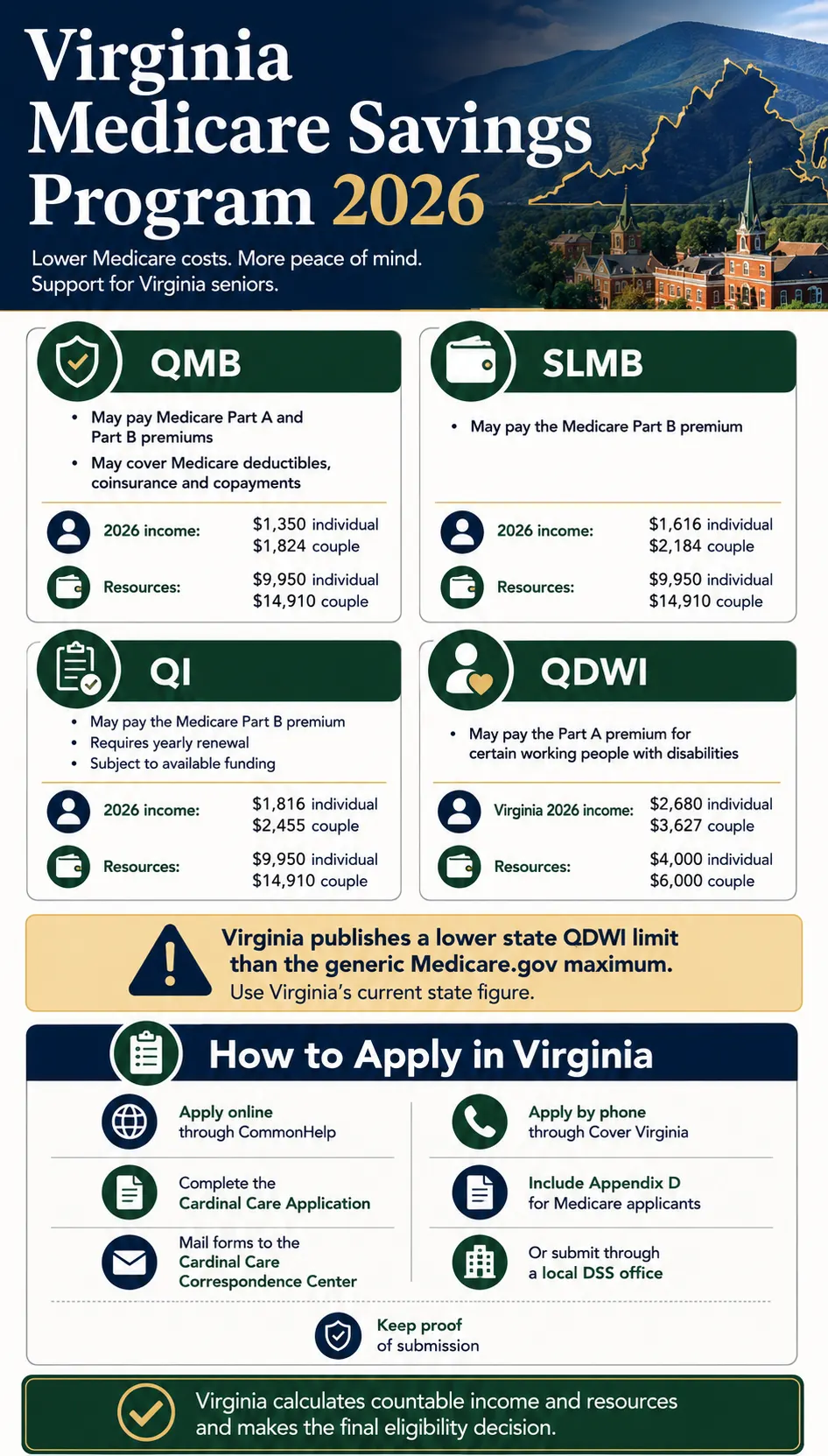
Virginia’s official 2026 aged, blind and disabled flyer lists the following monthly income and resource limits. The figures include the federal poverty amount plus the standard $20 unearned-income disregard.
| Program | Individual Monthly Income | Couple Monthly Income | Individual Resources | Couple Resources |
|---|---|---|---|---|
| QMB | $1,350 | $1,824 | $9,950 | $14,910 |
| SLMB | $1,616 | $2,184 | $9,950 | $14,910 |
| QI | $1,816 | $2,455 | $9,950 | $14,910 |
| QDWI | $2,680 | $3,627 | $4,000 | $6,000 |
Virginia-specific QDWI limit:
Virginia’s January 2026 flyer lists QDWI at 200% of the federal poverty level, which is $2,680 for one person and $3,627 for a couple after the standard $20 disregard. Use Virginia’s state figure when applying in Virginia rather than substituting a higher generic national maximum.
These are screening amounts, not a do-it-yourself eligibility calculation. Additional income and resource exclusions may apply depending on the type of income, asset ownership and applicant circumstances.
Do not subtract the standard $20 disregard yourself unless an application field specifically directs you to report countable income. Report the gross amount requested and allow Virginia to apply the rules.
Review the official Virginia 2026 aged, blind and disabled flyer.
Our related guides explain how MSP income limits work and which resources may count.
What Does Each Virginia Medicare Savings Program Pay?
| Program | Main Help | Important Rule |
|---|---|---|
| QMB | Part B premium, Part A premium when owed, and Medicare-covered deductibles, coinsurance and copayments | Provides federal QMB billing protection |
| SLMB | Medicare Part B premium | Does not provide QMB’s broader Medicare cost-sharing protection |
| QI | Medicare Part B premium | Must be renewed each year and is subject to available funding |
| QDWI | Medicare Part A premium for certain working people with disabilities | Does not pay the Part B premium or ordinary Medicare cost-sharing |
QMB Offers the Broadest Help
QMB may pay:
- The Medicare Part B premium
- The Medicare Part A premium when one is owed
- Medicare Part A and Part B deductibles
- Medicare coinsurance
- Medicare copayments for Medicare-covered services and items
Medicare providers and suppliers generally may not bill a QMB beneficiary for Medicare Part A or Part B cost-sharing on Medicare-covered services.
If a provider sends an improper bill:
- Confirm that QMB was active on the date of service.
- Compare the bill with the Medicare Summary Notice.
- Show the billing office proof of QMB status.
- Ask the provider to remove prohibited Medicare cost-sharing.
- Contact VICAP or 1-800-MEDICARE if the billing continues.
Read our detailed QMB Medicare Savings Program guide.
SLMB and QI Pay the Part B Premium
SLMB and QI generally pay the Medicare Part B premium. They do not ordinarily pay Medicare deductibles, coinsurance or copayments.
QI must be renewed every year. Funding is limited, and people who received QI in the prior year generally receive priority if they continue to qualify and complete the renewal process.
QDWI Pays a Part A Premium
QDWI is designed for a smaller group of people who:
- Have a qualifying disability
- Returned to work
- Lost Social Security disability cash benefits because of work activity
- Lost premium-free Medicare Part A because of work activity
- Meet Virginia’s QDWI financial and nonfinancial requirements
Virginia’s flyer uses the letters QWDI in one heading, but the standard federal program name is QDWI, Qualified Disabled and Working Individual.
Medicare Part D Extra Help
People approved for QMB, SLMB or QI generally receive automatic eligibility for Medicare Part D Extra Help.
In 2026, Extra Help may provide:
- A $0 qualifying Part D plan premium
- A $0 Part D deductible
- Generic-drug copays of no more than $5.10
- Brand-name drug copays of no more than $12.65
- $0 covered-drug costs after total drug costs reach $2,100
Some beneficiaries may pay lower amounts. Review the official Medicare Extra Help guide.
How Much Could Virginia MSP Save?
The standard Medicare Part B premium is $202.90 per month in 2026.
If QMB, SLMB or QI pays the full standard premium for 12 covered months, the potential premium assistance equals:
- $202.90 per month
- $2,434.80 over 12 months
The actual amount depends on the approved effective date and the premium owed. A late-enrollment penalty or income-related surcharge can make a person’s premium different from the standard amount.
Basic Virginia MSP Eligibility
Virginia generally reviews whether an applicant:
- Lives in Virginia
- Has or is eligible for the Medicare coverage required by the program
- Meets citizenship or eligible immigration rules
- Meets the program’s countable-income limit
- Meets the resource limit
- Meets any category-specific requirement
Someone may qualify for an MSP without qualifying for full Cardinal Care benefits. MSP-only coverage can be limited to Medicare premiums and cost-sharing.
What Resources May Virginia Ask About?
Appendix D asks the applicant and spouse to report resources and assets. Requested items include:
- Cash on hand
- Checking and savings accounts
- Credit-union and Direct Express accounts
- Certificates of deposit and money-market funds
- Stocks, bonds and mutual funds
- Retirement and deferred-compensation accounts
- Trusts, annuities, promissory notes and deeds of trust
- Life-insurance cash value
- Burial plots, burial arrangements and burial trusts
- Real estate and life-estate interests
- Vehicles, boats, trailers and recreational vehicles
- Business property
The home, a vehicle and certain burial or personal property may be excluded under applicable rules. Report what Appendix D requests and allow the eligibility worker to determine what counts.
How to Apply for the Virginia Medicare Savings Program
Virginia offers several application routes:
- Apply online through CommonHelp
- Apply by phone through Cover Virginia
- Mail a paper application to the Cardinal Care Correspondence Center
- Deliver a paper application to a local Department of Social Services
- Fax an application to a local DSS after confirming the correct fax number
- Work with an official application assister
| Application Route | Best For |
|---|---|
| CommonHelp | Applicants who can enter information and upload records online |
| Cover Virginia phone application | Applicants who prefer to answer application questions by phone |
| Paper application plus Appendix D | Applicants who prefer printed forms or help from a trusted person |
| Local DSS | Applicants needing local submission instructions or case assistance |
Option 1: Apply Online Through CommonHelp
Use the official Virginia CommonHelp portal.
CommonHelp is Virginia’s secure benefits portal. An account allows an applicant to return later, upload documents, check benefits and report changes.
Step 1: Start a Health Care Application
Choose the option to apply for benefits and select health care or medical assistance.
CommonHelp may not display a separate button labeled Medicare Savings Program. Report that you have Medicare and request evaluation for QMB, SLMB and QI.
Step 2: Enter Household and Medicare Information
Be prepared to report:
- Full legal name and date of birth
- Social Security number when required
- Virginia home and mailing addresses
- Spouse and household information
- Medicare number and Medicare coverage
- Other health insurance
- Citizenship or immigration information when applicable
Step 3: Report Income and Resources
Report all requested income, including Social Security, pensions, wages, self-employment income, veterans benefits, Railroad Retirement, interest, dividends and other regular payments.
Report the requested applicant and spouse resources. Do not omit an account merely because the balance is small or because you believe it should be excluded.
Step 4: Upload Available Proof
Upload clear, complete pages. A cropped image that does not show the account holder, statement date or balance may lead to another request.
Step 5: Submit and Save Confirmation
Review Medicare numbers, income, balances and contact information before signing.
Save:
- The confirmation page
- The application or tracking number
- The submission date
- A list of documents uploaded
Apply Online Through CommonHelp
Report that you have Medicare and request screening for Virginia’s Medicare Savings Programs.
Option 2: Apply by Phone Through Cover Virginia
Cover Virginia: 1-855-242-8282
TTY: 1-888-221-1590
Hours: Monday through Friday, 8 a.m. to 7 p.m.
Tell the representative:
“I already have Medicare and want to apply for help paying Medicare costs. Please screen me for QMB, SLMB and QI.”
Have your Medicare card, Social Security number, income information and approximate account balances nearby.
Before ending the call, ask for:
- Confirmation that an application was submitted
- The application date
- A confirmation or reference number
- The list of documents still required
- The deadline and submission method for those documents
Cover Virginia provides free language assistance and disability-accessible application support.
Option 3: Apply With Virginia Paper Forms
A Medicare beneficiary generally needs two documents:
- Virginia Cardinal Care Application
- ABD-LTC Application, Appendix D
Do not submit Appendix D by itself.
Cover Virginia states that Appendix D is not a stand-alone application. It must be submitted with the main Cardinal Care Application when someone applying is age 65 or older, has a disability, or is enrolled in or eligible for Medicare.
Use the official Cover Virginia applications page to obtain the current forms.
You can also open the current Virginia Appendix D.
What Appendix D Collects
Appendix D gathers information about:
- Marital and household status
- Medicare eligibility
- Disability information
- Cash and financial accounts
- Retirement funds, trusts and annuities
- Life insurance and burial arrangements
- Real property and vehicles
- Other income, including veterans benefits
- Help received from another person with bills
Appendix D dated July 22, 2025 is the current version linked by Cover Virginia at the time this guide was reviewed.
Where to Mail the Paper Application
Cardinal Care Correspondence Center
P.O. Box 1820
Richmond, VA 23218
Use the address printed on the current official application or Cover Virginia application page. Do not mail the application to the DMAS street address unless a current notice specifically tells you to do so.
Keep a complete copy and consider using tracked mail.
Submit Through a Local Department of Social Services
You may deliver the application to your city or county Department of Social Services.
Use the Virginia local social services locator.
Before visiting, confirm office hours, appointment requirements and document-submission procedures. Ask for a date-stamped copy or receipt.
Can You Fax a New Application?
Virginia guidance allows an MSP application to be faxed to a local DSS. Fax numbers differ by city or county.
Before faxing:
- Confirm the correct local benefits fax number.
- Ask whether the main application and Appendix D should be faxed together.
- Include a cover page with identifying information requested by the office.
- Keep the full transmission confirmation.
- Call the office to confirm that all pages were received and entered.
The statewide fax number used for requested verification documents should not automatically be used for a new application unless Cover Virginia or a notice directs you to use it.
Documents to Prepare
Virginia may verify some information electronically. The exact request depends on the application and available records.
Identity, Residence and Medicare
- Medicare card
- Social Security number or requested verification
- Full legal name and date of birth
- Proof of Virginia residence
- Citizenship or immigration documentation when applicable
- Other health-insurance information
Income Records
- Social Security benefit verification
- Pension or retirement statements
- Railroad Retirement information
- Veterans-benefit statements
- Recent pay stubs
- Self-employment income and expense records
- Interest or dividend documentation
- Proof of other regular payments
Resource Records
- Complete bank and credit-union statements
- Certificates of deposit
- Investment and retirement-account statements
- Annuity and trust records
- Life-insurance cash-value information
- Burial-fund or prepaid-burial records
- Information about real estate and vehicles
If a document is unavailable, explain that to Cover Virginia or the eligibility worker. Do not ignore a request or allow the deadline to expire without making contact.
How to Submit Verification Documents
When Virginia asks for additional information, use the method listed in the notice whenever possible.
| Method | Official Submission Information |
|---|---|
| Online | Upload through CommonHelp |
| [email protected] | |
| Fax | 1-888-221-9402 |
| Cardinal Care Correspondence Center, P.O. Box 1820, Richmond, VA 23218 | |
| In person | Local Department of Social Services |
Include the applicant’s name, date of birth and application or case number on each document. Keep the email confirmation, upload receipt, fax report or postal tracking number.
What Happens After You Apply?
Virginia reviews the application and may compare the information with electronic income, benefit and asset records.
Watch for communication through:
- Postal mail
- CommonHelp
- Telephone calls
- A local DSS worker
Respond by the deadline printed on every notice. Resend a document with the applicant’s identifiers when an earlier copy cannot be located.
What the Approval Notice Should Show
Keep the notice showing:
- The approved program
- The effective date
- Any prior months approved
- Renewal and reporting instructions
- Appeal rights
Virginia’s materials state that QMB beneficiaries receive a Medicaid card. SLMB and QI beneficiaries generally do not receive a Medicaid card because their coverage is limited mainly to premium assistance.
When Will the Part B Deduction Stop?
The deduction may continue temporarily after approval while Virginia, Medicare and Social Security update their records.
Keep the approval notice and compare its effective date with later Social Security payments. Contact Cover Virginia or the local DSS if deductions continue beyond the approved period.
Do not assume every deduction automatically creates a refund. Whether an adjustment is due depends on the approved program and effective date.
Virginia MSP Effective Dates
- QMB: Coverage begins after the end of the month in which the person is first determined eligible. QMB is not retroactive.
- SLMB and QI: Coverage may begin with the application month and may include up to three earlier months when every eligibility requirement was met.
Prior-month eligibility is not automatic. Virginia may request income and resource proof for each earlier month.
Renew Virginia Medicare Savings Program Coverage
Virginia Medicaid coverage must be renewed each year. QI also has a specific annual-renewal requirement.
Virginia may complete the renewal automatically if it has enough reliable information. Otherwise, it sends a renewal form that requires action.
Renewal options include:
- Online through CommonHelp by selecting Renew My Benefits
- By phone through Cover Virginia
- By mailing the completed renewal form
- In person through the local DSS
Keep the address, telephone number and email associated with the case current. Read every notice even when the Part B premium is already being paid.
Use our Medicare Savings Program renewal guide.
What to Do if Virginia Denies the Application
Read the denial notice before submitting another application.
Check whether the decision involved:
- Missing Appendix D
- An unsigned application or appendix
- Missing bank or income records
- Income calculated above the applicable limit
- Resources classified or valued incorrectly
- Incorrect Medicare information
- A missed verification deadline
- Evaluation under the wrong coverage category
Contact Cover Virginia or the local DSS and ask whether the record can be corrected. Send missing records and keep proof.
You have the right to appeal an action that denies, reduces or terminates Medicaid or FAMIS coverage. Follow the exact deadline and instructions in the notice.
Virginia accepts applicant appeals through:
- The DMAS AIMS appeals portal
- Email to [email protected]
- Telephone at 804-371-8488
- TTY at 1-800-828-1120
- Fax at 804-452-5454
- Mail or in-person delivery to the DMAS Appeals Division
Calling a caseworker or submitting a new application does not automatically file an appeal. Use the method stated in the notice.
Read our guide on what to do when a Medicare Savings Program application is denied.
Where to Get Free Virginia MSP Help
| Help Needed | Official Resource |
|---|---|
| Apply online | Virginia CommonHelp |
| Apply by phone or ask about an application | Cover Virginia: 1-855-242-8282 |
| TTY | 1-888-221-1590 |
| CommonHelp or general benefits assistance | Enterprise Call Center: 1-855-635-4370 |
| Find a local benefits office | Virginia Local DSS Locator |
| Free Medicare counseling | VICAP through a local Area Agency on Aging |
| National SHIP locator | 1-877-839-2675 |
| Medicare or QMB billing issue | 1-800-MEDICARE or 1-800-633-4227 |
| Medicare TTY | 1-877-486-2048 |
Virginia Insurance Counseling and Assistance Program
VICAP provides free, confidential and unbiased Medicare counseling through Virginia’s local Area Agencies on Aging.
A VICAP counselor can help explain:
- QMB, SLMB, QI and Extra Help
- Medicare and Cardinal Care coordination
- QMB billing protection
- Medicare notices and coverage dates
- Medicare appeals and complaints
VICAP counselors do not sell insurance and do not make the Cardinal Care eligibility decision.
Find local help through Virginia’s official Medicare counseling page.
Virginia and North Carolina Use Different Application Systems
The federal MSP categories are similar, but each state uses its own application system and terminology.
Virginia uses Cardinal Care, CommonHelp, Cover Virginia and Appendix D. North Carolina uses MQB terminology, NC ePASS and county DSS application procedures.
Read the previous article in this series: North Carolina Medicare Savings Program 2026 application guide.
Final Virginia MSP Application Checklist
- ☐ Used CommonHelp, Cover Virginia or the current official paper forms
- ☐ Clearly requested Medicare Savings Program screening
- ☐ Reported Medicare Part A and Part B information
- ☐ Completed the main Cardinal Care application
- ☐ Included Appendix D when applying on paper
- ☐ Reported applicant and spouse income
- ☐ Reported all requested resources
- ☐ Signed every required form
- ☐ Attached readable copies of available records
- ☐ Kept a complete copy of the submission
- ☐ Saved upload, telephone, mail, fax or delivery proof
- ☐ Started checking CommonHelp, mail and telephone messages for notices
Virginia Medicare Savings Program FAQs
Where do I apply online?
Apply through Virginia CommonHelp. Select health care or medical assistance, report that you have Medicare and request screening for QMB, SLMB and QI.
Can I apply by phone?
Yes. Call Cover Virginia at 1-855-242-8282, Monday through Friday from 8 a.m. to 7 p.m. TTY users can call 1-888-221-1590.
Which forms do I need for a paper application?
A Medicare beneficiary should generally submit the main Virginia Cardinal Care Application and Appendix D. Appendix D is not a stand-alone application.
Where do I mail the paper application?
Mail it to Cardinal Care Correspondence Center, P.O. Box 1820, Richmond, VA 23218. Confirm the address on the current official form before mailing.
Can I submit an application at a local social services office?
Yes. You may submit the application through your local Department of Social Services. Call first to confirm office hours and document-submission procedures.
Can I fax a new MSP application?
Virginia allows an MSP application to be faxed to a local DSS. Confirm the correct local fax number and whether all forms and documents should be sent together.
How do I send documents Virginia requests later?
Requested documents may be uploaded through CommonHelp, emailed to [email protected], faxed to 1-888-221-9402, mailed to the Cardinal Care Correspondence Center or delivered to a local DSS. Follow the method in the notice.
What are Virginia’s 2026 QMB limits?
Virginia lists QMB monthly income limits of $1,350 for one person and $1,824 for a couple, with resource limits of $9,950 and $14,910.
What are Virginia’s 2026 SLMB and QI limits?
Virginia lists SLMB at $1,616 for one person and $2,184 for a couple. QI is $1,816 for one person and $2,455 for a couple. Both use resource limits of $9,950 and $14,910.
What are Virginia’s 2026 QDWI limits?
Virginia’s 2026 flyer lists QDWI income limits of $2,680 for one person and $3,627 for a couple, with resource limits of $4,000 and $6,000.
Can QMB stop providers from billing me?
For Medicare-covered services, providers generally cannot bill a QMB beneficiary for Medicare deductibles, coinsurance or copayments. Show proof of QMB and ask the provider to correct the bill.
Can SLMB or QI cover earlier months?
Virginia may approve SLMB or QI for the application month and up to three previous months when all requirements were met. QMB is not retroactive.
Does a Virginia MSP include Extra Help?
QMB, SLMB and QI approval generally provides automatic eligibility for Medicare Part D Extra Help.
Does Virginia MSP coverage need to be renewed?
Yes. Virginia Medicaid coverage must be renewed each year, and QI has a specific annual-renewal requirement. Respond to every renewal notice by its deadline.
Apply Through the Method That Works for You
You do not need to understand every MSP rule before applying. Clearly report that you have Medicare, provide accurate income and resource information, and respond promptly when Virginia requests verification.
Apply online through CommonHelp, call Cover Virginia or submit the main Cardinal Care Application with Appendix D.
Use an Official Virginia Application Route
Virginia makes the final eligibility decision. Official application assistance is free, and approval is not guaranteed.