Indiana Medicare Savings Program 2026: Higher Income Limits
Indiana Medicare Cost Assistance Guide
Indiana Medicare Savings Program 2026: Higher Income Limits and How to Apply
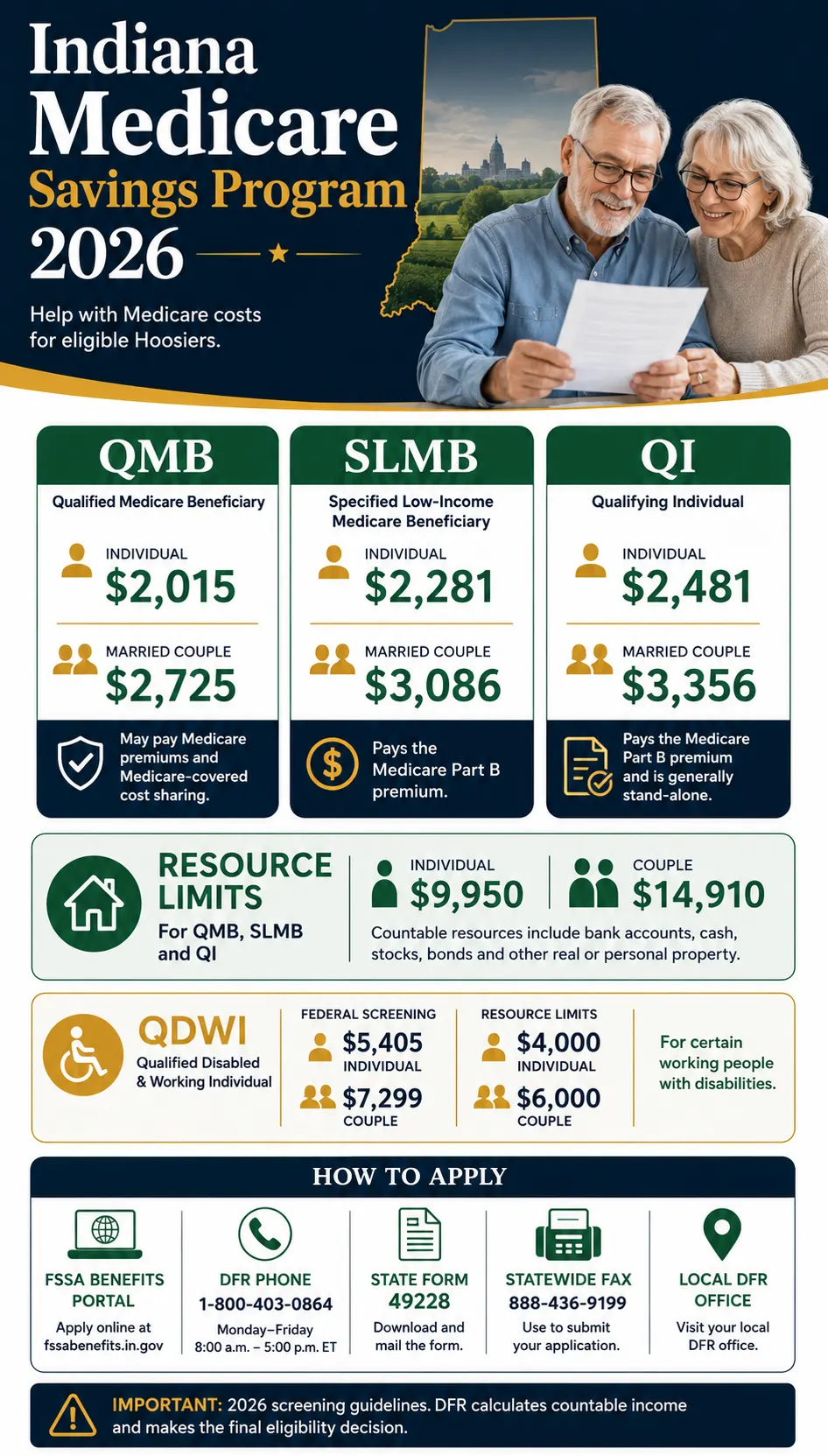
Indiana uses higher income limits than the basic federal figures shown on Medicare.gov. Eligible residents may receive help with the Medicare Part B premium and, under QMB, Medicare-covered deductibles, coinsurance and copayments.
Reviewed using 2026 Indiana SHIP, FSSA, DFR, Medicare and CMS information. Indiana’s Division of Family Resources makes the final eligibility decision.
Independent educational resource
This website is not Medicare, CMS, Indiana Medicaid, FSSA or another government agency. It does not process or approve applications. Use official state forms and follow the deadlines and instructions printed on your current DFR notice.
Quick Answer for Indiana Residents
Indiana Medicare Savings Programs are administered through the Family and Social Services Administration, or FSSA, and its Division of Family Resources, known as DFR.
- QMB may pay Medicare Part A and Part B premiums and Medicare-covered deductibles, coinsurance and copayments.
- SLMB pays the Medicare Part B premium.
- QI also pays the Medicare Part B premium.
- QDWI pays the Part A premium for certain working people with disabilities.
The standard Medicare Part B premium is $202.90 per month in 2026. Having the standard premium paid for a full year could provide up to $2,434.80 in annual premium assistance. Actual savings depend on the premium owed and the approved coverage period.
Table of Contents
- 2026 income limits
- What each program pays
- Resource limits
- Who may qualify
- Apply online
- Apply by phone
- Paper MSP form
- Fax or mail
- Apply in person
- Documents to prepare
- After applying
- Part B deduction and refunds
- Renewal
- Denial and appeal
- QMB billing protection
- Part D Extra Help
- Official help contacts
- FAQs
If Medicare costs are taking too much from your monthly budget, Indiana’s Medicare Savings Program may help. Indiana uses higher income limits than the basic figures shown on Medicare.gov, so you may still qualify even if a national chart makes your income appear too high.
Do not rule yourself out. Review the Indiana limits below, choose the easiest application method, and let DFR calculate your countable income and resources.
For general information, visit our Medicare Savings Programs educational resource. State rules differ. The latest state guide explains the Tennessee Medicare Savings Program and TennCare Connect application process.

Indiana Medicare Savings Program Income Limits for 2026
Indiana uses higher QMB, SLMB and QI income standards than the basic federal MSP chart.
| Program | Individual monthly income | Married couple monthly income | Resource limit |
|---|---|---|---|
| QMB | $2,015 | $2,725 | $9,950 individual $14,910 couple |
| SLMB | $2,281 | $3,086 | $9,950 individual $14,910 couple |
| QI | $2,481 | $3,356 | $9,950 individual $14,910 couple |
These are screening limits, not guaranteed eligibility amounts based only on gross income. Indiana DFR makes the final decision after calculating countable income, resources and household circumstances.
Indiana SHIP explains that:
- The first $65 of earned income may be excluded.
- Only half of remaining earned income may be counted after that exclusion.
- A general income disregard may also apply under the eligibility calculation.
Someone who works may therefore have gross income above the chart and still qualify. Apply rather than relying on a simple gross-income comparison.
Review the official Indiana SHIP 2026 Medicare cost-assistance limits. You can also read our guide to Medicare Savings Program income limits.
Indiana-specific warning: Do not use the lower national Medicare.gov QMB, SLMB and QI limits as the final Indiana eligibility test. Indiana publishes higher state income guidelines.
What about Indiana QDWI limits?
Indiana also recognizes the Qualified Disabled and Working Individual program. QDWI pays the Medicare Part A premium for certain people with disabilities who returned to work and lost premium-free Part A.
The federal 2026 QDWI screening limits are:
- Individual income: $5,405 per month.
- Married couple income: $7,299 per month.
- Individual resources: $4,000.
- Married couple resources: $6,000.
QDWI has additional disability, employment and Medicare Part A requirements. Call DFR at 1-800-403-0864 for an Indiana-specific screening.
What Does Each Indiana Medicare Savings Program Pay?
| Program | What it may pay | Can it accompany full Medicaid? |
|---|---|---|
| QMB | Part A premium if owed, Part B premium, and Medicare-covered deductibles, coinsurance and copayments | May be stand-alone or combined with qualifying full Medicaid coverage |
| SLMB | Medicare Part B premium | May be stand-alone or added to another qualifying Medicaid category |
| QI | Medicare Part B premium | Stand-alone only and generally cannot be combined with full Medicaid |
| QDWI | Medicare Part A premium | Stand-alone assistance for a limited group |
QMB provides the most complete Medicare cost assistance. Indiana Medicaid confirms that QMB and SLMB may be available either as stand-alone assistance or alongside certain broader Medicaid categories. QI and QDWI are stand-alone programs.
See the official Indiana Medicaid Medicare Savings Program description.
What Resources Count for Indiana MSP Eligibility?
Indiana applies a resource test to QMB, SLMB and QI. For 2026, the published limits are $9,950 for one person and $14,910 for a married couple.
Resources that may count include:
- Checking and savings accounts.
- Certificates of deposit.
- Stocks and bonds.
- Certain investment accounts.
- Cash value from some life-insurance policies.
Items that generally do not count include:
- The home where you live.
- Household belongings and furnishings.
- One vehicle.
- Burial plots.
- Certain burial funds, life-insurance amounts and annuitized retirement savings, depending on the applicable rules.
Do not assume that every account or insurance policy is countable. Ownership, accessibility, beneficiary designations and the type of resource can affect the decision.
Read our detailed Medicare Savings Program resource-limit guide.
Who May Qualify in Indiana?
You may qualify for an Indiana Medicare Savings Program if you:
- Live in Indiana.
- Have or are entitled to the Medicare coverage required for the MSP category.
- Meet the applicable countable-income standard.
- Meet the applicable resource limit.
- Meet citizenship or qualified immigration-status rules.
- Provide the information DFR needs to determine eligibility.
SLMB and QI generally require both Medicare Part A and Part B. QDWI has separate rules for certain people with disabilities who returned to work and must pay a Part A premium.
A spouse’s income and resources may be considered when a married applicant lives with their spouse. DFR should calculate the applicable household budget rather than requiring applicants to perform the calculation themselves.
See our guide explaining who may qualify for a Medicare Savings Program.
Are Indiana MSP rules statewide?
Yes. FSSA and DFR administer Indiana’s Medicare Savings Program throughout the state. The same program standards apply whether you live in Indianapolis, Fort Wayne, Evansville, South Bend or a rural county.
Each county has a DFR office for application support and document submission, but county location does not create a different income limit.
How to Apply Online Through the FSSA Benefits Portal
Use the official FSSA Benefits Portal and choose Apply Online for Health Coverage.
The portal can also be used to:
- Continue an unfinished application.
- Print a summary of a completed application.
- Review current benefits.
- View notices and correspondence.
- Upload requested documents.
- Report income, address or household changes.
- Print proof of eligibility.
- Complete a Medicaid redetermination or renewal.
Online application steps
- Open the FSSA Benefits Portal.
- Select Apply Online for Health Coverage.
- Create an account or follow the available instructions to begin an application.
- Enter the requested household, Medicare, income and resource information.
- Report that you have or are entitled to Medicare.
- Ask for help paying Medicare premiums and cost sharing.
- Review the application carefully.
- Submit the application.
- Save or print the confirmation page.
- Check the portal and regular mail for follow-up notices.
In a comments or additional-information field, you may write:
“I have Medicare and want to apply for the Medicare Savings Program. Please screen me for QMB, SLMB, QI and any other assistance for which I qualify.”
Creating a portal account does not by itself submit an application. Continue until you receive a submission confirmation.
Apply through Indiana’s official portal
Save the submission confirmation and respond promptly if DFR requests proof. Eligibility is not guaranteed until DFR completes its review.
Uploading requested documents
When DFR requests a complete bank statement, benefit letter or other document, upload every page, including pages that appear blank or contain only account terms.
Before uploading:
- Make sure the full page is visible.
- Check that names, dates, account numbers and dollar amounts are readable.
- Upload all pages of a multi-page document.
- Keep the original.
- Save any upload confirmation.
How to Apply by Phone
Call the Indiana Division of Family Resources at:
1-800-403-0864
Tell the representative:
“I have Medicare and want to apply for the Medicare Savings Program.”
Ask to be screened for QMB, SLMB and QI. Mention QDWI if you have a disability, returned to work and now have to pay a Medicare Part A premium.
Indiana permits health coverage applications by phone. The same number can be used to:
- Ask for application assistance.
- Check application status.
- Ask which documents are missing.
- Report changes.
- Get Benefits Portal technical support.
Will Indiana require an interview?
Indiana SHIP states that applicants may need to participate in an interview. The interview can take place in person or by telephone.
Answer calls and voicemail while the application is pending. If you miss a DFR call, contact 1-800-403-0864 and ask whether an interview or additional information is still needed.
How to Apply With Indiana’s Medicare Savings Program Paper Form
Indiana provides a shorter form specifically for QMB, SLMB and QI applications:
The official DFR forms page continues to list these applications for Medicare beneficiaries seeking help with Part B premiums, coinsurance and deductibles.
The form instructs applicants to complete both sides. If you do not understand a question, provide as much information as possible, complete the household section and sign the application.
Do not delay submitting a signed application solely because one supporting document is unavailable. DFR may request the missing proof after receiving the form.
For the most current links, check the official Indiana DFR forms page.
Form safety tip: Download the form from the live DFR forms page before applying. Confirm the current fax number and mailing instructions rather than relying only on an older saved copy.
How to Submit the Application by Fax or Mail
Fax the application
Indiana uses one DFR fax number for all counties:
888-436-9199
The current DFR forms page identifies this as the statewide number for submitting forms.
After faxing:
- Keep the original application.
- Save the fax transmission confirmation.
- Check that the correct fax number appears.
- Confirm that all pages were transmitted.
- Write your case number on every page if you already have one.
- Call DFR if the application does not appear in the system.
Mail the application
The current DFR forms page says forms may be mailed or delivered to the applicant’s local county DFR office.
Use the Indiana DFR county office locator to find the current local address.
The FSSA DFR contact page also lists this central mailing address:
FSSA Document Center
P.O. Box 1810
Marion, IN 46952
Because both a county-office route and central Document Center address appear in current state materials, the safest options are to:
- Fax the application to 888-436-9199.
- Deliver or mail it to the local DFR office shown in the current locator.
- Call 1-800-403-0864 to confirm the preferred address before mailing.
Keep a complete copy and use a mailing method that provides tracking when practical. Do not send your only Medicare card, identification document or bank statement.
How to Apply in Person at a DFR Office
Indiana has DFR offices throughout the state that assist with health coverage applications.
Official office hours are generally Monday through Friday, 8 a.m. to 4:30 p.m. local time. Call before visiting because individual-office access or service arrangements may change.
Applying in person may be useful when:
- You need help completing the application.
- You have several documents to submit.
- You received a confusing proof request.
- You cannot access the online portal.
- You want a receipt or date-stamped copy.
Bring copies of your documents and ask for proof showing when the application or verification was delivered.
Can an Extra Help Application Start an Indiana MSP Review?
Yes. When you apply for Medicare Part D Extra Help through Social Security, Social Security can send your information to Indiana to begin the Medicare Savings Program application process unless you ask Social Security not to transmit it.
This can be useful if you need both prescription drug assistance and Medicare premium help. However, Indiana may still request additional information before approving an MSP.
Watch for mail and phone contact from DFR. If you do not receive a state decision, apply directly through the FSSA Benefits Portal or call DFR.
Visit the official Social Security Extra Help application page.
What Information and Documents Should You Have Ready?
You do not need to assemble an oversized document file before starting, but it helps to have information about:
- Your Medicare card and Medicare coverage.
- Your Social Security number.
- Your Indiana home and mailing addresses.
- Social Security, pension, annuity and employment income.
- Self-employment income when applicable.
- Checking and savings accounts.
- Investments and other resources.
- Life-insurance information if requested.
- Other health insurance.
- Your spouse’s income and resources if you are married and living together.
DFR may request additional proof after reviewing the application. Respond by the deadline shown on the notice even when you believe the document was already submitted.
If you cannot obtain a requested document, contact DFR instead of ignoring the notice. Indiana’s MSP form says the agency may assist applicants who cannot obtain required information.
What Happens After You Apply?
Indiana SHIP states that an applicant should generally receive a written notice within 45 days explaining whether the MSP application was approved.
This is not a guaranteed completion date for every case. Processing may take longer when information is missing, verification is delayed or a disability determination or another complex issue is involved.
During processing:
- Watch your mail for DFR notices.
- Check your Benefits Portal account.
- Answer calls and voicemail from eligibility staff.
- Complete any required interview.
- Submit requested proof by the stated deadline.
- Keep copies of everything you send.
- Record your application and case numbers.
You can check the status through the Benefits Portal or by calling 1-800-403-0864.
When Will the Medicare Part B Deduction Stop?
Approval does not always change your next Social Security payment immediately.
Indiana must report the MSP approval through the Medicare buy-in process. Medicare and Social Security then update their records.
Indiana’s MSP form warns that it may take approximately three to four months for Social Security to stop withholding the Part B premium. Treat this as an estimate rather than a guaranteed processing period.
If premiums were deducted for months that Indiana later covers, an eligible beneficiary may receive reimbursement after the systems reconcile the account. The refund amount and delivery date are not guaranteed.
Keep your:
- DFR approval notice.
- Social Security payment records.
- Medicare premium notices.
- Bank statements showing continued deductions.
Contact DFR or Indiana SHIP if the deduction continues longer than expected.
How Does Indiana MSP Renewal Work?
Indiana health coverage eligibility generally must be reviewed periodically, commonly each year.
Indiana may attempt to renew eligibility automatically using available information. If DFR cannot complete the renewal automatically, it will send a notice or renewal form requesting information.
You may be able to manage renewal through:
- The FSSA Benefits Portal.
- A paper renewal or redetermination form.
- DFR phone assistance at 1-800-403-0864.
- Submission of requested documents through the portal, fax or local office.
QI beneficiaries should pay particular attention to annual renewal because QI generally requires a new eligibility determination each year and is subject to available program funding.
Report changes in address, phone number, household, income and resources promptly. Missing a renewal notice may cause a break in coverage.
See our Medicare Savings Program renewal guide.
What Should You Do if Indiana Denies the Application?
Read the entire denial notice. It should explain the reason for the decision and how to request an appeal.
Indiana SHIP states that an MSP applicant generally has 30 days from the denial to appeal. Follow the exact deadline and instructions printed on your current DFR notice.
A denial may result from:
- Missing income or resource verification.
- An account that was counted incorrectly.
- Incorrect household or marital-status information.
- Income deductions that were not applied.
- A document that was submitted but not matched to the case.
- An unsigned or incomplete application.
Take these steps:
- Identify the denial reason. Compare the notice with your application and documents.
- Call DFR. Ask how income and resources were calculated.
- Submit missing proof. Use the portal, statewide fax or local office.
- Request an appeal promptly. Follow the notice instructions.
- Keep proof. Save fax receipts, mailing records, uploads and appeal confirmations.
Indiana’s official Medicaid appeal page says eligibility appeals must follow the process described in the DFR notice. Review the Indiana Medicaid member appeal guidance.
Our Medicare Savings Program denial guide explains common correction and appeal steps.
Deadline warning: Submit an appeal before the date printed on your notice. Do not wait until every supporting document has been collected if the appeal deadline is approaching.
What if You Have QMB and Receive a Medical Bill?
Federal law prohibits Medicare providers and suppliers from billing a QMB beneficiary for Medicare Part A or Part B deductibles, coinsurance and copayments for Medicare-covered services and items.
If you receive a bill:
- Do not ignore it.
- Check that QMB was active on the date of service.
- Confirm that Medicare covered the service.
- Tell the provider’s billing office that you were enrolled in QMB.
- Show your Medicare and Indiana Medicaid or QMB information.
- Ask the office to correct the account and stop collection activity for protected cost sharing.
- Contact Medicare or Indiana SHIP if billing continues.
1-800-MEDICARE: 1-800-633-4227
Medicare TTY: 1-877-486-2048
If you already paid prohibited QMB cost sharing, ask the provider whether a refund or account correction is required.
QMB does not make every service free. You may still owe for non-covered care, permitted prescription charges or services Medicare properly denied.
Review the official CMS QMB billing-protection guidance and our QMB Medicare Savings Program guide.
Does Indiana MSP Approval Include Medicare Part D Extra Help?
People approved for QMB, SLMB or QI generally qualify automatically for Medicare Part D Extra Help.
In 2026, Extra Help can provide:
- A $0 Part D plan premium for a qualifying plan priced at or below the benchmark amount.
- A $0 Part D deductible.
- Copays of no more than $5.10 for each covered generic drug.
- Copays of no more than $12.65 for each covered brand-name drug.
- $0 for covered drugs after total drug costs reach $2,100 in 2026.
A person with full Medicaid and QMB may have a lower maximum prescription copay. Exact charges depend on Medicaid status, the prescription and the selected drug plan.
A plan priced above the applicable Extra Help benchmark may still charge part of its premium.
QDWI by itself should not be assumed to provide automatic Extra Help. Ask Indiana SHIP or Social Security whether a separate Extra Help application is appropriate.
Review the official Medicare Extra Help costs for 2026.
Is MSP-Only Coverage the Same as Full Indiana Medicaid?
No. An Indiana Medicare Savings Program can be approved as limited Medicare cost assistance without full Medicaid health coverage.
| Coverage type | General purpose |
|---|---|
| QMB-only | Medicare premiums and Medicare-covered cost sharing |
| QMB with full Medicaid | Medicare cost assistance plus broader qualifying Medicaid coverage |
| SLMB-only | Medicare Part B premium assistance |
| SLMB with full Medicaid | Part B premium help plus another qualifying Medicaid category |
| QI | Stand-alone Part B premium assistance |
Indiana PathWays for Aging, Hoosier Care Connect, MED Works and Medicare Advantage Dual Eligible Special Needs Plans serve different purposes. Enrollment in one is not automatically the same as MSP approval.
If you need broader Medicaid benefits, ask DFR to review you for full Medicaid and every applicable Medicare Savings Program.
Read our MSP versus Medicaid comparison.
Does Indiana Medicaid Estate Recovery Apply?
Indiana’s public estate-recovery guidance states that the state may seek recovery of certain Medicaid payments after a recipient’s death, particularly for payments made after age 55 and in other limited circumstances.
The public guidance does not provide a simple MSP-only exception that should be assumed for every person. Someone receiving only premium assistance may have a different situation from a person receiving full Medicaid, managed care or long-term services.
Do not make estate-planning decisions based on a general article. Review the official Indiana Medicaid estate-recovery guidance and request case-specific advice about the coverage you receive.
Where Can You Get Free Official Help in Indiana?
| What you need | Official resource |
|---|---|
| Apply online or manage benefits | FSSA Benefits Portal |
| Apply, check status or report changes | DFR: 1-800-403-0864 |
| Submit forms by fax | 888-436-9199 |
| Find a county office or mailing address | Indiana DFR office locator |
| Download the MSP application | Indiana DFR forms |
| Free Medicare and MSP counseling | Indiana SHIP: 1-800-452-4800 |
| Indiana SHIP TDD | 866-846-0139 |
| Local aging-services help | Area Agency on Aging: 1-800-986-3505 |
| Medicare or QMB billing questions | 1-800-MEDICARE: 1-800-633-4227 |
| Medicare TTY | 1-877-486-2048 |
Indiana SHIP provides free, objective and confidential Medicare counseling. Its counselors can help explain MSP eligibility, application notices, Part B premium problems, Extra Help and QMB billing protection. SHIP does not sell insurance.
Need free help before applying?
Contact Indiana SHIP for Medicare counseling or DFR for an official eligibility application. Neither organization can guarantee approval before DFR completes its review.
Indiana Medicare Savings Program FAQs
Does Indiana use the basic Medicare.gov income limits?
No. Indiana publishes higher 2026 income guidelines for QMB, SLMB and QI. DFR calculates countable income and makes the final eligibility decision.
What are Indiana’s 2026 MSP resource limits?
For QMB, SLMB and QI, Indiana lists resource limits of $9,950 for one person and $14,910 for a married couple. A primary home, one vehicle and certain other property generally do not count.
Where can I apply online?
Apply through the FSSA Benefits Portal and select Apply Online for Health Coverage. Save the final submission confirmation.
Can I apply for Indiana MSP by phone?
Yes. Call Indiana DFR at 1-800-403-0864 and ask to apply for the Medicare Savings Program.
Which paper application should I use?
Use State Form 49228, Application for Medicare Savings Program, for QMB, SLMB and QI. The Spanish application is State Form 49921.
Where should I fax the application?
Fax it to Indiana’s statewide DFR fax number, 888-436-9199. Keep the successful transmission confirmation.
Where should I mail the application?
The current DFR forms page says forms may be mailed or delivered to the local county office. The DFR contact page also lists the FSSA Document Center in Marion. Use the county locator or call 1-800-403-0864 before mailing if you are uncertain.
Can QMB pay doctor and hospital cost sharing?
QMB covers Medicare deductibles, coinsurance and copayments for Medicare-covered services. Medicare providers generally may not bill QMB beneficiaries for those protected amounts.
Can QI be combined with full Medicaid?
Generally, no. Indiana identifies QI as a stand-alone Medicare Savings Program that cannot be open with another full Medicaid coverage category.
Should I apply if my gross income is slightly over the limit?
Yes. Indiana applies income exclusions, including deductions for earned income. DFR should calculate your countable income and make the official decision.
Conclusion
Indiana residents should not rely only on the lower federal Medicare.gov income chart.
For 2026, Indiana publishes monthly screening limits of:
- $2,015 for one person or $2,725 for a couple under QMB.
- $2,281 for one person or $3,086 for a couple under SLMB.
- $2,481 for one person or $3,356 for a couple under QI.
Indiana still applies resource limits, but it does not count every type of income or property.
The fastest route for many applicants is the FSSA Benefits Portal. You may also call 1-800-403-0864, fax State Form 49228 to 888-436-9199, or submit the application through a local DFR office.
If your income is close, apply anyway. An approval may stop the standard Part B premium deduction, provide prescription drug Extra Help and, under QMB, protect you from Medicare-covered deductibles, coinsurance and copayments.
Apply through an official Indiana channel
Gather your available Medicare, income and resource information, submit the application and keep proof. Indiana DFR determines eligibility and the approved coverage period.
Editorial disclaimer: This article provides general educational information and is not legal, financial or benefits advice. Income standards, resource limits, forms and contact information may change. Check the current official Indiana form, FSSA website and DFR eligibility notice before acting. Indiana DFR makes the final eligibility decision.