New Mexico Medicare Savings Program 2026: QMB, SLIMB, QI1 Income Limits & How to Apply
Medicare Savings Program New Mexico guidance can be confusing because the state uses its own terminology and eligibility rules. New Mexico Medicare Savings Programs may help eligible Medicare beneficiaries pay Medicare premiums and, through QMB, protect them from many Medicare-covered deductibles, coinsurance and copayments.
Independent educational resource
This website is not Medicare, CMS, Social Security, the New Mexico Health Care Authority or another government agency. We do not process or approve applications. Income rules, Medicare status and other eligibility requirements apply. HCA’s Income Support Division makes the official Medicaid and Medicare Savings Program eligibility determination.
New Mexico Terminology to Know
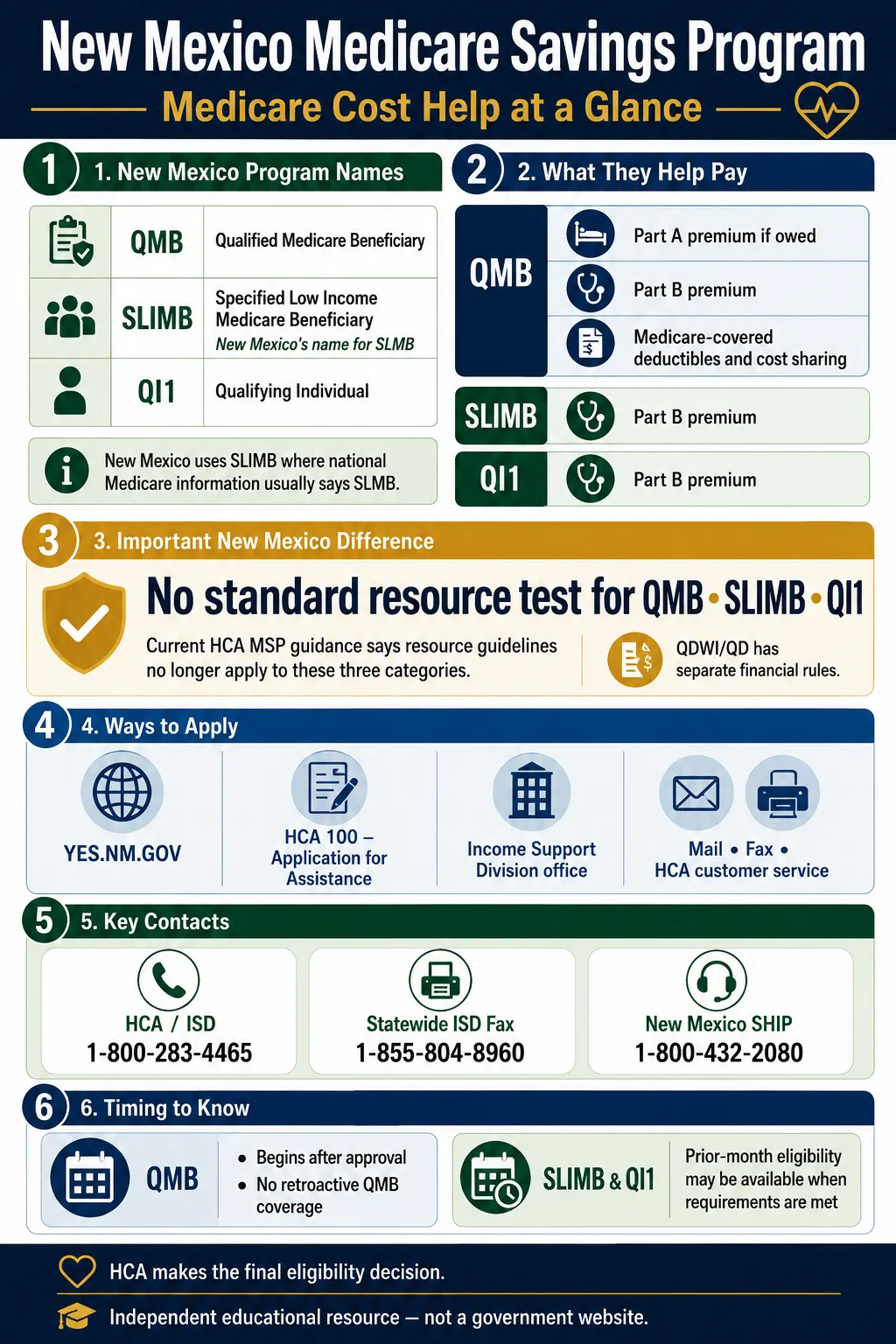
New Mexico uses SLIMB for the program commonly called SLMB on national Medicare pages. The state also uses QI1 for the federal Qualifying Individual category.
Another major New Mexico difference: current HCA Medicare Savings Program guidance says the usual resource guidelines no longer apply to QMB, SLIMB and QI1. The specialized QDWI/QD category has separate rules.
Quick Answer
| What you need | New Mexico route |
|---|---|
| Apply online | YES.NM.GOV |
| Current general paper form | HCA 100 – Application for Assistance |
| Eligibility agency | New Mexico HCA Income Support Division |
| Application and case help | 1-800-283-4465 |
| Statewide ISD fax | 1-855-804-8960 |
| Central ASPEN Scanning Area (CASA), PO Box 830, Bernalillo, NM 87004 | |
| Local help | HCA Income Support Division field office |
| Free Medicare counseling | New Mexico SHIP: 1-800-432-2080 |
| Main MSP categories | QMB, SLIMB and QI1, plus specialized QDWI/QD rules |
The standard Medicare Part B premium is $202.90 per month in 2026, or $2,434.80 over 12 months. The 2026 Part B deductible is $283.
Table of Contents
- Who runs New Mexico MSP?
- 2026 income limits
- Why federal limits look $20 higher
- New Mexico’s no-resource-test rule
- What QMB, SLIMB and QI1 pay
- QDWI / Qualified Disabled Working
- How to apply
- YESNM online application
- Paper application
- Mailing address
- Fax
- ISD field offices
- Phone help
- Interview rules
- Already have Medicaid?
- SSI automatic QMB
- Effective and retroactive dates
- After applying
- Renewal
- Denial and fair hearing
- New Mexico SHIP
- Extra Help
- MSP vs. full Turquoise Care
- Part B still being deducted
- QMB billing protection
- FAQs

New Mexico Medicare Savings Programs can reduce what eligible Medicare beneficiaries pay for Medicare premiums and, in the QMB category, Medicare-covered cost sharing.
Applications are handled through the New Mexico Health Care Authority (HCA), Income Support Division (ISD), not through Medicare.gov.
For a broader explanation of the programs, visit our Medicare Savings Programs educational resource. Our most recently published state guide covers the Medicare Savings Program in Kansas.
Who Runs the New Mexico Medicare Savings Program?
The New Mexico Health Care Authority administers Medicaid eligibility through its Income Support Division.
New Mexico reorganized the former Human Services Department into the Health Care Authority in 2024. Because of that transition, older forms, bookmarked webpages and documents may still contain the abbreviation HSD.
The programs are statewide. The same basic New Mexico eligibility framework applies whether the applicant lives in Albuquerque, Santa Fe, Las Cruces, Farmington, Roswell or a rural county.
New Mexico Medicare Savings Program Income Limits for 2026
New Mexico bases its Medicare Savings Program income standards on percentages of the Federal Poverty Level.
| New Mexico program | Individual monthly income | Married couple monthly income | Main help |
|---|---|---|---|
| QMB | $1,330 | $1,804 | Part A premium if owed, Part B premium and Medicare-covered cost sharing |
| SLIMB Federal SLMB category |
$1,596 | $2,164 | Part B premium |
| QI1 Federal QI category |
$1,796 | $2,435 | Part B premium |
These are the underlying 2026 FPL-based figures for the three main New Mexico MSP income tiers.
Use the New Mexico HCA income and Federal Poverty Level guidance for current state eligibility information.
Do not self-deny based on a simple income comparison. New Mexico uses countable-income rules, and applicable exclusions can reduce the amount that counts toward MSP eligibility.
Why Do Medicare.gov and Social Security Show Limits $20 Higher?
You may also see federal 2026 screening figures of:
- QMB: $1,350 for one person / $1,824 for a couple.
- SLMB: $1,616 / $2,184.
- QI: $1,816 / $2,455.
The difference generally reflects the federal $20 monthly general income exclusion.
For example, someone receiving $1,345 in countable-type unearned income should not automatically assume QMB is impossible because the underlying 100% FPL figure is $1,330.
Report the actual income requested by HCA. Do not subtract $20 yourself. ISD applies the appropriate income methodology.
For a national comparison, see the Social Security Medicare assistance information and our Medicare Savings Program income-limit guide.
Does New Mexico Have an MSP Asset or Resource Limit?
For the three main categories, New Mexico is different from many states.
Current HCA Medicare Savings Program eligibility guidance states that resource guidelines no longer apply to QMB, SLIMB and QI1.
This means a person should not reject themselves simply because they have:
- Savings.
- A checking account.
- Investments.
- A home.
- A vehicle.
New Mexico previously had MSP resource provisions, which is why older materials can be confusing. The state’s general MSP resource regulation was later reserved, and current published HCA guidance says the resource guidelines no longer apply to QMB, SLIMB and QI1.
Important exception: Do not extend the no-resource-test rule to every Medicare-related Medicaid category. New Mexico’s specialized Qualified Disabled Working/QDWI category has separate financial rules, discussed below.
You can also read our general Medicare Savings Program resource-limit guide.
What Does Each New Mexico Medicare Savings Program Pay?
QMB: Qualified Medicare Beneficiary
QMB provides the broadest Medicare cost assistance.
For eligible beneficiaries, QMB can help pay:
- The Medicare Part A premium when one is owed.
- The Medicare Part B premium.
- Medicare Part A and Part B deductibles.
- Medicare coinsurance.
- Medicare-covered copayments.
QMB also comes with federal protection against being billed for Medicare-covered Part A and Part B cost sharing.
Read our QMB Medicare Savings Program guide.
SLIMB: Specified Low Income Medicare Beneficiary
New Mexico calls the federal SLMB program SLIMB.
SLIMB pays the Medicare Part B premium.
It does not provide QMB’s broader protection from Medicare deductibles, coinsurance and copayments.
New Mexico regulations also state that no Medicaid card is issued solely because someone receives SLIMB, because Part B premium payment is the program’s benefit.
QI1: New Mexico’s QI Category
QI1 also pays the Medicare Part B premium, but it covers the higher income tier above SLIMB.
QI1 has an additional federal funding rule. New Mexico regulations provide that eligible QI1 applicants are served on a first-come, first-served basis, subject to the state’s available federal allotment.
People who qualified for QI1 or certain related MSP categories in the previous year receive preference for continued eligibility when they continue to meet the rules.
QI1 also generally cannot be received at the same time as another full Medicaid eligibility category.
That is why someone who appears to fall within the QI1 income range should not unnecessarily postpone an application.
Does New Mexico Have a QDWI Program?
Yes. New Mexico Medicaid regulations also recognize a specialized category for certain Qualified Disabled Working individuals. National Medicare information generally calls this program QDWI — Qualified Disabled & Working Individual.
QDWI is much narrower than QMB, SLIMB or QI1. It is intended for certain people with disabilities who returned to work and lost premium-free Medicare Part A because of their earnings.
Its benefit is help with the Medicare Part A premium.
| 2026 QDWI screening | Individual | Married couple |
|---|---|---|
| Federal income screen | $5,405 | $7,299 |
| Resource limit | $4,000 | $6,000 |
New Mexico’s current QD financial regulation retains the $4,000/$6,000 resource standard.
The apparently high federal QDWI income screen reflects special earned-income exclusions. Someone who is working should not compare gross wages directly with a basic FPL figure and assume they are ineligible.
Because QDWI cases are specialized, ask ISD to determine eligibility rather than trying to reproduce the calculation yourself.
How Do You Apply for a Medicare Savings Program in New Mexico?
New Mexico uses its regular state medical-assistance system for Medicare Savings Program eligibility.
You do not need a separate Medicare.gov application for QMB, SLIMB or QI1.
Available routes include:
- YES.NM.GOV.
- The HCA Application for Assistance.
- Mail.
- Fax.
- An Income Support Division field office.
- HCA customer-service assistance.
Option 1: Apply Online Through YES.NM.GOV
For many applicants, New Mexico’s YES.NM.GOV benefits portal is the simplest starting point.
YESNM can be used for applications, case information and certain eligibility updates.
Online application steps
- Open YES.NM.GOV.
- Sign in, create an account or follow the available application route.
- Start an application for medical assistance.
- Enter Medicare information carefully.
- Report Social Security, pension, wages and other income.
- Complete the household and eligibility questions that apply.
- Review the application.
- Submit it.
- Save the confirmation or application reference information.
- Continue checking YESNM and regular mail for HCA notices.
Use the words “Medicare Savings Program”
New Mexico does not require a separate MSP website.
When asking for help, be specific:
“I have Medicare and want to be screened for the Medicare Savings Programs, including QMB, SLIMB and QI1.”
That is clearer than asking only whether “Medicaid will pay my Medicare premium.”
Use New Mexico’s official benefits system
Apply through YESNM and keep proof of the filing date and any documents you submit.
Option 2: Apply With New Mexico’s Paper Application
New Mexico’s current official forms page lists HCA 100 – Application for Assistance.
Use the New Mexico HCA forms page to open the current version rather than relying on an old PDF saved elsewhere.
Why older documents may say HSD-100
Older New Mexico applications were labeled HSD-100 because the agency was then called the Human Services Department.
The state launched the Health Care Authority in 2024. The current forms page now labels the general application HCA 100.
If you find an old HSD-100 PDF online, use the current official HCA forms page before filing so you are working from the newest instructions.
Paper application checklist
- Enter the applicant’s name, mailing address and household information.
- Request medical assistance.
- Report Medicare coverage accurately.
- Report Social Security, pension, wages and other requested income.
- Include spouse information when applicable.
- Complete all Medicare- and medical-assistance-related questions that apply.
- Sign and date the form.
- Make a complete copy.
- Mail, fax or deliver the application using current HCA instructions.
Do not let missing paperwork create an unnecessary delay
Older New Mexico Application for Assistance instructions expressly allowed a filing date to be established with basic identifying information and a signature, with other information supplied during processing.
The safest approach with the current form is to submit as complete an application as you can, sign it, keep proof of filing and respond promptly if ISD requests additional verification.
If an important document such as a pension statement is still arriving, contact ISD rather than letting an otherwise ready application sit on the kitchen table for several weeks.
Where Do You Mail a New Mexico Application?
New Mexico uses a centralized scanning location called the Central ASPEN Scanning Area, or CASA.
Central ASPEN Scanning Area (CASA)
PO Box 830
Bernalillo, NM 87004
Current state benefit materials continue to use this address.
Mailing tips
- Keep a copy of the application and supporting documents.
- Put the applicant’s full name on separately submitted documents.
- Add the case number when one has already been assigned.
- Include the request notice when HCA asks you to return it with verification.
- For an important deadline, consider a mailing method that provides tracking.
Can You Fax a New Mexico MSP Application or Documents?
New Mexico’s statewide Income Support Division fax number is:
1-855-804-8960
The current HCA field-office directory uses this statewide fax number.
When faxing:
- Put the applicant’s name on every page.
- Add the case number when available.
- Include the HCA request notice when responding to a verification request.
- Number a longer packet — for example, 1 of 7, 2 of 7 and 3 of 7.
- Keep the fax transmission confirmation.
That last habit sounds minor until page six of an eight-page pension packet is missing and you need to show what was originally sent.
Option 3: Get Help at an Income Support Division Field Office
Use the official HCA Income Support Division field-office directory before traveling.
Most ISD field offices currently list lobby hours of 8:00 a.m. to 4:30 p.m., Monday through Friday, excluding holidays, but there are exceptions.
For example, current HCA listings show more limited hours at some locations, including Guadalupe and Hidalgo County offices. Check the specific office before making a long trip.
An office can be especially useful when
- YESNM is not working.
- A verification deadline is close.
- You need help understanding an HCA notice.
- Medicare recently started on an existing Medicaid case.
- A caregiver is helping an older applicant.
- You need to ask whether documents were received.
Bring Medicare information, available income records and any HCA or ISD notices already received.
Option 4: Get Application or Case Help by Phone
Call the New Mexico HCA Consolidated Customer Service Center:
1-800-283-4465
TTY: 711
Current HCA information lists live-agent hours of 7:00 a.m. to 6:30 p.m., Monday through Friday, while automated services may be available outside those hours.
Use the number to:
- Get application help.
- Check an existing case.
- Ask whether an application was received.
- Find an ISD field office.
- Ask what verification is missing.
- Report a change.
- Get help understanding an eligibility notice.
- Ask whether QMB, SLIMB and QI1 were considered.
Phone-number note: older New Mexico applications list additional telephone-application numbers. Because state application routing can change, 1-800-283-4465 is the current HCA customer-service number to use for application and case assistance unless the current form or your individual notice directs you elsewhere.
Do New Mexico MSP Applicants Need a Benefits Interview?
New Mexico’s general medical-assistance application process does not treat a traditional eligibility interview the same way SNAP or cash-assistance programs may.
That does not mean ISD will never contact you.
A worker may still need:
- Income verification.
- Medicare information.
- Residency information.
- Clarification of inconsistent information.
- A missing signature.
- Additional documentation.
Continue watching your phone, mail and YESNM account even if no formal interview is scheduled.
Already Have New Mexico Medicaid? Do Not Automatically File Another Application
This is one of New Mexico’s more useful MSP-specific rules.
For QMB, current New Mexico regulations say a separate application is not required when a person is already receiving Medicaid under another eligibility category.
New Mexico’s SLIMB rules similarly allow SLIMB eligibility to be determined for a current Medicaid recipient without a separate application.
If you already have Medicaid and Medicare recently started:
- Make sure ISD has your current Medicare information.
- Call 1-800-283-4465.
- Ask whether QMB or SLIMB has already been evaluated.
- Update the existing case before submitting a duplicate application unless ISD tells you a new application is required.
A duplicate application can create additional paperwork without correcting the actual problem.
Some SSI Medicaid Recipients Can Be Automatically Enrolled in QMB
New Mexico implemented an automatic QMB pathway for certain people receiving SSI Medicaid.
Effective October 1, 2024, New Mexico began automatically deeming SSI Medicaid recipients who are entitled to premium-free Medicare Part A into QMB.
Under the state rule:
- The Medicare Part B buy-in can begin with Part A entitlement.
- QMB group coverage begins the following month.
- Ongoing eligibility primarily depends on continued qualifying SSI Medicaid and Medicare status.
If someone already receives SSI Medicaid when Medicare starts, check the existing Medicaid case before completing an entirely new application.
When Do New Mexico MSP Benefits Start?
The timing is different for QMB, SLIMB and QI1.
| Program | General New Mexico timing |
|---|---|
| QMB | Begins the month after the case is approved. QMB does not provide retroactive coverage. |
| SLIMB | Initial eligibility begins in the approval month. Retroactive review can be available under New Mexico’s general Medicaid retroactive rules. |
| QI1 | Can also be included in New Mexico’s retroactive review rules when prior-month eligibility is properly requested and all requirements were met. |
QMB is not retroactive
New Mexico’s QMB regulation is explicit: QMB begins the month after the month the case is approved, and retroactive QMB coverage is not available.
This can matter for someone currently facing Medicare deductibles or coinsurance.
SLIMB and QI1 can have prior-month review
New Mexico’s retroactive Medicaid regulation lists SLIMB and QI1 among categories that may receive up to three months of retroactive eligibility review when the applicant met the applicable requirements in those months.
Current New Mexico rules also require a retroactive-coverage request to be made within 180 days of the Medicaid application.
Do not assume that this makes every old medical bill payable. SLIMB and QI1 primarily provide Medicare Part B premium assistance.
QI1 Has a Funding Rule That QMB and SLIMB Do Not
QI1 is not simply SLIMB with a higher income limit.
New Mexico regulations state that eligible QI1 applicants are served on a first-come, first-served basis, subject to available federal funds.
Prior-year recipients who continue to qualify receive preference under the state’s QI1 rules.
QI1 also generally applies only when the person is not otherwise eligible for another Medicaid category.
For a person whose income appears to fit the QI1 range, there is little benefit in postponing the application unnecessarily.
What Happens After You Apply?
HCA’s current application-status guidance says Medicaid processing can take up to 45 days.
HCA also asks applicants to allow about 14 days before checking application status.
During processing:
- Check YESNM.
- Open HCA mail promptly.
- Respond to verification requests.
- Keep upload, mailing or fax confirmations.
- Make sure your address and phone number remain current.
You can review the HCA guidance for applicants who already submitted an application.
If the case appears stalled after the normal processing window, call 1-800-283-4465 and ask about the existing application before filing another one.
Processing time is not an approval promise. Forty-five days is New Mexico’s general Medicaid processing framework, not a guarantee that every case will be completed or approved on a specific day.
Keep Your Address and Phone Number Current
HCA tells Medicaid applicants and members to keep eligibility information current.
Report relevant changes such as:
- Mailing address.
- Phone number.
- Income.
- Disability status.
- Other information that may affect eligibility.
You can update case information through YESNM or contact HCA customer service.
An applicant can meet every financial rule and still lose weeks of time because a verification letter went to an apartment they left several months earlier.
How Does New Mexico MSP Renewal Work?
Medicare Savings Program eligibility is not necessarily permanent.
New Mexico’s current regulations provide for periodic redetermination:
- QMB: eligibility is generally redetermined at least every 12 months.
- SLIMB: redetermination is made every 12 months.
- QI1: eligibility is offered on a yearly basis and remains subject to the QI federal allotment rules.
For SSI Medicaid recipients automatically deemed into QMB, the review process focuses heavily on whether the person continues to have the qualifying SSI Medicaid and Medicare status.
To reduce the risk of losing MSP:
- Keep your address current.
- Open every HCA renewal notice.
- Review prefilled information carefully.
- Report requested income information.
- Provide verification when requested.
- Return the renewal by the deadline on the notice.
Read our Medicare Savings Program renewal guide.
What Can Delay or Deny a New Mexico MSP Application?
Medicare information is incomplete
Provide the Medicare information requested by HCA accurately.
Social Security or pension income is omitted
Report gross income as requested and let ISD apply the applicable exclusions.
A verification request is ignored
A missing pension letter, Medicare detail or other requested document can prevent ISD from completing an otherwise eligible case.
A second application is filed instead of fixing the first
Check the existing application before starting over.
QMB is filed later than necessary
Because QMB itself is not retroactive, the filing and approval timeline can matter.
A QI1 applicant waits unnecessarily
QI1 operates under a federal allotment and first-come, first-served rules.
An existing Medicaid recipient does not report new Medicare coverage
ISD may be able to evaluate QMB or SLIMB without another application, but it still needs accurate Medicare information on the existing case.
What Should You Do if New Mexico Denies the MSP Application?
Read the complete denial notice before immediately submitting another application.
A denial can involve:
- Countable income.
- Missing verification.
- Medicare eligibility.
- Residency.
- Citizenship or qualified-status rules.
- Failure to provide required information.
If information is wrong or HCA did not consider evidence you submitted, New Mexico allows applicants and beneficiaries to request a Fair Hearing.
Most appeals must generally be requested within 90 days of the adverse action.
Office of Fair Hearings:
Phone: 505-476-6213 or 1-800-283-4465
Fax: 505-476-6215
Office of Fair Hearings
PO Box 2348
Santa Fe, NM 87504
If you already have benefits that are being reduced or closed, do not assume you can safely wait the full 90 days. Benefit-continuation rules can involve shorter timing. Follow the deadline and continuation instructions on your individual notice.
A hearing is not necessary for every missing-document problem. First ask ISD whether the case can be corrected administratively.
Read our Medicare Savings Program denial guide.
Get Free Medicare Help From New Mexico SHIP
New Mexico’s State Health Insurance Assistance Program (SHIP) provides free, unbiased Medicare counseling through the Aging and Long-Term Services Department.
1-800-432-2080
SHIP hours: Monday–Friday, 8:00 a.m.–5:00 p.m.
SHIP counselors can help with:
- QMB, SLIMB and QI1 questions.
- Medicare Savings Program screening.
- Medicare Part D.
- Extra Help.
- Medicare Advantage.
- Medigap.
- Medicare enrollment.
- Billing problems.
- Medicare appeals.
Visit the official New Mexico Medicare/SHIP page.
SHIP counselors do not sell insurance and do not determine Medicaid eligibility. HCA/ISD makes the MSP eligibility decision.
SHIP can be especially useful for an older adult who has an HCA approval notice in one hand and a confusing Medicare bill in the other.
Does New Mexico MSP Include Medicare Part D Extra Help?
People receiving QMB, SLIMB or QI1 are generally automatically deemed eligible for Medicare Part D Extra Help, also called the Low-Income Subsidy.
In 2026, full Extra Help can provide:
- $0 premium for a qualifying benchmark Part D plan.
- $0 Part D deductible.
- Up to $5.10 for a covered generic prescription.
- Up to $12.65 for a covered brand-name prescription.
- $0 for covered drugs after total drug costs reach $2,100.
Review Medicare’s current Extra Help guidance.
If a Part D plan or pharmacy still appears to be charging regular prices after MSP approval, keep the HCA approval notice and contact the Part D plan, Medicare or New Mexico SHIP.
QMB-Only Is Not the Same as Full Turquoise Care Medicaid
New Mexico’s Medicaid managed-care program is called Turquoise Care.
Medicare Savings Program-only coverage is not automatically the same as full-benefit Medicaid.
A person can qualify for Medicare premium help without receiving every service available through a full Medicaid eligibility category.
This distinction can affect:
- Dental coverage.
- Transportation.
- Medicaid-only services.
- Provider access.
- Medicare Advantage and dual-eligible planning.
Read the HCA approval notice for the exact eligibility category rather than assuming that any reference to Medicaid automatically means full Turquoise Care benefits.
Our Medicare Savings Program vs. Medicaid guide explains the broader distinction.
What if the Part B Premium Is Still Coming Out of Social Security?
The Part B deduction may not disappear from the first Social Security payment immediately after an MSP approval.
First check:
- Whether QMB, SLIMB or QI1 was approved.
- The effective date on the HCA notice.
- Whether the approved program includes Part B premium payment.
- Whether ISD still needs information.
- Later Social Security deposits.
- Any premium reimbursement or adjustment.
For HCA eligibility or buy-in questions, call 1-800-283-4465.
For Medicare-side troubleshooting, contact New Mexico SHIP at 1-800-432-2080.
Read our Medicare Part B premium assistance guide.
What if You Have QMB and Still Receive a Medicare Bill?
QMB includes important federal billing protection for Medicare-covered Part A and Part B cost sharing.
If a bill arrives:
- Do not automatically assume the bill is valid.
- Check whether QMB was active on the date of service.
- Check whether Medicare covered the service or item.
- Call the provider’s billing department.
- Tell the office you are a QMB beneficiary.
- Provide the appropriate Medicare and New Mexico QMB information.
- Ask the provider to correct protected Medicare cost sharing.
- Keep the bill and Medicare Summary Notice.
- Contact SHIP or Medicare if the provider will not correct the billing issue.
Federal rules generally prohibit Medicare providers and suppliers from billing QMB beneficiaries for Medicare-covered Part A and Part B deductibles, coinsurance and copayments.
QMB does not make every non-Medicare-covered item or service free. The reason for the bill still matters.
Review the official CMS QMB billing guidance.
New Mexico-Specific MSP Mistakes to Avoid
| Mistake | Better action |
|---|---|
| Using the federal QMB/SLMB/QI asset limit to self-deny | New Mexico HCA says resource guidelines no longer apply to QMB, SLIMB and QI1 |
| Searching only for “SLMB” | Also use New Mexico’s term SLIMB |
| Using the old HSD-100 as the assumed current form | Use HCA’s current forms page, which now lists HCA 100 |
| Waiting unnecessarily to apply for QMB | QMB itself is not retroactive |
| Filing another application while already on Medicaid | Ask ISD whether QMB or SLIMB can be added to the existing case |
| Overlooking SSI automatic QMB treatment | Check the existing Medicaid case when Medicare begins |
| Assuming QI1 works exactly like SLIMB | QI1 has federal funding and first-come, first-served rules |
| Ignoring an HCA document request | Respond by the deadline and keep proof |
| Assuming MSP means full Turquoise Care | Check the exact Medicaid eligibility category on the approval notice |
| Applying the no-resource-test rule to QDWI | QDWI/QD has separate income and resource rules |
New Mexico Medicare Savings Program FAQs
Where do I apply for the New Mexico Medicare Savings Program?
Apply through YES.NM.GOV, use New Mexico’s current HCA Application for Assistance, contact HCA at 1-800-283-4465 for help, fax or mail the application, or visit an Income Support Division field office.
What are New Mexico’s 2026 QMB income limits?
The underlying 2026 QMB FPL figures are $1,330 per month for one person and $1,804 for a couple. Federal screening figures may appear $20 higher because of the general income exclusion.
What does New Mexico call SLMB?
New Mexico uses the name SLIMB, meaning Specified Low Income Medicare Beneficiary. SLIMB pays the Medicare Part B premium and does not provide QMB’s broader Medicare cost-sharing protection.
Does New Mexico have an MSP asset limit?
Current New Mexico HCA Medicare Savings Program guidance states that resource guidelines no longer apply to QMB, SLIMB and QI1. The specialized QDWI/QD category has separate resource rules.
What paper application should I use?
New Mexico’s current official forms page lists HCA 100 – Application for Assistance. Older copies may still be labeled HSD-100 because the former Human Services Department was reorganized into the Health Care Authority.
Where do I mail a New Mexico application?
Mail it to Central ASPEN Scanning Area (CASA), PO Box 830, Bernalillo, NM 87004, unless a current HCA form or individual notice gives you different instructions.
What is the New Mexico ISD fax number?
Current HCA field-office information uses 1-855-804-8960 as the statewide ISD fax number. Follow a newer individual case notice if it gives you a different submission instruction.
How long can New Mexico take to process an MSP application?
HCA’s current Medicaid application guidance says processing can take up to 45 days. HCA asks applicants to allow about 14 days before checking application status. This is a processing framework, not a guarantee of approval or a decision on an exact day.
Is QMB retroactive in New Mexico?
No. New Mexico QMB generally begins the month after the case is approved, and QMB itself does not provide retroactive coverage.
Can SLIMB and QI1 have retroactive coverage?
Yes. New Mexico’s retroactive Medicaid rules list SLIMB and QI1 among categories that may receive up to three months of prior-month eligibility review when the applicant requests it and met all requirements in those months.
Do I need another MSP application if I already have New Mexico Medicaid?
Not always. New Mexico regulations allow QMB and SLIMB eligibility to be determined for some existing Medicaid recipients without a separate application. Contact ISD and make sure your current Medicare information is on the existing case.
Does New Mexico have QDWI?
Yes. New Mexico has a specialized Qualified Disabled Working category corresponding to federal QDWI. It can help certain working people with disabilities pay the Medicare Part A premium and has separate income and resource rules.
Does New Mexico MSP include Extra Help?
People receiving QMB, SLIMB or QI1 are generally automatically deemed eligible for Medicare Part D Extra Help, which can reduce Part D premiums, deductibles and prescription copayments.
How long do I have to appeal a New Mexico MSP denial?
Most New Mexico benefit appeals generally must be requested within 90 days of the adverse action. If existing benefits are ending, follow the notice immediately because benefit-continuation timing may be shorter.
Who can help with New Mexico Medicare questions for free?
Call New Mexico SHIP at 1-800-432-2080. SHIP provides free, unbiased Medicare counseling. For Medicaid eligibility and application questions, contact HCA at 1-800-283-4465.
Conclusion
New Mexico’s Medicare Savings Program is easier to navigate once you know the state’s terminology and application system.
Use YES.NM.GOV for online filing or use the current HCA 100 Application for Assistance from New Mexico’s official forms page. Applications and documents can also be handled through ISD offices, mail and the statewide 1-855-804-8960 fax.
The most important New Mexico-specific points are easy to miss:
- New Mexico calls SLMB SLIMB.
- HCA guidance says QMB, SLIMB and QI1 no longer use the usual MSP resource test.
- QDWI/QD remains a separate specialized category with its own financial rules.
- Some existing Medicaid recipients do not need another application for QMB or SLIMB.
- Certain SSI Medicaid recipients can be automatically deemed into QMB.
- QMB itself is not retroactive.
- SLIMB and QI1 can have prior-month review under applicable rules.
- QI1 is subject to federal funding availability.
If your income is close to the limit, submit an application instead of ruling yourself out based on a chart. Countable income can differ from the number printed on a benefit statement, and HCA/ISD makes the final eligibility calculation.
Apply through an official New Mexico channel
If you think you may qualify, use YESNM or another official HCA application route and let the Income Support Division determine your eligibility.
Editorial disclaimer: This article provides general educational information and is not legal, financial, medical or benefits advice. Eligibility rules, forms, income standards and procedures can change. Review current New Mexico HCA instructions and your individual notice. HCA makes the final eligibility determination.