Nevada Medicare Savings Program 2026: Limits & How to Apply
2026 Nevada Medicare Cost Assistance Guide
Nevada residents with limited income and savings may qualify for help with Medicare premiums and medical bills.
QMB, SLMB, or QI1 approval may eliminate the standard $202.90 monthly Part B premium in 2026. QMB may also cover Medicare deductibles, coinsurance, and copayments for Medicare-covered services. Nevada’s Division of Social Services makes the final eligibility decision.
Independent information: MedicareSavingsPrograms.com is an educational resource, not Medicare, Nevada Medicaid, or a government application processor. Eligibility is not guaranteed, and the state makes the final decision after reviewing countable income, resources, and other requirements.
Nevada Medicare Savings Program: Quick Answer
Nevada’s Medicare Savings Programs may pay some or all of a Medicare beneficiary’s premiums and out-of-pocket costs. QMB provides the broadest help, while SLMB and QI1 pay the Medicare Part B premium. QDWI pays the Part A premium for a much narrower group of working people with disabilities.
Apply through Access Nevada, use the current MAABD-SNAP paper application, or work with a Nevada Social Services office. Because Nevada applies income exclusions before deciding eligibility, it is worth applying even when gross income appears slightly above a published limit.
In This Guide
| Need | Nevada Route |
|---|---|
| Apply online | Access Nevada |
| Apply on paper | Form 2920-EM, MAABD-SNAP |
| Spanish application | Form 2920-EMS |
| Application help | 1-800-992-0900; TTY 1-800-326-6888 |
| Send requested verification | [email protected] or the office handling the case |
| Free Medicare counseling | Nevada MAP at 1-800-307-4444 |

Nevada Medicare Savings Program Income Limits for 2026
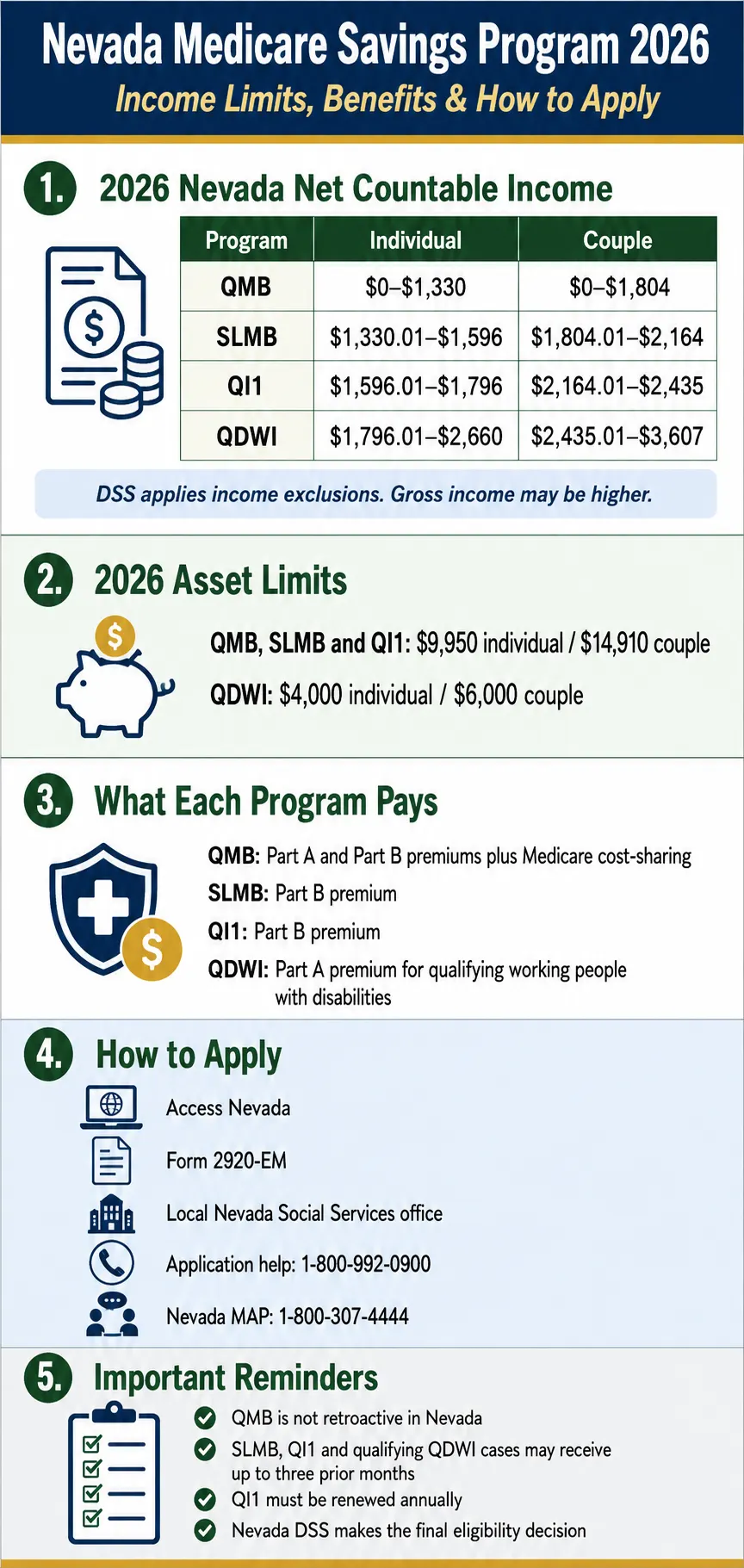
Nevada’s 2026 income chart lists the following Medicare Beneficiary ranges. These are net countable monthly income figures, not necessarily the gross amount shown at the top of a Social Security letter or paycheck.
| Program | Individual | Married Couple |
|---|---|---|
| QMB | $0–$1,330 | $0–$1,804 |
| SLMB | $1,330.01–$1,596 | $1,804.01–$2,164 |
| QI1 | $1,596.01–$1,796 | $2,164.01–$2,435 |
| QDWI | $1,796.01–$2,660 | $2,435.01–$3,607 |
These figures come from the Nevada DSS 2026 income-limit chart. The chart is a screening guide. DSS makes the final decision after applying Nevada’s income-counting, exclusion, and spousal-deeming rules.
QDWI is different: It is not a fourth premium-help tier for retirees whose income exceeds the QI1 limit. QDWI is limited to certain working people with disabilities who lost premium-free Part A because of earnings. Nevada’s chart shows net countable income. Federal public screening figures are much higher because they incorporate earned-income exclusions.
Why Medicare.gov Shows Limits That Are $20 Higher
The federal 2026 screening limits include the standard $20 general income exclusion:
- QMB: $1,350 individual / $1,824 couple
- SLMB: $1,616 individual / $2,184 couple
- QI: $1,816 individual / $2,455 couple
This does not conflict with Nevada’s chart. Nevada posts the poverty-level amount after the general exclusion, while federal 2026 MSP standards add the first $20 to the public screening figure.
For example, a single applicant whose only income is a $1,800 Social Security payment may have $1,780 in countable income after the $20 exclusion. That amount falls within Nevada’s QI1 range even though the gross payment exceeds the $1,796 figure shown on the state chart.
Do not compare gross QDWI wages directly with $2,660 or $3,607.
For QDWI, the federal 2026 screening limits are $5,405 for an individual and $7,299 for a couple because those figures include additional earned-income exclusions. Let DSS calculate net countable income.
For a broader explanation of countable income, see our Medicare Savings Program income-limits guide. State rules are not identical; our latest Iowa Medicare Savings Program guide shows how another state publishes and applies its limits.
Nevada MSP Asset Limits for 2026
Nevada uses a resource test for Medicare Savings Programs:
- QMB, SLMB, and QI1: $9,950 for one person or $14,910 for a married couple
- QDWI: $4,000 for one person or $6,000 for a married couple
The 2026 amounts are confirmed by Medicare.gov’s Medicare Savings Programs guidance and the Social Security Administration’s federal MSP standards.
Resources that may be reviewed include cash, checking and savings accounts, certificates of deposit, stocks, bonds, retirement accounts, and the cash surrender value of some life-insurance policies. A principal residence, personal belongings, certain burial funds, and some vehicles may be excluded. Vehicle and jointly owned property treatment depends on program rules and household circumstances, so report the property and allow DSS to determine whether it counts.
Read our detailed guide to Medicare Savings Program resource limits before assuming that a home, car, burial account, or life-insurance policy makes you ineligible.
What Each Nevada Medicare Savings Program Pays
| Program | What It May Pay | Important Nevada Rule |
|---|---|---|
| QMB | Part A premium if owed, Part B premium, and Medicare-covered deductibles, coinsurance, and copayments | Begins the month after the eligibility decision; Nevada does not provide prior QMB coverage |
| SLMB | Part B premium only | May begin with the application month and cover up to three prior months if every requirement was met |
| QI1 | Part B premium only | Must be renewed each year, cannot be combined with another Medicaid category, and may cover up to three prior months |
| QDWI | Part A premium only | Limited to qualifying working people under 65; may include up to three prior months when all requirements, including special Part A enrollment, were met |
Nevada refers to the federal Qualifying Individual program as QI1. Nevada’s official Medicare Beneficiaries program page confirms the main benefits and effective-date rules.
QMB and SLMB recipients may also qualify for full Medicaid under another category. MSP-only approval is not the same as full Medicaid coverage. Compare the differences in our guide to Medicare Savings Programs versus Medicaid.
QMB Includes Protection From Medicare Bills
QMB does more than pay a premium. Medicare providers generally cannot bill a QMB member for Medicare deductibles, coinsurance, or copayments on Medicare-covered services and items. Show both the Medicare card and the Nevada Medicaid or QMB card at each visit.
If a bill arrives:
- Check that Medicare covered the service or item.
- Call the provider’s billing office and give the QMB effective date.
- Ask the provider to correct the account instead of sending the balance to collections.
- Keep the bill and the matching Medicare Summary Notice.
- If the bill is not fixed, call Nevada MAP or 1-800-MEDICARE (1-800-633-4227).
The official Medicare Savings Programs page explains QMB billing protection. Our QMB Medicare Savings Program guide covers what to do when a provider continues billing.
MSP Approval and Part D Extra Help
People approved for QMB, SLMB, or QI1 automatically qualify for Medicare Part D Extra Help. Extra Help may reduce a drug plan’s premium, deductible, and copayments. Medicare.gov states that an MSP beneficiary will pay no more than $12.65 in 2026 for each covered drug, although many people pay less depending on their level of Extra Help and the drug.
Automatic Extra Help enrollment may not appear immediately after Nevada approves an MSP. Keep the approval notice and contact Nevada MAP or Medicare if prescription costs do not update. QDWI pays only the Part A premium and does not, by itself, establish the same automatic Extra Help status; a QDWI beneficiary may still apply for Extra Help separately.
Estate-recovery protection: Estate recovery does not apply to assistance that pays Medicare premiums or cost-sharing through an MSP. If someone also receives full Medicaid or long-term services and supports, separate Medicaid benefits may be subject to different recovery rules. Medicaid.gov explains the federal estate-recovery limits and exceptions.
Who Can Qualify in Nevada?
DSS reviews the complete application. An applicant generally must:
- Live in Nevada and meet the applicable citizenship or qualified-noncitizen rules.
- Be enrolled in or eligible for Medicare Part A for QMB, SLMB, or QI1.
- Meet the program’s net countable income and resource limits.
- Provide enough information for DSS to verify eligibility.
- Meet the separate disability, work, Part A, and Medicaid-status rules if applying for QDWI.
These requirements apply statewide, but the result depends on the applicant’s own income, resources, Medicare status, marital situation, and exclusions. See who may qualify for a Medicare Savings Program for a broader screening explanation.
How to Apply for a Medicare Savings Program in Nevada
Nevada offers three practical application routes: online, on paper, or through a local Social Services office.
Apply Online Through Access Nevada
Access Nevada is the state’s online benefits portal. It can be used to apply for health coverage, submit information, and manage an existing case.
- Create an account or sign in.
- Select the health-coverage or medical-assistance application.
- Enter the applicant’s Medicare information.
- Report all income, resources, and household details requested.
- Review the application for missing answers.
- Submit it and save the confirmation number or screenshot.
- Check the account and physical mail for verification requests.
A screening result is not an application or eligibility decision. Benefits cannot be approved until an application is submitted and DSS completes its review.
Open Official Access Nevada Portal
Apply With Form 2920-EM
The current English paper form is Application for Assistance (MAABD-SNAP), Form 2920-EM. The form is dated 07/26. The Spanish version is Form 2920-EMS.
Use a fresh copy from Nevada’s Applications & Forms page instead of reusing an old download. When completing the form:
- Apply for MAABD for the person seeking Medicare cost assistance.
- Complete the questions about age, blindness, or disability that apply.
- Include Medicare Part A and Part B information and the Medicare number requested.
- Report gross income, bank accounts, investments, insurance, and other resources.
- Answer the prior-medical-assistance question if you want DSS to review eligible prior months.
- Review every signature and certification line that applies.
- Make a copy of the complete application before submitting it.
Prior-month warning: Checking the prior-assistance box does not make QMB retroactive. Nevada QMB starts the month after the eligibility decision. The earlier three-month review may apply to SLMB, QI1, QDWI, or another Medicaid category when all rules were met during those months.
Apply Through a Social Services Office
Use Nevada’s official directory for Northern Social Services offices or Southern Social Services offices. The listings provide current office addresses, phone numbers, hours, and local fax numbers.
Before visiting, mailing, or faxing:
- Confirm the office hours and correct location.
- Ask whether that office handles applications for your ZIP code.
- Use the local fax number or the number printed on a DSS notice.
- Keep a delivery receipt, date-stamped copy, or fax confirmation.
Do not assume the Carson City administrative fax is the correct destination for a case. Using the office handling the application makes it easier to trace missing pages. Follow the current form, office directory, or case notice rather than an old saved address or fax number.
Do Not Apply Through Nevada Health Link
Nevada Health Link is the state’s marketplace for Qualified Health Plans. It is not the Medicare Savings Program application portal. Medicare beneficiaries seeking QMB, SLMB, QI1, or QDWI should use Access Nevada, Form 2920-EM, or Social Services.
Documents to Have Ready
DSS may verify some information electronically, but keeping readable copies nearby makes the application easier to complete. Documents may include:
- Medicare card and Part A/Part B effective dates
- Photo ID and proof of Nevada address, if requested
- Social Security award letter or benefit statement
- Pension, retirement, Railroad Retirement, or VA benefit statements
- Recent wage stubs or self-employment records
- Current bank and investment statements
- Life-insurance information showing face value and cash surrender value
- Information about Medicare Advantage, Part D, retiree, or employer coverage
- A spouse’s income and resources when applicable
Upload or submit complete pages. A bank statement without the page showing the account holder’s name, for example, may trigger another verification request even when the balance page is included.
Where to Send Verification Documents
Nevada’s DSS contact page states that information and verifications required for case processing can be sent to:
Use that address for requested supporting paperwork, not automatically as a substitute for filing the application. If a notice or caseworker provides a portal-upload option, office address, or fax number, follow those case-specific instructions. Avoid emailing unrequested sensitive information when a secure upload route is available.
What Happens After You Apply?
DSS may approve the case, deny it, or send a notice asking for more proof. Check Access Nevada and open every DSS letter promptly. A verification request normally states what is missing and when it is due. Processing and Medicare-system updates can vary, so do not treat an estimated timeline as a guaranteed approval or payment date.
The current Form 2920-EM lists these Voice Response Unit numbers for case status:
- Southern Nevada: 702-486-1646
- Northern Nevada: 775-684-7200
- Rural Nevada: 1-800-992-0900
The automated system may show whether a case is pending, approved, denied, or terminated. Keep the eligibility notice because it identifies the approved program and effective date.
If the Part B Premium Is Still Deducted
An MSP approval and a Social Security payment update do not always appear at the same time. First check:
- Whether the approval is QMB, SLMB, or QI1
- The MSP effective date
- Whether DSS requested additional proof
- Whether the latest Social Security payment covers a month before or after the approved date
If the deduction continues for a month the notice says is covered, contact the office handling the case. Nevada MAP can help explain the notice and the Medicare side of the problem. Do not discard an approval letter because the first payment has not changed. See our guide to getting help with the Medicare Part B premium for additional troubleshooting.
Renewing a Nevada Medicare Savings Program
Do not assume MSP help continues without review. Nevada DSS may use available records or send a renewal notice asking the household to confirm income, resources, address, Medicare status, and other information. QI1 must be renewed each year, and federal rules give priority to people who received QI benefits in the previous year.
- Keep the mailing address, phone number, and email on the case current.
- Open every DSS notice and check Access Nevada.
- Follow the method and deadline printed on the current renewal notice.
- Submit all requested pages and keep proof of delivery.
- Keep the renewal decision with the earlier approval notice.
Renewal dates and document requests depend on the case. Our Medicare Savings Program renewal guide explains how to prepare without relying on an outdated date or form.
If Nevada Denies the Application
Read the reason and the income or resource calculation on the notice. A denial caused by a missing bank statement is handled differently from a denial based on excess countable income.
If the decision appears wrong:
- Contact DSS promptly and ask what calculation or verification caused the denial.
- Compare the notice with the documents submitted.
- Save proof of the application date and every document sent.
- Follow the conference or hearing instructions on the notice.
The current 2920-EM form says a Medicaid hearing may be requested within 90 days of the notice date. Use the deadline and submission instructions on the actual notice because appeal procedures can change. Do not wait until the final day if continued coverage or an unpaid premium is involved.
For help organizing the next steps, read what to do when a Medicare Savings Program is denied.
Free Help With a Nevada MSP Application
Medicare
1-800-MEDICARE: 1-800-633-4227
TTY: 1-877-486-2048
Nevada MAP provides free, unbiased Medicare counseling and screening help. Counselors can explain MSP categories, Extra Help, QMB billing protection, and Medicare notices. DSS—not MAP, MedicareSavingsPrograms.com, or Medicare.gov—makes the Nevada eligibility decision.
Frequently Asked Questions
Where do I apply for Nevada’s Medicare Savings Program?
Apply through Access Nevada, submit the current Form 2920-EM, or work with a local Social Services office. Nevada DSS determines eligibility; Medicare.gov does not process the application.
What are Nevada’s 2026 QMB, SLMB, and QI1 income limits?
Nevada’s net countable monthly ceilings are $1,330/$1,804 for QMB, $1,596/$2,164 for SLMB, and $1,796/$2,435 for QI1, for an individual/couple. Federal screening charts show $20 more because they include the standard $20 general income exclusion.
Does Nevada have an asset limit for Medicare Savings Programs?
Yes. The 2026 limits are $9,950 for one person and $14,910 for a married couple for QMB, SLMB, and QI1. QDWI limits are $4,000 and $6,000.
Does Nevada call the QI program QI1?
Yes. Nevada’s income chart uses QI1 for the program Medicare.gov calls Qualifying Individual, or QI.
Can Nevada backdate MSP coverage?
SLMB, QI1, and QDWI may cover the application month and up to three prior months when every requirement was met. QMB is different: Nevada starts QMB the month after the eligibility decision and does not provide prior QMB coverage.
How do I check a pending Nevada MSP application?
Check Access Nevada or call the Voice Response Unit: 702-486-1646 in Southern Nevada, 775-684-7200 in Northern Nevada, or 1-800-992-0900 in rural Nevada. A local office can also help trace requested documents.
What should I do if a provider bills me after QMB approval?
Give the provider your QMB information and effective date, ask the billing office to correct the account, and keep the bill and Medicare Summary Notice. If the provider does not fix it, call Nevada MAP or 1-800-MEDICARE.
Conclusion
The most direct way to apply for a Nevada Medicare Savings Program is through Access Nevada. Applicants who prefer paper can use the current MAABD-SNAP Form 2920-EM or submit it through the correct Social Services office.
Do not reject yourself because a gross Social Security payment or paycheck appears slightly above Nevada’s chart. DSS uses net countable income, and the $20 general exclusion, earned-income rules, and other exclusions may change the result.
Apply through an official Nevada route, keep proof of submission, and respond quickly to every verification request. The state will decide which program, if any, applies.
Ready to Take the Next Step?
Use Nevada’s official portal or contact Nevada MAP for free counseling. Applying does not guarantee eligibility, but it allows DSS to apply the correct income and resource rules.