Wisconsin Medicare Savings Program 2026: ACCESS and SLMB+
Wisconsin Medicare Cost Assistance Guide
Wisconsin Medicare Savings Program 2026: ACCESS, SLMB+ and Income Limits
Wisconsin Medicare Savings Programs may help eligible Medicare beneficiaries pay the Part B premium and, under QMB, Medicare-covered premiums, deductibles, coinsurance and copayments. Applications are handled through Wisconsin Medicaid and county or Tribal income maintenance agencies.
Reviewed using 2026 Wisconsin Department of Health Services, ForwardHealth, Medicare and CMS information. The county or Tribal eligibility agency makes the final decision.
Independent educational resource
This website is not Medicare, CMS, Wisconsin Medicaid, ForwardHealth or another government agency. It does not process or approve applications. Use official Wisconsin portals and forms, and follow the instructions and deadlines printed on your current eligibility notice.
Quick Answer
Wisconsin offers four Medicare Savings Program levels:
- QMB may pay eligible Medicare Part A and Part B or Part B-ID premiums, deductibles, coinsurance and protected Medicare cost sharing.
- SLMB pays the Medicare Part B or Part B-ID premium.
- SLMB+ pays the Part B or Part B-ID premium for people in Wisconsin’s higher MSP income band.
- QDWI pays the Medicare Part A premium for certain working people with disabilities.
Wisconsin uses the name SLMB+ for the income category commonly called QI in national Medicare materials. When applying, ask to be screened for QMB, SLMB and SLMB+.
The standard Medicare Part B premium is $202.90 per month in 2026. A full year of standard Part B premium assistance could provide up to $2,434.80 in annual help. Actual savings depend on the premium owed and the approved coverage period.
Table of Contents
- 2026 income limits
- Asset limits
- What each program covers
- Who may qualify
- Apply through ACCESS
- Apply by phone
- F-10101 paper application
- Mail and fax addresses
- Apply in person
- Documents to prepare
- After applying
- Coverage start dates
- Annual renewal
- Denial and fair hearing
- QMB billing protection
- Part D Extra Help
- Free official help
- FAQs
If Medicare premiums are reducing your Social Security payment each month, Wisconsin’s Medicare Savings Program may be able to help. The most common benefit is payment of the Medicare Part B premium. People approved for QMB may receive additional help with Medicare premiums and Medicare-covered cost sharing.
For a general explanation of these programs, visit our Medicare Savings Programs educational resource. State terminology and application methods differ. You can compare Wisconsin’s SLMB+ system with the latest guide to the Missouri Medicare Savings Program and IM-1MSP application.
Wisconsin Medicare Savings Program Income Limits for 2026
Wisconsin uses countable monthly income, which may be lower than gross income after permitted credits and exclusions are applied.
The following income standards are effective from February 1, 2026, through January 31, 2027.
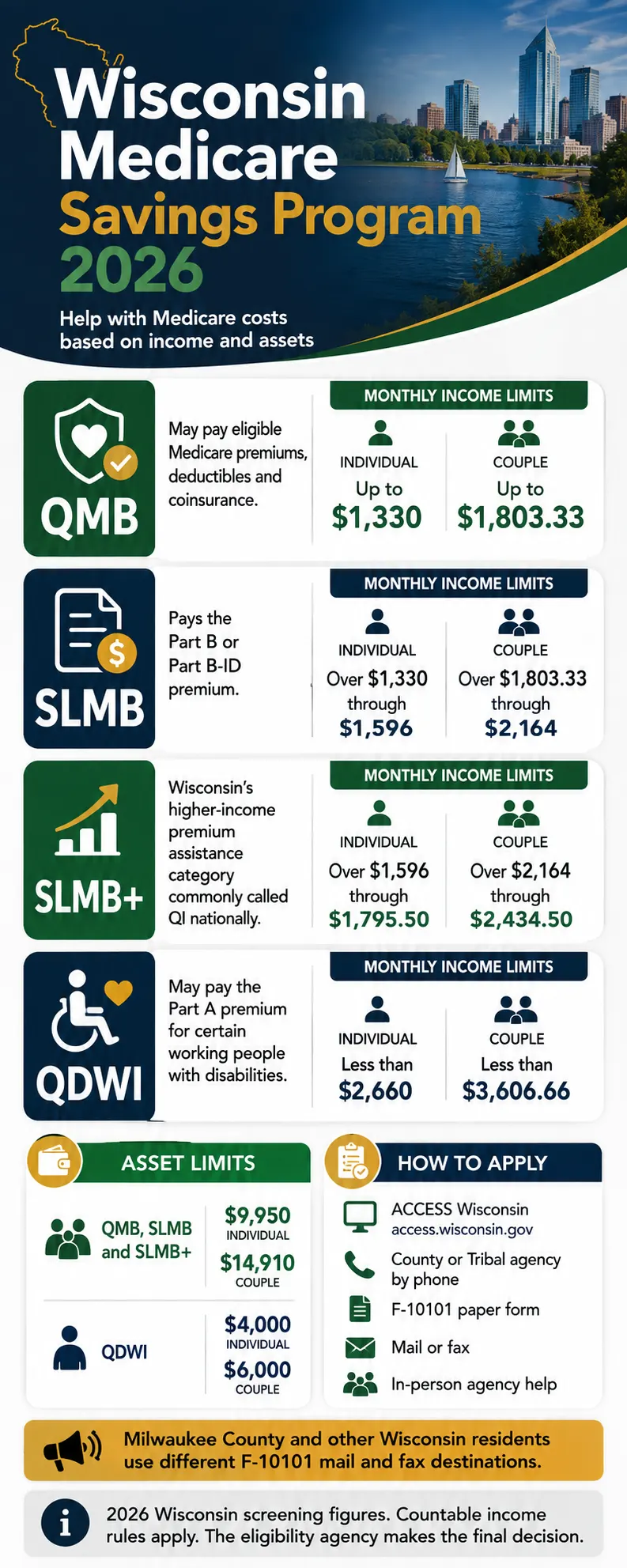
| Program | One person | Married couple | Income category |
|---|---|---|---|
| QMB | Up to $1,330.00 per month | Up to $1,803.33 per month | Up to 100% FPL after applicable credits |
| SLMB | Over $1,330.00 through $1,596.00 | Over $1,803.33 through $2,164.00 | Over 100% through 120% FPL |
| SLMB+ | Over $1,596.00 through $1,795.50 | Over $2,164.00 through $2,434.50 | Over 120% through 135% FPL |
| QDWI | Less than $2,660.00 per month | Less than $3,606.66 per month | Below 200% FPL after applicable credits |
These are screening figures, not an automatic eligibility decision. Your county or Tribal agency applies Wisconsin’s countable-income rules and determines which income is included or excluded.
Do not reject yourself merely because gross Social Security, pension or employment income appears slightly higher than a table amount. Ask the eligibility agency to complete the official calculation.
Review the official Wisconsin 2026 federal poverty-level guidelines and our broader guide to Medicare Savings Program income limits.
Wisconsin terminology: A person searching for “QI Wisconsin” should look for SLMB+ on Wisconsin DHS pages, ACCESS notices and eligibility letters.
Wisconsin Medicare Savings Program Asset Limits for 2026
| Program | One person | Married couple |
|---|---|---|
| QMB, SLMB and SLMB+ | $9,950 | $14,910 |
| QDWI | $4,000 | $6,000 |
Assets that may count include:
- Checking and savings accounts.
- Cash.
- Certificates of deposit.
- Stocks and bonds.
- Certain investment or retirement accounts.
- Cash value in certain life-insurance policies.
Items that may be excluded include:
- The home where you live.
- One vehicle.
- Household goods and personal belongings.
- Burial plots.
- Certain burial funds and insurance arrangements, depending on the applicable rules.
Wisconsin does not count every type of property in the same way. Report the requested assets and allow the agency to decide whether an account or item is countable.
Learn more in our Medicare Savings Program resource-limit guide.
What Does Each Wisconsin Medicare Savings Program Cover?
QMB: Premium and Medicare cost-sharing help
The Qualified Medicare Beneficiary program provides the most comprehensive MSP assistance.
Wisconsin QMB may pay:
- The Medicare Part A premium when a person owes one.
- The Medicare Part B or Part B-ID premium.
- Medicare deductibles.
- Medicare coinsurance.
- Protected Medicare copayments for Medicare-covered services.
QMB generally requires entitlement to Medicare Part A or Part B-ID, countable income at or below the QMB limit, and assets within the program limit.
Certain people who receive Supplemental Security Income, or who lost SSI after beginning to receive certain Social Security benefits, may already be enrolled automatically.
Review the official Wisconsin QMB eligibility and payment guidance.
SLMB: Medicare Part B premium help
The Specified Low-Income Medicare Beneficiary program pays the Medicare Part B or Part B-ID premium.
SLMB does not normally pay Medicare deductibles, doctor copayments or coinsurance. Its primary value is stopping the monthly premium deduction and potentially reimbursing eligible premiums for approved prior months.
An applicant generally must have Medicare Part A or Part B-ID entitlement, countable income within the SLMB range and assets within the program limit.
Review the official Wisconsin SLMB program page.
SLMB+: Wisconsin’s higher-income premium program
SLMB+ pays the Medicare Part B or Part B-ID premium for people in Wisconsin’s higher Medicare Savings Program income range.
To qualify, a person must generally:
- Have Medicare Part A or Part B-ID entitlement.
- Have countable income between 120% and 135% of the federal poverty level after applicable credits.
- Meet the asset limit.
- Not be enrolled in full-benefit Medicaid, Family Planning Only Services or Tuberculosis-Related Services Only.
SLMB+ is generally premium assistance only. It is not full-benefit Wisconsin Medicaid by itself.
Review the official Wisconsin SLMB+ guidance.
QDWI: Medicare Part A premium help
The Qualified Disabled and Working Individual program is intended for a narrower group.
QDWI may pay the Medicare Part A premium if you:
- Have a disability and are working.
- Are entitled to Medicare Part A.
- Meet the separate QDWI income and asset limits.
- Are not enrolled in Medicaid.
Most older adults seeking help with the Part B deduction will be screened for QMB, SLMB or SLMB+ rather than QDWI.
Review the official Wisconsin QDWI program page.
Who May Qualify for a Wisconsin Medicare Savings Program?
You may qualify if you:
- Live in Wisconsin.
- Have the Medicare entitlement required for the applicable MSP category.
- Meet the applicable countable-income standard.
- Meet the applicable asset limit.
- Meet citizenship or qualified immigration-status rules.
- Provide enough information for the county or Tribal agency to make a decision.
A spouse’s income and assets may be considered when a married applicant lives with their spouse.
You do not need to select the correct category before applying. Ask the agency to screen you for QMB, SLMB, SLMB+ and any other assistance for which you may qualify.
Read our general guide explaining who may qualify for a Medicare Savings Program.
Are Wisconsin MSP rules statewide?
Yes. Wisconsin DHS establishes statewide MSP standards. County and Tribal income maintenance agencies process applications, verification, changes and renewals.
The same program income standards apply whether you live in Milwaukee, Madison, Green Bay, Kenosha, Racine, Eau Claire or a rural county. The contact number and submission destination may differ by county or Tribe.
How to Apply Online Through ACCESS Wisconsin
The fastest application method for many people is the official ACCESS Wisconsin portal.
ACCESS can be used to:
- Apply for Wisconsin Medicaid and other benefits.
- Return to an unfinished application.
- Upload requested documents.
- Check benefit and renewal information.
- View notices and required actions.
- Report household, income or address changes.
- Complete an annual renewal.
ACCESS application steps
- Open ACCESS Wisconsin.
- Select the option to apply for benefits.
- Create an account or sign in.
- Enter information about yourself and your spouse when applicable.
- Report your Medicare coverage.
- Enter the requested income and asset information.
- Review the application for missing answers.
- Submit the application.
- Save or print the confirmation information.
- Check ACCESS, MyACCESS and regular mail for document requests and decisions.
When the application asks what help you need, you may state:
“I have Medicare and want to be screened for QMB, SLMB and SLMB+ Medicare Savings Program benefits.”
You do not need to determine the correct program yourself. The eligibility agency should apply the relevant rules to your information.
Apply through Wisconsin’s official portal
An ACCESS account alone does not complete the application. Continue until you receive confirmation that the application was submitted.
How to Apply by Phone
Phone applications are handled by Wisconsin county and Tribal income maintenance agencies. Wisconsin counties are grouped into regional consortia, so the correct telephone number depends on where you live.
Use the official Wisconsin income maintenance agency directory to find the call center serving your county or Tribe.
Tell the worker:
“I have Medicare and want to apply for help paying my Medicare premiums. Please screen me for QMB, SLMB and SLMB+.”
During the call, record:
- The worker’s name.
- The date and time of the call.
- Your application or case number.
- Documents the agency requests.
- The deadline for submitting proof.
County and Tribal agencies handle applications, eligibility questions, renewals, reported changes and verification documents.
How to Apply With the F-10101 Paper Application
Wisconsin does not use a short MSP-only paper form. Paper applicants use the Wisconsin Medicaid for the Elderly, Blind, or Disabled Application Packet, F-10101.
The current English packet has a release date of May 8, 2026. Other language versions are also available.
Download the current packet from the official Wisconsin F-10101 form collection.
Completing the F-10101
- Read the instructions at the beginning of the packet.
- Use blue or black ink.
- Enter your personal and contact information.
- Include spouse information when required.
- Report Medicare and other health insurance.
- Complete the income and asset sections.
- Review the application checklist.
- Sign and date the application.
- Keep a complete copy.
Your application date is generally the date the Medicaid office receives the signed application. An unsigned form may be returned, so review the signature section carefully.
Form safety tip: Download the current version immediately before applying. Wisconsin may update the packet, submission address or fax information during the year.
Where to Mail or Fax the Wisconsin Application
The May 2026 F-10101 packet uses separate submission details for Milwaukee County and the rest of Wisconsin.
Milwaukee County residents
Mail to:
MDPU
6055 N. 64th St.
Milwaukee, WI 53218
Fax: 888-409-1979
Residents outside Milwaukee County
Mail to:
CDPU
P.O. Box 5234
Janesville, WI 53547-5234
Fax: 855-293-1822
Before submitting:
- Confirm the destination on the first page of the current packet.
- Complete all applicable sections.
- Sign and date the application.
- Send copies rather than irreplaceable originals.
- Keep a copy of the completed packet.
- Save the fax confirmation or mailing proof.
You may also upload requested verification documents through ACCESS or MyACCESS.
How to Apply in Person
You may apply in person at a county or Tribal income maintenance agency during its office hours.
This may be helpful when:
- You cannot use ACCESS.
- You need help understanding the application.
- You do not have access to a printer or fax.
- You received a verification request you do not understand.
- An authorized representative is helping you apply.
- You want a receipt or date-stamped application copy.
Call before visiting to confirm the office location, hours and whether an appointment is required.
What Information and Documents Should You Prepare?
Helpful information may include:
- Full legal name and date of birth.
- Wisconsin home and mailing addresses.
- Social Security number.
- Medicare card and Medicare number.
- Marital status and spouse information.
- Social Security income.
- Pension, retirement or annuity income.
- Recent pay information if employed.
- Self-employment information when applicable.
- Bank and other potentially countable asset information.
- Current health insurance information.
- Recent Medicare, Medicaid or Social Security notices.
The F-10101 explains that applicants will need to provide proof of certain answers, including asset information. Examples can include bank statements, property records, vehicle documents or life-insurance information.
Do not mail original documents. Submit photocopies or upload readable images.
Do not postpone filing merely because one document is temporarily unavailable. Submit the signed application, preserve the application date and respond promptly when the agency requests verification.
What Happens After You Apply?
The county or Tribal agency reviews Medicare entitlement, income, assets, household information and other eligibility requirements.
The current F-10101 packet states that a Medicaid decision should generally be mailed within 30 days of the application date.
This does not guarantee that every case will be completed without delay. Missing, conflicting or incomplete information can require additional verification.
While the application is pending:
- Check regular mail.
- Review letters in ACCESS.
- Check MyACCESS reminders.
- Answer calls or voicemail from the agency.
- Submit proof before the stated deadline.
- Keep copies of everything submitted.
- Record your case number and submission confirmations.
If no decision is issued within the period stated in the application packet, contact your agency. The packet also recognizes the right to request a fair hearing when an application is not processed within the stated period.
Use MyACCESS after applying
The free MyACCESS mobile app can help you:
- Check benefit information and renewal dates.
- View reminders and required actions.
- See which documents are needed.
- Upload photos or PDF copies of proof.
- Check the status of submitted documents.
- Update your home or mailing address and telephone number.
- View digital membership cards.
People without a compatible smartphone can manage the case through the ACCESS website.
For MyACCESS technical assistance, call ForwardHealth Member Services at 800-362-3002, Monday through Friday, 8 a.m. to 6 p.m.
When Will Wisconsin Start Paying the Medicare Premium?
QMB effective date
Wisconsin QMB generally begins on the first day of the month after the application is approved.
For example, if the application is approved in April, QMB enrollment normally begins in May. QMB does not generally cover Medicare cost sharing for months before its effective date.
SLMB and SLMB+ retroactive coverage
SLMB and SLMB+ may pay eligible Medicare Part B or Part B-ID premiums for up to three months before the application date when the applicant met all program requirements during those months.
If premiums were deducted during approved months, Social Security may later issue a refund after Wisconsin, Medicare and Social Security update their records.
QDWI retroactive coverage
QDWI may also cover eligible Medicare Part A premiums for up to three months before the application date when all requirements were met.
Why the Social Security payment may not change immediately
Wisconsin Medicaid, Medicare and Social Security must exchange and update payment information. Wisconsin advises that the Social Security payment may not change for approximately one to three months after enrollment.
After the systems update:
- The Medicare premium deduction may stop.
- The Social Security payment may increase.
- Social Security may refund eligible premiums paid after the approved effective date.
A refund, amount and delivery date are not guaranteed until the state and federal records are reconciled. Keep the approval letter and Social Security payment records.
How Does Wisconsin MSP Renewal Work?
Wisconsin Medicaid eligibility must generally be renewed at least once every 12 months.
Around one month before the coverage end date, Wisconsin sends a renewal letter. The letter explains whether the state was able to renew eligibility automatically or whether additional information is required.
You may generally complete a renewal through:
- ACCESS Wisconsin.
- The MyACCESS app.
- Your county or Tribal agency by phone or in person.
- The paper renewal packet.
- The mail or fax destination printed on the current renewal notice.
If you do not renew by the end of the renewal month, benefits may end. Wisconsin’s current guidance says that when the renewal due date was less than three months ago, a person may still be able to submit the renewal information instead of filing a completely new application.
Possible retroactive coverage after a late renewal depends on the case. Contact the agency rather than assuming coverage will automatically be restored.
Review the official Wisconsin Medicaid renewal guidance and our Medicare Savings Program renewal checklist.
What Should You Do if Wisconsin Denies the Application?
Read the complete eligibility notice. It should explain why the application was denied and how to request a fair hearing.
Common issues may include:
- Missing bank or income verification.
- Incorrect spouse or household information.
- An asset counted at the wrong value.
- An income credit or exclusion that was not applied.
- A document submitted but not matched to the case.
- An unsigned or incomplete application.
Take these steps:
- Identify the denial reason. Compare the notice with your application and submitted proof.
- Contact the agency. Ask for an explanation of the countable-income and asset calculation.
- Submit missing or corrected proof. Include the case number or cover page shown on the notice.
- Request a fair hearing if needed. Follow the method and deadline on the notice.
- Keep proof. Save upload confirmations, fax records, mailing receipts and hearing-request documents.
The current F-10101 states that a fair-hearing request generally must be made no later than 45 days after the date of the action.
A written request may be sent to the Wisconsin Division of Hearings and Appeals. The packet also states that applicants can ask the agency where they applied for help filing the hearing request.
Use the official ForwardHealth program resources and fair-hearing information. Our Medicare Savings Program denial guide explains common correction steps.
Deadline warning: Follow the exact date on your notice. Do not wait until every supporting document has been collected if the hearing deadline is approaching.
What if You Have QMB and Receive a Medical Bill?
A doctor, hospital, supplier or other Medicare provider generally cannot bill a QMB beneficiary for Medicare-covered Part A or Part B deductibles, coinsurance or copayments.
This protection generally applies even when the provider does not participate in Wisconsin Medicaid.
If you receive a bill:
- Do not ignore it.
- Check that QMB was active on the service date.
- Confirm that Medicare covered the service.
- Tell the billing office that you were enrolled in QMB.
- Show your Medicare card and available ForwardHealth or QMB proof.
- Ask the provider to correct the account and stop collection activity for protected cost sharing.
- Contact Medicare or the Wisconsin Medigap Helpline if billing continues.
1-800-MEDICARE: 1-800-633-4227
Medicare TTY: 1-877-486-2048
If you already paid prohibited QMB cost sharing, ask the provider whether a refund or account correction is required.
QMB does not make every service free. You may still owe for non-covered care, permitted prescription charges or services Medicare properly denied.
Review the official CMS QMB billing-protection guidance and our QMB Medicare Savings Program guide.
Does Wisconsin MSP Approval Include Medicare Part D Extra Help?
People who receive state assistance paying their Medicare Part B premium generally qualify automatically for Medicare Part D Extra Help.
In 2026, Extra Help can provide:
- A $0 Part D plan premium for a qualifying plan priced at or below the applicable benchmark amount.
- A $0 Part D deductible.
- Copays of no more than $5.10 for each covered generic drug.
- Copays of no more than $12.65 for each covered brand-name drug.
- $0 for covered drugs after total drug costs reach $2,100 in 2026.
- No Part D late-enrollment penalty while receiving Extra Help.
A person who also receives full Medicaid and QMB may have lower prescription copays. Exact costs depend on Medicaid status, the covered drug and the selected Part D plan.
A plan priced above the Extra Help benchmark may still charge part of its premium.
QDWI by itself should not be assumed to provide automatic Extra Help. Ask the Wisconsin Medigap Helpline or Social Security whether a separate application is appropriate.
Review the official Medicare Extra Help costs for 2026.
Is MSP-Only Coverage the Same as Full Wisconsin Medicaid?
No. Medicare Savings Program assistance may be approved without full-benefit Wisconsin Medicaid.
| Coverage type | General purpose |
|---|---|
| QMB-only | Medicare premiums and protected Medicare cost sharing |
| QMB with full Medicaid | Medicare assistance plus broader qualifying Medicaid benefits |
| SLMB | Medicare Part B or Part B-ID premium assistance |
| SLMB+ | Stand-alone premium assistance for the higher income band |
| Full Wisconsin Medicaid or long-term care | May provide broader medical or long-term support under separate rules |
SLMB+ specifically excludes people enrolled in certain full-benefit Medicaid programs.
If you need broader Medicaid, in-home support or nursing-facility coverage, ask the agency to screen you for both MSP and the other appropriate Medicaid programs.
Read our Medicare Savings Program versus Medicaid comparison.
Does Wisconsin Estate Recovery Apply to MSP Benefits?
Wisconsin’s public estate-recovery guidance focuses primarily on long-term care and related Medicaid services.
The state says that people age 55 or older who live in the community and are not receiving long-term-care-related services or Wisconsin Chronic Disease Program services are not affected by estate recovery.
MSP premium assistance is different from long-term care. However, a person who receives an MSP together with full Medicaid, nursing-home coverage, personal care or another long-term care program should not assume that every benefit is excluded.
Review the official Wisconsin Estate Recovery Program guidance for the specific coverage you receive.
Where Can You Get Free Official Help in Wisconsin?
| What you need | Official resource |
|---|---|
| Apply or manage benefits online | ACCESS Wisconsin |
| Application and eligibility questions | County and Tribal agency directory |
| Paper application | F-10101 application packet |
| Free Medicare and MSP counseling | Wisconsin Medigap Helpline: 800-242-1060 |
| Medicare Part D and prescription help | 855-677-2783 |
| ForwardHealth or MyACCESS questions | 800-362-3002, Monday–Friday, 8 a.m.–6 p.m. |
| Aging and Disability Resource Center | Wisconsin ADRC directory: 844-947-2372 |
| Local benefit specialist | Wisconsin benefit specialist directory |
| Medicare or QMB billing questions | 1-800-MEDICARE: 1-800-633-4227 |
| Medicare TTY | 1-877-486-2048 |
The Wisconsin Medigap Helpline is part of the State Health Insurance Assistance Program. Counselors provide free, unbiased and confidential help and do not sell insurance.
They may help explain:
- QMB, SLMB and SLMB+.
- QMB billing protections.
- Medicare Advantage and Medigap.
- Medicare eligibility and costs.
- Extra Help and prescription coverage.
- Approval, denial and enrollment notices.
Need free help before applying?
Contact the Wisconsin Medigap Helpline for Medicare counseling or your county or Tribal agency for an official eligibility application. Approval cannot be guaranteed before the agency completes its review.
Common Wisconsin Application Mistakes
Looking only for QI
Wisconsin calls the higher-income premium assistance category SLMB+. Ask for QMB, SLMB and SLMB+ screening.
Applying through Medicare instead of Wisconsin
Medicare explains the programs, but Wisconsin determines eligibility. Apply through ACCESS or a Wisconsin county or Tribal agency.
Mailing F-10101 to the wrong destination
Milwaukee County and the rest of Wisconsin use different mail and fax destinations. Follow the first page of the current F-10101 packet.
Missing a verification request
Check ACCESS, MyACCESS and regular mail after applying. Requests for income, bank, identity, insurance or Medicare information normally include a deadline.
Assuming gross income is the final answer
Wisconsin applies countable-income rules and certain credits. Being slightly above a published figure does not automatically mean you will be denied.
Expecting the premium deduction to stop immediately
Approval and payment-system updates occur on different timelines. Keep your approval notice and allow time for Wisconsin Medicaid, Medicare and Social Security records to synchronize.
Wisconsin Medicare Savings Program FAQs
Is there a separate Wisconsin Medicare Savings Program paper application?
Wisconsin uses the F-10101 Medicaid for the Elderly, Blind, or Disabled Application Packet for paper applications. Online applications are submitted through ACCESS.
What is SLMB+ in Wisconsin?
SLMB+ is Wisconsin’s higher-income Medicare premium assistance program. It pays eligible Medicare Part B or Part B-ID premiums for people in the 120% through 135% federal poverty-level band who meet the other program rules.
Does Wisconsin SLMB+ provide full Medicaid?
Not by itself. SLMB+ is premium assistance, and Wisconsin excludes people enrolled in full-benefit Medicaid and certain other limited Medicaid programs from SLMB+ eligibility.
Can Wisconsin QMB pay Medicare copayments?
QMB pays eligible Medicare premiums, deductibles and coinsurance. Medicare providers generally may not bill a QMB member for Medicare-covered deductibles, coinsurance or copayments.
Can I apply if my income appears slightly over the limit?
Yes. Wisconsin uses countable income and applies certain credits and exclusions. Submit an application and let the eligibility agency calculate the official amount.
Can SLMB or SLMB+ reimburse past Medicare premiums?
These programs may cover eligible premiums for up to three months before the application date when all requirements were met. Social Security may later issue a refund for premiums deducted after the effective date.
How long should a Wisconsin Medicaid application decision take?
The current F-10101 packet states that a Medicaid decision should generally be mailed within 30 days of the application date. Missing or conflicting information may require additional verification.
How long do I have to appeal a denial?
The current application packet states that a fair-hearing request generally must be made within 45 days after the action. Follow the exact deadline printed on your eligibility notice.
How do I check my application status?
Sign in to ACCESS or use MyACCESS to review benefits, reminders, document requests and submitted verification. You may also contact your county or Tribal income maintenance agency.
Conclusion
Start with ACCESS Wisconsin if you are comfortable applying online. It is the quickest route for many applicants and allows you to upload proof and manage the case electronically.
For a paper application, download the current F-10101 packet. Milwaukee County residents and residents elsewhere in Wisconsin use different mail and fax destinations, so follow the first page of the current form.
For phone or in-person help, contact the income maintenance agency serving your county or Tribe.
Do not decide that you are ineligible based only on gross Social Security income or a bank balance. Wisconsin uses countable financial information, and people near the published limits may still qualify.
Approval may stop the monthly Part B premium deduction, provide Medicare Part D Extra Help and, under QMB, protect you from Medicare-covered deductibles, coinsurance and copayments.
Apply through an official Wisconsin channel
Gather your available Medicare, income and asset information, submit the application and keep proof. Wisconsin’s county or Tribal agency determines eligibility and the approved coverage period.
Editorial disclaimer: This article provides general educational information and is not legal, financial or benefits advice. Income standards, asset limits, forms and contact information may change. Check the current official Wisconsin application, DHS website and eligibility notice before acting. The county or Tribal eligibility agency makes the final decision.