Utah Medicare Savings Program 2026: myCase, Medical Only Application, DWS & Apply
Utah 2026 Guide
Utah Medicare Savings Program: Cost-Sharing Help and How to Apply
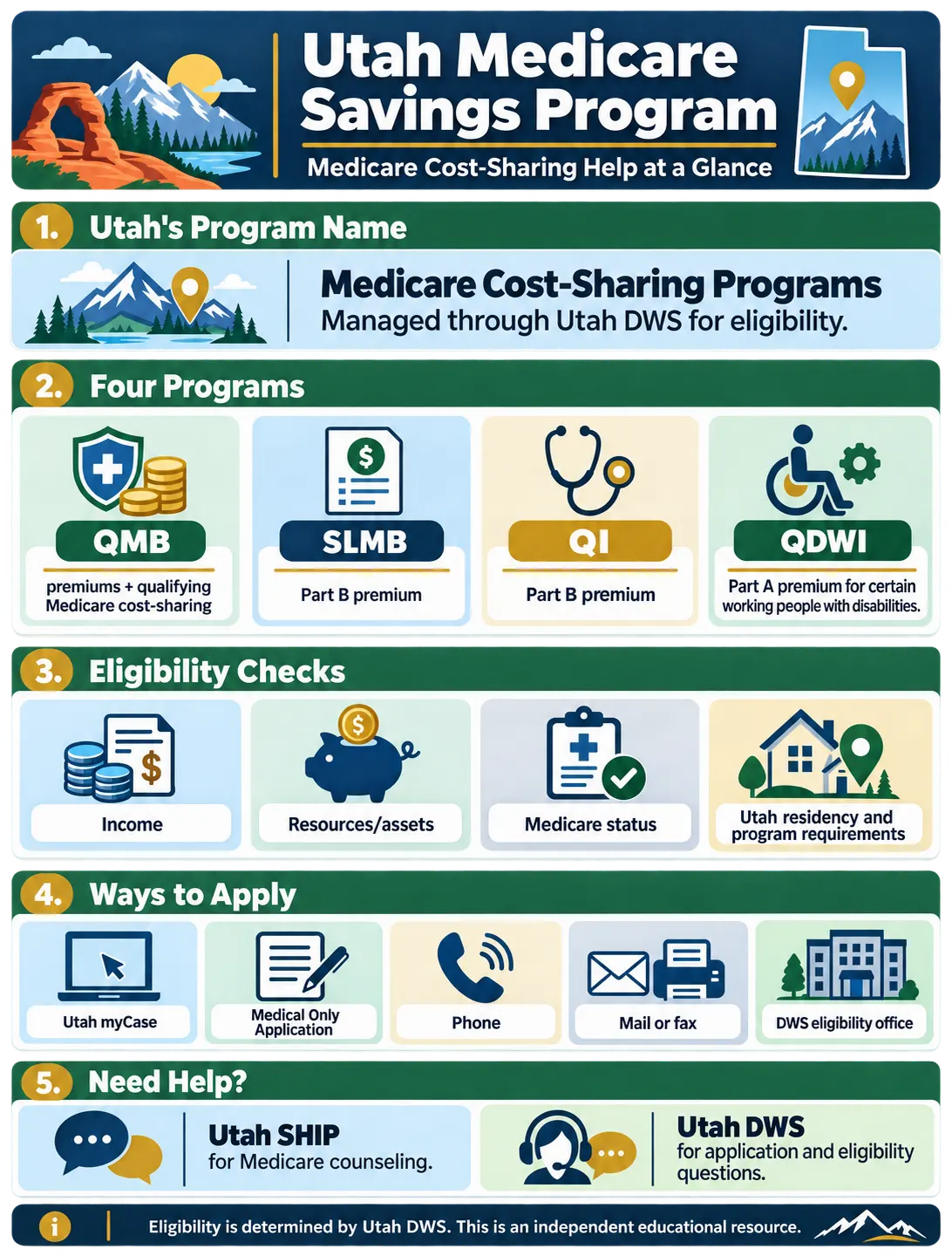
Utah usually calls its Medicare Savings Program benefits Medicare Cost-Sharing Programs. Eligible residents may receive help with Medicare Part A or Part B premiums and, through QMB, certain Medicare deductibles and cost-sharing. Applications are handled by the Utah Department of Workforce Services (DWS), not by Medicare.gov.
Quick Answer
To apply for the Utah Medicare Savings Program, ask DWS to screen you for Medicare Cost-Sharing. You can apply through myCase, submit Utah’s Medical Only Application, call DWS, mail or fax a form, or visit a DWS eligibility office. In 2026, QMB, SLMB and QI may help pay the standard $202.90 monthly Part B premium; QMB provides broader Medicare cost-sharing protection. Income and asset limits apply, and eligibility is not guaranteed.

Who Runs Utah Medicare Cost-Sharing?
The Utah Department of Health and Human Services (DHHS), Division of Integrated Healthcare, administers Utah Medicaid. The Utah Department of Workforce Services determines financial and nonfinancial eligibility and handles applications, reviews and eligibility notices.
The core eligibility rules are statewide, so a Utah resident uses the same DWS system whether applying from Salt Lake City or a rural county. In general, QMB, SLMB and QI applicants must be entitled to or receiving Medicare Part A, meet Utah residency and other nonfinancial requirements, and fall within the applicable income and resource rules. QDWI has special Part A and work-related criteria. Utah’s official Medicare Cost-Sharing overview explains the state terminology and main benefits.
Utah Medicare Savings Program Income Limits for 2026
Utah publishes its own base income standards for Medicare Cost-Sharing. The current state table is effective March 1, 2026. DWS does not always use gross income dollar for dollar; it applies program-specific income exclusions before comparing countable income with the limit.
| Program | Utah base monthly standard individual / couple |
Federal screening amount individual / couple |
2026 asset limit individual / couple |
|---|---|---|---|
| QMB | $1,330 / $1,804 | $1,350 / $1,824 | $9,950 / $14,910 |
| SLMB | $1,596 / $2,164 | $1,616 / $2,184 | $9,950 / $14,910 |
| QI | $1,796 / $2,435 | $1,816 / $2,455 | $9,950 / $14,910 |
| QDWI | $2,660 / $3,607 | $5,405 / $7,299 | $4,000 / $6,000 |
Why are two income figures shown? Utah’s official 2026 eligibility table lists the base federal-poverty-level standards. The national Medicare Savings Programs screening chart includes a general $20 monthly income exclusion for QMB, SLMB and QI. The QDWI screening amount is much higher because federal earned-income exclusions can apply. DWS calculates the amount that actually counts.
What counts toward the Utah asset limit?
Countable resources commonly include money in checking or savings accounts, cash, stocks, bonds and some other property. The home you live in, one car, household and personal items, a burial plot and limited burial funds generally do not count under federal MSP rules. Report every resource requested on the application and let DWS apply the exclusions.
Utah’s 2026 aged, blind and disabled eligibility table confirms asset limits of $9,950 for one person and $14,910 for a married couple for QMB, SLMB and QI. QDWI uses $4,000 and $6,000.
What Do Utah Medicare Cost-Sharing Programs Pay?
Utah’s public page describes QMB, SLMB and QI as its three main Medicare Cost-Sharing Programs. Utah’s eligibility manual also contains QDWI policy for a smaller group of workers with disabilities.
QMB
May pay the Part B premium, the Part A premium when applicable, and Medicare-covered Part A and Part B deductibles, coinsurance and copayments. QMB members have federal billing protections for Medicare-covered services.
SLMB
Pays the Medicare Part B premium. The applicant must receive Medicare Part A. SLMB can be received with Medicaid when all requirements are met.
QI
Pays the Medicare Part B premium. Utah does not provide QI to a person receiving ongoing Medicaid. QI funding is allocated annually, and prior-year recipients receive priority when funds are limited.
QDWI
Pays the Part A premium for certain people under 65 who have a disability, returned to work, lost premium-free Part A because of earnings and meet the other rules. It does not pay the Part B premium.
These benefits are not automatically the same as full Medicaid. A person with QMB-only coverage may receive a Utah Medicaid card marked “Medicare Cost-Sharing Only.” That wording means the person has cost-sharing assistance but may not have full Medicaid medical coverage. See our comparison of Medicare Savings Programs and full Medicaid for the broader distinction.
Why Part B premium help matters in 2026
The standard Medicare Part B premium is $202.90 per month in 2026, or $2,434.80 over 12 months. The annual Part B deductible is $283. QMB may help with both the premium and Medicare-covered cost-sharing; SLMB and QI focus on the Part B premium. These figures are confirmed in the CMS 2026 Medicare Part B fact sheet.
When Does Utah Coverage Start, and Can It Be Retroactive?
- QMB: Utah policy says coverage begins on the first day of the month after DWS determines that the person meets all QMB requirements. QMB is not retroactive and cannot start in the application month.
- SLMB, QI and QDWI: Utah policy allows DWS to consider up to three months before the application month when the applicant met the rules for the category. Eligibility can differ by month, and QI remains subject to available funding.
The Utah retroactive-eligibility policy explains these distinctions. Approval, start dates and any repayment of premiums are not guaranteed; use the effective date in the official DWS notice.
Utah says coordination with Medicare and Social Security may take about three months after eligibility. If Part B premiums were deducted during eligible months, Social Security may later issue a reimbursement. Watch future deposits and notices rather than assuming an exact update or refund date.
How to Apply for Utah Medicare Cost-Sharing
Applications are accepted statewide through DWS. Utah Medicaid says DWS may contact an applicant by mail or phone and may request additional proof before making a decision.
Start with the official Utah application route
Use Utah myCase for an online application, or review the official state instructions for mail, fax and in-person options. The state makes the final decision.
Method 1: Apply Online Through myCase
Use Utah myCase if you can apply online and want to manage the case electronically. DWS says myCase can be used to apply, check status, complete a review, report changes, read notices and print forms or benefit history.
- Create or sign in with a Utah ID.
- Start an application for medical assistance.
- Complete the Medicare questions, including Part A and Part B information.
- Enter household, income and resource details completely.
- Review the entries, submit the application and save the confirmation.
- Watch both myCase and regular mail for a DWS request or decision.
- Upload any requested proof by the deadline shown on the notice.
Prevent a delay: Starting an online application is not the same as submitting it. Use the same name, date of birth and Social Security number shown on Medicare and Social Security records, and keep the confirmation page.
Method 2: Use the Medical Only Application
Use Utah’s current Medical Only Application, form 61MED, if you only want medical assistance, including Medicare Cost-Sharing review. The current form is dated November 1, 2025.
- Complete the applicant and household sections, including spouse information when married.
- Enter Medicare Part A and Part B details.
- Report all income and resources requested by the form.
- Answer the question about medical assistance for the three months before the application month.
- Sign and date the form.
- Keep a full copy and proof of submission.
Mail:
Department of Workforce Services
PO Box 143245
Salt Lake City, UT 84114-3245
A missing signature can delay processing. Do not leave the asset section blank. Write “none” or “$0” only when that is accurate.
Method 3: Use the Multi-Program Application for Broader Help
Use the Multi-Program Application or the corresponding myCase route when the household needs medical assistance plus SNAP, child care or financial assistance. Utah says a separate Medical Only Application is not needed if you submit the Multi-Program Application.
This route may fit a household seeking:
- SNAP food assistance;
- child care assistance;
- financial assistance;
- medical coverage for another household member; or
- a broader DWS benefit review.
Method 4: Apply by Phone or Request a Mailed Form
Call DWS if the online application is difficult, you need a paper form mailed, or you have an urgent question about requested proof:
- Salt Lake area: 801-526-0950
- Toll-free: 1-866-435-7414
Phone help may be useful when a caregiver is assisting, the applicant needs interpreter or accessibility support, the Medical Only and Multi-Program routes are confusing, a notice is difficult to understand, or a verification deadline is approaching.
Suggested wording: “I want to apply for Utah Medicare Cost-Sharing. Please screen me for every category I may qualify for, including QMB, SLMB, QI and QDWI if applicable.” This wording avoids incorrectly claiming current Part A entitlement when the person may instead fit QDWI’s special premium-Part-A rules.
Method 5: Visit a DWS Eligibility Office
Utah accepts in-person applications at DWS eligibility offices. Use the official DWS Eligibility Services page to locate current office information and call before visiting when possible.
- Bring your Medicare card and identifying information.
- Bring income and resource proof.
- Bring a completed application if available.
- Ask for Medicare Cost-Sharing screening.
- Submit copies rather than irreplaceable originals unless DWS specifically requests otherwise.
- Keep a receipt or other proof of submission.
Method 6: Send Verification Documents Correctly
If DWS asks for proof after you apply, follow that notice carefully. You can commonly upload documents through myCase, fax them, mail them to Imaging Operations or take them to a DWS office.
| Method | DWS details |
|---|---|
| Online | Upload securely through myCase |
| Fax paperwork | 801-526-9500 or 1-877-313-4717 |
| Mail paperwork | Imaging Operations, PO Box 143245, Salt Lake City, UT 84114-3245 |
| In person | A DWS eligibility office |
Put the applicant’s name, case number if known, phone number and “Medicare Cost-Sharing” on each page. Save upload screenshots, fax confirmations, postal tracking or office receipts. Utah Medicaid warns against sending protected health information to ordinary Medicaid email addresses; use a secure method.
Method 7: Get Free Application Help From Take Care Utah
Take Care Utah, a nonprofit program of the Utah Health Policy Project, offers free statewide help with Medicaid and other health-coverage applications, renewals and requested documents. Multilingual support is available, and its listed phone number is 801-433-2299.
This help can be useful when myCase is confusing, technology or language is a barrier, a caregiver is assisting, proof is difficult to gather, or a case closed for missing information. Take Care Utah does not decide eligibility; DWS does.
Method 8: Get Free Medicare Counseling From Utah SHIP
Call Utah SHIP at 1-800-541-7735 for free, objective Medicare counseling. Utah Aging & Adult Services confirms that its State Health Insurance Assistance Program helps Medicare-eligible people, their families and caregivers.
SHIP is not the DWS eligibility office, but it can help explain QMB, SLMB and QI; Medicare Advantage or Part D questions; Extra Help that is not showing at the pharmacy; a provider bill after QMB approval; and Medicare Summary Notices.
What Documents May DWS Ask For?
Prepare copies before applying, but submit only what the application or DWS notice requests. DWS may need additional information to verify eligibility.
| Type | Examples DWS may request |
|---|---|
| Medicare | Medicare card and Part A or Part B start dates |
| Income | Social Security award notice, pension statement, wage stubs or retirement income |
| Resources | Bank statements, cash, investments, property details or insurance cash value |
| Identity and residence | Social Security number, date of birth, citizenship or qualified-status proof when requested, and Utah address |
| Other insurance | Medicare Advantage, Part D, employer, retiree or other health coverage information |
Send copies, not originals, unless DWS specifically directs otherwise. Keep a complete application copy and every DWS notice.
Tips That Help Prevent Delay or Denial
- Use Utah’s program name. Ask for “Medicare Cost-Sharing Programs” as well as “Medicare Savings Programs.”
- Ask for every applicable category. Request screening for QMB, SLMB, QI and QDWI if applicable instead of choosing one level yourself.
- Report resources fully. Utah uses asset limits. Leaving accounts, property or cash-value insurance blank can leave the application incomplete.
- Return proof by the notice deadline. If a document is difficult to obtain, contact DWS before the deadline and ask what alternative proof is acceptable.
- Keep contact information current. DWS may use mail or phone. Report changes through myCase or the method listed on your notice.
- Do not confuse QMB-only coverage with full Medicaid. Check whether the card says “Medicare Cost-Sharing Only.”
- Allow for coordination time. A continued Part B deduction immediately after approval does not necessarily mean the case failed.
- Do not send sensitive documents by ordinary email. Use myCase, an authorized fax, mail or a DWS office.
How Does Utah Medicare Cost-Sharing Renewal Work?
DWS says assistance cases are generally reviewed every six to 12 months. It usually sends a review notice during the month before the review is due. A registered myCase user can complete a review online; if the review is completed online, DWS says the paper review does not also need to be returned.
- Open every DWS notice and note the exact due date.
- Complete the review in myCase or return the current paper review as instructed.
- Provide requested income, resource and Medicare proof.
- Save confirmation that the review and verifications were received.
- Read the final eligibility notice and verify the program and effective dates.
QI requires a new determination each year and is subject to annual funding. People who received QI in the previous year generally receive priority, but continued eligibility is not guaranteed. Review the official DWS review instructions and our detailed guide to Medicare Savings Program renewal.
What If Utah Denies or Closes the Application?
Read the notice carefully. It should state the reason, the income or resource calculation, the effective date and hearing rights. Common problems include missing proof, a missing signature, an unreported resource, a data mismatch or use of the wrong program rule.
- Compare the notice with the application and the proof you submitted.
- Call DWS at 801-526-0950 or 1-866-435-7414 for an explanation.
- If information is missing, ask whether it can still be provided and how to submit it.
- If you disagree with the decision, follow the hearing deadline and instructions printed on the notice. Do not rely on a generic deadline from another program.
- Keep copies of the request, supporting records and delivery confirmation.
DWS lists an official public-assistance fair-hearing process and a toll-free fair-hearing number, 1-877-837-3247. For application or eligibility complaints, DWS Customer Relations lists 801-526-4390 and 1-800-331-4341. Our guide on what to do after a Medicare Savings Program denial provides a document checklist.
If the Part B Premium Still Comes Out
A continued Social Security deduction does not always mean the application was denied. The state, Medicare and Social Security systems may need time to coordinate.
Check the approval notice for:
- the program approved—QMB, SLMB or QI;
- the effective date;
- any outstanding verification request;
- changes in future Social Security deposits; and
- any separate reimbursement from Social Security.
For eligibility questions, call DWS at 801-526-0950 or 1-866-435-7414. For Medicare counseling, call Utah SHIP at 1-800-541-7735. Learn more about help paying the Medicare Part B premium.
If QMB is approved and you still receive a bill
Federal law generally prevents providers from billing QMB members for Medicare Part A or Part B deductibles, coinsurance and copayments for Medicare-covered services. A small Medicaid copayment may still apply in limited circumstances.
- Do not ignore the bill, but do not assume you owe it.
- Call the provider’s billing office and explain that you had QMB on the service date.
- Show your Medicare card, Utah QMB information and approval notice.
- Ask the provider to verify QMB status and correct the account.
- Keep the bill and Medicare Summary Notice.
- Call Utah SHIP or 1-800-MEDICARE if the provider does not correct an improper charge.
See our detailed QMB Medicare Savings Program guide for more about billing protections.
Does Approval Include Extra Help for Prescriptions?
People whose state pays their Part B premium through a Medicare Savings Program automatically qualify for Medicare Part D Extra Help. Extra Help can reduce drug-plan premiums, deductibles and copayments. In 2026, Medicare says a person with Extra Help generally pays no more than $5.10 for each covered generic drug or $12.65 for each covered brand-name drug at a participating pharmacy; some people with full Medicaid and QMB pay less.
Read the official Medicare Extra Help information. If Extra Help has not appeared after MSP approval, contact the Part D plan, Utah SHIP or 1-800-MEDICARE and keep the approval notice and prescription receipts.
Does Utah recover Medicare Cost-Sharing from an estate?
Federal Medicaid rules prohibit estate recovery of Medicare cost-sharing paid on behalf of Medicare Savings Program beneficiaries. However, Utah may seek recovery of certain other Medicaid assistance, particularly qualifying services received at age 55 or older, subject to survivor protections and other rules. Someone who also has full Medicaid or long-term-services-and-supports coverage should review Utah’s official estate-recovery information or seek legal advice about that separate coverage.
Utah Contacts and Official Links
| Need | Official or verified resource |
|---|---|
| Apply or manage a case online | Utah myCase |
| Medical-only application | Current Utah form 61MED |
| Application methods and broader benefits form | Utah Medicaid application page |
| DWS eligibility questions | 801-526-0950 or 1-866-435-7414 |
| Mail applications or paperwork | PO Box 143245, Salt Lake City, UT 84114-3245; follow the current form or notice for the addressee |
| Fax eligibility paperwork | 801-526-9500 or 1-877-313-4717; confirm the correct fax for a new application because official pages conflict |
| Medicaid benefit or plan help | Health Program Representative: 1-866-608-9422 |
| Free Medicare counseling | Utah SHIP: 1-800-541-7735 |
| Free application assistance | Take Care Utah: 801-433-2299 |
| Eligibility complaint | DWS Customer Relations: 801-526-4390 or 1-800-331-4341 |
| Fair-hearing information | 1-877-837-3247; follow the appeal instructions and deadline on the decision notice |
Utah-Specific Mistakes to Avoid
- Applying only through Medicare.gov: Medicare explains the programs, but Utah DWS handles the application.
- Using the wrong form: Use Medical Only for medical-only help and the Multi-Program route for broader benefits.
- Calling the benefit only “MSP”: Also say “Medicare Cost-Sharing Programs,” Utah’s official wording.
- Self-denying based on gross income: DWS applies income-counting rules and exclusions.
- Leaving out assets: Utah applies resource limits to these categories.
- Ignoring proof requests: Respond by the date on the notice or contact DWS before it passes.
- Assuming QMB-only means full Medicaid: Check the approval notice and card wording.
- Expecting an immediate Social Security update: Coordination can take time, and no refund date is guaranteed.
- Assuming QI continues automatically: QI requires annual review and depends on annual funding.
- Emailing sensitive records: Use secure upload, confirmed fax, mail or a DWS office.
Continue Your Research
Compare Utah’s process with the recently published Nevada Medicare Savings Program guide, or review the complete QMB, SLMB, QI and QDWI program comparison.
For deeper screening guidance, see the national explanations of Medicare Savings Program income limits and MSP resource limits.
Frequently Asked Questions
What is Utah’s Medicare Savings Program called?
Where do I apply online for Utah Medicare Cost-Sharing?
What paper form should I use?
Where do I mail a Utah medical application?
What fax number should I use?
Does Utah have an asset limit for Medicare Cost-Sharing?
Can I receive Utah QI if I already have Medicaid?
How long does the Part B premium update take?
Can Utah Medicare Cost-Sharing be retroactive?
Who can help with Medicare questions for free?
Conclusion
Utah Medicare Savings Program applicants should use the state’s actual DWS process. In Utah, the benefits are usually called Medicare Cost-Sharing, and residents can apply through myCase, the Medical Only Application, a Multi-Program Application, mail, fax, phone or a local DWS eligibility office.
Use the correct form, report income and resources fully, respond to DWS proof requests, keep contact information current and read the approval notice carefully. Remember that a QMB-only card may say “Medicare Cost-Sharing Only” and does not necessarily provide full Medicaid.
Think your income or resources may be close?
Submit an application and let Utah DWS calculate countable income and make the official decision. Eligibility and approval are not guaranteed.