Alaska Medicare Savings Program 2026: Income Limits, Benefits & How to Apply
Alaska Medicare Cost Assistance Guide
Alaska Medicare Savings Program 2026: Income Limits, Benefits and How to Apply
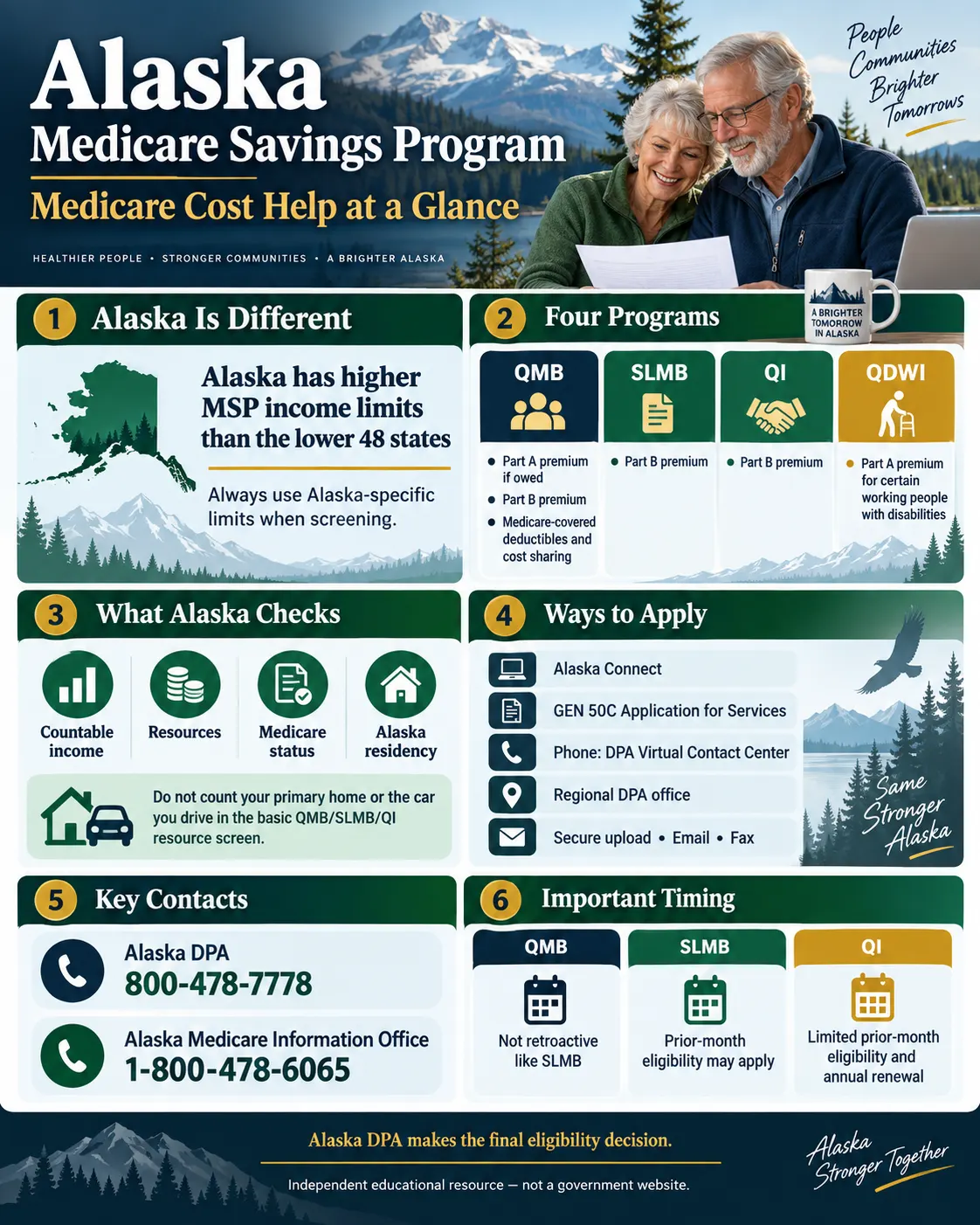
Medicare Savings Program Alaska rules are different from the limits shown for most states. Alaska has higher income limits, and eligible Medicare beneficiaries may receive help with Part B premiums and, through QMB, Medicare-covered deductibles, coinsurance and copayments.
Last verified September 8, 2026, using current Alaska Department of Health, Division of Public Assistance, Medicare, Medicaid.gov, CMS and Social Security information. Alaska DPA makes the final eligibility decision.
Independent educational resource
This website is not Medicare, CMS, Social Security, Alaska Medicaid, the Alaska Department of Health or another government agency. We do not process or approve applications. Income, resources, Medicare status and other eligibility requirements apply. Alaska’s Division of Public Assistance makes the official eligibility decision.
The Alaska Difference
Do not use a lower-48 MSP income chart to decide whether you qualify in Alaska.
Alaska has higher federal poverty guidelines, so its QMB, SLMB, QI and QDWI income limits are higher. In 2026, Alaska’s highest regular MSP tier, QI, reaches $2,265 per month for one person and $3,064 for a married couple.
Quick Answer
| What you need | Alaska route |
|---|---|
| Eligibility agency | Alaska Division of Public Assistance (DPA) |
| Apply online | Alaska Connect |
| Apply by phone | 800-478-7778 |
| Paper form | GEN 50C – Application for Services |
| Statewide VCC fax | 888-269-6250 |
| Anchorage VCC fax | 907-269-6520 |
| Email DPA | [email protected] |
| Free Medicare counseling | Alaska Medicare Information Office: 1-800-478-6065 |
| Programs | QMB, SLMB, QI and QDWI |
The standard Medicare Part B premium is $202.90 per month in 2026. The annual Part B deductible is $283.
Table of Contents
- 2026 Alaska MSP limits
- Why Alaska’s limits are higher
- Countable income
- Resource and asset limits
- What QMB, SLMB, QI and QDWI pay
- How to apply
- Alaska Connect
- Apply by phone
- GEN 50C paper application
- Upload, email and fax
- DPA offices
- After applying
- After approval
- Retroactive MSP rules
- Extra Help
- Renewal
- Denial and appeal
- QMB billing protection
- Estate recovery
- Where to get help
- FAQs

Medicare Savings Program Alaska applicants should use Alaska-specific figures rather than relying on a national chart for the 48 contiguous states.
If Medicare premiums are cutting into a fixed monthly income, an MSP may help. Depending on the program, Alaska can pay the Medicare Part B premium, and QMB can provide much broader protection from Medicare-covered deductibles, coinsurance and copayments.
For a general explanation, visit our Medicare Savings Programs educational resource. Our most recently published state article covers the Medicare Savings Program in New Mexico.
Alaska Medicare Savings Program Income Limits for 2026
Alaska uses the four federal Medicare Savings Program categories: QMB, SLMB, QI and QDWI.
| Program | Individual monthly income | Married couple | Individual resources | Couple resources | Main benefit |
|---|---|---|---|---|---|
| QMB | $1,683 | $2,275 | $9,950 | $14,910 | Part A premium if owed, Part B premium and Medicare-covered cost sharing |
| SLMB | $2,015 | $2,725 | $9,950 | $14,910 | Part B premium |
| QI | $2,265 | $3,064 | $9,950 | $14,910 | Part B premium |
| QDWI | $6,735 | $9,102 | $4,000 | $6,000 | Part A premium for certain working people with disabilities |
The QMB, SLMB and QI figures include the standard $20 monthly income disregard. QDWI figures also incorporate earned-income exclusions.
Alaska’s Department of Health identifies the 2026 regular MSP limits as effective April 1, 2026. The more detailed Alaska-specific program-by-program limits are also published in the Social Security Administration’s 2026 MSP table.
Near the limit? Do not automatically rule yourself out. Social Security instructs staff to encourage people to apply even when income or resources appear somewhat above MSP screening limits because the final countable amount can be different.
Why Are Alaska’s MSP Income Limits Higher?
This is where generic Medicare articles often create confusion.
The 2026 national QI screening limit for most states is $1,816 per month for one person.
In Alaska, the comparable QI limit is $2,265.
That is a difference of $449 per month.
The reason is that Alaska has a higher federal poverty guideline than the 48 contiguous states.
Medicare’s national Medicare Savings Program page specifically warns readers that income limits are higher in Alaska and Hawaii.
Someone living in Anchorage, Fairbanks, Juneau or rural Alaska could therefore appear over income on a lower-48 chart while still falling inside an Alaska MSP range.
Always use the Alaska numbers.
Is the Alaska MSP Limit Based on Gross Income?
Not always.
Medicare Savings Program eligibility is based on countable income. The amount DPA uses may not be identical to the amount printed on your Social Security benefit statement, pension check or pay stub.
Income you may need to report includes:
- Social Security benefits.
- Pension or retirement income.
- Wages.
- Self-employment income.
- Other recurring payments requested on the application.
Alaska’s published MSP figures already include a $20 monthly income disregard.
Do not subtract $20 yourself and report a lower number. Give DPA the actual income information the application requests and allow the agency to calculate countable income.
This is especially important when the household is only a few dollars above a screening figure.
See our Medicare Savings Program income-limit guide for more on gross versus countable income.
Does Alaska Have an MSP Asset Limit?
Yes.
For QMB, SLMB and QI, the 2026 resource limits are:
One person: $9,950
Married couple: $14,910
For QDWI:
One person: $4,000
Married couple: $6,000
Alaska says countable MSP assets can include money in:
- Bank accounts.
- Savings.
- Investment accounts.
- Other countable financial resources.
Do not count your primary home or car
Alaska’s current MSP guidance specifically says:
- Do not count the home you live in.
- Do not count the car you drive.
So do not add the market value of your primary residence to your savings account and automatically conclude that you are over the limit.
Federal MSP rules also provide a burial exclusion of up to $1,500 per person for designated burial funds in the standard resource calculation.
Other exclusions can apply. Report the resources DPA asks about and let the agency decide what counts.
Read our Medicare Savings Program resource-limit guide.
What Does Alaska’s Medicare Savings Program Pay?
QMB: Qualified Medicare Beneficiary
QMB provides the broadest Medicare cost assistance.
It can help pay:
- The Medicare Part A premium if you owe one.
- The Medicare Part B premium.
- Medicare Part A and Part B deductibles.
- Coinsurance.
- Medicare-covered copayments.
QMB beneficiaries also have federal protection from being billed for Medicare-covered Part A and Part B cost sharing.
Read our QMB Medicare Savings Program guide.
SLMB: Specified Low-Income Medicare Beneficiary
SLMB pays the Medicare Part B premium.
At the standard 2026 Part B rate of $202.90 per month, that is up to $2,434.80 over a full year for someone paying the standard premium all 12 months.
SLMB does not provide the broader QMB cost-sharing protection.
QI: Qualifying Individual
QI also pays the Medicare Part B premium, but it serves the higher income tier above SLMB.
QI is subject to federal funding rules. Medicare states that QI applications are approved on a first-come, first-served basis, with priority for people who received QI benefits during the previous year and continue to qualify.
QI recipients generally cannot also qualify for another Medicaid benefit category.
QDWI: Qualified Disabled & Working Individual
QDWI is for certain people with disabilities who returned to work and lost premium-free Medicare Part A because of their work earnings.
QDWI helps pay the Medicare Part A premium only.
In 2026, the full Medicare Part A premium can be as high as $565 per month. Some people who have 30–39 quarters of Medicare-covered work pay the reduced 2026 premium of $311 per month.
CMS publishes these amounts in its 2026 Medicare Parts A and B cost guidance.
How Do You Apply for the Medicare Savings Program in Alaska?
The Alaska Division of Public Assistance (DPA) handles eligibility and applications.
Current Alaska options include:
- Apply online through Alaska Connect.
- Apply by phone through the Virtual Contact Center.
- Use the GEN 50C Application for Services.
- Visit a regional DPA office.
- Upload documents securely.
- Email documents or information to DPA.
- Fax an application or supporting documents.
The current Alaska DPA services page provides the state’s application and contact routes.
Option 1: Apply Online Through Alaska Connect
For many applicants, Alaska Connect is the easiest place to start.
Alaska expanded its online application system in 2026 with a mobile-friendly Application for Services that tailors questions to the programs selected.
How to apply online
- Open Alaska Connect.
- Sign in with an existing myAlaska account or create one.
- Start the Application for Services.
- Select the Medicare Savings Program or Medicare Savings Plans option when available.
- Enter Medicare information carefully.
- Report household and spouse information when requested.
- Enter Social Security, pension, wages and other income.
- Complete the resource questions.
- Review the application.
- Submit it and save proof of submission.
- Continue using Alaska Connect to upload requested documents, report changes and renew benefits.
If the portal has a technical problem, DPA currently lists [email protected] for technical support.
Use Alaska’s official application system
Make clear that you want help paying Medicare costs through a Medicare Savings Program and keep your submission confirmation.
Option 2: Apply by Phone
You do not need internet access to start the process.
Call the Alaska DPA Virtual Contact Center:
800-478-7778
TDD/Alaska Relay: 7-1-1
Hours: Monday–Friday, 8 a.m.–5 p.m.
DPA says people applying for Medicaid due to age or disability can use the Virtual Contact Center to apply over the phone.
What to say when you call
A simple description is:
“I have Medicare and want to apply for a Medicare Savings Program.”
Have available:
- Medicare information.
- Social Security information.
- Pension or retirement information.
- Wages if you work.
- Basic bank and resource information.
Ask whether DPA needs additional proof and write down the date you applied.
DPA notes that the option to speak with an agent after 3 p.m. may be limited when call volume is high, so earlier calls may be easier.
Option 3: Apply With Alaska Form GEN 50C
Alaska’s current paper form is the Application for Services, GEN 50C.
The current official form is revised December 2025 and specifically includes a checkbox for:
Medicare Savings Plans — Helps Medicare recipients pay for all or part of their Medicare premiums.
You can open the current official GEN 50C Application for Services.
This corrects an older concern that the direct state PDF was unreliable. Alaska currently hosts an official updated version.
What the form asks for
The application can request information about:
- Identity.
- Household members.
- Alaska residency.
- Medicare and other health coverage.
- Social Security and pension income.
- Employment and self-employment.
- Bank accounts and other resources.
- Other information needed for the programs selected.
The application also says that the applicant’s legal name, address and signature on the required application page can establish a filing date, although other programs can have different benefit start rules.
Complete as much of the form as possible, sign it, keep a complete copy and return any verification DPA later requests.
How Do You Submit an Alaska Application or Supporting Documents?
DPA currently accepts applications and supporting information through several channels.
Secure upload
Use the secure document upload feature through Alaska Connect.
DPA says the upload system can accept:
- Applications.
- Recertifications and renewals.
- Requested verification.
- Pay stubs.
- Identification documents.
- Other supporting records.
If contacting DPA about an existing case, include enough identifying information for DPA to match the information to the correct case, while avoiding unnecessary sensitive information in an unsecured message.
Fax to the Virtual Contact Center
Statewide: 888-269-6250
Anchorage area: 907-269-6520
Do not confuse the two statewide-looking fax numbers. The Virtual Contact Center lists 888-269-6250 for statewide applications, information and reports of change. Regional DPA offices commonly list 888-269-6520. If sending something to a specific office, use that office’s current listed fax.
Always save your fax confirmation, upload receipt or sent-email record.
Option 4: Apply at an Alaska DPA Office
You can also get an application, submit documents or ask for help at a Division of Public Assistance office.
Use the current Alaska DPA office directory before traveling.
Most regional offices currently provide in-person service from 9 a.m. to 4 p.m., with interviews generally closing at 3 p.m.. Unless otherwise noted, offices provide full service Monday through Thursday and more limited clerical service Friday.
Schedules can vary by location.
| Area | Current DPA location |
|---|---|
| Anchorage | University Center, 4001 Ingra Street, Suite 131, Anchorage, AK 99503 |
| Fairbanks | 675 7th Avenue, Station E, Fairbanks, AK 99701 |
| Juneau | 10002 Glacier Highway, Suite 201, Juneau, AK 99801 |
| Wasilla / Mat-Su | 855 W. Commercial Drive, Wasilla, AK 99654 |
| Kenai | 11312 Kenai Spur Highway, Suite 2, Kenai, AK 99611 |
| Bethel | 460 Ridgecrest Drive, Suite 121, Bethel, AK 99559 |
| Kodiak | 211 Mission Road, Suite 101, Kodiak, AK 99615 |
If you live far from an office, verify current hours before making the trip.
When you arrive, say that you need to apply for a Medicare Savings Program, not simply “Medicaid,” so staff understand the type of Medicare cost assistance you are asking about.
What Happens After You Apply?
Submitting an application does not necessarily finish the process.
DPA may request verification such as:
- Medicare information.
- Social Security or pension statements.
- Recent pay stubs.
- Bank statements.
- Identity or residency documents.
- Other information needed to calculate eligibility.
Keep your own record of:
- The date you applied.
- Your confirmation or reference number.
- Documents you submitted.
- Upload receipts.
- Fax transmission confirmations.
- Important DPA calls and notices.
To check a case or ask whether something is missing, call 800-478-7778.
Processing-time caution: Alaska’s current general application form lists up to 45 days for MAGI Medicaid and up to 90 days for Medicaid applications involving a disability determination. Those numbers should not be treated as a guaranteed MSP decision date. If an MSP application appears stalled, contact DPA and ask what is still needed.
Alaska MSP Application Checklist
- Apply: Use Alaska Connect, call DPA, use GEN 50C or visit a DPA office.
- Ask for MSP: Clearly say you need help with Medicare costs through a Medicare Savings Program.
- Report income: Give DPA the actual amounts requested rather than subtracting disregards yourself.
- Report resources: List accounts requested on the application; do not count your primary home or car as basic MSP assets.
- Send proof: Return requested bank statements, pension records or other verification by the deadline.
- Save copies: Keep confirmations, upload receipts, emails and fax records.
- Read your mail: DPA may need more information before it can make an eligibility decision.
A Practical Alaska Tip: Keep Proof of Every Submission
Alaska accepts documents through Alaska Connect, regional offices, email and multiple fax routes.
That makes recordkeeping particularly useful.
Keep a simple application folder or digital note showing:
- When you applied.
- Which application route you used.
- What documents you sent.
- Where you sent them.
- When you followed up.
- What DPA told you was still missing.
If DPA later cannot locate a document, a fax confirmation or upload receipt gives you something specific to reference instead of starting from memory.
What Happens After Alaska Approves the MSP?
If Alaska approves QMB, SLMB or QI, the state can begin paying the applicable Medicare premium through the state buy-in system.
The change may not appear in the first Social Security payment immediately after approval.
SSA explains that once Part B buy-in takes effect:
- The Part B premium stops being deducted for months covered by buy-in.
- Premiums already deducted or paid for months covered by buy-in are refunded.
If the deduction continues, first check:
- Which MSP was approved.
- The effective date on the Alaska notice.
- Whether DPA still needs verification.
- Later Social Security payments.
- Any separate premium refund or adjustment.
Contact DPA for the state eligibility record. The Alaska Medicare Information Office can help with the Medicare side of the issue.
Read our Medicare Part B premium help guide.
Can Alaska MSP Benefits Be Retroactive?
It depends on the program.
QMB is not retroactive in the same way
Federal QMB rules provide that QMB eligibility starts no earlier than the month following the month the person is determined eligible.
Do not assume that a later QMB approval automatically wipes out Medicare cost sharing from the three months before the application.
SLMB can have prior-month eligibility
Federal Medicaid rules allow SLMB eligibility to be retroactive for up to three months before the application month when all eligibility requirements were met.
QI has a special calendar-year rule
QI determinations may also be retroactive for a maximum of three months, but QI retroactivity cannot extend into the previous calendar year.
Use the Alaska approval notice. The program level and effective date matter. Do not assume every MSP provides the same retroactive coverage.
Does Alaska MSP Include Medicare Extra Help?
People who qualify for QMB, SLMB or QI generally automatically qualify for Medicare Part D Extra Help.
Alaska’s Medicare Information Office specifically says that people already receiving Medicaid, SSI or Medicare Savings Program assistance automatically qualify for Extra Help and do not need to submit a separate application.
In 2026, full Extra Help generally provides:
- $0 premium for an applicable benchmark Part D plan.
- $0 Part D deductible.
- Up to $5.10 for a covered generic drug.
- Up to $12.65 for a covered brand-name drug.
- $0 for covered prescriptions after total drug costs reach $2,100.
Review Medicare’s current Extra Help information.
How Do You Renew an Alaska Medicare Savings Program?
DPA periodically reviews continued eligibility for public-assistance programs.
Alaska Connect can be used to:
- Renew benefits.
- Upload verification.
- Update contact information.
- Report changes.
DPA also uses the Eligibility Review Form, GEN-72, for most public-assistance review or recertification processes. A prefilled review form may be sent with the renewal notice.
QI has an additional federal rule: QI eligibility must be renewed every year, and funding remains subject to the annual QI allotment.
To reduce the chance of a coverage gap:
- Keep your mailing address, phone number and email current.
- Open every DPA notice.
- Complete the review by the deadline shown.
- Provide requested income and resource information.
- Keep proof of submission.
- Read the final eligibility notice carefully.
Read our Medicare Savings Program renewal guide.
What if Alaska Denies Your MSP Application?
Read the denial notice before immediately submitting another application.
A denial or delay can involve:
- Missing documents.
- Countable income above the applicable limit.
- Countable resources above the applicable limit.
- Incomplete household or spouse information.
- Medicare information that could not be verified.
- A missing signature.
- A missed verification or renewal deadline.
If DPA says income is too high, ask what countable income amount it used and how it was calculated.
If a document is missing, ask whether the case can be corrected before starting a duplicate application.
Can You Appeal an Alaska MSP Decision?
Yes.
Alaska’s current Application for Services says Medicaid applicants have a right to request a fair hearing when they believe DPA made an incorrect eligibility decision.
The application states that fair-hearing requests for applicable public-assistance decisions generally must be made within 30 days from the date of the notice.
A Medicaid hearing request may be made to DPA in person, by telephone or in writing.
If existing benefits are being changed or ended, requesting the hearing before the effective date of the action can matter for continued benefits while the appeal is pending.
Follow your own notice. Do not wait until day 30 if the notice gives you an earlier date to protect existing coverage. Appeal instructions can differ depending on what action is being challenged.
Contact DPA at 800-478-7778 if you need help understanding how to request the eligibility hearing.
Read our Medicare Savings Program denial guide.
What if You Have Alaska QMB and Receive a Medicare Bill?
QMB provides strong federal billing protection.
Medicare providers and suppliers generally may not bill a QMB beneficiary for Medicare-covered Part A or Part B:
- Deductibles.
- Coinsurance.
- Copayments.
If a bill arrives:
- Do not automatically pay it.
- Confirm QMB was active on the service date.
- Confirm Medicare covered the service or item.
- Call the provider’s billing department.
- Tell the office you are a QMB beneficiary.
- Provide your Medicare and Alaska QMB information.
- Ask the office to correct the protected cost-sharing balance.
- Keep the bill and Medicare Summary Notice.
- Contact the Alaska Medicare Information Office or 1-800-MEDICARE if the billing continues.
QMB does not make every service free. You may still owe for services or items that Medicare does not cover.
Review the official CMS QMB billing guidance.
Does Estate Recovery Apply to Alaska Medicare Savings Program Help?
Medicare Savings Program premium and Medicare cost-sharing assistance should not be confused with long-term-care Medicaid estate recovery.
Current federal MSP guidance states that estate recovery does not apply to help paid through an MSP for Medicare premiums or Medicare cost sharing.
Alaska’s general Medicaid application does contain estate-recovery language, but it describes recovery associated with certain other Medicaid services, particularly institutional and home- and community-based services for people age 55 or older.
If you receive only MSP premium or cost-sharing assistance, do not assume that the broader long-term-care estate-recovery rules automatically apply to that MSP help.
If you also receive full Medicaid, nursing-facility coverage, HCBS waiver services or another Medicaid benefit, separate Alaska estate-recovery rules may apply.
7 Alaska MSP Mistakes to Avoid
- Using lower-48 income limits. Alaska has higher QMB, SLMB, QI and QDWI limits.
- Using $2,265 for every program. That is Alaska’s 2026 QI limit for one person. QMB and SLMB have lower limits.
- Looking only at gross income. MSP eligibility uses countable-income rules and applicable exclusions.
- Counting your home or primary car as basic MSP assets. Alaska’s published MSP guidance tells applicants not to count them.
- Not keeping proof. Save upload receipts, screenshots, emails and fax confirmations.
- Ignoring a DPA request. Additional verification may be needed even after the application is submitted.
- Automatically paying a QMB cost-sharing bill. QMB beneficiaries have federal protection from Medicare-covered deductibles, coinsurance and copayments.
Where Can You Get Help With an Alaska MSP?
Alaska Division of Public Assistance
Use DPA for:
- Applications.
- Eligibility questions.
- Missing documents.
- Case status.
- Renewals.
- Reporting changes.
Virtual Contact Center: 800-478-7778
TDD/Alaska Relay: 7-1-1
Email: [email protected]
Visit the Alaska Division of Public Assistance services page.
Alaska Medicare Information Office
The Alaska Medicare Information Office is the state’s SHIP program and provides free, unbiased Medicare counseling.
Toll-free: 1-800-478-6065
Anchorage: 907-269-3680
Email: [email protected]
Counselors can help with:
- Medicare Savings Programs.
- Extra Help.
- Part D.
- Medicare Advantage.
- Medigap.
- Medicare billing questions.
Visit the Alaska Medicare Information Office.
Medicare
1-800-MEDICARE: 1-800-633-4227
TTY: 1-877-486-2048
Use Medicare for Medicare coverage questions, QMB billing problems and Medicare records. DPA—not Medicare—makes the Alaska MSP eligibility decision.
Alaska Medicare Savings Program FAQs
What is the Alaska Medicare Savings Program income limit for 2026?
It depends on the program. For one person, the 2026 monthly limits are $1,683 for QMB, $2,015 for SLMB, $2,265 for QI and $6,735 for QDWI. For a married couple, the limits are $2,275, $2,725, $3,064 and $9,102 respectively.
Why are Alaska MSP income limits higher than other states?
Alaska has higher federal poverty guidelines than the 48 contiguous states. Medicare and Social Security therefore publish higher Alaska income limits for QMB, SLMB, QI and QDWI.
What is the Alaska MSP asset limit?
For QMB, SLMB and QI, the 2026 resource limit is $9,950 for one person and $14,910 for a married couple. QDWI uses $4,000 for one person and $6,000 for a couple.
Does my house count toward the Alaska MSP resource limit?
Alaska’s current MSP guidance says not to count the home you live in or the car you drive toward the basic QMB, SLMB and QI resource screen.
Where do I apply for the Alaska Medicare Savings Program?
Apply through Alaska Connect, call the Alaska Division of Public Assistance at 800-478-7778, use the GEN 50C Application for Services, or visit a regional DPA office.
Can I apply for Alaska MSP by phone?
Yes. Alaska DPA says people applying for Medicaid due to age or disability can call the Virtual Contact Center at 800-478-7778 to apply over the phone.
What paper form do I use for an Alaska MSP?
Use Alaska’s GEN 50C Application for Services. The current state form specifically includes “Medicare Savings Plans” as a program option.
What if my income is slightly above the Alaska limit?
Consider applying instead of ruling yourself out. MSP uses countable income, the published Alaska limits include a $20 monthly disregard, and additional exclusions can affect eligibility in some situations.
Does Alaska MSP pay the Medicare Part B premium?
QMB, SLMB and QI can pay the Medicare Part B premium. QMB can also help with Medicare-covered deductibles, coinsurance and copayments. QDWI instead helps certain working people with disabilities pay the Part A premium.
Is Alaska QMB retroactive?
QMB generally begins no earlier than the month after the eligibility determination and does not use the same three-month retroactive rule that can apply to SLMB. QI can also have limited prior-month eligibility, but it cannot extend into a previous calendar year.
Why is Social Security still deducting my Part B premium after Alaska approves MSP?
State buy-in can take time to appear in Social Security records. Once buy-in is processed, Part B premiums should no longer be deducted for covered months, and premiums already paid for covered months are generally refunded.
Does Alaska MSP automatically give me Medicare Extra Help?
People receiving QMB, SLMB or QI generally qualify automatically for Medicare Part D Extra Help. Alaska’s Medicare Information Office says people already receiving MSP assistance do not need to submit a separate Extra Help application.
How long do I have to appeal an Alaska MSP denial?
Alaska’s current Application for Services says applicable public-assistance fair-hearing requests generally must be made within 30 days from the notice date. Follow the exact instructions on your notice, especially if you want existing benefits continued while the appeal is pending.
Does estate recovery apply to Alaska MSP benefits?
Federal MSP guidance says estate recovery does not apply to Medicare premiums or cost-sharing assistance paid through an MSP. Other Alaska Medicaid benefits, including some long-term-care services, can have separate estate-recovery rules.
Who can help me with Alaska Medicare questions for free?
Call the Alaska Medicare Information Office at 1-800-478-6065, or 907-269-3680 in Anchorage, for free Medicare counseling. For MSP applications and eligibility questions, call DPA at 800-478-7778.
Conclusion
The Alaska Medicare Savings Program is worth checking even when a national Medicare chart makes your income look too high.
Alaska’s limits are substantially higher than the limits for most states. In 2026, one person can have countable monthly income up to $2,265 under QI, while the married-couple QI limit is $3,064. QMB has a lower income limit but provides much broader Medicare cost protection.
Use Alaska Connect, call DPA at 800-478-7778, submit the current GEN 50C or visit a regional DPA office.
If your income is close to a cutoff, do not stop at an online calculator. Give DPA the requested income and resource information and let the agency make the countable-income determination.
Keep copies of your application and supporting documents, answer verification requests promptly, and read the approval or denial notice carefully.
Apply through an official Alaska channel
If you think you may qualify, submit an application and let Alaska DPA determine your countable income, resources and correct MSP category.
Editorial disclaimer: This article provides general educational information and is not legal, financial, medical or benefits advice. Income limits, resource limits, forms, contact details and procedures can change. Review current Alaska Department of Health instructions and your individual DPA notice. Alaska DPA makes the final eligibility determination.