Maryland Medicare Savings Program 2026: Application & Limits
Maryland Medicare Cost Assistance Guide
Maryland Medicare Savings Program 2026: Income Limits, Application and Retroactive Benefits
Maryland Medicare Savings Programs may help eligible Medicare beneficiaries pay Medicare premiums. QMB may also protect eligible beneficiaries from Medicare-covered deductibles, coinsurance and copayments.
Reviewed August 10, 2026, using current Maryland Department of Health, Maryland Department of Human Services, Maryland Department of Aging, Medicare, CMS and Maryland regulations. Maryland makes the final eligibility decision.
Independent educational resource
This website is not Medicare, CMS, Maryland Medicaid, the Maryland Department of Health or the Department of Human Services. It does not process or approve applications. Use current official Maryland forms and follow the instructions and deadlines printed on your eligibility notice.
Quick Answer
Maryland offers four Medicare Savings Program categories:
- QMB may pay Medicare Part A and Part B premiums and Medicare-covered deductibles, coinsurance and copayments.
- SLMB pays the Medicare Part B premium.
- QI pays the Medicare Part B premium for people with income above the SLMB range.
- QDWI may pay the Medicare Part A premium for certain working people with disabilities.
The standard Medicare Part B premium is $202.90 per month in 2026, or $2,434.80 over a full year. The 2026 Part B deductible is $283.
Which Maryland Application Route Should You Use?
MSP-only help: Maryland’s dedicated Medicare Savings Program instructions currently direct applicants to submit the MSP application to their local Department of Social Services in person or by mail.
MSP plus full Medicaid: If you are applying based on being age 65+, blind or disabled and want broader Medicaid coverage too, MarylandBenefits.gov or your local DSS is the broader route.
Table of Contents
- 2026 income and asset limits
- What each program pays
- Who may qualify
- Apply for MSP-only help
- Apply for MSP plus full Medicaid
- Maryland Health Connection
- Documents to prepare
- Processing and follow-up
- Retroactive MSP benefits
- Part B deduction after approval
- Annual renewal
- Denial and appeal
- QMB billing protection
- Extra Help and SPDAP
- Estate recovery
- Free Maryland help
- FAQs
If you have Medicare in Maryland and the $202.90 monthly Part B premium is taking too much out of your Social Security payment, a Medicare Savings Program may be able to help pay it.
For a person approved for QMB, the assistance can be more valuable than the premium alone. QMB may also cover Medicare Part A and Part B deductibles and coinsurance, and federal law protects QMB beneficiaries from being billed for Medicare-covered cost sharing.
The harder part for many Maryland residents is knowing which application system to use and understanding why QMB, SLMB and QI do not all begin on the same date.
For general program information, visit our Medicare Savings Programs educational resource. The latest state article explains the South Carolina Medicare Savings Program and Healthy Connections application process.

Maryland Medicare Savings Program Income and Asset Limits for 2026
Maryland’s current Medicare Savings Program page directs applicants to the current Medicare MSP limits. The following 2026 figures are useful screening amounts.
| Program | Individual income | Couple income | Individual resources | Couple resources |
|---|---|---|---|---|
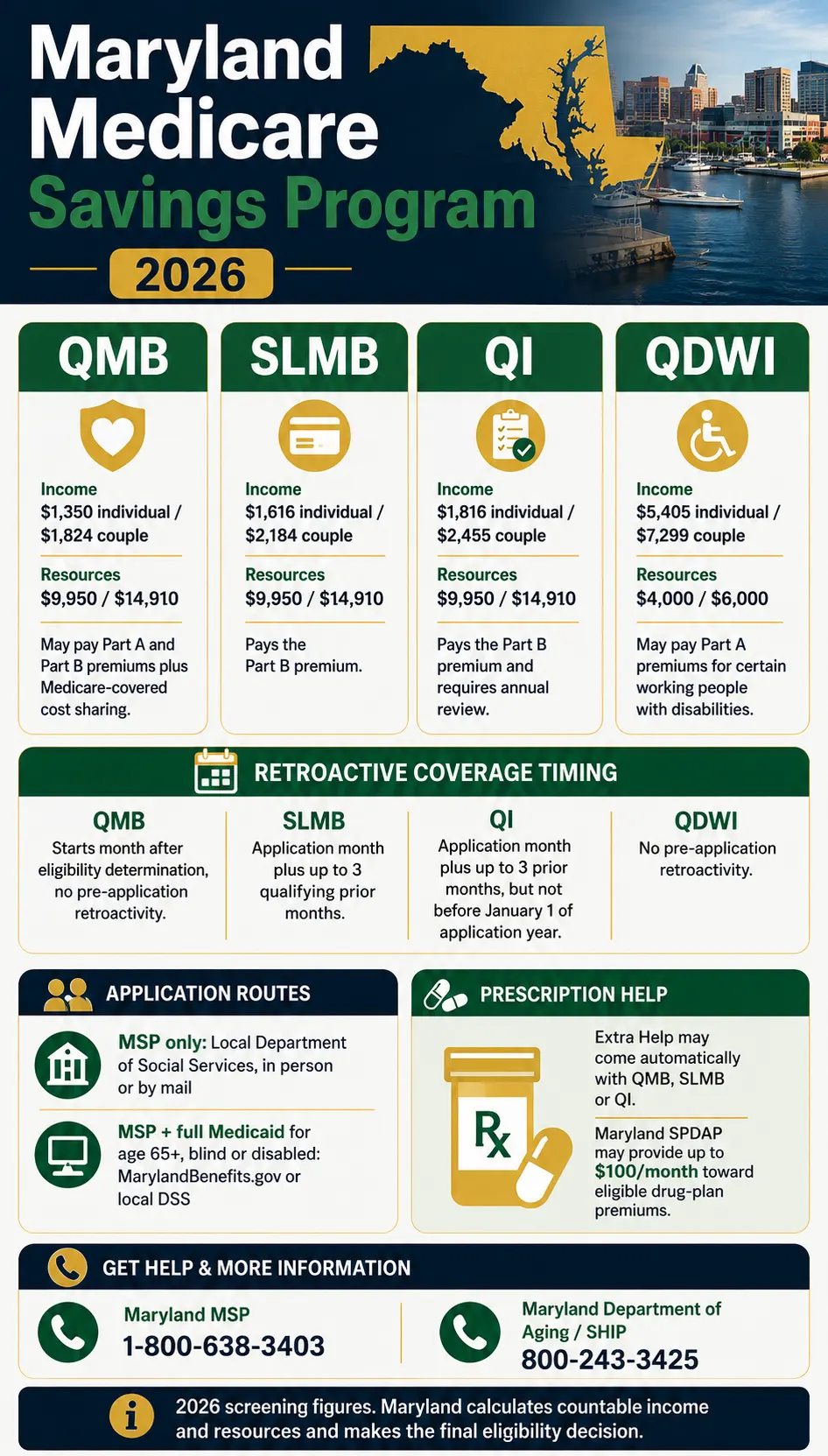
| QMB | $1,350/month | $1,824/month | $9,950 | $14,910 |
| SLMB | $1,616/month | $2,184/month | $9,950 | $14,910 |
| QI | $1,816/month | $2,455/month | $9,950 | $14,910 |
| QDWI | $5,405/month | $7,299/month | $4,000 | $6,000 |
These are screening limits, not an automatic eligibility decision.
Maryland regulations use net countable income and program-specific resource rules. Income and resources that appear on a bank statement or benefit letter are not necessarily counted dollar-for-dollar in the final determination.
Maryland also temporarily disregards the annual Social Security cost-of-living increase until after the updated federal poverty level is published and incorporated into the eligibility calculation.
Apply if you are close to a limit. Do not assume that being a few dollars above an online table means you are automatically ineligible. Maryland must calculate countable income and resources.
Review the official 2026 Medicare Savings Program limits and our Medicare Savings Program income-limit guide.
What resources may count?
Depending on the application, Maryland may ask about:
- Checking accounts.
- Savings accounts.
- Certificates of deposit.
- Stocks and bonds.
- Retirement or investment accounts.
- Property other than excluded property.
- Other assets requested by DSS.
Maryland regulations also provide specific exclusions, including treatment of life-insurance cash value and certain burial or funeral funds.
Do not transfer property or move money simply because you think an asset may count. Ask DSS or a qualified benefits counselor how the rules apply first.
See our MSP resource-limit guide.
What Does Each Maryland Medicare Savings Program Pay?
| Program | Main assistance | Who should pay attention |
|---|---|---|
| QMB | Part B premium, Part A premium when owed, Medicare-covered deductibles and coinsurance | People struggling with both premiums and Medicare medical bills |
| SLMB | Part B premium | People above the QMB income range who mainly need premium help |
| QI | Part B premium | People above the SLMB range who are not otherwise eligible for Medicaid |
| QDWI | Part A premium | Certain working people with disabilities who lost premium-free Part A |
QMB: Premium and Medicare cost-sharing help
QMB provides the broadest Medicare Savings Program assistance.
Maryland QMB may pay:
- The Medicare Part B premium.
- The Medicare Part A premium if you are not entitled to premium-free Part A.
- Medicare Part A deductibles.
- Medicare Part B deductibles.
- Medicare coinsurance for Medicare-covered services.
Federal QMB billing rules also protect beneficiaries from Medicare-covered Part A and Part B copayments and other cost sharing.
SLMB: Part B premium help
SLMB pays the Medicare Part B premium. It does not provide the broader Medicare cost-sharing protection that QMB provides.
For someone paying the standard 2026 Part B premium, a full year of assistance could remove up to $2,434.80 in standard premium costs.
QI: Part B premium help at a higher income level
QI also pays the Medicare Part B premium.
Important QI rules include:
- Income is higher than the SLMB range but below the QI limit.
- QI is for people who are not otherwise eligible for Medicaid.
- Eligibility must be reviewed each year.
- Funding is limited.
- Previous-year QI beneficiaries generally receive priority.
QDWI: Part A premium help
QDWI is a narrower category for certain working people with disabilities.
Maryland regulations require the applicant to be under age 65, meet the disability and employment-related requirements, be entitled to enroll in premium Part A, satisfy QDWI financial rules and not otherwise be eligible for Medicaid.
Who May Qualify for an MSP in Maryland?
You may qualify if you:
- Are a Maryland resident.
- Meet the Medicare entitlement requirements for the applicable program.
- Meet the applicable countable-income standard.
- Meet the applicable resource standard.
- Meet Maryland Medicaid’s non-financial requirements.
- Provide enough information for the eligibility agency to make a decision.
When you are married and living with your spouse, Maryland generally considers the spouse’s countable income and resources as part of the assistance unit.
You do not need to choose the correct program yourself. Ask to be screened for every Medicare Savings Program for which you may qualify.
See our guide explaining who may qualify for a Medicare Savings Program.
How to Apply if You Only Want Medicare Savings Program Help
Maryland’s current dedicated MSP page gives two primary application routes:
- Apply in person at your local Department of Social Services.
- Mail the MSP application to your local Department of Social Services.
Start from the official Maryland Medicare Savings Program page.
Maryland DHS maintains the current MSP application in its official forms directory:
Open the Maryland DHS QMB, SLMB and MSP application forms directory
Use the Maryland DHS local-office directory to identify the DSS serving your county or Baltimore City.
Before mailing the MSP application
- Complete every applicable question.
- Sign and date the application.
- Include requested copies of verification.
- Keep a complete copy.
- Confirm the local DSS mailing address.
- Keep proof of when the application was sent.
If you hand-deliver the application, ask for a date-stamped copy or other receipt when possible.
Maryland MSP program help
Phone: 1-800-638-3403
Hours: Monday-Friday, 8:00 a.m.-5:00 p.m.
What if You Also Need Full Maryland Medicaid?
The route is broader when you want more than Medicare premium assistance.
Maryland says people applying on the basis of being age 65+, blind or disabled may apply:
- Online through MarylandBenefits.gov.
- In person at a local Department of Social Services.
- By mailing the appropriate application to a local DSS.
If you need both full Medicaid and Medicare Savings Program screening, say so clearly.
“I have Medicare and want to be evaluated for QMB, SLMB, QI and any full Medicaid program for which I may qualify.”
Read our Medicare Savings Program versus Medicaid comparison.
Should You Apply Through Maryland Health Connection?
Usually not as the primary route when your Medicaid application is based on being age 65+, blind or disabled.
Maryland’s application chart separates these groups:
| Applicant group | Primary route |
|---|---|
| Adults 20-64, children, pregnant applicants, parents and certain other MAGI groups | Maryland Health Connection |
| Age 65+, blind or disabled | MarylandBenefits.gov, local DSS or mail |
| MSP-only application | Dedicated MSP application through local DSS |
If you are bounced between systems, call Maryland’s MSP program or contact Maryland SHIP for help identifying the correct route.
What Documents Should You Gather?
You do not need a perfect file before starting, but having common records nearby can make follow-up easier.
You may be asked for:
- Medicare card.
- Social Security number.
- Maryland home and mailing addresses.
- Social Security benefit information.
- Pension or retirement statements.
- Recent pay information if working.
- Self-employment information when applicable.
- Bank statements.
- Investment or resource information.
- Spouse information when married.
- Other health-insurance information.
- Recent Medicare, Medicaid, DSS or Social Security notices.
Do not hand over your only copy of an irreplaceable record unless the agency specifically needs to inspect an original.
One of the most common benefits-application problems is not a complicated eligibility rule. It is an unsigned form, an incomplete statement or a missed verification letter.
How Long Can a Maryland Eligibility Decision Take?
Maryland fair-hearing regulations establish timeframes that allow an applicant to appeal when an eligibility application is not acted on promptly.
- Aged or blind Medicaid applicants: generally 45 days.
- Applications requiring a disability determination: generally 60 days.
These are regulatory processing benchmarks, not a promise that every MSP case will take exactly that long.
If your case appears stalled:
- Confirm the application was received.
- Ask whether verification is missing.
- Ask whether the application has been assigned.
- Keep a record of calls and submission dates.
- Contact Maryland SHIP or the MSP program when the problem involves Medicare buy-in or program coordination.
Maryland MSP Timing and Retroactive Benefits
The effective date depends on which program Maryland approves.
| Program | Current eligibility | Prior months |
|---|---|---|
| QMB | First day of the month after QMB eligibility is determined | No retroactive QMB coverage before the application month |
| SLMB | First day of the application month | Up to 3 calendar months before application if eligible in each month |
| QI | First day of the application month | Up to 3 prior months, but not before January 1 of the application year |
| QDWI | Effective date depends on SSA and QDWI enrollment rules | No retroactive coverage before the application month |
Important: QMB does not work like SLMB. Do not assume QMB will automatically protect you from deductibles or coinsurance from three months before your application.
What Happens if the Part B Premium Is Still Deducted After Approval?
An MSP approval does not always cause the next Social Security payment to change immediately.
The approval must move through Maryland’s Medicare buy-in process and federal Medicare and Social Security systems.
Keep:
- Your Maryland approval notice.
- The effective date.
- Social Security payment records.
- Bank statements showing continued premium deductions.
- Any later Medicare or Social Security adjustment notice.
If deductions continue after approval, contact the local DSS or Maryland Medicare Savings Program and ask whether the Medicare buy-in information has been transmitted correctly.
Do not assume that a single continued deduction means your eligibility was cancelled.
Review our Part B premium help guide.
How Does Maryland MSP Renewal Work?
Maryland regulations require MSP eligibility to be redetermined at least once every 12 months.
Maryland Medicaid’s current renewal guidance says:
- Medicaid coverage is generally renewed every 12 months.
- A renewal notice is sent when action is required.
- People who are age 65+, blind or disabled renew through the Department of Human Services rather than the normal Maryland Health Connection route.
- The renewal notice generally gives 60 days to respond.
- Changes affecting eligibility should be reported promptly.
Maryland regulations also allow the redetermination form to ask whether anything has changed since the last review.
Keep your mailing address current. Missing a renewal letter can eventually cause the Part B premium to begin coming out of your Social Security payment again.
Review the official Maryland Medicaid renewal guidance and our MSP renewal checklist.
What Should You Do if Maryland Denies or Ends Your MSP?
Read the entire notice before assuming that you were denied only because of income.
Common problems may include:
- Missing verification.
- An unsigned application.
- An incomplete bank statement.
- Incorrect spouse information.
- A document that was submitted but not matched to the case.
- An income exclusion that was not applied.
- A missed renewal or verification deadline.
If you disagree:
- Identify the exact reason on the notice.
- Call the local DSS and ask how income and resources were calculated.
- Submit missing or corrected information when appropriate.
- Request a fair hearing before the deadline if you disagree with the eligibility decision.
- Keep proof of every submission.
Maryland Medicaid appeal deadline
For Medicaid eligibility decisions, Maryland generally requires a fair-hearing request within 90 days from the date on the notice.
If you already have Medicaid coverage and want it to continue while the appeal is pending, Maryland says you generally need to appeal within 10 calendar days of the applicable notice, postmark or action date described by the state.
Use the deadline on your individual notice. Continuation-of-benefits deadlines can be much shorter than the overall appeal period.
Maryland’s Medicaid Appeals office currently lists:
Maryland Department of Health
Attention: Medicaid Appeals
201 West Preston St., L9
Baltimore, MD 21201
Fax: 410-333-5154
Use the official Maryland Medicaid appeal page for the current online fair-hearing request and instructions.
See our Medicare Savings Program denial guide.
What if You Have QMB but a Doctor Still Sends You a Bill?
Federal law prohibits Medicare providers and suppliers from billing people enrolled in QMB for Medicare-covered Part A and Part B deductibles, coinsurance and copayments.
This protection is important because an incorrect medical bill can look legitimate even when the QMB beneficiary has no legal obligation to pay the protected amount.
If a bill appears:
- Confirm that QMB was active on the date of service.
- Check whether Medicare covered the service.
- Call the provider’s billing office.
- Explain that you are enrolled in the Qualified Medicare Beneficiary program.
- Ask the billing office to verify your QMB status.
- Show your Medicare and available Medicaid or QMB documentation.
- Keep the bill and Medicare Summary Notice.
- Contact Medicare or Maryland SHIP if the billing problem continues.
1-800-MEDICARE: 1-800-633-4227
Medicare TTY: 1-877-486-2048
If you already paid prohibited QMB cost sharing, CMS says providers may be required to refund improper payments.
QMB does not make every service free. You may still owe for non-covered services or other charges not protected by QMB rules.
Review the official CMS QMB billing guidance and our QMB Medicare Savings Program guide.
MSP Approval Can Also Unlock Prescription Drug Help
People who qualify for QMB, SLMB or QI generally qualify automatically for Medicare Part D Extra Help.
In 2026, Extra Help can provide:
- A $0 premium for a qualifying Part D plan priced at or below the applicable benchmark.
- A $0 Part D deductible.
- Generic prescription copays of no more than $5.10.
- Brand-name prescription copays of no more than $12.65.
- $0 for covered drugs after total drug costs reach $2,100.
- No Part D late-enrollment penalty while receiving Extra Help.
If you also have full Medicaid and QMB, Medicare says the maximum covered-drug copay can be lower.
Review Medicare’s official Extra Help information.
Maryland Senior Prescription Drug Assistance Program
Maryland also operates the Senior Prescription Drug Assistance Program, or SPDAP, for qualifying Medicare beneficiaries.
Current 2026 SPDAP information says the program may pay a subsidy of up to $100 per month toward an approved Maryland Medicare prescription drug plan or Medicare Advantage plan with drug coverage.
SPDAP eligibility currently includes requirements such as:
- Maryland residency for at least six months.
- Medicare eligibility.
- Enrollment in qualifying prescription drug coverage.
- Household income at or below 300% of the Federal Poverty Level.
SPDAP is not the same program as Extra Help. Someone with prescription costs may benefit from asking about both.
Visit the Maryland SPDAP website for current eligibility and enrollment information.
Does Estate Recovery Apply to Maryland MSP Benefits?
Federal Medicaid rules specifically protect Medicare cost-sharing payments made on behalf of Medicare Savings Program beneficiaries from estate recovery.
This means MSP Medicare premium and cost-sharing assistance should not automatically be treated the same as recoverable nursing-facility or home and community-based Medicaid benefits.
However, a person who receives an MSP together with full Medicaid or long-term care services may have a different estate-recovery situation because other Medicaid benefits can be subject to separate federal and state rules.
Do not make estate-planning decisions based only on an MSP article. Review the actual Medicaid coverage received and obtain qualified advice when necessary.
Where Can You Get Free Medicare Help in Maryland?
| What you need | Official resource |
|---|---|
| Maryland MSP questions | Maryland Medicare Savings Program: 1-800-638-3403 |
| MSP-only application | Maryland MSP page |
| Find local DSS | DHS local offices |
| Broader age 65+, blind or disabled Medicaid application | MarylandBenefits.gov |
| DHS general assistance | 1-800-332-6347 |
| Free Medicare counseling | Maryland SHIP |
| Maryland Department of Aging toll-free | 800-243-3425 |
| SPDAP prescription premium help | Maryland SPDAP: 1-800-551-5995 |
| Medicare and QMB billing | 1-800-MEDICARE: 1-800-633-4227 |
| Medicare TTY | 1-877-486-2048 |
Maryland’s SHIP network provides free and confidential one-on-one Medicare counseling. The Department of Aging currently lists 19 local SHIP offices across the state.
SHIP can help with:
- QMB, SLMB and QI screening questions.
- Medicare Savings Program applications.
- Part B premium problems after approval.
- QMB billing disputes.
- Medicare Extra Help.
- SPDAP.
- Medicare plan questions.
- Medicare appeals and billing problems.
SHIP does not sell insurance.
Not sure which Maryland application route applies?
For MSP-only help, start with Maryland’s MSP page and local DSS. If you also need full Medicaid based on age, blindness or disability, MarylandBenefits.gov or local DSS is the broader route.
Common Maryland MSP Mistakes to Avoid
Applying through the wrong system
For MSP-only help, follow the dedicated Maryland MSP instructions and local DSS route. If you also need full Medicaid based on age, blindness or disability, MarylandBenefits.gov is available.
Assuming every MSP goes back three months
QMB, SLMB and QI have different effective-date rules. QMB does not provide pre-application retroactive coverage, while SLMB and QI can in qualifying situations.
Paying a QMB bill without checking it
Federal billing protections apply to Medicare-covered QMB cost sharing. Verify the bill before paying.
Treating the income chart as an automatic rejection
Maryland determines countable income and resources. Apply if you appear close to the screening amounts.
Forgetting the annual review
MSP eligibility must be redetermined at least every 12 months. QI also has specific annual eligibility and funding rules.
Using an outdated SPDAP subsidy amount
Current 2026 SPDAP guidance says the premium subsidy may be up to $100 per month, not $75.
Maryland Medicare Savings Program FAQs
What is the Medicare Savings Program in Maryland?
Maryland’s Medicare Savings Program, also called Medicare Buy-In, is Medicaid-administered assistance that may help qualifying Medicare beneficiaries pay Part A or Part B premiums and, under QMB, Medicare-covered cost sharing.
What is the 2026 Maryland QMB income limit?
The current 2026 screening limit is $1,350 per month for one person and $1,824 for a married couple. Current screening resource limits are $9,950 and $14,910.
What is the 2026 SLMB income limit?
The current 2026 screening limit is $1,616 per month for one person and $2,184 for a married couple.
What is the 2026 QI income limit?
The current 2026 screening limit is $1,816 per month for one person and $2,455 for a married couple.
Can I apply for Maryland MSP online?
Maryland’s dedicated MSP page currently directs MSP-only applicants to apply in person or mail an application to their local DSS. People seeking broader Medicaid based on being age 65+, blind or disabled may apply through MarylandBenefits.gov.
Does Maryland QMB cover the previous three months?
No. Maryland regulations state that QMB becomes effective the first day of the month after eligibility is determined and does not provide retroactive QMB coverage before the application month.
Can SLMB be retroactive in Maryland?
Yes. Maryland allows up to three calendar months of retroactive SLMB benefits before the application month when the applicant met SLMB requirements during each month.
Can QI be retroactive in Maryland?
Potentially. QI may cover up to three prior months when all requirements were met, but a retroactive QI month cannot be earlier than January 1 of the year in which the person applied.
Does QMB protect me from Medicare copay bills?
Yes. Federal law prohibits Medicare providers and suppliers from billing QMB beneficiaries for Medicare-covered Part A and Part B deductibles, coinsurance and copayments.
Do QMB, SLMB and QI include Extra Help?
People receiving state help paying their Part B premium through QMB, SLMB or QI generally receive Medicare Part D Extra Help automatically.
How much can Maryland SPDAP pay in 2026?
Current Maryland SPDAP guidance says the program can provide a subsidy of up to $100 per month toward an eligible Maryland prescription drug plan or Medicare Advantage plan with drug coverage.
How often does Maryland review MSP eligibility?
Maryland regulations require MSP eligibility to be redetermined at least once every 12 months.
How long do I have to appeal a Maryland Medicaid eligibility decision?
Maryland generally requires an eligibility fair-hearing request within 90 days from the date on the notice. A shorter 10-day period may apply when an existing beneficiary wants coverage to continue while the appeal is pending.
Who can help me for free?
Maryland SHIP provides free and confidential Medicare counseling. You can also call the Maryland Medicare Savings Program at 1-800-638-3403 for MSP-specific questions.
Bottom Line
For many Maryland Medicare beneficiaries, the first benefit they notice from a Medicare Savings Program is straightforward: the monthly Part B premium may stop reducing their Social Security payment.
For QMB beneficiaries, the value may be much greater because federal billing protections apply to Medicare-covered deductibles, coinsurance and copayments.
The main challenge is choosing the correct Maryland application route and understanding when each program begins.
For MSP-only help: start with Maryland’s dedicated Medicare Savings Program application and your local DSS.
If you also want full Medicaid based on being age 65+, blind or disabled: use MarylandBenefits.gov or contact local DSS and request screening for both Medicaid and the Medicare Savings Programs.
If you are unsure: call the Maryland Medicare Savings Program at 1-800-638-3403 or use Maryland SHIP for free counseling.
Apply through the correct Maryland channel
Do not spend weeks trying to decide whether you are probably eligible. Submit the appropriate application, keep proof and allow Maryland to calculate countable income and resources.
Editorial disclaimer: This article provides general educational information and is not legal, financial or benefits advice. Income limits, resource standards, application forms, drug assistance, appeal procedures and contact information may change. Check current Maryland and Medicare guidance and follow the instructions on your individual notice. Maryland makes the final eligibility decision.