Minnesota Medicare Savings Program 2026: DHS-3876 & Limits
Minnesota Medicare Cost Assistance Guide
Minnesota Medicare Savings Program 2026: DHS-3876, Income Limits and How to Apply
Minnesota Medicare Savings Programs may help eligible Medicare beneficiaries pay Medicare premiums. QMB may also pay Medicare-covered deductibles, coinsurance and copayments.
Reviewed August 12, 2026, using current Minnesota Department of Human Services, Minnesota Health Care Programs, Minnesota Aging Pathways, Medicare, CMS and Medicaid guidance. The county or Tribal agency makes the final eligibility decision.
Independent educational resource
This website is not Medicare, CMS, Minnesota DHS, Medical Assistance or another government agency. It does not process or approve applications. Use current Minnesota forms and follow the instructions and deadlines on your Health Care Notice.
Minnesota’s Most Important Application Rule
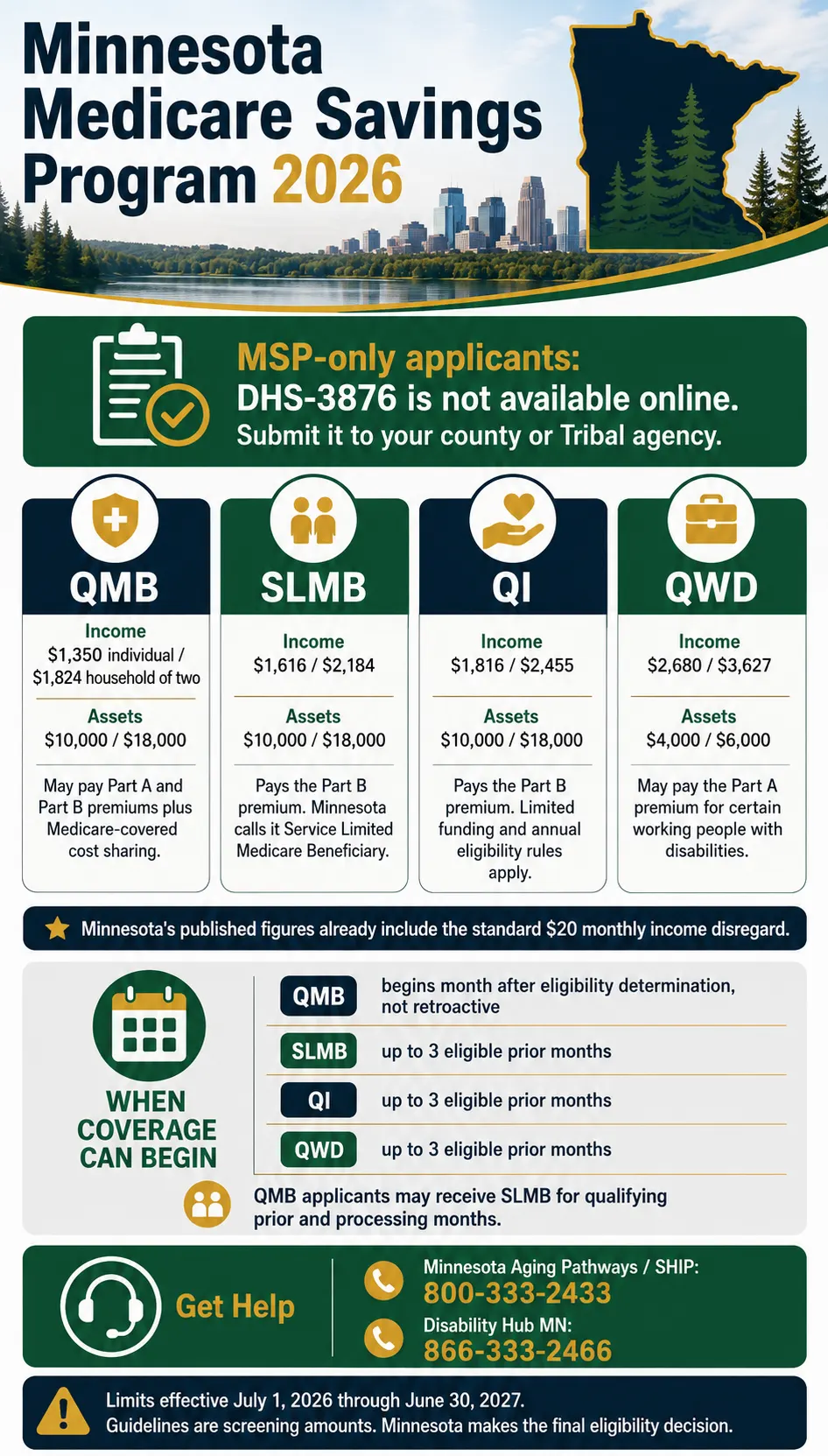
If you are applying only for a Medicare Savings Program, Minnesota DHS currently directs you to DHS-3876. The dedicated DHS-3876 route is not available as an online application. Submit the completed form to the county or Tribal agency that handles your case.
Quick Answer
- QMB may pay Medicare Part A and Part B premiums plus Medicare-covered deductibles, coinsurance and copayments.
- SLMB pays the Medicare Part B premium. Minnesota calls it Service Limited Medicare Beneficiary.
- QI pays the Part B premium for people in a higher income range, subject to program funding rules.
- QWD is Minnesota’s name for the Qualified Working Disabled category, commonly called QDWI nationally. It may pay the Part A premium.
- MSP-only form: DHS-3876.
- Submit to: Your Minnesota county or Tribal agency.
The standard Medicare Part B premium is $202.90 per month in 2026, equal to $2,434.80 over a full year. The 2026 Part B deductible is $283.
2026 Minnesota Limits Are Now Updated
Minnesota’s current MSP income and asset guidelines are effective July 1, 2026 through June 30, 2027. The standard $20 monthly income disregard is already included in Minnesota’s published QMB, SLMB, QI and QWD figures below.
Table of Contents
- 2026 income and asset limits
- What assets count
- Asset Verification Service
- QMB, SLMB, QI and QWD
- MSP versus Medical Assistance
- Who may qualify
- Apply with DHS-3876
- County or Tribal agency
- When LoginMN applies
- Free application assistance
- Health Care Consumer Support
- Minnesota Aging Pathways / SHIP
- Disability Hub MN
- Documents to prepare
- After you apply
- Retroactive benefits
- Part B still deducted
- QMB billing protection
- Extra Help
- Renewals
- Denial and appeal
- Estate recovery
- Minnesota help and contacts
- FAQs
If your Medicare Part B premium is coming out of your Social Security payment, Minnesota’s Medicare Savings Program may help lower that cost.
Minnesota’s application system is different from several other states. An applicant seeking only Medicare Savings Program assistance generally does not use a dedicated online Medicare portal. Instead, Minnesota DHS directs the applicant to the DHS-3876 paper application and the appropriate county or Tribal agency.
That distinction matters. Using the wrong application route can create unnecessary delays.
For broader MSP education, visit our Medicare Savings Programs educational resource. State rules vary significantly. The previous state guide explains the Oregon Medicare Savings Program and its no-asset rule.

Minnesota Medicare Savings Program Income and Asset Limits for 2026
Minnesota DHS publishes the following MSP guidelines effective July 1, 2026 through June 30, 2027.
| Program | Individual monthly income | Couple monthly income | Individual asset limit | Household of two asset limit |
|---|---|---|---|---|
| QMB | $1,350 | $1,824 | $10,000 | $18,000 |
| SLMB | $1,616 | $2,184 | $10,000 | $18,000 |
| QI | $1,816 | $2,455 | $10,000 | $18,000 |
| QWD Federal QDWI category |
$2,680 | $3,627 | $4,000 | $6,000 |
Minnesota’s current chart states that the standard $20 monthly disregard is already included for QMB, SLMB, QI and QWD.
This is important because you should not add another $20 to the figures in the table.
DHS also describes these figures as approximations for general reference. The actual decision is based on Minnesota’s countable-income rules and your household circumstances.
Do not self-deny. If your income or assets are close to the limit, submit an application and let the county or Tribal agency calculate eligibility.
Review the official Minnesota income and asset guidance and our Medicare Savings Program income-limit guide.
What Assets Does Minnesota Review?
Minnesota has an asset test for its Medicare Savings Programs.
Assets can include:
- Checking accounts.
- Savings accounts.
- Certificates of deposit.
- Stocks and bonds.
- Retirement accounts.
- Other financial investments.
- Certain real property.
- Life insurance cash value when applicable.
- Other resources requested by the county or Tribal worker.
Not every asset is countable.
Minnesota DHS says that, in most cases:
- The home where you live does not count.
- One car generally does not count.
Other exclusions may also apply depending on the asset and eligibility category.
Do not transfer property, close accounts or give away money simply because you believe an asset will count. Ask your eligibility worker how Minnesota’s rules apply.
Read our Medicare Savings Program asset and resource guide.
What Is Minnesota’s Asset Verification Service?
Some Minnesota Medicare Savings Program applicants must authorize the Asset Verification Service, or AVS.
AVS is used to verify certain financial accounts held at financial institutions, such as checking and savings accounts.
Your county or Tribal worker determines whether AVS authorization is required.
If required, the worker sends an authorization form. Depending on your circumstances, signatures may also be required from a spouse or immigration sponsor.
Do not ignore an AVS request. Minnesota DHS states that an MSP application can be denied when required AVS authorization is not completed and returned.
If you need more time, contact the county or Tribal worker immediately rather than allowing the deadline to pass.
Review the official Minnesota Asset Verification Service guidance.
What Does Each Minnesota Medicare Savings Program Pay?
| Program | What Minnesota calls it | What it may pay |
|---|---|---|
| QMB | Qualified Medicare Beneficiary | Part A premium if owed, Part B premium, Medicare-covered deductibles, coinsurance and copayments |
| SLMB | Service Limited Medicare Beneficiary | Medicare Part B premium |
| QI | Qualified Individual | Medicare Part B premium |
| QWD | Qualified Working Disabled | Medicare Part A premium |
QMB: The broadest Medicare Savings Program
QMB may pay:
- Medicare Part A premium when you owe one.
- Medicare Part B premium.
- Part A deductibles.
- Part B deductibles.
- Medicare coinsurance.
- Medicare-covered copayments.
Minnesota allows a person to qualify for QMB-only or for QMB together with Medical Assistance when the person meets both sets of rules.
SLMB: Minnesota calls it Service Limited Medicare Beneficiary
National Medicare materials use the name Specified Low-Income Medicare Beneficiary.
Minnesota DHS uses Service Limited Medicare Beneficiary.
Both refer to the SLMB Medicare Savings Program.
SLMB pays the Medicare Part B premium and can be available by itself or alongside Medical Assistance when the applicable rules are met.
QI: Part B premium help with limited funding
QI pays the Medicare Part B premium.
Minnesota DHS notes:
- A limited amount of QI funding is available.
- Benefits are handled on a first-come, first-served basis.
- A person generally cannot have ongoing QI and Medical Assistance at the same time.
- QI beneficiaries automatically qualify for Medicare Part D Extra Help.
Limited exceptions can create temporary overlap while retroactive MA or another eligibility determination is being processed.
QWD: Minnesota’s QDWI category
Minnesota calls this category Qualified Working Disabled, or QWD. Medicare commonly refers to the category as Qualified Disabled and Working Individuals, or QDWI.
QWD may pay the Part A premium for certain employed people under age 65 who:
- Meet a blindness or disability basis.
- Are eligible to enroll in premium Medicare Part A under the qualified working disabled provisions.
- Meet the QWD income and asset standards.
- Are not otherwise eligible for Medical Assistance.
A person cannot remain enrolled in both QWD and MA.
Is Minnesota MSP the Same as Medical Assistance?
No. Medical Assistance, or MA, is Minnesota’s Medicaid program. A Medicare Savings Program is a particular type of help with Medicare costs.
| Approval wording | What it generally means |
|---|---|
| QMB only | Medicare premium and protected Medicare cost-sharing help, but not necessarily full MA |
| SLMB only | Part B premium assistance |
| QI only | Part B premium assistance, generally without ongoing MA |
| QMB + MA | Medicare cost assistance plus broader Medical Assistance coverage |
| MA with an MSP | The county or Tribal agency determined that you meet both program requirements |
Read the Health Care Notice carefully so you know exactly which benefits were approved.
See our Medicare Savings Program versus Medicaid guide.
Who May Qualify in Minnesota?
Eligibility depends on the program, but you generally need to:
- Live in Minnesota.
- Meet the Medicare eligibility or enrollment rules for the applicable MSP.
- Meet the applicable countable-income limit.
- Meet the applicable asset limit.
- Meet citizenship or qualifying immigration rules.
- Provide information needed by the county or Tribal agency to determine eligibility.
A spouse’s income and assets may affect the calculation depending on the household.
You do not need to decide the correct MSP yourself. Ask the county or Tribal agency to screen you for every program that may apply.
Read our guide explaining who may qualify for a Medicare Savings Program.
Application Method 1: Apply With DHS-3876
For an MSP-only applicant, DHS-3876 is Minnesota’s main route.
Minnesota DHS directs applicants to DHS-3876 when every person applying fits the applicable certain-population rules, including cases where the applicant is:
- Age 65 or older.
- Blind or has a disability.
- Receiving Supplemental Security Income.
- Age 21 or older with Medicare and no children under 19 at home.
- Applying only for a Medicare Savings Program.
- Applying for Medical Assistance for Employed Persons with Disabilities.
Minnesota DHS explicitly states that this application is not available online.
Use the official Minnesota health care application page to confirm that DHS-3876 is the correct application for your household.
Download the current DHS-3876 Minnesota Health Care Programs Application for Certain Populations.
DHS-3876 application steps
- Download the current DHS-3876.
- Complete the identifying and household sections.
- Provide your Medicare information.
- Report income.
- Report requested assets.
- Include spouse information when applicable.
- Sign and date the application.
- Attach available copies of requested proof.
- Send it to the correct county or Tribal agency.
- Keep a complete copy and proof of submission.
Do not send DHS-3876 to a random statewide address. Minnesota says this paper application should normally go to the county or Tribal agency serving the applicant.
Application Method 2: Submit Through Your County or Tribal Agency
Minnesota does not use one statewide mailing address for every MSP-only DHS-3876 application.
Use the Minnesota Health Care Programs county and Tribal directory to find your local:
- Mailing address.
- Phone number.
- Fax number.
- Office location.
The directory covers Minnesota counties and Tribal Nations and should be checked immediately before sending an application.
Example: Hennepin County
As a practical example, current Minnesota and Hennepin County information lists:
Hennepin County Human Services
PO Box 107
Minneapolis, MN 55440-0107
Phone: 612-596-1300
Fax: 612-288-2981
Do not use Hennepin County’s address unless Hennepin is the correct agency for you. Always use the official statewide directory for your own county or Tribal agency.
Your county or Tribal agency can help with
- Choosing the correct health care application.
- Submitting DHS-3876.
- Sending missing verification.
- Checking application status.
- Understanding a Health Care Notice.
- Adding MSP screening to an existing Medical Assistance case.
- Reporting income, address or household changes.
Application Method 3: When Does Minnesota’s Online LoginMN Route Apply?
Minnesota does have an online health care application, but it is not the MSP-only DHS-3876 route.
The online application may be appropriate for households that include people such as:
- Parents or caretakers with children under 19.
- Pregnant applicants.
- Adults under age 65.
- Children or young adults under age 19.
- Former foster care youth.
- Mixed households where not every applicant fits the DHS-3876 group.
Minnesota DHS says these applicants can use the online health care application or the DHS-6696 paper application.
To apply online, start from the DHS health care application page and select the online option. You will create or sign in to a LoginMN account.
Health care accounts use additional security, so identity verification may be required even if you have used LoginMN before.
Simple rule: If you are applying only for MSP assistance, do not assume the LoginMN application replaces DHS-3876. Follow the DHS application selector and use the county or Tribal agency when DHS-3876 applies.
Application Method 4: Use a Free Navigator or Application Assister
Minnesota offers free application help.
A navigator or assister can help you:
- Determine which application fits the household.
- Understand DHS-3876 versus DHS-6696.
- Complete application sections.
- Identify requested verification.
- Find the correct county or Tribal agency.
- Understand the next step after receiving a notice.
Use Minnesota DHS’s free application-help information to find assistance.
What Is Health Care Consumer Support Used For?
Minnesota DHS Health Care Consumer Support is useful for general state health care support, MinnesotaCare questions and certain fee-for-service issues.
It is not normally the main destination for a county-based DHS-3876 MSP-only application.
Twin Cities: 651-297-3862
Toll-free outside the Twin Cities: 800-657-3672
Fax: 651-431-7500
Mail:
DHS Health Care Consumer Support
PO Box 64252
St. Paul, MN 55164-0252
Current in-person location:
Elmer L. Andersen Building
540 Cedar St.
St. Paul, MN
General hours are Monday through Friday, 8 a.m. to 4 p.m.
If your MSP case is handled by a county or Tribal agency, contact that agency first for case-specific eligibility questions.
Application Method 5: Minnesota Aging Pathways and SHIP
Minnesota Aging Pathways, formerly known as the Senior LinkAge Line, is Minnesota’s State Health Insurance Assistance Program, or SHIP.
It provides free and unbiased Medicare counseling.
800-333-2433
Hours are generally Monday through Friday, 8 a.m. to 4:30 p.m.
Minnesota Aging Pathways can help with:
- Medicare Savings Program questions.
- Medicare Part D Extra Help.
- Forms assistance.
- Medicare Advantage.
- Part D plans.
- Prescription drug costs.
- QMB billing problems.
- General Medicare enrollment and coverage questions.
Visit the official Minnesota Aging Pathways Medicare page.
Application Method 6: Disability Hub MN
Disability Hub MN can be especially useful for people with disabilities, working disabled applicants and people comparing QWD with other Minnesota Medical Assistance options.
866-333-2466
Consider Disability Hub MN when your situation involves:
- Disability-based Medical Assistance.
- Working while disabled.
- Medical Assistance for Employed Persons with Disabilities.
- QWD.
- Medicare plus disability benefits.
- Employment and health coverage questions.
Visit Disability Hub MN.
What Documents Should You Prepare?
Send copies rather than irreplaceable originals unless the agency specifically asks to inspect an original.
Medicare and identity
- Medicare card.
- Social Security number.
- Minnesota address information.
- Photo identification if requested.
- Citizenship or immigration documents when applicable.
Income
- Social Security benefit information.
- Pension or retirement statements.
- Pay stubs.
- Self-employment records.
- Other regular income documentation.
Assets
- Checking account statements.
- Savings account statements.
- Retirement accounts.
- Stocks, bonds or investments.
- Burial funds or arrangements.
- Life insurance information if requested.
- Vehicle or property information if requested.
If your county or Tribal worker requests a complete statement, send every requested page rather than only a screenshot showing the balance.
What Happens After You Apply?
Minnesota DHS’s general health care application guidance says that within about three weeks of submitting an application online, by mail or in person, you should normally receive one or more pieces of correspondence.
That may include:
- A Minnesota Health Care Programs ID card.
- A health plan enrollment letter or selection packet when applicable.
- A Health Care Notice.
- A Request for Information.
For an MSP-only case, the most important item may be the Health Care Notice or request for verification.
If a notice asks for more information, it should identify:
- What is missing.
- The deadline.
- Where to send it.
- What may happen if it is not received.
If DHS or the county does not receive requested information by the deadline, the application may be denied or existing coverage may close.
If no card or letter arrives within about three weeks, do not automatically submit a second application. Minnesota DHS advises applicants to contact the appropriate office first.
Can Minnesota MSP Benefits Cover Earlier Months?
Yes, but the rule depends on which program you receive.
| Program | Minnesota timing rule |
|---|---|
| QMB | Starts the first day of the month after eligibility is determined. QMB itself cannot begin in or before the application month. |
| SLMB | May be available for up to three months before the application month when all requirements were met. |
| QI | May be available for up to three months before the application month when all requirements were met. |
| QWD | May also have up to three months of retroactive eligibility when all requirements were met. |
Minnesota has an additional QMB rule that can be helpful.
If you ultimately qualify for QMB, Minnesota may provide SLMB for the three-month retroactive period and for qualifying processing months before QMB begins, assuming the SLMB rules were met.
QMB itself is not retroactive. Do not assume a later QMB approval automatically erases Medicare cost-sharing bills from months before QMB became effective.
What if the Part B Premium Still Comes Out After Approval?
MSP approval does not always change the next Social Security payment immediately.
Minnesota must process the Medicare buy-in information, and federal Medicare and Social Security systems must update their records.
Keep:
- Your Health Care Notice.
- The program approved.
- The effective date.
- Social Security payment records.
- Records showing Part B deductions after the approved date.
If Part B continues to be deducted, contact the county or Tribal worker and ask whether the Medicare buy-in has been processed.
Minnesota Aging Pathways can also help you understand Medicare-side delays.
Read our Medicare Part B premium help guide.
What if You Have QMB and Receive a Medicare Bill?
Federal law prohibits Medicare providers and suppliers from billing QMB beneficiaries for Medicare-covered Part A or Part B deductibles, coinsurance and copayments.
If you receive a bill:
- Do not automatically pay it.
- Confirm QMB was active on the date of service.
- Check whether Medicare covered the service.
- Call the provider’s billing office.
- Tell the billing office that you are enrolled in QMB.
- Show your Medicare and available Minnesota Health Care Programs information.
- Ask the provider to correct the protected Medicare cost-sharing charges.
- Keep the bill and Medicare Summary Notice.
- Contact Minnesota Aging Pathways or Medicare if the billing problem continues.
1-800-MEDICARE: 1-800-633-4227
Medicare TTY: 1-877-486-2048
If you already paid Medicare cost sharing that federal QMB rules prohibited the provider from billing, ask the provider to review whether a refund or account correction is required.
QMB does not make non-covered services free.
Review the official CMS QMB billing protection guidance and our QMB Medicare Savings Program guide.
Does Minnesota MSP Approval Include Medicare Part D Extra Help?
People enrolled in QMB, SLMB or QI automatically qualify for Medicare Part D Extra Help.
In 2026, Extra Help provides:
- A $0 premium for a qualifying benchmark Part D plan.
- A $0 Part D deductible.
- Up to $5.10 for each covered generic drug.
- Up to $12.65 for each covered brand-name drug.
- $0 for covered drugs after total drug costs reach $2,100.
- No Part D late-enrollment penalty while receiving Extra Help.
If you also receive full Medicaid and QMB, Medicare says the covered-drug copay can be even lower.
Review Medicare’s official Extra Help guidance.
How Does Minnesota MSP Renewal Work?
Minnesota Medicare Savings Program coverage generally requires periodic renewal.
Minnesota now attempts to automatically renew MSP eligibility when the county or Tribal agency can confirm continued eligibility using available electronic income and asset information.
If Minnesota can automatically renew your case:
- You receive a renewal notice.
- Review the information carefully.
- If everything is correct, you generally do not need to take further renewal action.
If information is wrong, contact the worker identified on the notice promptly.
If Minnesota cannot renew you automatically, a health care renewal form will be mailed.
For MSP and certain age 65+, blind or disability-related cases, Minnesota uses a renewal form for certain populations rather than the standard families and children form.
Return the renewal to the agency listed on your paperwork.
Available submission methods can include:
- Online document upload where available.
- Mail.
- Fax.
- In person.
- Telephone renewal when the agency allows it.
Minnesota’s general MA renewal schedule is based on the anniversary of enrollment. Members usually receive advance renewal information before the due date.
Do not ignore renewal mail. Losing MSP eligibility can cause the Part B premium deduction to restart and may affect QMB billing protection or Extra Help status.
Review Minnesota’s automatic MSP renewal guidance and our Medicare Savings Program renewal checklist.
What Should You Do if Minnesota Denies or Closes MSP Coverage?
Read the entire Health Care Notice before assuming that your income or assets were too high.
A denial or closure may involve:
- Missing verification.
- An unsigned application.
- Incomplete financial statements.
- Failure to complete required AVS authorization.
- A missed deadline.
- Incorrect household information.
- A document that was not matched to the case.
- An income or asset calculation you believe is wrong.
Take these steps:
- Read the reason. Identify exactly why the county or state acted.
- Contact the county or Tribal agency. Ask how income and assets were calculated.
- Send missing or corrected proof. Keep a copy and submission confirmation.
- Appeal when appropriate. Follow the instructions on the Health Care Notice.
- Keep the deadline. Do not delay an appeal while gathering every supporting document.
Minnesota fair-hearing deadline
Minnesota DHS states that a hearing request generally must be received within 30 days after you receive written notice of the agency’s decision.
If you have good cause for missing the 30-day deadline, Minnesota may allow an appeal up to 90 days.
Minnesota DHS Appeals Office
PO Box 64941
St. Paul, MN 55164-0941
Phone: 651-431-3600
Fax: 651-431-7523
Minnesota uses the Appeal to State Agency form, DHS-0033, and the state also provides an online appeal route.
Review the official Minnesota DHS appeals page and our Medicare Savings Program denial guide.
Always use the deadline on your individual notice. Different health plan, eligibility and service disputes can have different appeal procedures.
Does Minnesota Estate Recovery Apply to MSP Benefits?
Estate recovery and MSP assistance should not automatically be treated as the same issue.
Federal Medicaid rules specifically exclude Medicare cost-sharing payments made for Medicare Savings Program beneficiaries from optional Medicaid estate recovery.
Minnesota’s estate recovery program generally focuses on certain Medical Assistance benefits, particularly long-term care services received by qualifying individuals age 55 or older and certain permanently institutionalized individuals.
This means a person receiving MSP-only Medicare cost-sharing assistance can have a different estate-recovery situation from someone receiving broader Medical Assistance or long-term care benefits.
Because Medicare premiums and other MA benefits can raise additional state-specific questions, do not make estate-planning decisions from an MSP article alone. Review the actual benefits paid and seek qualified advice for a specific estate.
See Minnesota’s official estate recovery and liens guidance.
Minnesota Medicare Savings Program Help and Contacts
| What you need | Minnesota resource |
|---|---|
| MSP-only paper application | DHS-3876 |
| Choose the correct application | Minnesota DHS application page |
| Submit DHS-3876 or ask about MA/MSP eligibility | County and Tribal directory |
| General Health Care Consumer Support | 651-297-3862 / 800-657-3672 |
| Health Care Consumer Support fax | 651-431-7500 |
| Free Medicare counseling | Minnesota Aging Pathways: 800-333-2433 |
| Disability-related benefits help | Disability Hub MN: 866-333-2466 |
| Language assistance | 651-431-2670, TTY 711 |
| DHS eligibility appeal | 651-431-3600 |
| Medicare or QMB billing | 1-800-MEDICARE: 1-800-633-4227 |
Best path for an MSP-only Minnesota application
Confirm DHS-3876 is the right form, complete it, submit it to your county or Tribal agency and keep a full copy. Respond promptly to any AVS request, Health Care Notice or Request for Information.
Check Minnesota Application Route
Find County or Tribal Agency
Common Minnesota MSP Mistakes to Avoid
Looking for an online MSP-only application
DHS-3876 is not available as an online application. MSP-only applicants should use the current paper form and county or Tribal route.
Mailing DHS-3876 to the wrong agency
Use the official county and Tribal directory. Minnesota does not use one statewide DHS-3876 mailing address for every applicant.
Using the national federal resource limits
Minnesota uses state MSP asset limits of $10,000 individual and $18,000 household of two for QMB, SLMB and QI. Do not substitute the lower generic federal resource chart.
Adding another $20 to Minnesota’s income chart
Minnesota’s current DHS chart already includes the standard $20 monthly disregard in the QMB, SLMB, QI and QWD figures.
Confusing Minnesota’s SLMB name
Minnesota calls SLMB the Service Limited Medicare Beneficiary program. National Medicare materials call it Specified Low-Income Medicare Beneficiary.
Ignoring Asset Verification Service paperwork
If Minnesota requires AVS authorization, return it by the deadline. Failure to authorize required asset verification can cause an MSP denial.
Submitting another application too quickly
If no notice or ID card arrives within about three weeks, contact the appropriate agency before automatically filing another application.
Paying a QMB bill immediately
QMB beneficiaries have federal protection against Medicare-covered Part A and Part B cost-sharing bills. Verify the charge first.
Ignoring renewal mail
Minnesota may automatically renew some MSP cases, but if electronic information is insufficient, you must complete the mailed renewal form.
Minnesota Medicare Savings Program FAQs
What is Minnesota’s Medicare Savings Program?
Minnesota Medicare Savings Programs help eligible people with Medicare pay certain Medicare costs. Depending on the program, assistance can include Part A or Part B premiums and, under QMB, Medicare-covered deductibles, coinsurance and copayments.
What form should I use for MSP-only help in Minnesota?
Minnesota DHS directs MSP-only applicants who fit the certain-populations application rules to DHS-3876, the Minnesota Health Care Programs Application for Certain Populations.
Can I apply online for MSP-only in Minnesota?
No. Minnesota DHS states that the DHS-3876 application used for MSP-only and certain related cases is not available online. Submit the completed paper application to the appropriate county or Tribal agency.
What is the 2026 Minnesota QMB income limit?
For July 1, 2026 through June 30, 2027, Minnesota DHS lists QMB at $1,350 per month for one person and $1,824 for a household of two. The standard $20 monthly disregard is already included.
What is Minnesota’s 2026 SLMB income limit?
Minnesota DHS lists SLMB at $1,616 per month for one person and $2,184 for a household of two for the current July 2026 through June 2027 guideline period.
What is Minnesota’s 2026 QI income limit?
Minnesota DHS lists QI at $1,816 per month for one person and $2,455 for a household of two for the current guideline period.
What is Minnesota’s QWD income limit?
For July 1, 2026 through June 30, 2027, Minnesota lists QWD at $2,680 per month for one person and $3,627 for a household of two.
What are Minnesota’s MSP asset limits?
Minnesota lists QMB, SLMB and QI asset limits of $10,000 for one person and $18,000 for a household of two. QWD uses $4,000 for one person and $6,000 for a household of two.
Does Minnesota count the home I live in?
Usually not. Minnesota DHS says that in most cases the home you live in and one car do not count against the applicable asset limit.
What is AVS in Minnesota?
AVS is the Asset Verification Service. Certain MSP applicants who have an asset limit must authorize Minnesota to use AVS to verify financial accounts. Your county or Tribal worker will tell you if authorization is required.
What is SLMB called in Minnesota?
Minnesota calls SLMB the Service Limited Medicare Beneficiary program. National Medicare materials call the same category the Specified Low-Income Medicare Beneficiary program.
Can Minnesota QMB be retroactive?
QMB itself is not retroactive. It begins the first day of the month after eligibility is determined. However, a person who becomes eligible for QMB may qualify for SLMB during eligible prior months and processing months before QMB starts.
Can Minnesota SLMB or QI cover previous months?
Yes. Minnesota allows SLMB and QI eligibility for up to three months before the application month when all program requirements were met during those months.
Does QMB protect me from Medicare copay bills?
Yes. Federal law prohibits Medicare providers and suppliers from billing QMB beneficiaries for Medicare-covered Part A and Part B deductibles, coinsurance and copayments.
Does Minnesota MSP approval include Extra Help?
People enrolled in QMB, SLMB or QI automatically qualify for Medicare Part D Extra Help, which can lower premiums, deductibles and prescription copayments.
Can Minnesota automatically renew my MSP?
Yes. A county or Tribal agency may automatically renew an MSP when available electronic income and asset information confirms that the person still qualifies. If automatic renewal is not possible, a renewal form is mailed.
How long do I have to appeal a Minnesota eligibility decision?
Minnesota DHS says a hearing request normally must be received within 30 days after you receive written notice. With good cause for missing the deadline, an appeal may be accepted up to 90 days.
Who can help me for free?
Call Minnesota Aging Pathways at 800-333-2433 for free, unbiased Medicare counseling. People with disability-related questions can also contact Disability Hub MN at 866-333-2466.
Conclusion
Minnesota Medicare Savings Program applicants should begin with the correct application route.
If you are applying only for an MSP and fit Minnesota’s certain-populations application rules, DHS directs you to DHS-3876. That application is not available online and should be submitted to your county or Tribal agency.
For the current July 2026 through June 2027 guideline period, Minnesota uses its own MSP asset limits and already includes the standard $20 monthly income disregard in the published income amounts.
If an Asset Verification Service authorization, Health Care Notice or Request for Information arrives, respond by the deadline.
QMB can provide substantially more than premium assistance because federal law protects beneficiaries from Medicare-covered Part A and Part B cost sharing. SLMB and QI focus primarily on the Part B premium.
If you are unsure which route applies, contact the county or Tribal agency, Minnesota Aging Pathways or Disability Hub MN.
Start with the correct Minnesota application
For MSP-only assistance, confirm that DHS-3876 fits your situation, submit it to the correct county or Tribal agency and keep proof of submission.
Editorial disclaimer: This article provides general educational information and is not legal, financial, medical or benefits advice. Income limits, asset rules, application procedures, forms and appeal requirements may change. Check current Minnesota DHS guidance and the instructions on your individual Health Care Notice. The applicable county or Tribal agency makes the final eligibility decision.