Oregon Medicare Savings Program 2026: No Asset Limit & ONE
Oregon Medicare Cost Assistance Guide
Oregon Medicare Savings Program 2026: No Asset Limit, ONE Application and Income Limits
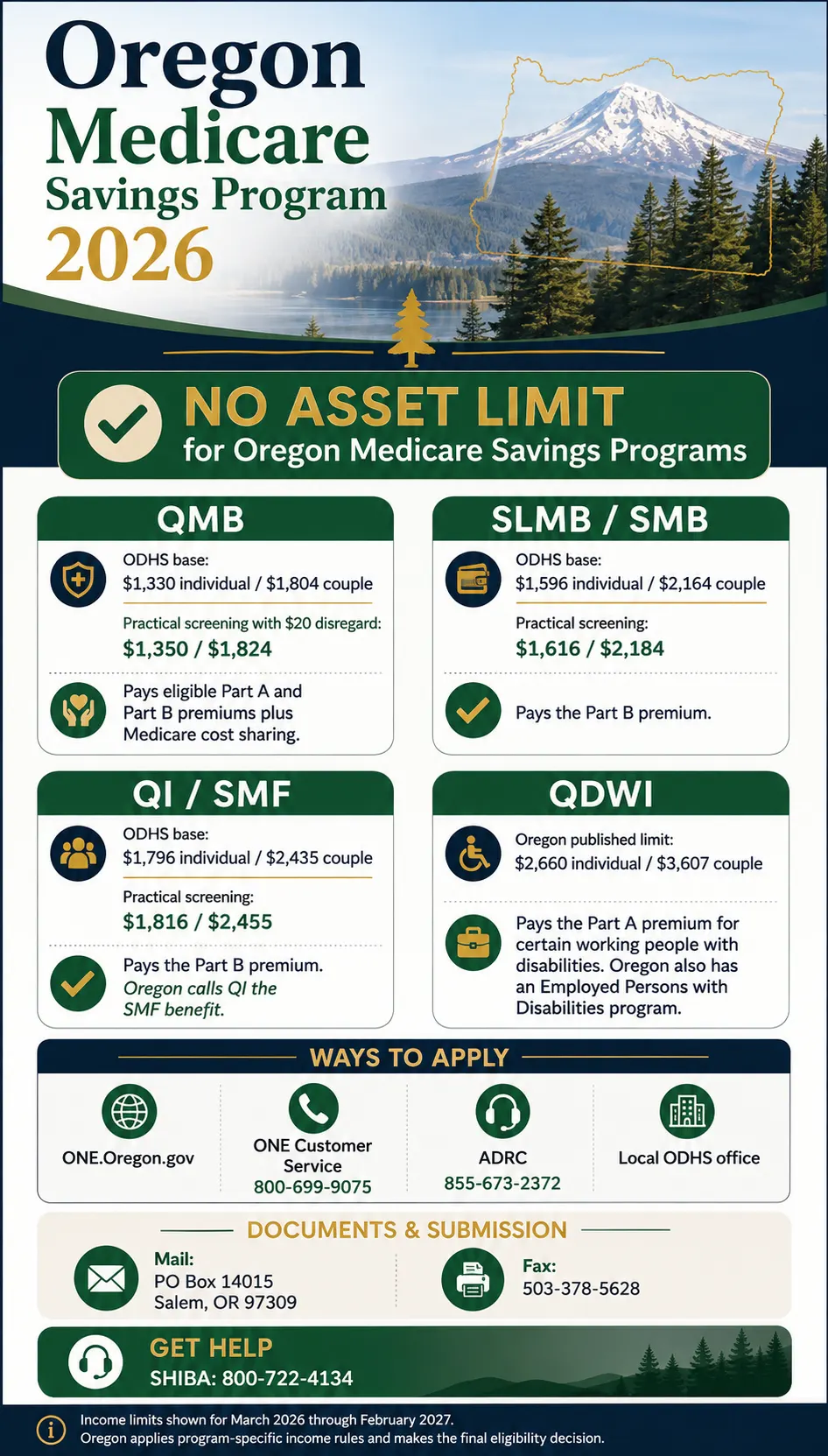
Oregon Medicare Savings Programs may help eligible Medicare beneficiaries pay Medicare premiums. QMB may also pay Medicare-covered deductibles, coinsurance and copayments. Oregon does not apply an asset limit to its Medicare Savings Programs.
Reviewed August 11, 2026, using current Oregon Department of Human Services, Oregon Health Authority, SHIBA, Medicare, CMS and Medicaid information. Oregon determines final eligibility.
Independent educational resource
This website is not Medicare, CMS, Oregon Health Plan, Oregon Department of Human Services or another government agency. It does not process or approve applications. Oregon decides eligibility and benefit effective dates. Program rules, income limits and procedures can change.
Oregon’s Most Important MSP Rule
Oregon has no asset limit for its Medicare Savings Programs. Savings, investments or other resources should not automatically stop you from applying. Income and the other eligibility requirements still matter, and Oregon must make the final decision.
Quick Answer
- QMB may pay Medicare Part A and Part B premiums plus Medicare-covered deductibles and coinsurance.
- SLMB, sometimes called SMB in Oregon materials, pays the Part B premium.
- QI is called the SMF benefit in Oregon. It pays the Part B premium for people in a higher income range.
- QDWI may pay the Part A premium for certain working people with disabilities.
- No Oregon MSP asset limit: Oregon does not impose an asset test on these programs.
- Apply through ONE: Online, by phone, through an ODHS office, or with help from ADRC.
The standard Medicare Part B premium is $202.90 per month in 2026, which equals $2,434.80 over a full year. The 2026 Part B deductible is $283.
Why Oregon Income Charts Can Look $20 Different
Oregon ODHS publishes the Federal Poverty Level amounts before the standard $20 monthly SSI income disregard. Federal Medicare screening tables include that $20 disregard. That is why you may see QMB shown as either $1,330 or $1,350 for one person. Do not treat this difference as a contradiction or use it to self-deny.
Table of Contents
- 2026 Oregon MSP income limits
- Oregon’s no-asset rule
- QMB, SMB, SMF and QDWI
- QMB vs OHP
- Apply online through ONE
- Apply by phone
- ADRC assistance
- Local ODHS office
- Submit documents
- After you apply
- Prior-month benefits
- Part B still deducted
- QMB billing protection
- Prescription Extra Help
- Renewals and changes
- Denial and hearing
- Estate recovery
- Oregon help and contacts
- FAQs
If Medicare Part B premiums are deducted from your Social Security payment, Oregon’s Medicare Savings Program may be worth exploring before assuming you do not qualify.
Oregon is unusual in an important way. It does not impose an asset limit on its Medicare Savings Programs. A person with savings therefore should not automatically conclude that they are ineligible.
Income still matters, and each program provides a different level of assistance. Oregon also uses some terminology that can be confusing when you compare state and federal websites. In Oregon, the federal QI program is known as the SMF benefit, while some Oregon materials refer to SLMB as SMB.
For general background, visit our Medicare Savings Programs educational resource. State rules vary significantly. The previous state guide explains the Maryland Medicare Savings Program and its DSS application routes.

Oregon Medicare Savings Program Income Limits for 2026
Oregon Department of Human Services states that the following income standards apply from March 2026 through February 2027.
| Program | ODHS published individual limit | Practical screening with $20 disregard | ODHS couple limit | Practical couple screening | Asset limit |
|---|---|---|---|---|---|
| QMB | $1,330 | $1,350 | $1,804 | $1,824 | None |
| SLMB / SMB | $1,596 | $1,616 | $2,164 | $2,184 | None |
| QI / SMF | $1,796 | $1,816 | $2,435 | $2,455 | None |
| QDWI | $2,660 | Special work/disability rules apply | $3,607 | Special work/disability rules apply | None under Oregon’s MSP rule |
The first set of QMB, SLMB and SMF numbers is the Federal Poverty Level standard published by Oregon. The practical screening amounts shown beside them add the standard $20 monthly SSI general income disregard used in federal MSP screening.
This distinction explains why an Oregon page may show QMB at $1,330 while Medicare.gov shows $1,350. Both numbers can appear in legitimate program materials because they describe different stages of the income calculation.
Do not self-deny: If your income is near a limit, apply. Oregon determines countable income and applies the required exclusions. A screening table cannot make the final decision.
See the official Oregon Medicare Savings Program page and our Medicare Savings Program income-limit guide.
Why Oregon QDWI numbers look different from the national chart
Oregon currently publishes QDWI at $2,660 for one person and $3,607 for a couple, based on 200% of the Federal Poverty Level.
You may see much higher QDWI amounts in a generic federal table because federal QDWI screening can involve additional earned-income disregards.
For an Oregon application, do not replace Oregon’s published state figure with a generic QDWI number. Ask ODHS to perform the actual work and disability-related calculation.
Oregon also notes that many working people with disabilities will not use QDWI because the state has an Employed Persons with Disabilities, or EPD, program that can provide full Medicaid benefits.
Does Oregon Have an MSP Asset or Resource Limit?
No. Oregon Department of Human Services explicitly states that there are no asset limits for its Medicare Savings Programs.
This is a major difference from the default federal MSP rules.
For Oregon MSP eligibility, do not assume that the following automatically disqualify you:
- Money in a checking account.
- Money in savings.
- Certificates of deposit.
- Stocks or bonds.
- Retirement savings.
- Investment accounts.
- A second vehicle.
- Other assets that would matter in a state using the standard federal MSP resource limit.
This does not mean Oregon will never ask financial questions. Information about accounts or property may be relevant to income, another Medicaid program, long-term care coverage or a different benefit category.
But do not use the federal $9,950 individual or $14,910 couple resource limit to screen yourself out of an Oregon Medicare Savings Program.
Read our Medicare Savings Program resource-limit guide for a state-by-state explanation.
What Does Each Oregon Medicare Savings Program Pay?
| Program | Oregon terminology | What it may pay | Asset test |
|---|---|---|---|
| QMB | QMB | Part A and B premiums, Medicare-covered deductibles and coinsurance | None |
| SLMB | SLMB / SMB | Part B premium | None |
| QI | SMF benefit | Part B premium | None |
| QDWI | QDWI | Part A premium | None under Oregon’s MSP rule |
QMB: The strongest Oregon MSP
QMB can help pay:
- The Medicare Part A premium if you owe one.
- The Medicare Part B premium.
- Medicare Part A deductibles.
- Medicare Part B deductibles.
- Medicare coinsurance.
- Medicare-covered copayments under federal QMB billing protections.
Oregon Health Authority states that QMB members are not responsible for Medicare Part A or Part B copays, deductibles or coinsurance for Medicare-covered services.
SLMB / SMB: Part B premium help
SLMB pays the Medicare Part B premium.
It normally does not provide the broader Medicare cost-sharing protection that QMB provides.
For a beneficiary paying the standard 2026 premium, a full year of Part B premium assistance can be worth up to $2,434.80.
QI / SMF: Oregon’s higher-income Part B program
Most states call this program QI, or Qualifying Individual. Oregon calls it the SMF benefit.
SMF pays the Medicare Part B premium.
Important SMF/QI rules include:
- Income is above the SLMB range but within the SMF limit.
- Oregon can serve only a limited number of people through this federally funded category.
- Enrollment may close if the available program capacity is reached.
- If you are eligible for another Oregon Medicaid benefit, you are not eligible for SMF.
QDWI: Part A premium help for certain workers with disabilities
QDWI helps pay the Medicare Part A premium only.
Oregon describes QDWI as a limited program for a person who:
- Has a disability.
- Returned to work.
- Lost Social Security disability cash benefits because of work.
- Lost premium-free Medicare Part A.
- Meets the Oregon income requirements.
- Is not eligible for another Medicaid program.
Because Oregon offers the Employed Persons with Disabilities program, applicants in this situation should ask ODHS to compare QDWI with EPD rather than assuming QDWI is the best or only option.
Is Oregon QMB the Same as Full Oregon Health Plan?
No. A QMB approval does not automatically mean that you have full Oregon Health Plan benefits.
| Coverage | What it means |
|---|---|
| QMB only | OHA uses the QMB benefit to pay eligible Medicare premiums and Medicare cost sharing. QMB itself is not a full health-care benefit package. |
| QMB + OHP with Limited Drug | You retain OHP benefits while Medicare is primary, and OHA also handles eligible Medicare cost sharing. |
| SLMB / SMB | Part B premium assistance without QMB’s broader Medicare cost-sharing benefit. |
| SMF / QI | Part B premium assistance for people not eligible for another Oregon Medicaid benefit. |
| Full OHP with Medicare | Medicare is generally primary while OHP may cover additional eligible Medicaid benefits. |
Oregon says some QMB-only members receive an Oregon Health ID card so that OHA can process Medicare cost-sharing payments.
Most OHP members who also have Medicare receive OHP with Limited Drug. Medicare Part D pays most prescription drugs, while OHP with Limited Drug may cover certain medications that Part D does not cover.
See our Medicare Savings Program versus Medicaid guide.
How to Apply Online Through ONE
Oregon uses the ONE Eligibility system for medical, food, cash and child care benefits.
Apply online through the official ONE Oregon benefits portal.
ONE application steps
- Open ONE.Oregon.gov.
- Create a ONE Online account or sign in.
- Start a medical-benefits application.
- Enter personal and household information.
- Add your Medicare Part A and Part B information.
- Enter income information accurately.
- Request screening for Medicare Savings Program assistance.
- Review the application.
- Submit it.
- Save your confirmation information.
- Check the ONE Message Center for requests and notices.
A useful note is:
“I have Medicare and want to be screened for QMB, SLMB/SMB, SMF/QI, QDWI and any other Oregon Medicaid program for which I may qualify.”
If you have difficulty creating or accessing a ONE account, call:
833-978-1073
ONE technical support is generally available Monday through Friday, 7 a.m. to 6 p.m. Pacific Time.
Apply through ONE
Use ONE to apply, upload documents, review eligibility notices, renew benefits and report changes.
How to Apply by Phone
Call ONE Customer Service:
800-699-9075
Hours are generally Monday through Friday, 7 a.m. to 6 p.m. Pacific Time.
Oregon allows medical-benefits applications to be started by phone. You can also use the number to:
- Request a mailed application.
- Ask about an existing application.
- Find out what documents are missing.
- Renew benefits.
- Report changes.
- Ask for help using ONE.
Have available:
- Your Medicare card.
- Social Security number.
- Oregon address.
- Social Security or pension information.
- Work income if applicable.
- Oregon Health ID information if you already have OHP.
Write down the date, representative’s name, confirmation or case number, and any document deadline.
How ADRC Can Help
Oregon’s Aging and Disability Resource Connection can help older adults, people with disabilities, caregivers and families navigate the benefits system.
ADRC: 855-673-2372
ADRC may be particularly helpful when:
- You have Medicare and OHP at the same time.
- You are unsure whether QMB, SMB, SMF or another Oregon program applies.
- You are helping a parent or spouse.
- You have disability-related benefit questions.
- You also need in-home care or long-term care assistance.
- You need a connection to a local Aging and People with Disabilities or Area Agency on Aging office.
ADRC is especially useful for navigation and referral. The formal application and document process generally runs through ONE, ODHS or the appropriate local office.
Apply or Get Help at a Local ODHS Office
You may also apply or get assistance in person.
Use the official ODHS office finder.
A local office may help when:
- ONE is difficult to use.
- You do not have reliable internet access.
- You need to submit documents in person.
- You already have OHP and want Medicare Savings Program screening.
- You received a notice you do not understand.
- Your case appears delayed or documents are missing.
Bring copies of available Medicare, income and Oregon benefit records. Keep proof of anything you submit.
How to Submit Oregon Benefits Documents
Oregon accepts supporting documents several ways.
| Method | Where to submit |
|---|---|
| ONE Online | Upload through your ONE account |
| Oregon ONE Mobile | Upload documents through the mobile app |
| PO Box 14015, Salem, OR 97309 | |
| Fax | 503-378-5628 |
| In person | A local ODHS office |
Document tips
- Send copies rather than irreplaceable originals.
- Put your name and date of birth on documents when appropriate.
- Include all pages of statements requested by Oregon.
- Make sure uploaded photographs are clear and upright.
- Keep the fax confirmation.
- Keep mailing proof.
- Check your ONE Message Center after submitting verification.
What Happens After You Apply?
ODHS states that it will let you know whether your Medicare Savings Program application is approved within 45 days of the date you apply.
During that period, check:
- The ONE Message Center.
- Oregon ONE Mobile notices.
- Regular mail.
- Requests for income or Medicare proof.
- Approval or denial notices.
- Later Social Security payment changes.
If you applied by mail, phone or in person and have not heard anything, call ONE Customer Service at 800-699-9075.
Do not assume silence means approval. The agency may be waiting for information.
Can Oregon Medicare Savings Program Benefits Cover Earlier Months?
The answer depends on the Medicare Savings Program category and the eligibility period stated in your Oregon notice.
Oregon SHIBA guidance distinguishes QMB from the premium-only programs:
- QMB: QMB generally does not receive the same 90-day retroactive treatment used for the premium-only categories.
- SLMB / SMB: Eligible prior months may be covered, depending on the application and eligibility dates.
- QI / SMF: Prior-month Part B premium assistance may also be available when the person met the program requirements.
Do not assume a 90-day rule guarantees a specific refund.
Check the approval notice for:
- The program Oregon approved.
- The effective date.
- Any earlier months included.
- The period for which Oregon is paying Medicare premiums.
If earlier Part B premiums were deducted during months later approved for assistance, a federal adjustment may follow after state and Medicare records update.
What if the Part B Premium Still Comes Out After Approval?
A Medicare Savings Program approval may not change your Social Security payment immediately.
Oregon must transmit the Medicare buy-in information, and Medicare and Social Security must update their records.
Keep:
- Your Oregon approval notice.
- The program name.
- The effective date.
- Social Security payment records.
- Records of Part B premiums deducted after the approved date.
If the deduction continues for several months, contact ONE Customer Service, your local ODHS office or SHIBA.
Do not assume a continued deduction means the application was reversed.
Read our Medicare Part B premium help guide.
What if You Have QMB and Receive a Medicare Bill?
Federal law prohibits Medicare providers and suppliers from billing QMB beneficiaries for Medicare-covered Part A and Part B deductibles, coinsurance and copayments.
Oregon Health Authority also tells QMB members that they are not responsible for Part A or Part B copays, deductibles or coinsurance charges for Medicare-covered services.
If you receive a bill:
- Do not automatically pay it.
- Confirm that QMB was active on the date of service.
- Check whether Medicare covered the service.
- Call the provider’s billing office.
- Tell the office that you have QMB through Oregon.
- Show your Medicare card and Oregon Health ID card when applicable.
- Ask the provider to verify QMB status and correct the account.
- Keep the bill and Medicare Summary Notice.
- Contact SHIBA or Medicare if the problem continues.
1-800-MEDICARE: 1-800-633-4227
Medicare TTY: 1-877-486-2048
If you already paid prohibited Medicare cost sharing while QMB was active, ask the provider whether the improper payment must be refunded.
QMB does not make every service free. It protects Medicare-covered Part A and Part B cost sharing, not every non-covered charge.
Review the official CMS QMB billing rules and our QMB Medicare Savings Program guide.
Does Oregon MSP Approval Include Medicare Part D Extra Help?
If Oregon is paying your Medicare Part B premium through a Medicare Savings Program, you generally receive Medicare Part D Extra Help automatically.
In 2026, Extra Help provides:
- A $0 premium for a qualifying benchmark Part D plan.
- A $0 Part D deductible.
- Up to $5.10 for a covered generic drug.
- Up to $12.65 for a covered brand-name drug.
- $0 for covered drugs after total drug costs reach $2,100 in 2026.
- No Part D late-enrollment penalty while receiving Extra Help.
If you also receive full Medicaid and QMB, your prescription copays may be lower.
OHP with Limited Drug does not replace Medicare Part D. Oregon states that Medicare Part D covers most prescriptions for members who have Medicare and OHP with Limited Drug.
OHP may cover certain eligible drugs that Medicare Part D does not cover.
Review Medicare’s official Extra Help guidance.
How Do Oregon MSP Renewals Work?
Oregon sends a medical-benefits renewal notice before the renewal date.
ODHS currently states that medical-benefit notices are generally sent 90 days before the due date.
You can renew or provide information:
- Through ONE Online.
- Through Oregon ONE Mobile.
- By phone at 800-699-9075.
- At a local ODHS office.
- By mail.
- By fax.
Oregon first reviews available information. Your notice will tell you whether coverage was renewed automatically or whether more information is required.
If you do not respond to a required renewal, benefits can close. Oregon’s current renewal guidance says members may still have a limited period after closure to provide the information, but you should not rely on that grace period.
Keep your address current and open all ODHS and OHA mail.
If an MSP closes, the Medicare Part B premium may eventually start being deducted from your Social Security payment again.
Review the official Oregon renewal guidance and our MSP renewal checklist.
What Should You Do if Oregon Denies or Ends MSP Coverage?
Read the entire eligibility notice before assuming that your income was too high.
Common problems may include:
- Missing income verification.
- Incomplete Medicare information.
- An application that was not fully submitted.
- A document that could not be matched to the case.
- A missed verification deadline.
- A missed renewal.
- Incorrect household information.
- An income calculation you believe is wrong.
Take these steps:
- Read the reason. Identify the specific rule or missing information.
- Call ONE Customer Service. Ask how the decision was made.
- Submit missing or corrected information. Keep proof.
- Request a hearing when appropriate. Follow the deadline and instructions on your Oregon eligibility notice.
- Get help. SHIBA, ADRC or a local ODHS office can help you understand the next step.
Oregon medical-assistance hearings
Oregon rules provide a hearing right when medical assistance is denied, reduced, closed or suspended, and when the agency has not acted on a medical-assistance application within the required timeframe.
Medical-assistance hearing deadlines are governed by Oregon Health Authority rules and your specific notice. Oregon’s current OHA administrative-hearing page lists a 60-calendar-day filing period for certain OHA Notices of Denial.
Use the deadline printed on your own eligibility notice. Do not rely on a deadline from a different type of OHP service appeal.
Oregon uses the Administrative Hearing Request, MSC 443, for certain medical-assistance hearing requests.
Review the official OHP appeals and hearings information and our MSP denial guide.
Appeal deadline warning: Eligibility appeals and health-service appeals are not necessarily governed by the same deadline. Follow the exact appeal instructions included with the decision you received.
Does Oregon Estate Recovery Apply to Medicare Savings Program Benefits?
Federal Medicaid rules prohibit states from recovering Medicare cost-sharing benefits paid on behalf of Medicare Savings Program beneficiaries.
This means MSP Medicare cost-sharing assistance should not automatically be treated the same as other Medicaid benefits that may be subject to estate recovery.
However, Oregon warns that estate recovery can apply to certain Oregon Health Plan benefits, especially in situations involving nursing-facility or other covered long-term care services.
A person with QMB-only assistance can therefore have a different estate-recovery situation from a person receiving QMB plus broader OHP or long-term care Medicaid.
Do not make estate-planning decisions based only on an MSP article. Review the actual benefits paid and obtain qualified advice when necessary.
Oregon Medicare Savings Program Help and Contacts
| What you need | Oregon contact |
|---|---|
| Apply or manage benefits online | ONE.Oregon.gov |
| Apply by phone or benefits help | 800-699-9075 |
| ONE account or login help | 833-978-1073 |
| Aging and disability navigation | ADRC: 855-673-2372 |
| OHP member questions | OHP Client Services: 800-273-0557 |
| Mail documents | PO Box 14015, Salem, OR 97309 |
| Fax documents | 503-378-5628 |
| Free Medicare counseling | SHIBA: 800-722-4134 |
| Medicare billing or QMB help | 1-800-MEDICARE: 1-800-633-4227 |
Free Medicare counseling through SHIBA
Oregon SHIBA is a free statewide Medicare counseling service operated through ODHS.
SHIBA can help with:
- QMB, SLMB/SMB and SMF/QI questions.
- Medicare and OHP coordination.
- Part B premium problems after MSP approval.
- QMB billing problems.
- Medicare Part D Extra Help.
- Medicare Advantage.
- Medigap.
- Prescription drug plan questions.
SHIBA does not sell Medicare insurance.
Best Oregon path to apply
Apply through ONE, call ONE Customer Service, contact ADRC or visit a local ODHS office. Do not let savings stop you from applying because Oregon does not impose an MSP asset limit.
Common Oregon MSP Mistakes to Avoid
Using the federal asset test
Oregon has no MSP asset limit. Do not use $9,950 or $14,910 to screen yourself out.
Thinking $1,330 and $1,350 are contradictory QMB limits
The $1,330 figure is Oregon’s published 100% FPL standard. The $1,350 federal screening amount reflects the additional standard $20 income disregard.
Using the generic federal QDWI chart
Oregon currently publishes $2,660 individual and $3,607 couple for QDWI and also offers the Employed Persons with Disabilities program. Let ODHS evaluate which category applies.
Assuming QMB means full OHP
QMB-only and QMB plus OHP with Limited Drug are different benefit packages.
Ignoring ONE messages
ODHS may request verification electronically or by mail. Check both.
Keeping no proof of documents
Save upload confirmations, fax transmission records, mailing receipts and copies of documents.
Paying a QMB bill before checking it
QMB beneficiaries have strong federal protections against Medicare-covered Part A and Part B cost-sharing bills.
Missing renewal mail
Oregon sends medical renewal notices in advance. Keep your address current and respond when the notice requests information.
Oregon Medicare Savings Program FAQs
Does Oregon have an asset limit for Medicare Savings Programs?
No. Oregon Department of Human Services states that there are no asset limits for its Medicare Savings Programs. Income and other eligibility requirements still apply.
What is the 2026 Oregon QMB income limit?
ODHS publishes $1,330 for one person and $1,804 for a couple from March 2026 through February 2027. With the standard $20 monthly SSI income disregard included, practical screening amounts are $1,350 and $1,824.
What is the 2026 Oregon SLMB income limit?
ODHS publishes $1,596 for one person and $2,164 for a couple. Practical federal screening amounts after the standard $20 disregard are $1,616 and $2,184.
What is SMF in Oregon?
SMF is Oregon’s name for the federal Qualifying Individual, or QI, Medicare Savings Program. It helps pay the Medicare Part B premium.
What is Oregon’s QDWI income limit in 2026?
ODHS currently publishes $2,660 per month for one person and $3,607 for a couple. QDWI also has special disability and employment requirements.
Where do I apply online for Oregon MSP?
Apply through ONE.Oregon.gov. ONE can also be used to upload documents, view notices, renew benefits and report changes.
Can I apply by phone?
Yes. Call ONE Customer Service at 800-699-9075. It is generally open Monday through Friday from 7 a.m. to 6 p.m. Pacific Time.
Where do I mail Oregon benefits documents?
ODHS currently lists PO Box 14015, Salem, OR 97309 for benefits documents.
What is the Oregon document fax number?
The current ODHS benefits-document fax number is 503-378-5628.
How long does Oregon take to decide an MSP application?
ODHS states that it will let applicants know if they are approved within 45 days of the date they apply.
Does Oregon QMB pay Medicare copays?
QMB beneficiaries are protected from Medicare-covered Part A and Part B deductibles, coinsurance and copayments. Providers generally cannot bill a QMB beneficiary for those protected amounts.
Is QMB the same as full Oregon Health Plan?
No. QMB-only is a Medicare cost-assistance benefit. Some QMB beneficiaries separately qualify for OHP and receive QMB plus OHP with Limited Drug.
Does Oregon MSP approval include Medicare Extra Help?
People receiving state help paying their Medicare Part B premium generally qualify automatically for Medicare Part D Extra Help.
How often does Oregon renew MSP eligibility?
Oregon reviews medical eligibility periodically and sends a medical-benefits renewal notice when action is required. Current ODHS guidance says the medical renewal notice is generally sent 90 days before the due date.
Who can help me for free?
Call Oregon SHIBA at 800-722-4134 for free Medicare counseling. ADRC at 855-673-2372 can also help older adults and people with disabilities navigate Oregon benefit programs.
Conclusion
Oregon’s Medicare Savings Program is worth checking if the Part B premium is reducing your monthly Social Security payment or Medicare cost-sharing bills are difficult to manage.
The most important Oregon-specific rule is that there is no MSP asset limit.
Do not let savings stop you from applying.
Use ONE.Oregon.gov, call ONE Customer Service at 800-699-9075, contact ADRC or visit a local ODHS office.
Ask Oregon to screen you for QMB, SLMB/SMB, SMF/QI, QDWI and any other Medicaid program that may fit your circumstances.
If approved, keep the eligibility notice. The Part B premium may take time to stop being deducted, and QMB beneficiaries should verify Medicare bills before paying protected cost sharing.
Apply through Oregon’s official ONE system
Oregon has no MSP asset limit. If your income is near the program limits, submit an application and let Oregon make the eligibility calculation.
Editorial disclaimer: This article provides general educational information and is not legal, financial, medical or benefits advice. Income standards, program terminology, effective-date rules, application procedures and contacts may change. Review your current Oregon eligibility notice and official ODHS/OHA guidance. Oregon makes the final eligibility decision.