Illinois Medicare Savings Program 2026: Benefits & Apply
Illinois Medicare Savings Program Benefits and How to Apply
Illinois Medicare Savings Programs may help eligible Medicare beneficiaries pay the Part B premium. QMB may also cover Medicare premiums and protect members from Medicare-covered deductibles, coinsurance and copayments.
Updated with final 2026 Illinois income standards, resource limits and application guidance
Independent educational resource: This website is not Medicare, Illinois HFS, IDHS, ABE or a Family Community Resource Center. Illinois makes the final eligibility decision. Approval, effective dates, processing times and premium refunds are not guaranteed.
Quick Answer for Illinois Residents
Illinois operates three main Medicare Savings Program categories: QMB, SLIB and QI-1.
QMB may pay Medicare Part A and Part B premiums and Medicare-covered cost-sharing. SLIB, called SLMB nationally, and QI-1 generally pay the Medicare Part B premium only.
Apply online through ABE or complete Form HFS 2378M and submit it to your local IDHS Family Community Resource Center. You do not need separate applications for QMB, SLIB and QI-1.
Illinois publishes exact countable-income standards and applies an automatic $25 income disregard. Your gross income may therefore be slightly higher than the countable-income ranges shown in the official standards.
Table of Contents
- What Illinois MSPs cover
- 2026 income and resource limits
- QMB, SLIB and QI-1 benefits
- Basic eligibility requirements
- Ways to apply
- Apply online through ABE
- Apply with HFS 2378M
- Documents to prepare
- Mail, fax or in-person submission
- What happens after applying
- Renewal
- Denials and appeals
- Free official help
- Frequently asked questions
What Is a Medicare Savings Program in Illinois?
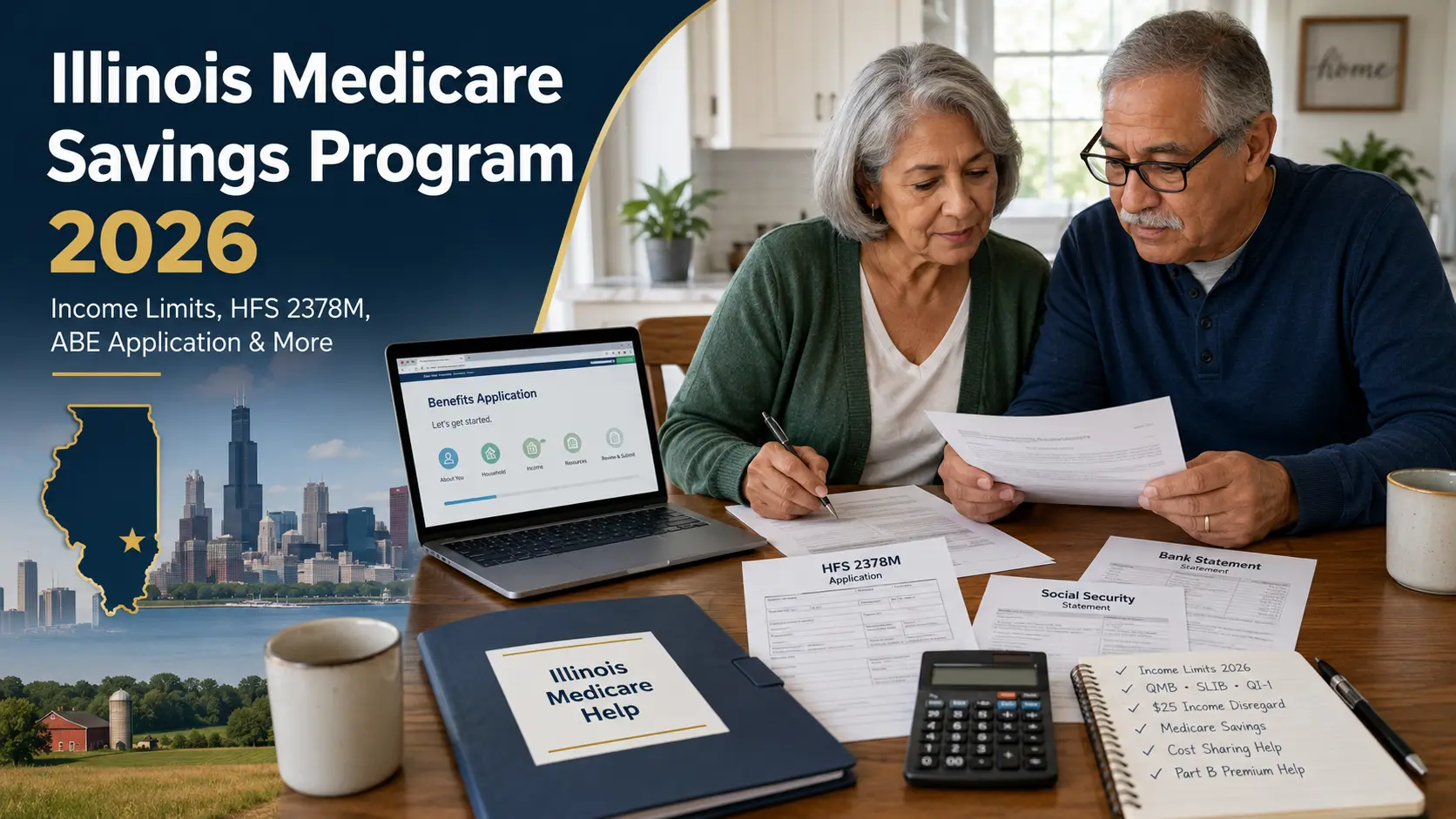
A Medicare Savings Program, or MSP, is a Medicaid-administered program that helps certain Medicare beneficiaries pay Medicare expenses.
Illinois administers Medicare cost-sharing assistance through the Department of Healthcare and Family Services and the Department of Human Services. Local Family Community Resource Centers process applications and supporting documents.
Illinois uses these names:
- QMB: Qualified Medicare Beneficiary
- SLIB: Specified Low-Income Medicare Beneficiary, called SLMB nationally
- QI-1: Qualifying Individual-1
You do not need to identify the final category before applying. Illinois reviews Medicare enrollment, countable income, resources and other eligibility factors.
For a broader explanation, read our guide to what a Medicare Savings Program is. You can also visit the Medicare Savings Programs information center.
Illinois Medicare Savings Program Income Limits for 2026
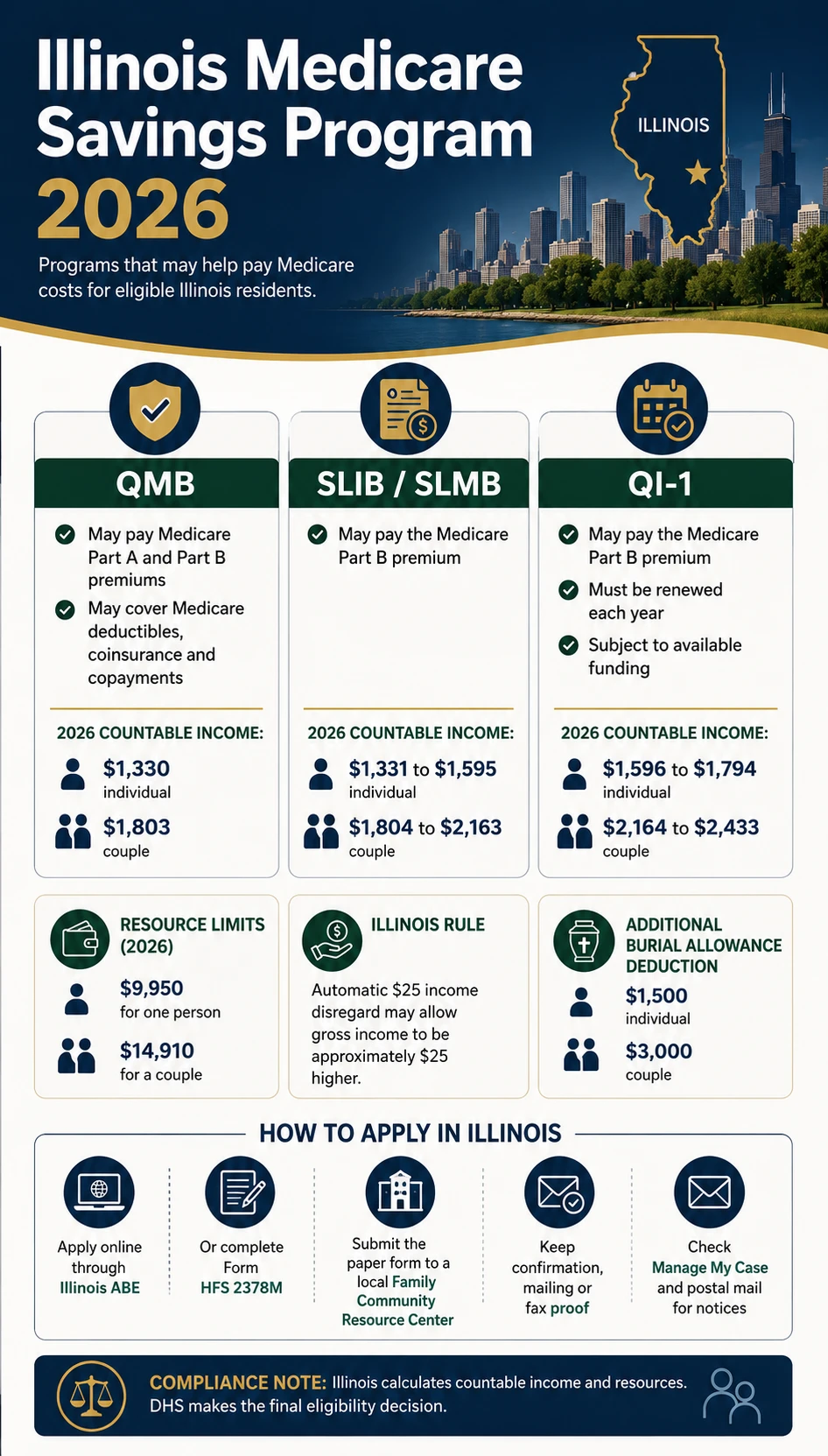
Illinois DHS publishes exact countable-income standards. These are not always the same as gross income because Illinois automatically disregards $25 of monthly income before comparing the remaining countable amount with the program standard.
| Program | Official Countable Income: Individual | Official Countable Income: Couple | Approximate Gross Screening After $25 Disregard |
|---|---|---|---|
| QMB | Up to $1,330 | Up to $1,803 | About $1,355 individual or $1,828 couple |
| SLIB / SLMB | $1,331 to $1,595 | $1,804 to $2,163 | About $1,356 to $1,620 individual or $1,829 to $2,188 couple |
| QI-1 | $1,596 to $1,794 | $2,164 to $2,433 | About $1,621 to $1,819 individual or $2,189 to $2,458 couple |
Use the two columns correctly:
The official Illinois standards are countable-income amounts. The gross screening amounts are only a practical illustration of the automatic $25 disregard. Other income exclusions may also apply, so Illinois must complete the official calculation.
Do not subtract the $25 disregard yourself when the application asks for gross income. Report the amount requested and provide documentation showing deductions such as Medicare premiums.
Review the final 2026 Illinois DHS income and resource standards and the Illinois SHIP 2026 Medicare Savings Program chart.
Our separate guide explains Medicare Savings Program income limits.
Illinois MSP Resource Limits for 2026
The 2026 Illinois resource limits for QMB, SLIB and QI-1 are:
- $9,950 for one person
- $14,910 for two people
Illinois also identifies an additional burial-allowance deduction of $1,500 for one person or $3,000 for a couple.
Resources that may count include:
- Checking and savings accounts
- Certificates of deposit
- Cash
- Stocks and bonds
- Mutual funds and investment accounts
- Certain retirement accounts
- Annuities and trusts
- Life-insurance cash value
- Real estate other than the principal home
Examples of property that may be excluded include the home where you live, one vehicle, household furniture, personal possessions and burial plots. Report all requested property and allow Illinois to decide whether it counts.
See our MSP resource limits guide for additional examples.
What Illinois Medicare Savings Programs Pay
| Program | Main Benefit | Effective-Date Guidance |
|---|---|---|
| QMB | Part A and Part B premiums, Medicare deductibles, coinsurance and copayments for covered services | Illinois generally starts QMB prospectively after the eligibility determination |
| SLIB / SLMB | Medicare Part B premium | May cover the application month and up to three earlier eligible months |
| QI-1 | Medicare Part B premium | May cover the application month and up to three earlier eligible months |
QMB Provides the Broadest Help
QMB may pay:
- The Medicare Part A premium if you owe one
- The Medicare Part B premium
- Medicare Part A and Part B deductibles
- Medicare coinsurance
- Medicare copayments for Medicare-covered services and items
Medicare providers and suppliers generally may not bill QMB members for Medicare Part A or Part B cost-sharing on Medicare-covered services.
If you receive an improper bill:
- Confirm that QMB was active on the date of service.
- Compare the bill with the Medicare Summary Notice.
- Show the provider your QMB or Medicaid documentation.
- Ask the billing department to remove prohibited Medicare cost-sharing.
- Contact Illinois SHIP or 1-800-MEDICARE if billing continues.
If you already paid prohibited Medicare cost-sharing, ask the provider whether a refund is due.
Read our detailed QMB Medicare Savings Program guide.
SLIB and QI-1 Pay the Part B Premium
SLIB and QI-1 generally pay the Medicare Part B premium. They do not normally provide QMB’s broader protection from Medicare deductibles, coinsurance and copayments.
QI-1 must be renewed each year. QI funding is limited, applications are generally handled according to available funding, and prior-year recipients receive priority under federal rules.
A person generally cannot receive QI while receiving full Medicaid coverage, although another Medicaid or MSP category may apply.
What About QDWI?
QDWI is a federal MSP category that may pay the Medicare Part A premium for certain working people with disabilities. Illinois’s main 2026 consumer chart and HFS 2378M application focus on QMB, SLIB and QI-1.
A person seeking QDWI should contact IDHS and ask for the correct application and eligibility review rather than assuming the standard income bands above apply.
Our MSP types comparison explains all four federal categories.
How Much Could Illinois MSP Assistance Save?
The standard Medicare Part B premium is $202.90 per month in 2026.
If an MSP pays the full standard premium for 12 covered months, the potential premium assistance equals:
- $202.90 per month
- $2,434.80 over 12 months
The actual financial effect depends on the premium you owe, your approved effective date and whether a late-enrollment penalty or income-related adjustment applies.
Review the official 2026 Medicare Parts A and B cost information.
Basic Illinois MSP Eligibility Requirements
Illinois generally reviews whether the applicant:
- Has Medicare Part A or is eligible for the applicable Medicare benefit
- Lives in Illinois
- Meets citizenship or eligible immigration requirements
- Has countable income within an MSP range
- Has countable resources within the applicable limit
- Meets program-specific requirements
Receiving Social Security, working part-time, owning a home or having a bank account does not automatically make a person ineligible. Illinois must apply its income and resource rules.
MSP-Only Help Versus Full Illinois Medicaid
Receiving QMB, SLIB or QI-1 does not automatically mean that you have full Illinois Medicaid coverage.
MSP-only assistance focuses on Medicare premiums and, for QMB, Medicare-covered cost-sharing. Full Medicaid may cover additional healthcare services when the applicant meets the separate requirements.
If you want Illinois to review you for full healthcare coverage, SNAP or cash assistance as well as an MSP, apply through ABE and select the broader benefits requested.
Our guide to Medicare Savings Programs versus Medicaid explains the distinction.
How to Apply for an Illinois Medicare Savings Program
Illinois accepts applications through several official routes:
- Online through Illinois ABE
- By paper Form HFS 2378M
- By mail to the local Family Community Resource Center
- By fax when the local office confirms acceptance
- In person at a local FCRC
- With application help from IDHS
| Application Goal | Suitable Route |
|---|---|
| MSP-only premium and cost-sharing assistance | ABE or Form HFS 2378M |
| MSP plus full Medicaid, SNAP or cash assistance screening | ABE or the appropriate combined-benefits application |
| Help finding the correct local office | IDHS Office Locator or IDHS Help Line |
Option 1: Apply Online Through Illinois ABE
Use the official Illinois Application for Benefits Eligibility portal.
ABE allows applicants to request healthcare coverage and Medicare Savings Program assistance. Portal wording may change, but the current system includes an application option for healthcare, SNAP, cash assistance and Medicare Savings Programs.
Step 1: Sign In or Start an Application
Follow the portal instructions to create or use an ILogin and ABE account. An account can make it easier to save progress, upload documents and use Manage My Case.
Save your login information securely.
Step 2: Select the Benefits You Need
Select Medicare Savings Program when the portal presents that option. Select broader healthcare or other benefits when you also want full Medicaid, SNAP or cash-assistance screening.
Step 3: Report Medicare Coverage
Enter the Medicare information requested, including:
- Medicare number
- Part A enrollment
- Part B enrollment
- Coverage start dates when requested
- Other health insurance
Step 4: Report Household and Spouse Information
Provide your legal name, Illinois residence, mailing address, marital status and spouse information when applicable.
Even when only one spouse applies, Illinois may need the other spouse’s income and resource information.
Step 5: Report Income
Report each requested income source, including:
- Social Security retirement or disability benefits
- Supplemental Security Income when requested
- Railroad Retirement
- Pensions and annuities
- Veterans benefits
- Employment earnings
- Self-employment income
- Rental or royalty income
- Other regular payments
Use the amount requested by the application. A Social Security deposit can be lower than the gross benefit because the Part B premium or other deductions were taken out.
Do not subtract Illinois’s $25 disregard yourself. DHS applies it during eligibility processing.
Step 6: Report Resources
Report checking, savings, investments, retirement accounts, life insurance, trusts, burial funds and other property requested by ABE.
If an account is jointly owned or contains money belonging to another person, report the account and provide an explanation with supporting records.
Step 7: Upload Supporting Documents
Upload clear, complete copies. Every statement page should be included, even when a page appears to contain little information.
Step 8: Review and Submit
Review names, Medicare information, income, resource values, addresses and uploaded files. Save or print the confirmation page and application number.
Step 9: Use Manage My Case
Manage My Case may allow you to:
- Check case information
- View available notices
- Upload requested documents
- Report changes
- Complete renewals
- Manage available appeal actions
Continue checking postal mail because IDHS may send a paper verification request with a deadline.
Apply Online Through Illinois ABE
Select Medicare Savings Program and report Medicare, income and resource information accurately.
Option 2: Apply With Form HFS 2378M
The official MSP-only paper form is:
HFS 2378M
Application for Payment of Medicare Premiums, Deductibles and Coinsurance
Download the official English HFS 2378M application or the official Spanish HFS 2378MS application.
PDF opening problem:
The fillable English form may display a “Please wait” message inside a browser. Save the PDF to your device and open it in Adobe Acrobat Reader or another compatible PDF viewer.
The form is designed specifically for Medicare premiums, deductibles and coinsurance. It is not the combined application for full Medicaid, SNAP or cash assistance.
A face-to-face interview is not normally required for this MSP-only form.
Information Requested on HFS 2378M
Be prepared to provide:
- Applicant name, address, birth date and Social Security number
- People living with the applicant
- Citizenship or immigration information when applicable
- Medicare Part A and Part B information
- Other health insurance
- Applicant and spouse property
- Bank, investment, retirement and insurance resources
- Applicant and spouse income
- Employment earnings and work-related expenses
- Signature and date
Report income before deductions when the form requests gross income. Include the spouse’s income and property when required.
Answer every applicable question. Use an additional sheet when needed and write the applicant’s name on each extra page.
Documents to Prepare
The exact verification request depends on what Illinois can confirm electronically and what you report.
Medicare, Identity and Residence Records
- Medicare card or Medicare entitlement letter
- Social Security number or requested verification
- Photo identification when requested
- Proof of Illinois residence
- Citizenship or immigration documents when applicable
- Other health-insurance information
Income Records
- Social Security benefit statement
- Pension or annuity statement
- Railroad Retirement record
- Veterans-benefit documentation
- Recent pay stubs
- Self-employment income and expense records
- Rental, royalty or trust-payment records
- Proof of other recurring income
Resource Records
- Complete checking and savings statements
- Certificates of deposit
- Stock, bond and mutual-fund statements
- Retirement-account statements
- Annuity and trust records
- Life-insurance information
- Burial-fund and prepaid-burial records
- Real-estate and vehicle information when requested
Send readable copies unless Illinois specifically requests an original or certified document. Keep the originals and a complete copy of everything submitted.
Where to Submit the Illinois MSP Application
Illinois does not use one statewide mailing address for every HFS 2378M application.
Submit the completed form to your local IDHS Family Community Resource Center.
Use the official IDHS Office Locator. Select Family Community Resource Center as the office type. Choose your county and, in Cook County, enter the ZIP code when requested.
Apply by Mail
- Complete and sign HFS 2378M.
- Attach readable copies of available proof.
- Keep a complete copy.
- Confirm the current local FCRC mailing address.
- Consider using trackable mail.
- Keep the mailing receipt.
Apply by Fax
Fax procedures and numbers may differ by office. Before faxing:
- Find the local FCRC through the official locator.
- Call and confirm that it accepts new MSP applications by fax.
- Confirm the current fax number.
- Ask whether supporting documents should be faxed with the application.
- Use a clear cover sheet.
- Keep the fax confirmation.
- Confirm receipt with the office.
Apply in Person
You may deliver the application to the local FCRC. Check current office hours and submission procedures before visiting. Ask for a dated receipt or stamped copy of the first page.
Get Help by Phone
Call the Illinois Department of Human Services at 1-800-843-6154. TTY users can call 1-866-324-5553.
The representative may help locate the correct office, explain which application to use, identify requested verification or discuss an existing case. Make sure a complete signed application is actually submitted.
What Happens After You Apply?
IDHS reviews the application and may verify:
- Medicare status
- Illinois residence
- Citizenship or eligible immigration status
- Countable income
- Countable resources
- Spouse and household information
- Program-specific requirements
Illinois may send a verification request for missing or updated records. Respond by the deadline shown on the notice.
If you previously submitted the same document, send another copy with your name, case number and application number rather than assuming it was matched correctly.
How Long May the Decision Take?
The current HFS 2378M instructions tell applicants to allow approximately 45 days for a decision.
This is not a guaranteed deadline. Missing verification, unresolved ownership questions or mismatched Medicare information may delay processing.
The Eligibility Notice
The written notice should explain:
- Whether the application was approved or denied
- The approved MSP category
- The effective date
- Whether earlier months were approved
- Renewal or reporting requirements
- Appeal instructions
When Will the Part B Deduction Stop?
After approval, Illinois sends eligibility information to federal Medicare systems. The Part B premium may continue to be deducted while Illinois, Medicare and Social Security update their records.
An Illinois HFS notice says applicable premium refunds commonly take two to three months, but actual timing can vary.
Keep the approval notice and monitor:
- The approved category and effective date
- Future Social Security or Railroad Retirement payments
- Medicare premium bills
- Any refund or adjustment notice
Contact IDHS if deductions continue beyond the approved period. Do not immediately submit a duplicate application unless the state instructs you to do so.
Can Illinois Cover Earlier Months?
The Illinois 2026 MSP chart states:
- QMB: Generally begins prospectively after the eligibility determination.
- SLIB: May cover the application month and up to three earlier eligible months.
- QI-1: May cover the application month and up to three earlier eligible months.
Earlier-month assistance is not automatic. Illinois may require income and resource proof for each month. The eligibility notice controls.
Extra Help With Prescription Drug Costs
People approved for QMB, SLIB or QI-1 generally receive automatic eligibility for Medicare Extra Help with Part D costs.
Extra Help may reduce:
- Part D plan premiums
- The Part D deductible
- Prescription copayments
- Coinsurance for covered drugs
- The Part D late-enrollment penalty while Extra Help remains active
Review the official Medicare Extra Help information.
Does Illinois MSP Assistance Cause Estate Recovery?
Illinois states that it will not place an estate claim for Medicare cost-sharing expenses paid through an MSP.
This protection covers MSP-paid Medicare premiums, deductibles and coinsurance. Separate estate-recovery rules may apply when a person also receives full AABD Medicaid, long-term care or other recoverable Medicaid services.
Check the exact coverage category rather than assuming all Medicaid-funded benefits receive the same estate-recovery treatment.
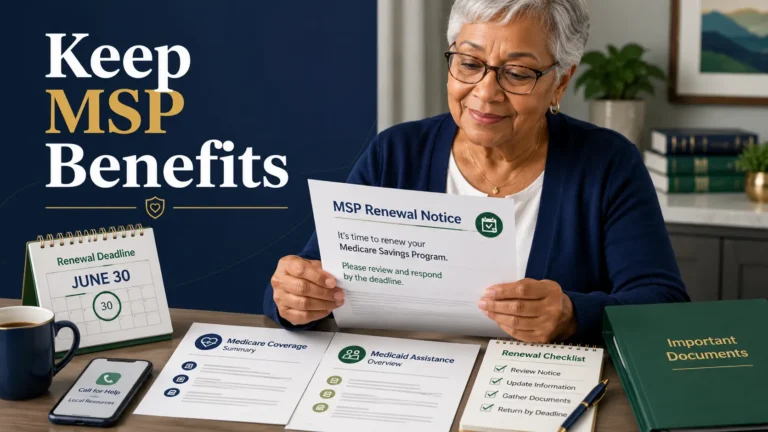
Does an Illinois MSP Need to Be Renewed?
Yes. Illinois reviews continuing eligibility, and QI-1 must be renewed each year.
IDHS may use available records or request updated:
- Income information
- Bank and investment statements
- Household and spouse information
- Medicare information
- Illinois residence information
- Signatures or representative documents
Keep your address and telephone number current. Check Manage My Case and postal mail. Respond before each deadline.
Use our Medicare Savings Program renewal guide.
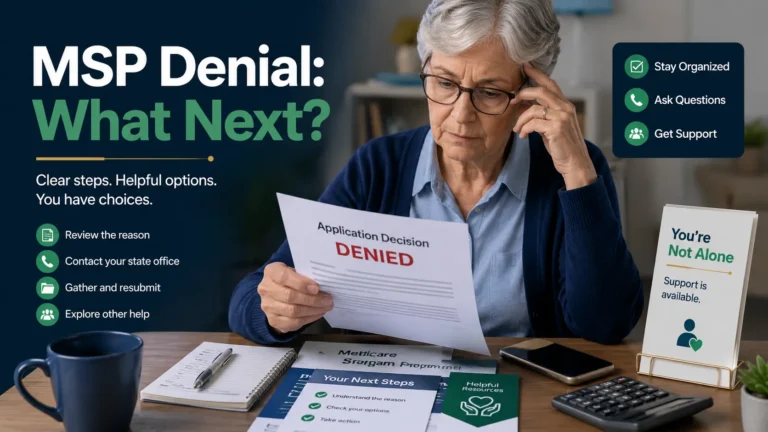
What to Do if Illinois Denies the Application
Read the decision notice before submitting another application.
Check whether the denial involved:
- Income calculated above the program range
- Resources calculated above the limit
- Failure to apply the $25 disregard
- An asset that may have been classified incorrectly
- Missing Medicare, income or bank records
- An unsigned or incomplete form
- Incorrect spouse or household information
- A missed verification deadline
- Review under the wrong eligibility category
Contact the local FCRC and ask whether the case can be corrected. Send missing or updated records and keep proof.
For healthcare coverage decisions, Illinois generally requires an appeal within 60 calendar days after the decision. Follow the exact deadline and instructions printed on your notice.
You may be able to file through ABE, by telephone or by submitting the official appeal form. The DHS appeal telephone number is 1-800-435-0774, and the TTY number is 1-877-734-7429.
Do not assume that contacting the caseworker or filing a new application automatically files an appeal.
Use our guide on what to do when a Medicare Savings Program application is denied.
Where to Get Free Help in Illinois
| Help Needed | Official Resource |
|---|---|
| Apply online | Illinois ABE |
| English paper application | HFS 2378M |
| Spanish paper application | HFS 2378MS |
| Find a local FCRC | IDHS Office Locator |
| Application or case help | IDHS: 1-800-843-6154 |
| IDHS TTY | 1-866-324-5553 |
| Free Medicare counseling | Illinois SHIP: 1-800-252-8966 or 711 TRS |
| DHS appeals | 1-800-435-0774; TTY 1-877-734-7429 |
| Medicare or QMB billing help | 1-800-MEDICARE or 1-800-633-4227 |
| Medicare TTY | 1-877-486-2048 |
Illinois SHIP Medicare Counseling
The Illinois Senior Health Insurance Program provides free statewide Medicare counseling for beneficiaries and caregivers.
SHIP counselors may help explain:
- QMB, SLIB and QI-1
- Medicare Part D Extra Help
- QMB billing protection
- Medicare notices and premium deductions
- Medicare Advantage and Medigap coordination
SHIP counselors do not make the MSP eligibility decision and do not sell insurance.
Visit the official Illinois SHIP page.
Illinois and Ohio Use Different MSP Systems
The program categories are federal, but state terminology, income calculations, forms and submission routes differ.
Illinois uses QMB, SLIB and QI-1 terminology, ABE, HFS 2378M and Family Community Resource Centers. Ohio uses MPAP terminology, Ohio Benefits, ODM 07216 and County Departments of Job and Family Services.
For the latest state guide in this series, read Ohio Medicare Savings Program 2026 MPAP application guidance.
Final Illinois MSP Application Checklist
- ☐ Used ABE or the official HFS 2378M form
- ☐ Clearly requested Medicare Savings Program help
- ☐ Reported Medicare Part A and Part B information
- ☐ Reported gross income as requested
- ☐ Did not subtract the $25 disregard manually
- ☐ Reported spouse information when applicable
- ☐ Reported requested resources and property
- ☐ Attached readable copies of available proof
- ☐ Signed and dated the application
- ☐ Confirmed the correct local FCRC
- ☐ Kept a complete copy and submission receipt
- ☐ Started checking ABE and postal mail for notices
Illinois Medicare Savings Program FAQs
What are the final Illinois MSP income limits for 2026?
Illinois’s countable-income standards are up to $1,330 for an individual or $1,803 for a couple under QMB; $1,331 to $1,595 or $1,804 to $2,163 under SLIB; and $1,596 to $1,794 or $2,164 to $2,433 under QI-1. Illinois also applies an automatic $25 income disregard.
What are the 2026 Illinois MSP resource limits?
The resource limit is $9,950 for one person and $14,910 for two people. Illinois also identifies an additional burial-allowance deduction of $1,500 for an individual or $3,000 for a couple.
Should I add $25 to the income limit?
The official DHS standards are countable-income figures, and Illinois automatically disregards $25. For rough gross-income screening, add $25, but report income exactly as requested and allow DHS to complete the calculation.
Which paper application should I use?
Use HFS 2378M, Application for Payment of Medicare Premiums, Deductibles and Coinsurance. HFS 2378MS is the Spanish version.
Why does the English PDF say Please wait?
The English form is a fillable PDF that may not display correctly inside a browser. Download it and open it in Adobe Acrobat Reader or another compatible PDF viewer.
Do I need separate applications for QMB, SLIB and QI-1?
No. Submit one MSP application. Illinois reviews the information and determines which category may apply.
Where do I mail HFS 2378M?
Mail the signed form to the IDHS Family Community Resource Center serving your area. Use the official Office Locator to confirm the current address.
Is a face-to-face interview required?
A face-to-face interview is not normally required for the MSP-only HFS 2378M application. Illinois may still contact you for additional information.
Can Illinois cover earlier Part B premiums?
SLIB and QI-1 may cover the application month and up to three earlier eligible months. QMB generally begins prospectively. The eligibility notice controls the approved dates.
How long may a premium refund take?
An Illinois HFS notice says applicable refunds commonly take two to three months after systems update. Actual timing can vary, so keep the approval notice and follow up when deductions continue beyond the approved period.
Does Illinois MSP approval include Extra Help?
QMB, SLIB and QI-1 approval generally provides automatic eligibility for Medicare Extra Help with Part D prescription costs.
Does an MSP create an Illinois estate claim?
Illinois states that it will not place an estate claim for Medicare cost-sharing expenses paid through an MSP. Separate rules may apply to full Medicaid or long-term care services.
How do I appeal an Illinois denial?
Follow the notice instructions. Healthcare coverage appeals generally must be filed within 60 calendar days. You may be able to appeal through ABE or call 1-800-435-0774.
Apply Through the Method That Works for You
You do not need to understand every Illinois MSP calculation before applying. Submit accurate Medicare, income, spouse and resource information and respond promptly to verification requests.
Apply online through ABE or use HFS 2378M for MSP-only assistance. Submit paper documents to the local Family Community Resource Center and keep proof.
Use an Official Illinois Application Route
Illinois makes the final eligibility decision. Official applications are free, and approval is not guaranteed.