Connecticut Medicare Savings Program 2026: No Asset Test
Connecticut Medicare Cost Assistance Guide
Connecticut Medicare Savings Program 2026: No Asset Test, Income Limits and How to Apply
Connecticut has unusually high Medicare Savings Program income limits and does not apply an asset test. Eligible residents may receive help with the Medicare Part B premium, while QMB can also protect against Medicare-covered deductibles, coinsurance and copayments.
Last verified August 14, 2026, using current Connecticut Department of Social Services, CHOICES, Medicare, CMS and Medicaid guidance. Connecticut DSS makes the final eligibility decision.
Independent educational resource
This website is not Medicare, CMS, Connecticut DSS, HUSKY Health or another government agency. It does not process or approve applications. Income rules, forms, program funding and procedures may change. Connecticut DSS makes the final eligibility decision.
Connecticut’s Big MSP Advantage
Connecticut does not have an asset test for Medicare Savings Programs. DSS says it does not determine MSP eligibility based on whether you own a home or have money in the bank. Income still matters, but savings and property should not automatically stop you from applying.
Quick Answer
| Need | Connecticut detail |
|---|---|
| Agency | Connecticut Department of Social Services, or DSS |
| Online application | ConneCT |
| MSP-only form | W-1QMB, Application for Medicare Savings Programs |
| Spanish MSP form | W-1QMBS |
| Other DSS benefits too | W-1E Application for Benefits |
| Paper application mail | DSS ConneCT Scanning Center, PO Box 1320, Manchester, CT 06045-1320 |
| DSS Benefits Center | 1-855-626-6632 |
| TDD/TTY | 800-842-4524 |
| Free Medicare counseling | CHOICES: 1-800-994-9422 |
| Asset test | None |
| MSP levels | QMB, SLMB and ALMB |
| Processing | DSS says processing may take 45 days |
The standard Medicare Part B premium is $202.90 per month in 2026, equal to $2,434.80 over a full year. The 2026 Part B deductible is $283.
Table of Contents
- 2026 income limits
- Working and earned-income rules
- No asset test
- QMB, SLMB and ALMB benefits
- MSP versus HUSKY
- Apply online through ConneCT
- Apply with W-1QMB
- W-1E for additional benefits
- MyDSS
- DSS Resource Centers
- DSS Benefits Center
- CHOICES / SHIP
- Documents and verification
- After applying
- MSP start dates
- Part B still being deducted
- Starting Medicare soon
- Missed Part B enrollment
- QMB billing protection
- QMB and Medicare Advantage
- Extra Help
- Renewal
- Denial and appeal
- Contacts
- FAQs
If the Medicare Part B premium is coming out of your Social Security payment, Connecticut’s Medicare Savings Program may provide meaningful assistance.
Connecticut is especially worth checking because its MSP income limits are substantially higher than the standard federal Medicare Savings Program screening amounts, and the state has eliminated the MSP asset test.
That means having a home, bank account, retirement savings or other assets does not automatically prevent Connecticut MSP eligibility.
For general background, visit our Medicare Savings Programs educational resource. State rules differ significantly. The previous state guide explains the Minnesota Medicare Savings Program and DHS-3876 application process.

Connecticut Medicare Savings Program Income Limits for 2026
Connecticut DSS publishes MSP income limits based on gross monthly income or combined gross monthly income with a spouse.
The current limits became effective March 1, 2026.
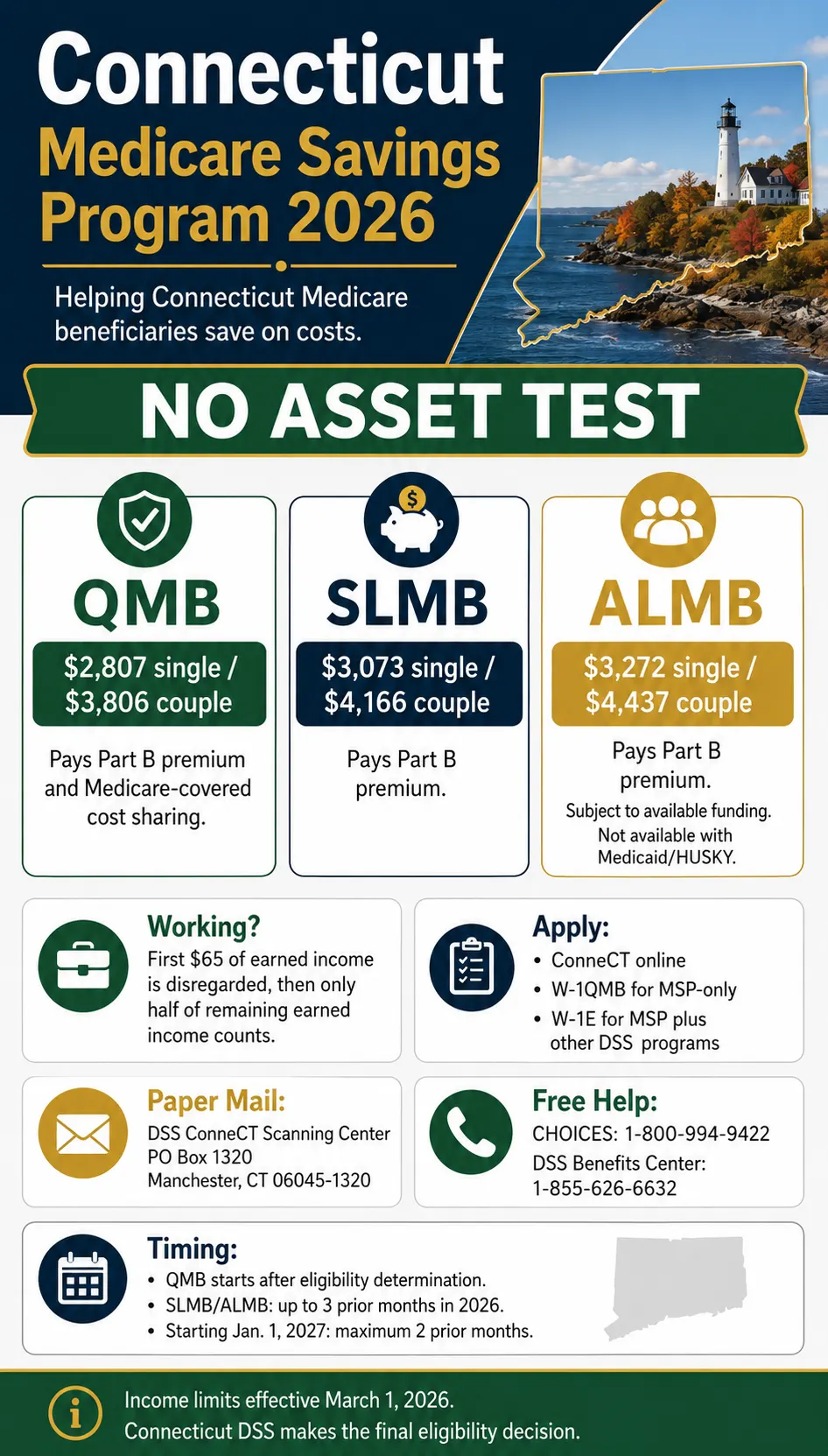
| Program | Single | Couple | Asset test | Main benefit |
|---|---|---|---|---|
| QMB | $2,807/month | $3,806/month | None | Part B premium plus Medicare-covered cost sharing |
| SLMB | $3,073/month | $4,166/month | None | Part B premium |
| ALMB | $3,272/month | $4,437/month | None | Part B premium, subject to available funding |
These limits are much higher than the default national MSP income table.
Do not replace Connecticut’s figures with the lower federal QMB, SLMB or QI chart when evaluating a Connecticut resident.
Use the official Connecticut DSS MSP eligibility page for the current state figures.
Apply if your income is close to the limit. Connecticut does not count all earnings dollar-for-dollar, so gross wages alone may not tell you whether you qualify.
Can You Work and Still Qualify for Connecticut MSP?
Yes. Working does not automatically disqualify you.
Connecticut DSS says that when a Medicare beneficiary has earned income:
- The first $65 of monthly earned income is not counted.
- Only half of the remaining earned income is counted toward MSP eligibility.
For example, if you receive $1,065 per month in wages, the first $65 is disregarded. Of the remaining $1,000, only $500 would be counted as earned income under this specific earned-income calculation. Other income can still affect the total eligibility calculation.
DSS may consider income such as:
- Social Security.
- Pensions.
- Interest.
- Wages.
- Other income received by you or your spouse.
Connecticut DSS also states that certain Veterans benefits, including specified VA non-service-connected pension amounts, Aid and Attendance and Housebound Allowance, are not counted for MSP eligibility.
Do not perform your own final eligibility calculation if your income is close to the limit. Submit the application and let DSS determine the countable amount.
See our Medicare Savings Program income-limit guide.
Does Connecticut Have an MSP Asset Test?
No.
Connecticut DSS states that it does not review assets when determining Medicare Savings Program eligibility.
Therefore, the following should not automatically disqualify you from Connecticut MSP:
- Checking accounts.
- Savings accounts.
- Home ownership.
- Vehicles.
- Retirement accounts.
- Investment accounts.
- Burial funds.
- Life insurance value.
This is specifically an MSP rule. Assets can still matter if you are applying for a different DSS or HUSKY program that uses its own financial eligibility rules.
Do not use Medicare.gov’s national MSP resource limits to screen yourself out in Connecticut.
See our state-by-state MSP resource-limit guide.
What Does Connecticut MSP Pay?
QMB
Qualified Medicare Beneficiary is Connecticut’s strongest MSP level.
QMB may help pay:
- Medicare Part B premium.
- Medicare Part A premium if one is owed and program requirements are met.
- Medicare Part A deductibles.
- Medicare Part B deductibles.
- Medicare coinsurance.
- Medicare-covered copayments.
Connecticut DSS describes QMB as similar to a Medicare supplemental or Medigap policy because of its Medicare cost-sharing assistance. QMB is not a private Medigap insurance policy, however.
SLMB
Specified Low-Income Medicare Beneficiary pays the Medicare Part B premium.
SLMB does not generally provide QMB’s broader protection for Medicare deductibles, coinsurance and copayments.
ALMB
Connecticut’s higher-income premium-only MSP category is called Additional Low Income Medicare Beneficiaries, or ALMB.
ALMB:
- Pays the Medicare Part B premium.
- Is subject to available program funding.
- Is not available while the person is receiving Medicaid/HUSKY.
- Automatically provides eligibility for Medicare Part D Extra Help while MSP eligibility qualifies the person for LIS.
When talking with Connecticut DSS, use the state’s term ALMB rather than assuming that every state uses the same QI label.
Is Connecticut MSP the Same as Medicaid or HUSKY?
No.
| Connecticut term | General meaning |
|---|---|
| MSP | Helps with Medicare costs |
| QMB | Strongest MSP level, including protected Medicare cost-sharing assistance |
| SLMB | Part B premium assistance |
| ALMB | Part B premium assistance subject to funding |
| HUSKY C | Connecticut Medicaid coverage for certain aged, blind or disabled adults |
| W-1QMB | Short MSP-only application |
| W-1E | Broader DSS benefits application |
Some people may receive QMB and broader Medicaid benefits at the same time. Others receive only MSP assistance.
ALMB, however, is not available to a person receiving Medicaid/HUSKY.
Read our MSP versus Medicaid comparison.
Application Method 1: Apply Online Through ConneCT
Connecticut allows Medicare Savings Program applications through the state’s ConneCT benefits system.
Open the official ConneCT benefits portal.
ConneCT application steps
- Open ConneCT.
- Choose the option to apply for benefits.
- Create a DSS MyAccount or sign in.
- Follow the medical or Medicare Savings Program application pathway.
- Enter your Medicare information.
- Enter household and spouse information when applicable.
- Report income accurately.
- Review the application.
- Submit it.
- Save the confirmation information.
- Watch ConneCT and regular mail for DSS notices.
Connecticut’s general DSS guidance identifies online application as the fastest way to get an application into the system.
Apply through Connecticut’s official benefits system
Apply online, save your confirmation, and watch for any later DSS request for information.
Application Method 2: Apply With W-1QMB
If you want to apply only for a Medicare Savings Program, Connecticut DSS lists W-1QMB as the dedicated paper application.
The Spanish version is W-1QMBS.
Use the official Connecticut MSP forms page to obtain the current form.
Where to mail W-1QMB
DSS ConneCT Scanning Center
PO Box 1320
Manchester, CT 06045-1320
Before mailing:
- Complete all applicable questions.
- Include spouse information if applicable.
- Report gross income accurately.
- Sign the application.
- Keep a complete copy.
- Keep a record of the date it was mailed.
Do you need to send bank statements or other proof?
Connecticut’s MSP-only application is lighter than many states.
DSS says you do not need to send supporting documentation unless DSS requests information from you.
That is especially important because Connecticut does not have an MSP asset test.
Do not delay a complete signed application merely because you have not collected a large packet of bank or property documents that DSS has not requested.
Fax note
Connecticut’s public MSP application instructions list online, mail and in-person application routes and do not publish a dedicated W-1QMB fax number on the MSP instructions.
If DSS gives you a case-specific fax number, barcode or coversheet, follow those instructions. Otherwise, use the published ConneCT, mail, MyDSS or Resource Center options.
Application Method 3: Use W-1E if You Want Other DSS Benefits Too
W-1QMB is designed for MSP-only assistance.
If you also want Connecticut DSS to review you for other programs, use the broader W-1E Application for Benefits when appropriate.
DSS specifically identifies W-1E for applicants seeking MSP plus programs such as:
- SNAP food assistance.
- HUSKY C.
- Cash assistance.
- MED-Connect.
- Other eligible DSS programs.
Use the official DSS applications and forms directory to obtain the latest W-1E.
Simple rule: MSP only = W-1QMB. MSP plus broader DSS benefits = consider W-1E or the appropriate ConneCT application route.
Application Method 4: Use MyDSS to Manage Your Case
After applying, MyDSS can make case management easier.
DSS says MyDSS can be used to:
- Check benefit status.
- Open notices.
- Upload requested verification documents.
- Report changes.
- Renew benefits.
- Download proof of benefits.
- Reduce the need for an office visit.
If you upload a requested document, save the confirmation or screenshot showing that it was submitted.
Application Method 5: Visit a DSS Resource Center
You may apply for MSP or get application assistance at a Connecticut DSS Resource Center.
Current Resource Center hours are generally Monday through Friday, 8:00 a.m. to 4:30 p.m.
Because an individual location can move temporarily, use the official DSS Office Locator immediately before traveling.
DSS Resource Centers are currently listed in:
- Bridgeport.
- Danbury.
- Greater Hartford / Windsor.
- Manchester.
- Middletown.
- New Britain.
- New Haven.
- Norwich.
- Stamford.
- Torrington.
- Waterbury.
- Willimantic.
A Resource Center can help with forms, general questions, document drop-off and application assistance.
Application Method 6: Call the DSS Benefits Center
1-855-626-6632
DSS also refers to this as 1-855-6-CONNECT.
Benefits Center staff are generally available Monday through Friday from 8:00 a.m. to 4:00 p.m., subject to call capacity.
The automated client information system is available 24/7.
Use the Benefits Center for:
- MSP application questions.
- ConneCT assistance.
- Case follow-up.
- DSS notice questions.
- Document questions.
- Reasonable accommodation requests.
- Finding the correct application route.
TDD/TTY: 800-842-4524
Application Method 7: Get Free Medicare Help Through CHOICES
CHOICES is Connecticut’s State Health Insurance Assistance Program, or SHIP.
1-800-994-9422
CHOICES provides free, unbiased Medicare counseling for people with Medicare, families and caregivers.
CHOICES can help with:
- Medicare Savings Program screening.
- Completing an MSP application.
- QMB, SLMB and ALMB questions.
- QMB billing problems.
- Medicare Part D Extra Help.
- Medicare Advantage.
- Part D plan comparisons.
- Medicare enrollment questions.
- Moving from HUSKY coverage to Medicare.
Visit the official CHOICES page.
What Information Should You Have Ready?
For an MSP-only W-1QMB application, DSS says supporting documents do not need to be sent unless requested.
Still, keep the following information nearby in case DSS needs clarification:
| Category | Examples |
|---|---|
| Medicare | Medicare number, Part A and Part B information |
| Income | Social Security, wages, pension, disability, unemployment, rental or investment income |
| Spouse | Spouse information and gross income when married |
| Insurance | Medicare Advantage, Part D, employer or retiree coverage when applicable |
| Existing DSS case | Client ID, Case ID and current DSS notices if known |
If DSS later requests proof, follow the deadline and submission instructions on the request.
What Happens After You Apply?
Connecticut DSS says MSP processing may take 45 days.
Watch for:
- DSS mail.
- ConneCT or MyDSS notices.
- An approval or denial notice.
- A request for information.
- A gray CONNECT card if QMB is approved and you do not already have one.
- A later Social Security payment adjustment.
- Medicare Part D / Extra Help updates.
Do not assume that a lack of immediate change in your Social Security payment means the MSP application failed.
When Do Connecticut MSP Benefits Start?
| Program | Connecticut start-date rule |
|---|---|
| QMB | Begins in the month after DSS determines that the person is eligible |
| SLMB | May cover up to 3 qualifying months before DSS receives the application during 2026 |
| ALMB | May cover up to 3 qualifying months before DSS receives the application during 2026 |
January 1, 2027 change: Connecticut DSS says the maximum retroactive period for SLMB and ALMB will be reduced from three months to two months starting January 1, 2027.
QMB itself does not receive the same pre-application retroactive treatment.
What if Your Social Security Check Does Not Increase Right Away?
Connecticut DSS says it can take up to three months after MSP is granted for the Part B premium change to appear in a Social Security payment.
During that processing period, Medicare premiums may continue to be deducted.
DSS states that Social Security should refund premiums owed for eligible months after the federal records update.
Keep:
- Your DSS approval notice.
- The program approved.
- The effective date.
- Social Security payment records.
- Any later reimbursement or adjustment notice.
If the Part B premium remains deducted beyond the expected processing period, contact DSS Benefits Center or CHOICES.
Read our Medicare Part B premium assistance guide.
Can You Apply Before Medicare Starts?
Yes.
Connecticut DSS says you may apply for MSP the month before your Medicare start date.
This can be useful if:
- You are turning 65 soon.
- You have already received notice that Medicare will begin.
- You are transitioning from HUSKY D to Medicare.
- You want Connecticut to evaluate MSP eligibility as soon as Medicare begins.
DSS recommends applying for MSP as soon as you are notified that you are eligible for Medicare.
Can Connecticut MSP Help if You Missed Medicare Part B Enrollment?
Potentially, yes.
Connecticut has an important Medicare buy-in feature.
DSS says all three MSP levels may help an eligible beneficiary obtain Medicare Part B when the person did not enroll during the initial enrollment period.
When MSP is approved, Connecticut may use the state buy-in process so Medicare Part B begins based on the date Connecticut starts paying the premium.
DSS also states that this can eliminate the Part B late-enrollment penalty that would otherwise apply in the qualifying situation.
If you delayed Part B because you could not afford the premium, contact DSS or CHOICES rather than assuming you must wait for another enrollment period.
What if You Have Connecticut QMB and Receive a Medicare Bill?
Federal law prohibits Medicare providers and suppliers from billing QMB beneficiaries for Medicare-covered Part A or Part B deductibles, coinsurance and copayments.
Connecticut DSS also explains that if a provider agrees to treat a QMB beneficiary for a Medicare-covered service, the provider cannot balance bill the beneficiary for protected Medicare cost sharing merely because the provider is not a Connecticut Medicaid provider.
If a bill arrives:
- Do not automatically pay it.
- Confirm QMB was active on the date of service.
- Check that Medicare covered the service.
- Call the provider’s billing office.
- Tell the office that you have QMB.
- Show your Medicare card.
- Show your gray CONNECT card if you have received one.
- If the card has not arrived, use your DSS granting notice as proof.
- Ask the provider to correct the protected cost-sharing charge.
- Call CHOICES or Medicare if the problem continues.
1-800-MEDICARE: 1-800-633-4227
Medicare TTY: 1-877-486-2048
If you already paid cost sharing that federal QMB rules prohibited the provider from collecting, ask the provider to review whether the account must be corrected or refunded.
Read the official CMS QMB billing guidance and our QMB Medicare Savings Program guide.
How Does QMB Work With Medicare Advantage in Connecticut?
QMB can work with Medicare Advantage, but it does not automatically cover every Medicare Advantage charge.
| Situation | Connecticut QMB point |
|---|---|
| Medicare-covered Part A or Part B service | QMB billing protection may apply to Medicare cost sharing |
| Extra dental, vision or another benefit not covered by Original Medicare | QMB does not necessarily cover the extra benefit’s cost sharing |
| Medicare Advantage plan premium | QMB may pay only part of an additional plan premium |
| Out-of-network provider under your Medicare Advantage plan | QMB does not override the Medicare Advantage plan’s coverage and network rules |
If a Medicare Advantage charge is confusing, CHOICES can help you identify whether it is protected Medicare Part A/B cost sharing or a separate plan charge.
Does Connecticut MSP Include Medicare Part D Extra Help?
All three Connecticut MSP levels automatically qualify eligible beneficiaries for the Medicare Part D Low-Income Subsidy, commonly called Extra Help.
In 2026, Extra Help can provide:
- $0 premium for a qualifying benchmark Part D plan.
- $0 Part D deductible.
- Up to $5.10 for each covered generic drug.
- Up to $12.65 for each covered brand-name drug.
- $0 for covered drugs after total drug costs reach $2,100.
- No Part D late-enrollment penalty while receiving Extra Help.
If your MSP has been approved but Extra Help is not yet showing at the pharmacy, Connecticut DSS says the MSP approval letter can be provided to the Medicare Part D plan as best available evidence while federal records are updating.
Review Medicare’s current Extra Help guidance.
How Does Connecticut MSP Renewal Work?
Connecticut MSP is normally granted for a one-year period.
About one month before expiration, DSS reviews the case to determine whether eligibility continues.
Renewal can happen in two ways:
Automatic renewal
If DSS already has enough information to confirm eligibility, MSP may renew automatically. DSS sends a letter confirming continued coverage.
Renewal form required
If DSS needs more information, it sends a renewal form at least 30 days before the renewal is due.
Complete and return the renewal by the deadline.
You can use ConneCT or MyDSS to review and manage benefits and upload requested information.
If MSP closes, the Part B premium may later begin coming out of your Social Security payment again.
Read our Medicare Savings Program renewal guide.
What Should You Do if Connecticut Denies or Ends MSP?
Read the complete DSS Notice of Action before assuming your income was too high.
Possible problems include:
- Income entered incorrectly.
- Earned-income exclusions not reflected as expected.
- A missing signature.
- A requested document not received.
- Incorrect spouse information.
- A missed renewal.
- ALMB funding or Medicaid-overlap rules.
Take these steps:
- Read the reason for the action.
- Contact DSS. Ask what income and information were used.
- Provide missing or corrected information.
- Request a hearing if you disagree.
- Do not miss the notice deadline.
Connecticut DSS hearing deadline
For DSS programs other than SNAP, Connecticut generally requires the hearing request within 60 days from the date of the DSS Notice of Action.
The preferred method is the Hearing Request Form attached to the notice. If that is unavailable, DSS accepts a signed letter explaining the decision being appealed and identifying the applicant or recipient.
DSS Office of Legal Counsel, Regulations and Administrative Hearings
55 Farmington Avenue
Hartford, CT 06105
Administrative Hearings: 860-424-5760
Toll-free in Connecticut: 1-800-462-0134
Fax: 860-424-5729
If existing benefits are being reduced or closed and you want continuation during an appeal, act immediately and follow the continuation instructions on your individual notice. Connecticut says Medicaid benefits may continue when the hearing request is filed before the date of the proposed action.
Review the official Connecticut DSS hearing guidance and our MSP denial guide.
Does Estate Recovery Apply to Connecticut MSP?
Medicare Savings Program assistance should not automatically be treated the same as broader Medicaid long-term care coverage.
Federal Medicaid rules specifically exclude Medicare cost-sharing paid on behalf of Medicare Savings Program beneficiaries from optional Medicaid estate recovery.
If you also receive HUSKY C, long-term care Medicaid or other Medicaid services, those benefits can involve separate estate-recovery rules.
Do not make estate-planning decisions based only on MSP enrollment. Review the specific benefits received and obtain qualified advice when needed.
Connecticut MSP Contacts and Official Resources
| Need | Official resource |
|---|---|
| Apply online | ConneCT |
| MSP-only application | W-1QMB / W-1QMBS |
| Mail paper MSP application | DSS ConneCT Scanning Center, PO Box 1320, Manchester, CT 06045-1320 |
| Manage case / upload documents | MyDSS |
| DSS Benefits Center | 1-855-626-6632 |
| DSS general information | 800-842-1508 |
| TDD/TTY | 800-842-4524 |
| Find a DSS office | DSS Office Locator |
| Free Medicare counseling | CHOICES: 1-800-994-9422 |
| Medicare / QMB billing | 1-800-MEDICARE: 1-800-633-4227 |
Best Connecticut MSP application path
Apply through ConneCT or use W-1QMB for MSP-only assistance. Connecticut has no MSP asset test, so do not let savings or home ownership prevent you from applying.
Common Connecticut MSP Mistakes
Using the lower federal MSP income chart
Connecticut publishes much higher state-specific QMB, SLMB and ALMB income limits.
Thinking savings disqualify you
Connecticut does not have an MSP asset test.
Ignoring the earned-income exclusion
For working Medicare beneficiaries, DSS says the first $65 of monthly earned income is disregarded and only half of the remainder is counted.
Searching only for QI
Connecticut’s higher-income premium-only MSP level is called ALMB.
Sending unnecessary asset documents with W-1QMB
DSS says no supporting documents are required with the MSP application unless DSS asks for information.
Using W-1QMB when you also want several DSS benefits
If you also want SNAP, HUSKY C, cash assistance or MED-Connect, W-1E or the broader ConneCT application route may be more appropriate.
Expecting QMB to cover earlier months like SLMB
QMB starts after eligibility is determined. SLMB and ALMB have separate retroactive rules.
Expecting Social Security to update immediately
DSS says the change can take up to three months after MSP is granted.
Assuming QMB covers every Medicare Advantage extra
QMB protects Medicare-covered Part A and Part B cost sharing. Extra plan benefits and additional plan premiums may be treated differently.
Connecticut Medicare Savings Program FAQs
What is the Connecticut Medicare Savings Program?
Connecticut MSP is a DSS-administered program that helps eligible Medicare beneficiaries pay Medicare costs. All three levels help with the Part B premium, while QMB can also help with Medicare-covered deductibles, coinsurance and copayments.
What are Connecticut’s 2026 MSP income limits?
Effective March 1, 2026, Connecticut lists QMB at $2,807 for one person and $3,806 for a couple, SLMB at $3,073 and $4,166, and ALMB at $3,272 and $4,437.
Does Connecticut have an MSP asset test?
No. Connecticut DSS states that it does not review assets when deciding MSP eligibility.
Can I qualify if I am still working?
Potentially. DSS says the first $65 of monthly earned income is not counted and only half of the remaining earned income is counted toward MSP eligibility.
What form should I use for MSP-only?
Use W-1QMB, the Application for Medicare Savings Programs. Connecticut also lists W-1QMBS as the Spanish version.
Can I apply online?
Yes. Connecticut accepts online MSP applications through the ConneCT benefits system.
Where do I mail W-1QMB?
Mail it to DSS ConneCT Scanning Center, PO Box 1320, Manchester, CT 06045-1320.
Do I need to send bank statements with W-1QMB?
DSS says no supporting documentation is required unless DSS requests information from you.
What is ALMB?
ALMB is Connecticut’s Additional Low Income Medicare Beneficiaries program. It pays the Medicare Part B premium, is subject to available funding, and is not available while the person receives Medicaid/HUSKY.
How long can Connecticut MSP processing take?
Connecticut DSS says MSP processing may take 45 days.
Can Connecticut QMB be retroactive?
QMB begins in the month after DSS determines eligibility. It does not use the same three-month pre-application retroactive rule that applies to SLMB and ALMB during 2026.
How much retroactive coverage can SLMB or ALMB receive?
During 2026, eligible SLMB and ALMB applicants may qualify for payment for up to three months before DSS receives the application. Beginning January 1, 2027, DSS says the maximum will be two months.
When will my Social Security check increase?
DSS says it may take up to three months after MSP is granted for the increased Social Security payment to appear. Social Security should later adjust eligible premiums that continued to be deducted.
Can I apply before Medicare starts?
Yes. Connecticut DSS says a person may apply for MSP during the month before the Medicare start date.
Can MSP help if I missed Medicare Part B enrollment?
Potentially. Connecticut says all three MSP levels can use the state Medicare buy-in process for eligible beneficiaries who need Part B enrollment, including qualifying situations involving a late-enrollment penalty.
Does QMB protect me from Medicare bills?
Federal law prohibits providers and suppliers from billing QMB beneficiaries for Medicare-covered Part A and Part B deductibles, coinsurance and copayments.
Does QMB cover all Medicare Advantage charges?
No. QMB protects Medicare-covered Part A and B cost sharing, but extra Medicare Advantage benefits, additional premiums and services outside the plan’s coverage rules may still create costs.
Does Connecticut MSP include Extra Help?
Yes. QMB, SLMB and ALMB recipients qualify for the Medicare Part D Low-Income Subsidy, also called Extra Help.
How often does Connecticut renew MSP?
MSP is normally granted for one year. DSS may renew it automatically when it has enough information, or send a renewal form at least 30 days before the renewal is due.
How long do I have to appeal a Connecticut DSS MSP decision?
Connecticut DSS generally requires a hearing request for non-SNAP programs within 60 days from the date of the Notice of Action. Follow the exact instructions and continuation-of-benefits deadline on your individual notice.
Who can help me for free?
Call CHOICES at 1-800-994-9422 for free and unbiased Medicare counseling, MSP screening and application help.
Conclusion
Connecticut’s Medicare Savings Program is more generous than the standard federal MSP framework in two important ways: the state uses higher income limits and does not impose an MSP asset test.
If you need only Medicare cost assistance, apply through ConneCT or use W-1QMB.
If you also want SNAP, HUSKY C, MED-Connect, cash assistance or another DSS benefit, use the broader application route that matches those programs.
Do not assume that wages automatically put you over the limit. Connecticut applies a substantial earned-income exclusion.
If QMB is approved, verify Medicare medical bills before paying protected Part A or Part B cost sharing.
If the Medicare Part B premium continues to be deducted after approval, remember that DSS says federal processing can take up to three months.
If you are unsure about an application, Medicare bill or prescription coverage issue, CHOICES provides free Medicare counseling.
Apply through an official Connecticut channel
Connecticut has no MSP asset test. If your income is near the state limit, submit an application and let DSS determine eligibility.
Editorial disclaimer: This article provides general educational information and is not legal, financial, medical or benefits advice. Eligibility rules, income limits, application procedures, funding and contact details may change. Review current DSS instructions and your individual Notice of Action. Connecticut DSS makes the final eligibility decision.