Delaware Medicare Savings Program 2026: No Asset Test & ASSIST
Delaware Medicare Cost Assistance Guide
Delaware Medicare Savings Program 2026: ASSIST, Income Limits and No Asset Test
Delaware Medicare Savings Programs may help eligible Medicare beneficiaries pay Medicare premiums. QMB may also help with Medicare-covered deductibles, coinsurance and copayments. Delaware uses favorable resource rules for QMB, SLMB and QI-1.
Last verified August 15, 2026, using current Delaware DHSS, DMMA, DSS, Delaware Medicare Assistance Bureau, Medicare and CMS information. Delaware makes the final eligibility decision.
Independent educational resource
This website is not Medicare, CMS, Delaware DHSS, Delaware Medicaid or another government agency. It does not process, approve or guarantee Medicare Savings Program applications. Program rules, income standards and procedures can change.
Delaware’s Key MSP Advantage
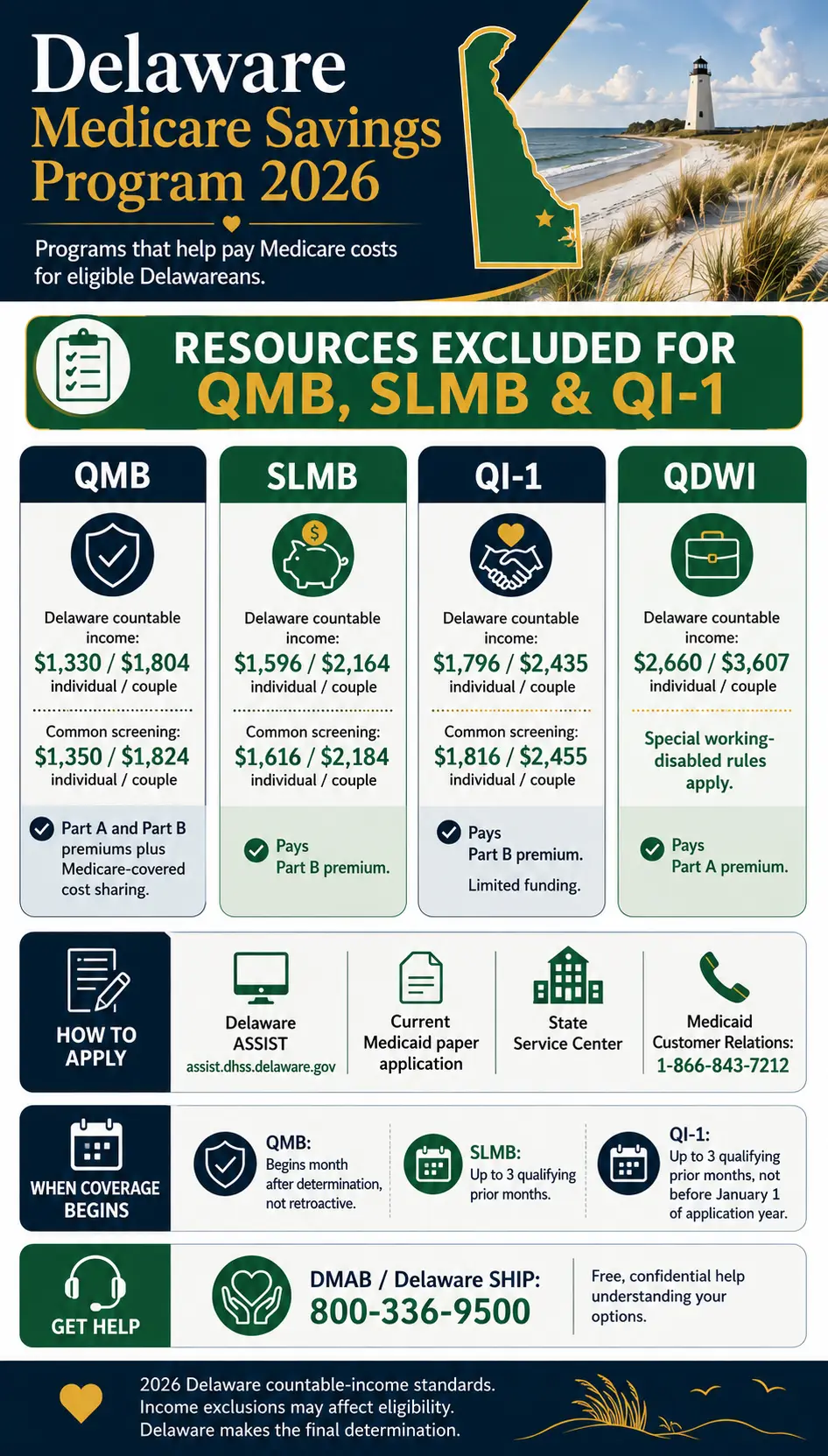
Resources are excluded for Delaware QMB eligibility, and SLMB and QI-1 follow QMB financial eligibility rules except for their different income limits. That means bank savings, investments or home ownership should not automatically cause you to rule yourself out of QMB, SLMB or QI-1.
Quick Answer
| What you need | Delaware route |
|---|---|
| Apply online | Delaware ASSIST |
| Check possible eligibility | ASSIST screening tool |
| Paper application | Delaware Medicaid application / Form 100 |
| In-person assistance | Delaware State Service Center |
| Application and case questions | Medicaid Customer Relations: 1-866-843-7212 |
| Report a change | ASSIST or 302-571-4900, Option 2 |
| Free Medicare counseling | DMAB: 800-336-9500 or 302-674-7364 |
| Main MSP categories | QMB, SLMB and QI-1 |
| Resource test for QMB/SLMB/QI-1 | Resources excluded |
The standard Medicare Part B premium is $202.90 per month in 2026, or $2,434.80 over 12 months. The annual Part B deductible is $283.

Table of Contents
- 2026 income limits
- Countable income and disregards
- Delaware resource rules
- QMB, SLMB, QI-1 and QDWI
- MSP versus full Medicaid
- Who may qualify
- Apply through ASSIST
- Documents after ASSIST
- Paper application
- State Service Centers
- Customer Relations
- Report changes
- DMAB / SHIP
- Documents to prepare
- After applying
- Retroactive benefits
- Part B deduction after approval
- QMB billing protection
- Extra Help
- Renewal
- Denial and fair hearing
- Estate recovery
- Contacts
- FAQs
The Delaware Medicare Savings Program can help people with Medicare pay expenses that otherwise come out of a limited monthly income.
You do not apply for this assistance through Medicare.gov. Delaware administers MSP eligibility through its own medical-assistance system, including the ASSIST benefits portal and Delaware State Service Centers.
Delaware is also an important example of why a generic national MSP chart should never replace state-specific research. Its QMB, SLMB and QI-1 financial rules exclude resources, while the state publishes its own countable-income standards.
For broader information, visit our Medicare Savings Programs educational resource. State rules differ significantly. The previous state guide explains the Connecticut Medicare Savings Program and its higher state income limits.
Delaware Medicare Savings Program Income Limits for 2026
Delaware DHSS publishes the following monthly countable-income standards for 2026.
| Program | Delaware countable income: individual | Delaware countable income: couple | Common screening amount: individual | Common screening amount: couple | Main help |
|---|---|---|---|---|---|
| QMB | $1,330 | $1,804 | $1,350 | $1,824 | Part A/Part B premiums and Medicare cost sharing |
| SLMB | $1,596 | $2,164 | $1,616 | $2,184 | Part B premium |
| QI-1 | $1,796 | $2,435 | $1,816 | $2,455 | Part B premium |
| QDWI | $2,660 | $3,607 | Special work/disability calculation | Special work/disability calculation | Part A premium |
The first income columns are the figures Delaware publishes as countable-income limits.
The slightly higher QMB, SLMB and QI screening figures reflect the common $20 general income exclusion used under SSI-related MSP methodology. The final calculation can also involve other exclusions and spouse-deeming rules.
Do not self-deny based on gross Social Security or wages alone. If your income is close to a limit, apply and allow Delaware to calculate countable income.
Review the official Delaware Medicaid income-limit table and our Medicare Savings Program income-limit guide.
How Does Delaware Count Income?
Delaware’s QMB methodology uses SSI-related income rules rather than simply comparing every dollar received against the poverty-level figure.
Depending on the type of income and household situation, exclusions can affect countable income.
Important concepts include:
- A general $20 income exclusion can apply under SSI methodology.
- Earned income can receive additional exclusions.
- Spouse income may be subject to deeming rules.
- Certain income is specifically excluded by law.
- Social Security COLA increases receive special treatment during the early part of the year under Delaware MSP rules.
This is why the official $1,330 QMB countable-income standard can coexist with a practical $1,350 screening figure.
Do not add $20 automatically to every type of income or household calculation. Let Delaware apply the exclusions to your actual circumstances.
Does Delaware Have an Asset Limit for QMB, SLMB and QI-1?
Delaware has unusually favorable resource rules for these three programs.
For QMB, Delaware’s administrative rules state that all resources of the applicant and spouse are excluded.
SLMB applicants follow the QMB technical and financial eligibility requirements except for the higher SLMB income limit. QI applicants also follow QMB financial eligibility requirements except for their different income level.
Therefore, for Delaware QMB, SLMB and QI-1, do not automatically assume that the following prevent eligibility:
- Checking account balances.
- Savings accounts.
- Certificates of deposit.
- Stocks or bonds.
- Retirement accounts.
- Home ownership.
- Vehicles.
- Other resources that could matter in a state using the standard federal MSP resource limit.
This rule is specific to the relevant Delaware MSP categories. Long-term care Medicaid and other medical-assistance programs can use different financial rules.
QDWI caution: Do not automatically extend the QMB/SLMB/QI-1 no-resource statement to a QDWI case. QDWI has separate federal and Delaware work, disability and Medicare Part A rules. Ask DMMA to make the category-specific determination.
Read our MSP resource-limit guide.
What Does Each Delaware Medicare Savings Program Pay?
QMB: Qualified Medicare Beneficiary
QMB provides the broadest Medicare cost assistance.
Delaware QMB may pay:
- Medicare Part A premium if you owe one.
- Medicare Part B premium.
- Medicare Part A deductible.
- Medicare Part B deductible.
- Medicare coinsurance.
- Medicare-covered copayments under federal QMB billing protections.
At the standard 2026 Part B premium alone, premium assistance can be worth $2,434.80 over a full year. For someone who regularly uses Medicare-covered medical care, QMB’s cost-sharing protection can be even more valuable.
SLMB: Specified Low-Income Medicare Beneficiary
SLMB pays the Medicare Part B premium.
It does not provide the same Medicare deductible and coinsurance coverage as QMB.
Delaware sets the SLMB countable-income standard at 120% of the Federal Poverty Level.
QI-1: Qualifying Individual
Delaware calls the higher-income category QI-1.
QI-1 pays the Medicare Part B premium.
Important QI rules include:
- Income is above the SLMB level but within the QI-1 standard.
- QI funding is limited.
- Applicants are generally served on a first-come, first-served basis.
- Priority is given to people who received QI in the previous year.
- QI is not available to a person who is otherwise eligible for Medicaid.
QDWI: Qualified Disabled and Working Individuals
QDWI is a narrower category for certain people with disabilities who returned to work and lost premium-free Medicare Part A.
Delaware’s 2026 countable-income table lists:
- $2,660 per month for one person.
- $3,607 per month for a couple.
The actual QDWI calculation can involve special earned-income deductions. An applicant must also meet the Medicare Part A, disability, employment and other QDWI requirements.
QDWI pays the Medicare Part A premium rather than the Part B premium.
Is Delaware MSP the Same as Full Medicaid?
No.
Delaware specifically states that people receiving QMB, SLMB or QI Medicare Savings Program benefits do not automatically receive regular Medicaid services.
| Approval | What it generally means |
|---|---|
| QMB | Medicare premiums and Medicare cost-sharing assistance |
| SLMB | Part B premium assistance |
| QI-1 | Part B premium assistance, without simultaneous full Medicaid eligibility |
| Full Delaware Medicaid | Broader Medicaid medical coverage |
| Long-term care Medicaid | Separate financial, medical and documentation rules |
A person may qualify for both QMB and full Medicaid when all requirements for both programs are met, but one approval should not be assumed to mean the other.
Read our Medicare Savings Program versus Medicaid guide.
Who May Qualify for Delaware MSP?
The exact requirements depend on the program, but an applicant generally needs to:
- Live in Delaware.
- Meet the applicable Medicare entitlement requirements.
- Meet the relevant countable-income standard.
- Meet citizenship or qualifying immigration requirements.
- Provide enough information for Delaware to determine eligibility.
QMB, SLMB and QI-1 applicants should not self-deny because of assets.
Delaware ASSIST is currently displaying an alert about federal Medicaid eligibility changes for certain noncitizens beginning October 1, 2026. If you are not a U.S. citizen, contact Delaware Medicaid Customer Relations for current guidance on how the rules affect your specific medical-assistance category.
See our guide explaining who may qualify for a Medicare Savings Program.
Application Path 1: Apply Online Through Delaware ASSIST
Delaware’s main online benefits system is ASSIST.
ASSIST specifically lists Qualified Medicare Beneficiary among the programs available through its benefits application process.
Open the official Delaware ASSIST portal.
How to apply through ASSIST
- Open Delaware ASSIST.
- Choose the option to apply for benefits.
- Use the screening tool first if you want a preliminary eligibility check.
- Start the benefits application.
- Follow the medical-assistance path that includes Qualified Medicare Beneficiary.
- Enter your Medicare information.
- Report household and income information accurately.
- Review the application.
- Submit it.
- Save your confirmation information.
- Return to ASSIST to check status and notices.
If you apply on a phone or tablet, save a screenshot or PDF of the confirmation page before closing the browser.
ASSIST can also be used later to:
- Finish a saved application.
- Check application status.
- View notices.
- Report changes.
- Renew existing benefits.
Apply through Delaware ASSIST
Use the state’s official portal to apply, screen for possible eligibility, check your application and manage notices.
Where Should ASSIST Applicants Send Documents?
Do not assume that every Delaware online applicant should send supporting documents to one universal address.
After the application is submitted, follow:
- The ASSIST confirmation page.
- Your ASSIST account instructions.
- Any Request for Information.
- Any DSS or DMMA eligibility notice.
The instructions may direct you to upload, mail, fax, drop off or otherwise provide specific verification.
Keep the notice together with a copy of whatever you send.
If mailing documents, use the destination listed on your current notice rather than copying an address from an old article.
Application Path 2: Apply on Paper
Delaware also provides a paper Medicaid application for applicants who prefer not to use ASSIST.
Delaware materials have historically identified the general application as Form 100.
Because application forms can be revised, use the current Delaware Medicaid forms and publications page to download the latest English or Spanish Medicaid application.
Paper application steps
- Download or request the current Medicaid application.
- Complete the medical-assistance sections that apply to you.
- Provide Medicare information.
- Report income carefully.
- Include spouse information when applicable.
- Sign and date the application.
- Provide verification requested by the form or agency.
- Submit the application according to current DSS instructions.
- Keep a complete copy.
Do not send your only original Medicare card, Social Security notice or other irreplaceable record unless the agency specifically asks to inspect an original.
Application Path 3: Get Help at a Delaware State Service Center
Delaware State Service Centers help residents apply for and manage social-service and Medicaid benefits.
They are available across New Castle, Kent and Sussex counties.
Use the official Delaware State Service Center locator immediately before visiting because office locations and schedules can change.
A State Service Center can be useful if:
- You cannot comfortably use ASSIST.
- You need a paper application.
- You need help understanding a notice.
- You need to provide documents.
- Medicare and Medicaid issues overlap.
- You have unreliable internet access.
- A family member is helping you complete the application.
Many State Service Center locations operate generally from 8:00 a.m. to 4:30 p.m., but check the individual location before traveling.
Application Path 4: Call Delaware Medicaid Customer Relations
1-866-843-7212
TTY: 711
Customer Relations can provide general information, referrals and assistance to Delaware Medicaid and medical-assistance applicants and clients.
Consider calling for:
- Application questions.
- ASSIST problems.
- Help finding the appropriate office.
- Case-status questions.
- Confusing notices.
- Language assistance.
- Questions about current eligibility rules.
For an existing application, have the application date, case number or recent notice nearby.
Application Path 5: Report Changes After Approval
Keep your contact and case information current after approval.
Delaware currently accepts changes through:
- ASSIST.
- Change Report Center: 302-571-4900, Option 2.
- Fax: 302-571-4901.
- Mail or in-person submission at the appropriate DHSS location.
Depending on the program, reportable changes can include:
- Income.
- Employment.
- Household composition.
- Address.
- Phone or contact information.
An old mailing address can become a serious problem if a renewal or information request is sent to the wrong place.
Application Path 6: Get Free Medicare Counseling From DMAB
Delaware Medicare Assistance Bureau, or DMAB, is Delaware’s State Health Insurance Assistance Program.
800-336-9500
302-674-7364
Email: [email protected]
DMAB provides free counseling and can help with:
- Medicare Savings Programs.
- QMB billing problems.
- Medicare Part D Extra Help.
- Medicare Part D plans.
- Medicare Advantage.
- Medigap.
- Medicare claims and billing questions.
- Understanding whether a problem belongs with Medicare, DSS or Medicaid.
Visit the official Delaware Medicare Assistance Bureau page.
What Documents Should You Have Ready?
Delaware needs enough information to establish identity, Medicare status, residence, income and other eligibility requirements.
| Category | Examples |
|---|---|
| Medicare | Medicare number, Part A and Part B information |
| Identity | Name, date of birth, Social Security number |
| Residence | Delaware home and mailing address, phone number |
| Income | Social Security, pension, wages, self-employment or other income information |
| Immigration, if applicable | Lawful-status documentation when requested |
| Case tracking | ASSIST confirmation, case number and DSS notices |
Remember that QMB, SLMB and QI-1 use Delaware’s favorable resource treatment. Do not automatically build a large asset-document package unless the agency requests information relevant to your case or another benefit program.
Keep one benefits folder
Keep copies of:
- The application.
- ASSIST confirmation.
- Documents submitted.
- DSS or DMMA notices.
- Approval or denial letters.
- Medicare Summary Notices connected with later billing disputes.
What Happens After You Apply?
After applying through ASSIST, on paper or with help from a State Service Center:
- Check your ASSIST account if you created one.
- Watch regular mail.
- Read all notices promptly.
- Respond to requests by the deadline.
- Keep proof of documents you submit.
- Report required changes.
- Read the approval notice carefully.
Delaware’s general medical-assistance eligibility standard is 45 days for most applicants. Applications based on a disability determination can use a longer standard.
The 45-day period is a processing standard, not a required waiting period. Delaware should make the decision as quickly as possible when it has the information needed.
Pay particular attention to:
- Which MSP was approved.
- The effective date.
- Whether prior months are included.
- Any future renewal date or reporting instruction.
Can Delaware MSP Benefits Be Retroactive?
The answer depends on the program.
| Program | Delaware timing |
|---|---|
| QMB | Begins the first day of the month after Delaware determines QMB eligibility. QMB itself is not retroactive. |
| SLMB | May begin with the application month and can cover up to 3 qualifying months before the application month. |
| QI-1 | May begin with the application month and can cover up to 3 qualifying prior months, but not before January 1 of the application year. |
| QDWI | Retroactive eligibility may be available when the individual met the QDWI requirements, including the required Part A enrollment. |
QMB warning: Do not assume that a QMB approval will erase Medicare deductibles, coinsurance or copayments from the three months before you applied. QMB itself is prospective.
What if the Part B Premium Is Still Deducted After Approval?
An MSP approval and a Social Security payment update do not always occur at the same time.
The state must transmit the Medicare premium-payment information, and Medicare and Social Security systems must update their records.
Keep:
- The Delaware approval notice.
- The program name.
- The effective date.
- Social Security payment records.
- Any later premium adjustment or reimbursement notice.
If deductions continue and you believe the approved effective date has already passed, contact Delaware Medicaid Customer Relations or DMAB for help identifying whether the problem is with the state eligibility record or federal Medicare processing.
Read our Medicare Part B premium help guide.
What if You Have QMB and a Provider Sends You a Bill?
Federal law prohibits Medicare providers and suppliers from billing QMB beneficiaries for Medicare-covered Part A and Part B deductibles, coinsurance and copayments.
If a bill arrives:
- Do not automatically pay it.
- Confirm that QMB was active on the date of service.
- Confirm Medicare covered the service.
- Call the provider’s billing office.
- Tell the office you have QMB.
- Provide your Medicare and available QMB or Medicaid information.
- Ask the provider to correct the protected cost-sharing charge.
- Keep the bill and Medicare Summary Notice.
- Contact DMAB or Medicare if the billing problem continues.
1-800-MEDICARE: 1-800-633-4227
Medicare TTY: 1-877-486-2048
If you already paid a protected amount that the provider was prohibited from billing, ask the provider to review whether a refund or account correction is required.
QMB does not make every medical service free. The protection applies to Medicare-covered Part A and Part B cost sharing.
Read the official CMS QMB billing guidance and our QMB Medicare Savings Program guide.
Does Delaware MSP Include Medicare Part D Extra Help?
People who qualify for QMB, SLMB or QI automatically qualify for Medicare Part D Extra Help.
In 2026, Extra Help provides:
- $0 premium for a qualifying benchmark Part D plan.
- $0 Part D deductible.
- Up to $5.10 for each covered generic drug.
- Up to $12.65 for each covered brand-name drug.
- $0 for covered drugs after total drug costs reach $2,100.
- No Part D late-enrollment penalty while receiving Extra Help.
If you also have full Medicaid and QMB, Medicare may apply a lower covered-drug copay.
Review Medicare’s official Extra Help information.
How Does Delaware MSP Renewal Work?
Delaware’s QMB, SLMB, QI and QDWI rules require eligibility to be redetermined at least every 12 months, and eligibility can also be reviewed when a relevant change is reported.
Delaware may be able to renew medical eligibility using information already available electronically.
If more information is needed, respond to the renewal request by the stated deadline.
ASSIST allows returning users to select Renew My Benefits.
Before renewal:
- Make sure Delaware has your current mailing address.
- Check ASSIST notices.
- Report required income or household changes.
- Keep copies of anything submitted.
- Do not ignore a renewal notice because your MSP worked automatically the previous year.
QI funding and annual eligibility rules make timely renewal especially important for QI-1 beneficiaries.
Read our Medicare Savings Program renewal guide.
What Should You Do if Delaware Denies or Ends MSP?
Read the entire eligibility notice before assuming that the problem is income.
A denial or closure can involve:
- Missing verification.
- An incomplete application.
- A missed information deadline.
- Incorrect household or spouse information.
- An income calculation you believe is incorrect.
- A missed renewal.
- Program-specific QI or QDWI requirements.
Take these steps:
- Read the stated reason.
- Contact Customer Relations or the office handling the case.
- Provide missing or corrected information when appropriate.
- Request a fair hearing if you disagree with the decision.
- Follow the deadline on the notice.
Delaware fair-hearing deadline
Under Delaware’s current fair-hearing rules, a hearing is generally available when the request is received within 90 days from the effective date of the agency action.
If you are already receiving benefits that Delaware plans to reduce or terminate, a much shorter timing rule matters.
The state’s timely notice period is generally the 10-day period between the mailing of the notice and the proposed effective date. A hearing request filed during that period can preserve benefits pending the appeal, subject to the program’s continuation rules.
Do not wait 90 days if existing benefits are about to close. Follow the continuation-of-benefits instructions and effective date printed on your individual notice.
Medical-assistance hearing requests can be accepted through several methods. Delaware DSS also publishes a fair-hearing request email on its contact page.
Review the current Delaware DSS contact and fair-hearing information and our Medicare Savings Program denial guide.
Does Estate Recovery Apply to Delaware MSP Benefits?
Medicare Savings Program assistance should not automatically be treated the same as full Medicaid or long-term care Medicaid.
Federal Medicaid rules exclude Medicare cost-sharing payments made on behalf of MSP beneficiaries from optional Medicaid estate recovery.
However, a person who separately receives full Medicaid, nursing-facility care or other long-term services may have a different estate-recovery situation.
Do not make estate-planning decisions based only on an MSP approval. Review the actual Medicaid benefits received and obtain qualified advice when necessary.
Delaware Medicare Savings Program Contacts
| Need | Delaware contact |
|---|---|
| Apply or screen online | Delaware ASSIST |
| Current paper Medicaid application | DMMA Forms and Publications |
| Find in-person help | State Service Center locator |
| Medicaid Customer Relations | 1-866-843-7212 |
| Customer Relations TTY | 711 |
| Report changes | 302-571-4900, Option 2 |
| Change report fax | 302-571-4901 |
| DMAB / Delaware SHIP | 800-336-9500 / 302-674-7364 |
| DMAB email | [email protected] |
| Medicare / QMB billing | 1-800-MEDICARE: 1-800-633-4227 |
Best Delaware path to start
Use ASSIST for an online application or screening, or contact a Delaware State Service Center if you need hands-on help. For QMB, SLMB and QI-1, do not let savings or other resources stop you from applying.
Common Delaware MSP Mistakes to Avoid
Using only a generic national chart
Delaware publishes state countable-income standards and uses SSI-related income exclusions. Use Delaware guidance for the final screening.
Thinking savings automatically disqualify you
Resources are excluded under Delaware QMB financial eligibility, and SLMB and QI-1 follow the QMB financial methodology except for income.
Extending the no-resource statement to every Medicaid program
Long-term care and other Delaware Medicaid programs can use different financial rules.
Treating QDWI exactly like QMB
QDWI has separate work, disability, Part A and financial rules. Ask Delaware to determine the category rather than assuming the QMB resource treatment applies.
Sending documents to an old address
For ASSIST applications, follow the current confirmation page or notice for the correct document-submission route.
Expecting QMB to cover the previous three months
QMB is prospective. SLMB and QI-1 have separate retroactive rules.
Paying a QMB bill without checking it
Federal law protects QMB beneficiaries from Medicare-covered Part A and Part B cost sharing.
Ignoring renewal or address updates
An expired MSP can cause Medicare premiums to begin coming out of a Social Security payment again.
Waiting 90 days when benefits are about to close
The general appeal window is different from the shorter timely-notice period used to preserve existing benefits during an appeal.
Delaware Medicare Savings Program FAQs
Where do I apply for the Delaware Medicare Savings Program?
You can apply through Delaware ASSIST or get help through Delaware DSS and a State Service Center.
What are Delaware’s 2026 QMB income limits?
Delaware’s official 2026 countable-income limit is $1,330 per month for one person and $1,804 for a couple. A common screening figure after the standard $20 general income exclusion is $1,350 and $1,824.
What are Delaware’s 2026 SLMB income limits?
Delaware lists a 2026 countable-income standard of $1,596 for one person and $2,164 for a couple. A common screening figure after the $20 general exclusion is $1,616 and $2,184.
What are Delaware’s 2026 QI-1 income limits?
Delaware lists QI-1 at $1,796 in monthly countable income for one person and $2,435 for a couple. A common screening figure after the $20 general exclusion is $1,816 and $2,455.
Does Delaware have an asset test for QMB, SLMB and QI-1?
Delaware excludes all resources when determining QMB eligibility. SLMB and QI-1 follow QMB technical and financial requirements except for their different income standards, so resources are not used as a standard eligibility limit for these three programs.
What does Delaware QMB pay?
QMB may pay Medicare Part A and Part B premiums, Medicare deductibles, coinsurance and protected Medicare-covered copayments.
What does SLMB pay?
SLMB pays the Medicare Part B premium. It does not provide the broader Medicare cost-sharing protection available through QMB.
What does QI-1 pay?
QI-1 pays the Medicare Part B premium. Funding is limited, applicants are generally served first-come, first-served, and priority is given to people who received QI in the previous year.
What is Delaware’s 2026 QDWI income limit?
Delaware’s 2026 countable-income table lists QDWI at $2,660 per month for one person and $3,607 for a couple. Special work, disability, Medicare Part A and income-deduction rules apply.
Can I apply online?
Yes. Delaware ASSIST provides an online benefits application and specifically lists Qualified Medicare Beneficiary among the programs available through the portal.
Is there a paper application?
Yes. Delaware provides a paper Medicaid application. Use the current DMMA Forms and Publications page or request help from a State Service Center to make sure you use the current version.
Where should I send documents after applying through ASSIST?
Follow the submission instructions on your ASSIST confirmation page or current Delaware notice. Do not assume every application uses the same mailing address or fax number.
How long can a Delaware MSP application take?
Delaware’s general Medicaid eligibility standard is 45 days for most non-disability applications. A decision can take longer in unusual circumstances or when required information is delayed.
Can Delaware QMB be retroactive?
No. Delaware QMB begins the first day of the month after the state determines QMB eligibility. QMB itself does not cover the previous three months.
Can SLMB or QI-1 cover earlier months?
Yes. Delaware allows SLMB and QI eligibility for up to three qualifying months before the application month. QI coverage cannot begin before January 1 of the year in which the application is filed.
Does QMB protect me from Medicare bills?
Yes. Federal law prohibits Medicare providers and suppliers from billing QMB beneficiaries for Medicare-covered Part A and Part B deductibles, coinsurance and copayments.
Does Delaware MSP include Extra Help?
People who qualify for QMB, SLMB or QI also qualify automatically for Medicare Part D Extra Help.
How often is Delaware MSP eligibility renewed?
Delaware’s MSP rules require eligibility to be redetermined at least every 12 months. ASSIST can be used to renew benefits when action is required.
How long do I have to appeal a Delaware MSP eligibility decision?
Delaware generally allows a fair-hearing request within 90 days from the effective date of the agency action. If existing benefits are about to be reduced or closed, act during the shorter timely-notice period if you want to request continuation while the appeal is pending.
Who can help me with Medicare questions for free?
Call the Delaware Medicare Assistance Bureau at 800-336-9500 or 302-674-7364. DMAB is Delaware’s SHIP program and provides free Medicare counseling.
Conclusion
Delaware’s Medicare Savings Program is easier to navigate when you focus on how Delaware actually administers it.
Use ASSIST for online applications and account management, the current Delaware Medicaid paper application when you prefer paper, State Service Centers for hands-on help, Medicaid Customer Relations for case questions, and DMAB for Medicare counseling.
Delaware’s resource rules are especially important. QMB excludes the applicant’s and spouse’s resources, while SLMB and QI-1 follow QMB financial eligibility rules except for their different income standards.
If $202.90 is coming out of your Social Security payment each month and your income is near Delaware’s MSP range, do not rule yourself out because of your savings balance or a generic federal chart.
Submit the appropriate application and let Delaware make the eligibility determination.
Start with Delaware ASSIST
If your income is near the Delaware MSP limit, use the official state system and allow DHSS to determine your countable income and program category.
Editorial disclaimer: This article provides general educational information and is not legal, financial, medical or benefits advice. Eligibility rules, income limits, immigration requirements, application procedures and contact details may change. Review current Delaware DHSS instructions and your individual eligibility notice. Delaware makes the final eligibility decision.