Iowa Medicare Savings Program 2026: Income, Assets & How to Apply
Iowa Medicare Cost Assistance Guide
Iowa Medicare Savings Program 2026: Income, Resources and How to Apply
Iowa Medicare Savings Programs may help eligible Medicare beneficiaries pay Part A or Part B premiums. QMB can also protect eligible members from Medicare-covered deductibles, coinsurance and copayments.
Last verified August 22, 2026, using current Iowa Health and Human Services, Iowa SHIIP-SMP, Medicare and CMS information. Iowa HHS makes the final eligibility decision.
Independent educational resource
This website is not Medicare, CMS, Iowa HHS, Iowa Medicaid or another government agency. We do not process or approve applications. Income limits, resource limits, forms and procedures may change. Iowa HHS makes the final eligibility determination.
Iowa Terminology to Know
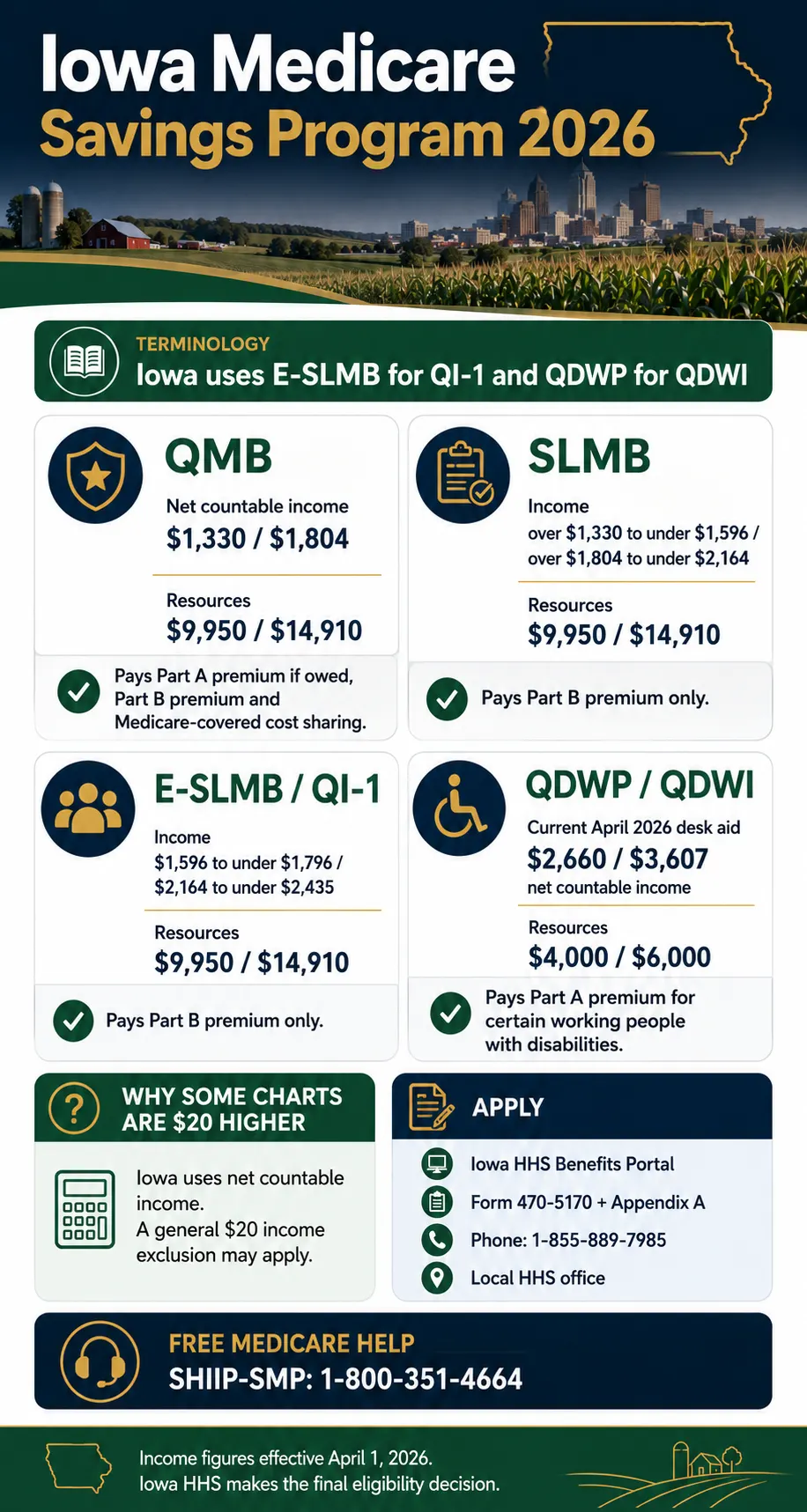
Iowa calls the federal QI-1 category Expanded Specified Low-Income Medicare Beneficiary, or E-SLMB. Iowa also calls the federal QDWI category QDWP, Qualified Disabled & Working Persons. Using the Iowa names can make state forms and notices easier to understand.
Quick Answer
| What you need | Iowa contact or next step |
|---|---|
| Apply online | Iowa HHS Benefits Portal |
| Paper application | Form 470-5170 with Appendix A |
| Apply by phone | 1-855-889-7985 |
| Fax signed application | 515-564-4017 |
| Email signed application | [email protected] |
| Mail signed application | Imaging Center 4, PO Box 2027, Cedar Rapids, IA 52406 |
| Local help | Iowa HHS office |
| Free Medicare counseling | SHIIP-SMP: 1-800-351-4664 |
| Iowa MSP categories | QMB, SLMB, E-SLMB and QDWP |
The standard Medicare Part B premium is $202.90 per month in 2026, or $2,434.80 over a full year. The 2026 Part B deductible is $283.
Table of Contents
- 2026 income and resource limits
- Why some charts are $20 higher
- What income counts
- What resources count
- QMB, SLMB, E-SLMB and QDWP
- How to apply
- Online application
- Paper application
- Phone application
- Local HHS office
- SHIIP-SMP
- After applying
- Form 470-4846
- Effective and retroactive dates
- Part B still being deducted
- QMB billing protection
- Extra Help
- Renewal
- Denial and appeal
- Estate recovery
- FAQs
Iowa’s Medicare Savings Program can pay some or all of a qualifying Medicare member’s Part A and Part B costs.
Depending on the category, that may mean only the monthly Medicare Part B premium or broader protection from Medicare deductibles, coinsurance and copayments.
You apply through Iowa Health and Human Services, not through Medicare.gov.
For broader Medicare Savings Program information, visit our Medicare Savings Programs educational resource. State rules vary. The previous guide explains the Arkansas Medicare Savings Program, including its SMB terminology and resource limits.

Iowa Medicare Savings Program Income and Resource Limits for 2026
Iowa HHS’s April 2026 Medical Assistance Desk Aid uses net countable monthly income.
| Iowa program | Individual income | Couple income | Individual resources | Couple resources | Main benefit |
|---|---|---|---|---|---|
| QMB | Up to $1,330 | Up to $1,804 | $9,950 | $14,910 | Part A premium if owed, Part B premium and Medicare-covered cost sharing |
| SLMB | Over $1,330 but under $1,596 | Over $1,804 but under $2,164 | $9,950 | $14,910 | Part B premium |
| E-SLMB Federal QI-1 category |
At least $1,596 but under $1,796 | At least $2,164 but under $2,435 | $9,950 | $14,910 | Part B premium |
| QDWP Federal QDWI category |
Up to $2,660 net countable income | Up to $3,607 net countable income | $4,000 | $6,000 | Part A premium for certain working people with disabilities |
These figures became effective April 1, 2026.
Use the current Iowa HHS Medical Assistance Desk Aid for the state’s dated eligibility figures.
QDWP update: Iowa’s separate QDWP webpage may still display older 2026 figures. The newer April 2026 HHS desk aid lists $2,660 for one person and $3,607 for a couple. Use the newer dated document for initial screening and let HHS make the final calculation.
See our Medicare Savings Program income-limit guide for additional context.
Why Do Some Iowa MSP Charts Show Income Limits $20 Higher?
Iowa HHS publishes its primary table using net countable income.
SSI-related calculations include a general income exclusion that can reduce countable income by up to $20 per month.
This is why you may also see practical screening figures such as:
- QMB individual: $1,350 instead of $1,330.
- QMB couple: $1,824 instead of $1,804.
- Upper Part B assistance screen: $1,816 instead of $1,796 for one person.
- Upper couple screen: $2,455 instead of $2,435.
For example, someone receiving $1,345 in countable-type unearned income should not automatically assume they are over Iowa’s $1,330 QMB standard. HHS must apply the appropriate exclusions.
Best practice: Report your actual gross income accurately. Do not subtract $20 yourself and do not self-deny because your income is slightly above a published net-countable figure.
What Income Should You Report?
Report all income requested by Iowa HHS, even when you believe some of it may later be excluded.
Examples can include:
- Social Security benefits.
- Pensions.
- Veterans benefits.
- Railroad Retirement.
- Wages.
- Self-employment earnings.
- Interest and dividends.
- Annuity or retirement income.
Use gross figures when HHS asks for gross income. Do not use the lower amount deposited into your bank account after Medicare premiums, taxes or other deductions.
Working applicants can have additional earned-income exclusions under SSI-related methodology. This is especially important for QDWP applicants.
What Resources Count for Iowa Medicare Savings Programs?
Iowa uses resource limits, but not everything you own necessarily counts.
Resources that should be reported when requested can include:
- Checking accounts.
- Savings accounts.
- Cash.
- Certificates of deposit.
- Stocks and bonds.
- Mutual funds.
- IRAs and 401(k) accounts.
- Annuities.
- Life insurance information.
- Vehicles.
- Real estate.
- Trusts and other financial resources.
Iowa SHIIP guidance excludes a person’s primary home and primary vehicle from its MSP resource screening. Other exclusions may also apply.
Still, list the property, vehicles and financial accounts requested on the Iowa application. HHS, not the applicant, should decide what is countable.
Read our Medicare Savings Program resource-limit guide.
What Does Each Iowa Medicare Savings Program Pay?
QMB: Qualified Medicare Beneficiary
QMB provides the broadest Medicare cost assistance.
Iowa QMB can help pay:
- Medicare Part A premium if you owe one.
- Medicare Part B premium.
- Part A deductibles.
- Part B deductible.
- Medicare coinsurance.
- Medicare-covered copayments.
QMB does not pay Medigap premiums or make services that Medicare does not cover automatically free.
Read the official Iowa QMB information and our QMB guide.
SLMB: Specified Low-Income Medicare Beneficiary
SLMB pays the Medicare Part B premium only.
It does not pay Medicare deductibles, coinsurance or copayments the way QMB can.
Iowa requires SLMB applicants to have both Medicare Part A and Part B and to meet the applicable net-countable income and resource rules.
Review the official Iowa SLMB page.
E-SLMB: Iowa’s QI-1 Category
Iowa calls the federal Qualifying Individual, or QI-1, category Expanded Specified Low-Income Medicare Beneficiary, or E-SLMB.
E-SLMB:
- Pays the Part B premium only.
- Uses the higher 120% to 135% FPL income tier.
- Requires resources below the MSP resource limit.
- Cannot be received when the person qualifies for another Medicaid category.
- Operates under the federal QI funding framework.
Review Iowa’s official E-SLMB information.
QDWP: Iowa’s QDWI Category
QDWP stands for Qualified Disabled & Working Persons. Medicare generally calls the federal category QDWI.
QDWP is intended for certain people with disabilities who returned to work and need help paying a Medicare Part A premium.
It pays the Part A premium only.
QDWP does not pay:
- Part B premiums.
- Medicare deductibles.
- Coinsurance.
- Copayments.
Special earned-income exclusions can significantly affect a QDWP calculation. Do not compare gross wages directly with the $2,660/$3,607 net-countable standard and assume you are ineligible.
How Do You Apply for Iowa’s Medicare Savings Program?
You do not need to submit four separate MSP applications or decide the final category yourself.
Submit an Iowa medical-assistance application and indicate that you need assistance paying Medicare premiums.
Iowa HHS determines whether QMB, SLMB, E-SLMB, QDWP or another Medicaid category applies.
Option 1: Apply Online Through the Iowa HHS Benefits Portal
For applicants comfortable using an online system, the Iowa HHS Benefits Portal is a practical starting point.
Open the Iowa HHS Benefits Portal.
Online application steps
- Gather Medicare, income and resource information.
- Open the Iowa HHS Benefits Portal.
- Choose the option to apply for assistance.
- Create an account or sign in.
- Complete the health-coverage questions for the Medicare beneficiary.
- Report Medicare Part A and Part B information.
- Enter income and spouse information completely.
- Report requested resources and assets.
- Upload verification when requested or available.
- Review the application carefully.
- Submit it.
- Save the confirmation page or application number.
After filing, continue checking both the portal and regular mail because HHS may request additional information.
Apply through Iowa’s official benefits system
Use the HHS Benefits Portal for an online medical-assistance application and save proof that the application was submitted.
Option 2: Apply With Iowa Form 470-5170
Iowa’s paper form is the Application for Health Coverage and Help Paying Costs, Form 470-5170.
Open the current Iowa medical-assistance application.
For a Medicare Savings Program application, Appendix A for Health Coverage is especially important.
Paper application steps
- Complete the main household application.
- Complete Appendix A for the person who is aged, blind or disabled and has Medicare.
- Mark “Assistance paying Medicare premiums.”
- Report income.
- Report bank and investment accounts.
- Report requested retirement accounts and annuities.
- Report vehicles and real estate requested on the form.
- Report life insurance, burial arrangements or trusts when applicable.
- Provide copies of available verification, not irreplaceable originals.
- Sign and date the application.
- Keep a complete copy.
Where to send the signed application
| Method | Iowa HHS destination |
|---|---|
| [email protected] | |
| Fax | 515-564-4017 |
| Imaging Center 4, PO Box 2027, Cedar Rapids, IA 52406 | |
| In person | Local Iowa HHS office |
If you do not want to email sensitive financial documents, use the Benefits Portal, fax, mail or an HHS office.
Keep evidence of filing, such as a fax confirmation, sent-email record, mailing receipt or date-stamped office copy.
Option 3: Apply by Phone
1-855-889-7985
Iowa HHS says you can call this number to complete a medical-assistance application by phone or get application help.
Relay Iowa TTY: 1-800-735-2942
If applying by phone, record:
- The date of the call.
- The representative’s name if provided.
- Your application or reference number.
- Documents HHS says it still needs.
- The deadline and submission method for those documents.
Option 4: Apply at a Local Iowa HHS Office
In-person help may be useful if financial questions, resources or paperwork are confusing.
Use the official Iowa HHS Office Locations page before traveling.
Call the office first when possible because office coverage and appointment arrangements can vary.
Bring:
- Medicare information.
- Income records.
- Available resource information.
- Any partially completed application.
- Recent HHS notices.
Ask for proof when you submit an application or important verification in person.
Option 5: Get Free Help From Iowa SHIIP-SMP
Iowa SHIIP-SMP provides free, confidential and unbiased Medicare counseling.
1-800-351-4664
TTY: 1-800-735-2942
Email: [email protected]
SHIIP-SMP can help with:
- Medicare Savings Program screening.
- Application assistance.
- QMB billing issues.
- Medicare Part D Extra Help.
- Medicare Advantage.
- Medigap.
- Understanding Medicare notices and coverage.
Visit the official Iowa SHIIP-SMP Medicare Savings Program page.
What Happens After You Apply?
Iowa HHS may:
- Approve the application.
- Request additional verification.
- Request clarification.
- Send a denial notice.
Check:
- Your HHS Benefits Portal account.
- Regular mail.
- Email.
- Voicemail or phone messages.
If you have heard nothing after about 30 days, contact Iowa HHS at 1-855-889-7985 and ask whether the application was received, what filing date is recorded, and whether anything is missing.
Do Not Ignore Iowa Form 470-4846
There is another route into Iowa MSP that can begin when someone applies to Social Security for Medicare Part D Extra Help.
If the person does not opt out of MSP screening on the Extra Help application, Social Security can forward the application information to Iowa HHS.
For many such cases, Iowa sends Form 470-4846, Medicare Savings Programs Additional Information Request.
The form is important because it asks for information Iowa still needs to complete the MSP determination.
If you receive it:
- Check the prefilled information from Social Security.
- Correct anything that is wrong.
- Complete all applicable household questions.
- Complete requested income information.
- Complete requested resource information.
- Provide requested proof.
- Return the form by the deadline printed on it.
- Keep a complete copy.
Do not miss this deadline. Iowa’s current processing policy gives applicants a short return period for Form 470-4846. Failure to return required information can lead to denial of the MSP application.
When Do Iowa Medicare Savings Program Benefits Begin?
Effective dates differ by program.
| Program | General Iowa timing |
|---|---|
| QMB | Begins the first day of the month after the month eligibility is determined. QMB itself is not retroactive. |
| SLMB | Can begin with the application month and may extend into the three-month retroactive period when all eligibility requirements were met. |
| E-SLMB / QI-1 | Can begin with the application month and can potentially include qualifying prior months under applicable QI rules. |
The Iowa medical-assistance application asks about recent unpaid medical expenses. Answer those questions accurately.
Do not assume a later QMB approval will erase Medicare cost sharing from months before QMB became effective.
What if the Part B Premium Is Still Being Deducted?
The Part B deduction may not disappear from the first Social Security payment after an Iowa MSP approval.
First check:
- Which program Iowa approved.
- The effective date.
- Whether HHS still needs information.
- Later Social Security deposits.
- Any premium reimbursement or adjustment.
If deductions continue after the approved effective period, call Iowa HHS to confirm the case record. SHIIP-SMP can help with the Medicare side of the problem.
Read our Medicare Part B premium assistance guide.
What if You Have Iowa QMB and Receive a Medical Bill?
Federal law prohibits Medicare providers and suppliers from billing QMB beneficiaries for Medicare-covered Part A or Part B deductibles, coinsurance and copayments.
If a provider sends a bill:
- Do not automatically pay it.
- Confirm QMB was active on the service date.
- Confirm Medicare covered the service or item.
- Call the provider’s billing office.
- Tell the office you are a QMB beneficiary.
- Provide your Medicare and Iowa Medicaid/QMB information.
- Ask the office to remove or correct the protected cost-sharing balance.
- Keep the bill and Medicare Summary Notice.
- Call Medicare or SHIIP-SMP if billing continues.
1-800-MEDICARE: 1-800-633-4227
TTY: 1-877-486-2048
You may still owe for services or items that Medicare does not cover.
Review the official CMS QMB billing guidance.
Does Iowa MSP Include Medicare Part D Extra Help?
People who qualify for QMB, SLMB or E-SLMB/QI also automatically qualify for Medicare Part D Extra Help.
In 2026, Extra Help can provide:
- $0 premium for a qualifying benchmark Part D plan.
- $0 Part D deductible.
- Up to $5.10 for a covered generic drug.
- Up to $12.65 for a covered brand-name drug.
- $0 for covered drugs after total drug costs reach $2,100.
- No Part D late-enrollment penalty while receiving Extra Help.
Review Medicare’s current Extra Help guidance.
How Does Iowa MSP Renewal Work?
Iowa Medicare Savings Program coverage is part of non-MAGI Medicaid eligibility and is reviewed periodically.
Iowa uses its Medicaid/State Supp Review process for annual non-MAGI reviews.
You may be able to complete a review through the HHS Services Portal when the renewal is available online.
Renewal information can also be submitted through methods listed on the review notice.
To reduce the risk of losing MSP:
- Keep your address current with HHS.
- Open every HHS notice.
- Review prefilled information carefully.
- Report requested income and resource information.
- Provide copies of verification when requested.
- Sign the review form if a signature is required.
- Return it by the due date.
Read our Medicare Savings Program renewal guide.
What Should You Do if Iowa Denies or Ends MSP?
Read the entire Notice of Decision before responding.
Possible issues include:
- Missing verification.
- Income calculated incorrectly.
- Resources above the applicable limit.
- A resource that you believe should have been excluded.
- Missing Appendix A information.
- A missed Form 470-4846 deadline.
- A missed annual review.
- Program-specific eligibility requirements.
You can:
- Contact HHS and ask what information was used.
- Provide missing or corrected information.
- Submit a new application if appropriate.
- File an appeal if you disagree with the decision.
Iowa Medicaid appeal deadline
Iowa currently gives Medicaid applicants and members 90 days from the decision to file an appeal.
Medicaid appeals can be filed in person, by telephone or in writing.
HHS Appeals phone: 1-888-723-9637
Fax: 515-564-4044
Iowa Department of Health and Human Services
Appeals
321 E 12th Street
Des Moines, IA 50319
Use the official Iowa HHS appeal instructions.
Existing benefits can have a shorter deadline. Iowa’s continuation rules can require an appeal within 10 calendar days of receipt of the notice or before the action becomes effective. Follow the exact continuation instructions on your individual notice.
Read our Medicare Savings Program denial guide.
Are Iowa Medicare Savings Program Benefits Recovered From Your Estate?
Iowa provides an unusually clear answer for MSP assistance.
Iowa SHIIP-SMP says that Medicare Savings Program benefits paid on or after January 1, 2010 do not have to be repaid to the state after death.
Iowa HHS estate-recovery material also states that MSP services provided after January 1, 2010 are not included in estate recovery.
This should not be confused with other Medicaid coverage.
Full Medicaid, nursing-facility benefits, waiver services and other Title XIX assistance can have separate estate-recovery rules.
Review the Iowa SHIIP-SMP MSP guidance if estate recovery is a concern.
Common Iowa MSP Application Mistakes
Comparing a bank deposit with the income limit
The amount deposited after Medicare or other deductions is not necessarily the amount HHS uses. Report gross income as requested.
Giving up because income is $20 above the HHS chart
Iowa uses net countable income and SSI-related exclusions. Let HHS make the calculation.
Using the older QDWP web figure without checking the current desk aid
The April 2026 HHS desk aid contains newer QDWP figures than the standalone QDWP webpage.
Skipping Appendix A
For the paper application, complete Appendix A and mark “Assistance paying Medicare premiums” when appropriate.
Omitting accounts or property because you think they are excluded
Report requested resources and let HHS determine which exclusions apply.
Ignoring Form 470-4846
If Iowa sends this form after an Extra Help application, return it by the deadline.
Assuming SLMB or E-SLMB covers medical cost sharing
SLMB and E-SLMB pay the Part B premium only. QMB provides the broader Medicare cost-sharing protection.
Paying a QMB cost-sharing bill without checking it
QMB beneficiaries have federal protection from Medicare-covered Part A and Part B deductibles, coinsurance and copayments.
Waiting 90 days when existing benefits are about to close
The general Medicaid appeal window is 90 days, but benefit-continuation deadlines can be much shorter.
Iowa Medicare Savings Program FAQs
Where do I apply for Iowa’s Medicare Savings Program?
Apply through the Iowa HHS Benefits Portal, by phone at 1-855-889-7985, with the paper medical-assistance application, or through a local Iowa HHS office.
What is Iowa’s 2026 QMB income limit?
Iowa’s April 2026 desk aid lists net countable monthly income of up to $1,330 for one person and $1,804 for a couple, with resources below $9,950 and $14,910.
Why does SHIIP show $1,350 instead of $1,330 for QMB?
Iowa HHS publishes a net-countable $1,330 standard, while practical screening figures can reflect the $20 general income exclusion. Report actual income and let HHS calculate countable income.
What is Iowa’s 2026 SLMB income range?
For one person, Iowa lists net countable income over $1,330 but under $1,596. For a couple, the range is over $1,804 but under $2,164.
Does Iowa call QI E-SLMB?
Yes. Iowa calls the federal QI-1 premium-assistance tier Expanded Specified Low-Income Medicare Beneficiary, or E-SLMB.
What is Iowa’s 2026 E-SLMB income range?
For one person, Iowa lists net countable income from $1,596 to less than $1,796. For a couple, it is $2,164 to less than $2,435.
Does Iowa have an MSP asset limit?
Yes. QMB, SLMB and E-SLMB use resource limits of $9,950 for one person and $14,910 for a couple. QDWP uses $4,000 and $6,000.
Will my home or car automatically count as an MSP resource?
Iowa SHIIP screening guidance excludes a primary home and primary vehicle, but you should still report property and vehicles requested on the application so HHS can apply the correct exclusions.
What does Iowa QMB pay?
QMB can pay the Part A premium when owed, the Part B premium, and Medicare-covered Part A and Part B deductibles, coinsurance and copayments.
What do SLMB and E-SLMB pay?
SLMB and E-SLMB pay the Medicare Part B premium only. They do not provide QMB’s broader Medicare cost-sharing protection.
What is Iowa QDWP?
QDWP is Iowa’s name for the federal QDWI category. It pays the Part A premium for certain working people with disabilities who meet Medicare, income, resource and other requirements.
What QDWP income limit should I use for 2026?
Iowa’s April 2026 Medical Assistance Desk Aid lists $2,660 in net countable monthly income for one person and $3,607 for a couple. Special earned-income exclusions can apply.
What paper form do I use?
Use Iowa Form 470-5170, Application for Health Coverage and Help Paying Costs. For MSP, complete Appendix A and mark “Assistance paying Medicare premiums.”
Can I apply for Iowa MSP by phone?
Yes. Iowa HHS says you can call 1-855-889-7985 to complete a medical-assistance application by phone or get application help.
What is Form 470-4846?
Form 470-4846 is Iowa’s Medicare Savings Programs Additional Information Request. It may be sent after Social Security forwards an Extra Help application to Iowa for MSP screening.
Is Iowa QMB retroactive?
No. QMB generally begins the first day of the month after eligibility is determined. SLMB and other applicable categories have different retroactive rules.
Does QMB protect me from Medicare bills?
Yes. Federal law prohibits Medicare providers and suppliers from billing QMB beneficiaries for Medicare-covered Part A and Part B deductibles, coinsurance and copayments.
Does Iowa MSP include Extra Help?
People who qualify for QMB, SLMB or E-SLMB/QI automatically qualify for Medicare Part D Extra Help.
How long do I have to appeal an Iowa Medicaid decision?
Iowa generally gives Medicaid applicants and members 90 days from the decision to appeal. A shorter deadline may apply if you want existing benefits continued while the appeal is pending.
Are Iowa MSP benefits recovered from my estate?
Iowa states that Medicare Savings Program services provided after January 1, 2010 are not included in estate recovery. Other Medicaid or long-term-care benefits can have separate estate-recovery rules.
Who can help me apply for free?
Call Iowa SHIIP-SMP at 1-800-351-4664 for free Medicare counseling and MSP application assistance. Iowa HHS also provides application help at 1-855-889-7985.
Conclusion
For Iowa Medicare premium assistance, start with Iowa HHS and submit one medical-assistance application.
Use the HHS Benefits Portal if you prefer an online application. You can also apply by phone, by paper, or through a local HHS office.
For a paper MSP application, remember the important step: complete Appendix A and mark “Assistance paying Medicare premiums.”
Do not self-deny because your income is slightly above a table. Iowa uses net countable income, and SSI-related exclusions can reduce the amount that counts.
Do not ignore the resource section either. Iowa uses resource limits for all four MSP categories, although exclusions can apply.
If Iowa sends Form 470-4846 after an Extra Help application, return it promptly.
If you need free Medicare-specific help, contact Iowa SHIIP-SMP.
Apply through an official Iowa channel
If your income or resources are close to Iowa’s MSP limits, submit the application and let Iowa HHS determine your net countable income, resources and correct program category.
Editorial disclaimer: This article provides general educational information and is not legal, financial, medical or benefits advice. Eligibility rules, income limits, resource limits, forms and application procedures may change. Review current Iowa HHS instructions and your individual notice. Iowa HHS makes the final eligibility decision.