Colorado Medicare Savings Program 2026: Income & Asset Limits, Benefits and How to Apply
Colorado Medicare Cost Assistance Guide
Colorado Medicare Savings Program 2026: Income Limits, Benefits and How to Apply
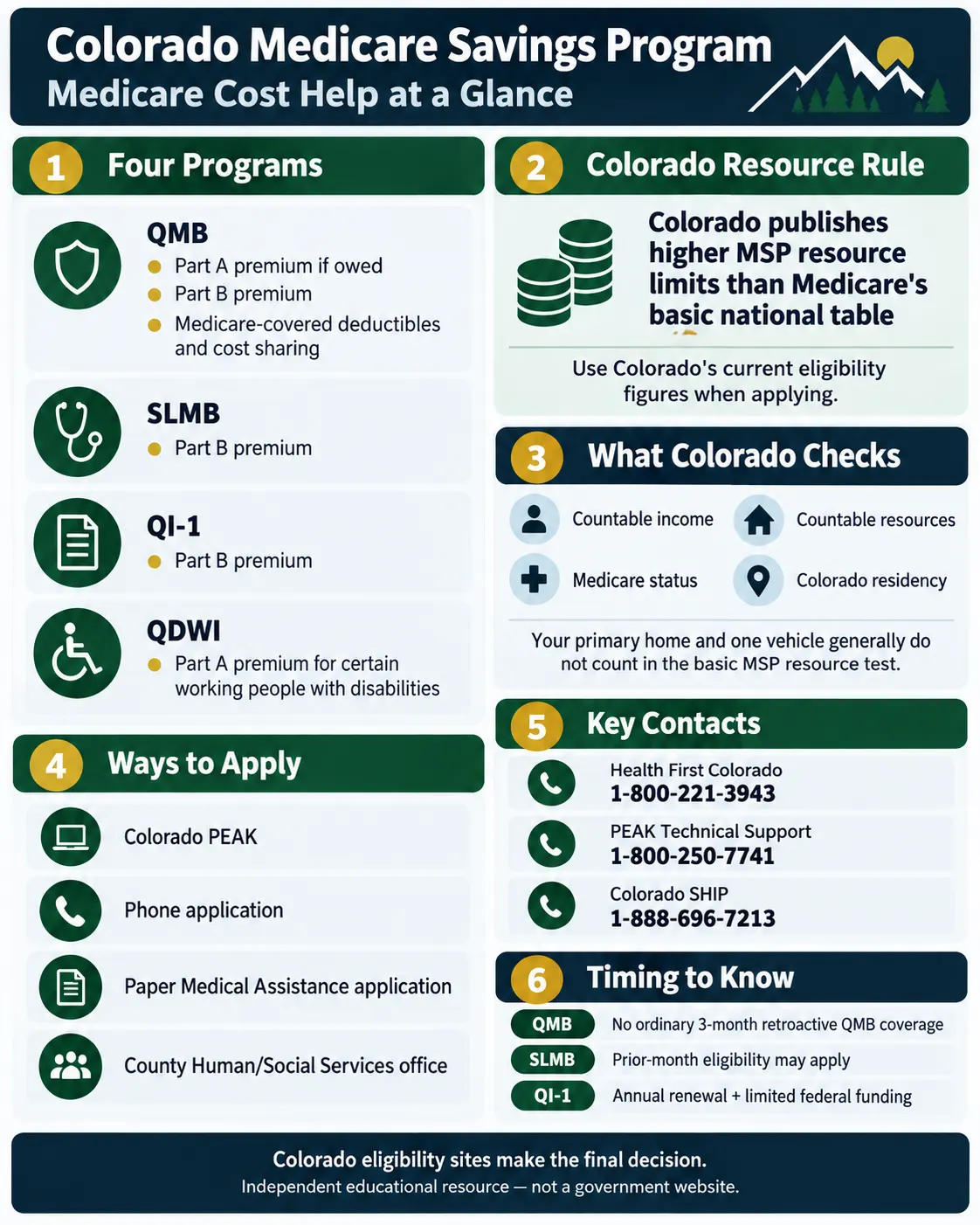
Medicare Savings Program Colorado assistance may help eligible Medicare beneficiaries pay the Part B premium and, through QMB, Medicare-covered deductibles, coinsurance and copayments. Colorado also uses a higher published resource limit than the basic figure shown on Medicare.gov.
Last verified September 12, 2026, using current Colorado HCPF, Health First Colorado, Medicare, CMS, Social Security and SHIP information. Colorado eligibility sites make the final eligibility decision.
Independent educational resource
This website is not Medicare, CMS, Health First Colorado, the Colorado Department of Health Care Policy and Financing or another government agency. We do not process or approve applications. Income, resources, Medicare status and other eligibility requirements apply. Colorado’s eligibility system makes the official decision.
Colorado-Specific Detail to Know
Colorado’s published 2026 resource ceiling for QMB, SLMB and QI-1 is $11,450 for one person and $17,910 for a married couple.
Those figures are higher than the $9,950/$14,910 amounts displayed in Medicare’s national table. If an older Colorado webpage still shows $11,160/$17,470, use the current 2026 HCPF eligibility guidance rather than last year’s figures.
Quick Answer
| Need | Colorado route |
|---|---|
| Apply online | Colorado PEAK |
| Apply by phone | 1-800-221-3943 |
| State Relay | 711 |
| Paper application | Use the current Health First Colorado Medical Assistance application |
| Where paper forms go | Your county Department of Human/Social Services or eligibility site |
| PEAK technical support | 1-800-250-7741 |
| Free Medicare counseling | Colorado SHIP: 1-888-696-7213 |
| Programs | QMB, SLMB, QI-1 and QDWI |
The standard Medicare Part B premium is $202.90 per month in 2026, and the annual Part B deductible is $283.
Table of Contents
- 2026 income and resource limits
- Colorado’s higher resource limits
- What resources count
- What each MSP pays
- How to apply
- Apply through PEAK
- Apply by phone
- Paper application
- Documents Colorado may request
- Processing time
- After approval
- Retroactive coverage
- Extra Help
- Renewal
- Denials and appeals
- QMB billing protection
- Estate recovery
- Colorado SHIP and help
- FAQs

Medicare Savings Program Colorado applicants can apply through the state’s Medical Assistance system, but eligibility is generally administered by county Departments of Human or Social Services and other approved eligibility sites.
The Colorado Department of Health Care Policy and Financing, or HCPF, oversees Health First Colorado, the state’s Medicaid program.
For a broader overview of MSP assistance, visit MedicareSavingPrograms.com. Our most recently published state guide covers the Medicare Savings Program in Alaska.
Colorado Medicare Savings Program Income Limits for 2026
Colorado’s Medicare Savings Programs include QMB, SLMB, QI-1 and QDWI.
| Program | Individual monthly income | Married couple | Colorado resource limit | Main benefit |
|---|---|---|---|---|
| QMB | $1,350 | $1,824 | $11,450 / $17,910 | Part A premium if owed, Part B premium and Medicare-covered cost sharing |
| SLMB | $1,616 | $2,184 | $11,450 / $17,910 | Part B premium |
| QI-1 | $1,816 | $2,455 | $11,450 / $17,910 | Part B premium |
| QDWI | $2,660 base FPL standard* | $3,607 base FPL standard* | $4,000 / $6,000 | Part A premium for certain working people with disabilities |
Resource format: individual / married couple.
The QMB, SLMB and QI-1 income figures include the standard $20 general income exclusion.
Colorado’s current income standards took effect in 2026 under HCPF’s MSP income guidance. You can also compare the main QMB, SLMB and QI limits with Medicare’s official 2026 MSP limits.
Do not self-deny if you are slightly above a chart. Eligibility uses countable income. Working applicants in particular may have income exclusions that make the final countable amount lower than gross wages.
QDWI income needs a different explanation
Colorado’s QDWI eligibility standard is based on 200% of the Federal Poverty Level. For 2026, that base amount is $2,660 for one person and $3,607 for a two-person household.
But QDWI includes important earned-income exclusions.
That is why Medicare and Social Security show much higher 2026 QDWI screening figures of $5,405 for one person and $7,299 for a married couple.
Those numbers are not actually contradictory. Colorado’s eligibility system applies the applicable earned-income disregards when evaluating a working applicant.
If you are working and potentially meet the QDWI disability and Medicare requirements, do not compare your full gross wages with $2,660 and stop there. Let the county calculate the income that counts.
Colorado Uses Higher Published MSP Resource Limits
This is one of the most important Colorado-specific details.
For 2026, Colorado HCPF publishes the following limits for QMB, SLMB and QI-1:
- Individual: $11,450.
- Married couple: $17,910.
The limits increased from $11,160/$17,470 in 2025 to the current 2026 amounts.
Colorado’s current HCPF 2026 Medicare Savings Program resource-limit guidance is the better source when an older Colorado webpage still displays last year’s figures.
Medicare’s national table currently displays base limits of $9,950 for one person and $14,910 for a couple, but Medicare also warns that states can use different or more generous resource methodologies.
For a Colorado application, use Colorado’s current eligibility instructions.
What Resources Count for Colorado MSP Eligibility?
Countable resources can include money or value in:
- Checking accounts.
- Savings accounts.
- Stocks.
- Bonds.
- IRAs.
- Certain annuities.
- Some trusts or other countable property.
Colorado’s QMB guidance identifies several common exclusions.
Resources generally excluded from the basic MSP calculation include:
- The home you live in.
- One vehicle.
- Furniture and household goods.
- Personal possessions.
- A burial plot.
- Certain money set aside for burial expenses.
So do not add the market value of your house and the car you use for transportation to your bank balance and assume you are automatically over Colorado’s MSP limit.
Report resources as requested and let the eligibility worker apply Colorado’s exclusions.
For broader context, read our Medicare Savings Program resource-limit guide.
What Does Colorado’s Medicare Savings Program Pay?
QMB: Qualified Medicare Beneficiary
QMB provides the broadest Medicare cost assistance.
It may pay:
- The Medicare Part A premium if you owe one.
- The Medicare Part B premium.
- Medicare Part A and Part B deductibles.
- Medicare coinsurance.
- Medicare-covered copayments.
QMB beneficiaries also receive federal protection from being billed for Medicare-covered Part A and Part B cost sharing.
See our QMB Medicare Savings Program guide.
SLMB: Specified Low-Income Medicare Beneficiary
SLMB pays the Medicare Part B premium.
The standard Part B premium is $202.90 per month in 2026. Someone paying that standard amount for all 12 months would otherwise pay $2,434.80 over the year.
SLMB does not provide QMB’s broader Medicare cost-sharing protection.
QI-1: Qualifying Individual
QI-1 also pays the Medicare Part B premium but serves people in the higher income range above SLMB.
QI has two important federal rules:
- You must reapply or renew eligibility each year.
- QI is funded through an annual federal allotment and applications are handled on a first-come, first-served basis, with priority for certain people who received QI the prior year.
QI is generally not available to someone who qualifies for another Medicaid eligibility category.
QDWI: Qualified Disabled & Working Individual
QDWI is a narrower program for certain people with disabilities who returned to work and lost premium-free Medicare Part A because of their work earnings.
QDWI helps pay the Medicare Part A premium.
In 2026, the full Part A premium can be as high as $565 per month. Certain people with 30–39 quarters of Medicare-covered employment pay a reduced premium of $311 per month.
CMS confirms the 2026 Part B premium, Part B deductible and Part A premium figures in its official 2026 Medicare cost fact sheet.
How Do You Apply for the Medicare Savings Program in Colorado?
The Colorado Department of Health Care Policy and Financing (HCPF) oversees Health First Colorado, but eligibility is commonly processed through county human-services departments and other eligibility sites.
Colorado offers four practical application routes:
- Colorado PEAK.
- Telephone application.
- Paper application.
- In-person assistance through a county or approved application site.
Health First Colorado’s official Apply Now page lists the current routes and identifies PEAK as the fastest way to apply.
Use Colorado’s official application system
Apply for Medical Assistance and make sure your Medicare information is included so the eligibility system can evaluate you for the Medicare Savings Programs.
Option 1: Apply Online Through Colorado PEAK
Colorado PEAK is the state’s official online benefits system.
Health First Colorado calls PEAK the fastest way to apply and says applicants can also use it to check application status.
How to apply through PEAK
- Open Colorado PEAK.
- Sign in or create an account.
- Choose the option to apply for benefits or Medical Assistance.
- Enter household information.
- Report that you have Medicare or are eligible for Medicare.
- Enter Social Security, pension, wage and other income information.
- Complete the resource questions.
- Review the application carefully.
- Submit it and save the confirmation or tracking information.
- Continue checking PEAK and your regular mail for verification requests or eligibility notices.
Because the Medicare Savings Programs have resource rules, do not skip bank or asset questions simply because another Health First Colorado category you have heard about does not use an asset test.
PEAK technical help
If you can sign in but PEAK gives you a password, error-message or navigation problem, contact:
PEAK Technical Support: 1-800-250-7741
Hours: Monday–Friday, 7:30 a.m.–5:15 p.m., excluding state holidays.
This number is for technical PEAK problems, not for determining whether you qualify for MSP.
Option 2: Apply by Phone
You can also complete a Medical Assistance application by phone.
1-800-221-3943
State Relay: 711
Phone application hours: Monday–Friday, 8 a.m.–4 p.m.
Have available:
- Medicare information.
- Social Security income.
- Pension or retirement income.
- Wages if you work.
- Household and spouse information.
- Basic bank and resource information.
Tell the representative clearly that you have Medicare and want to be evaluated for a Medicare Savings Program.
Option 3: Apply With a Paper Application
Colorado also allows applicants to download and print a paper Medical Assistance application.
Use the current Health First Colorado application page to get the latest paper form instead of relying on an older saved PDF.
Complete the Medicare, household, income and resource questions that apply, sign the form and keep a complete copy.
Where do you send the Colorado paper application?
There is no single statewide mailing address that every Colorado MSP applicant should use.
Colorado eligibility is county-administered. Submit the application according to the instructions for the Department of Human or Social Services in your county of residence or another approved eligibility site.
Use HCPF’s Colorado county eligibility directory to find the current office.
Mailing or faxing? Confirm the address or fax for your county before sending the application. Colorado does not use one universal county mailing address for all MSP cases.
Option 4: Apply in Person
You can apply or ask for assistance through your county Department of Human or Social Services or another approved application-assistance site.
Bring the information you already have, such as:
- Photo identification.
- Medicare information.
- Social Security benefit information.
- Recent income records.
- Pension information.
- Bank or other resource information.
At the desk, say that you want to apply for a Medicare Savings Program.
If you already submitted an application through PEAK, ask the worker to locate that existing application before automatically starting a second one.
What Documents May Colorado Ask For?
The exact verification depends on what Colorado can confirm electronically and what you report.
You may be asked for:
- Medicare information.
- Social Security number or identification information.
- Proof of Colorado residence.
- Social Security benefit information.
- Pension or retirement statements.
- Recent pay stubs.
- Self-employment records.
- Bank statements.
- Investment information.
- Information about other resources.
- Citizenship or immigration documentation when required.
Colorado may be able to verify some information through electronic data sources, so not every applicant will be asked for every document on this list.
If PEAK or your county asks for a specific item, send the requested proof by the deadline and keep evidence showing when you submitted it.
Quick Colorado MSP Application Checklist
- Apply: Use PEAK, call 1-800-221-3943, use the current paper application or visit your county office.
- Ask for MSP: Clearly say you want help with Medicare costs through a Medicare Savings Program.
- Report Medicare: Make sure the Medicare information on your case is accurate.
- Report income: Give the actual figures requested and let Colorado apply allowable exclusions.
- Complete resource questions: MSP uses a resource test even when some other Health First Colorado categories do not.
- Send proof: Return requested verification before the deadline.
- Save records: Keep PEAK confirmations, screenshots and copies of documents.
- Watch your case: Check PEAK and regular mail for additional requests and the final Notice of Action.
Colorado Tip: Save Your Upload Confirmation
Colorado’s official instructions explain how to apply, but one practical habit is worth adding:
Keep your own record of every important submission.
Save:
- PEAK upload confirmations.
- Screenshots.
- Copies of letters.
- Case numbers.
- Mailing or fax proof.
- Dates and key details from important calls.
If a worker later says a bank statement or another document is missing, you can identify exactly what you sent and when instead of trying to reconstruct the application from memory.
Another easy mistake is landing on a private insurance or lead-generation website while searching for Colorado benefits. Start with Health First Colorado or Colorado PEAK when you are applying.
How Long Does a Colorado MSP Application Take?
Some Medical Assistance applications are decided quickly when Colorado can verify the needed information electronically.
Health First Colorado currently says an application may take up to 45 days, or up to 90 days if a disability determination is required, from the date the application is received.
Those are general Medical Assistance processing standards, not a guarantee that every Medicare Savings Program case will take exactly that long.
If the case appears stuck, check PEAK and ask your county:
- Was my application received?
- What application date is showing?
- Is the Medicare Savings Program request visible?
- Is any verification still missing?
- Was a notice sent?
- Has an eligibility decision been made?
Ask what is holding up the case, rather than only asking whether the application is still pending.
What Happens After Colorado Approves Your MSP?
If Colorado approves QMB, SLMB or QI-1, the state can pay the applicable Medicare Part B premium through the federal state buy-in process.
The change may not appear in your Social Security payment immediately.
You could receive an MSP approval notice and still see the $202.90 Part B premium deducted from a Social Security payment while the records are updating.
That does not automatically mean the approval failed.
Social Security explains that once Part B buy-in takes effect:
- Part B premiums stop being deducted for months covered by buy-in.
- Premiums already deducted or directly paid for covered buy-in months are refunded.
If deductions continue, check:
- Which MSP level was approved.
- The effective date.
- Whether the county still needs information.
- Later Social Security payments.
- Any separate premium reimbursement.
For eligibility questions, contact your county or Health First Colorado. For Medicare-side questions, Colorado SHIP can help.
See our Medicare Part B premium help guide.
Can Colorado MSP Benefits Be Retroactive?
It depends on the Medicare Savings Program.
QMB
QMB itself generally begins no earlier than the month after the month eligibility is determined.
QMB does not use the ordinary three-month retroactive Medicaid rule.
SLMB
SLMB eligibility can generally be established for up to three months before the application month when all eligibility requirements were met during those months.
QI-1
QI determinations can also be retroactive for up to three months, but QI retroactivity cannot extend into the previous calendar year.
Do not assume a retroactive date. Check the program and effective date printed on your Colorado Notice of Action. If you believe the effective date is wrong, ask the county to explain how it was determined.
Does Colorado MSP Include Medicare Part D Extra Help?
People who receive QMB, SLMB or QI-1 generally qualify automatically for Medicare Part D Extra Help.
Extra Help can reduce:
- Part D premiums.
- The Part D deductible.
- Prescription copayments.
- Part D late-enrollment-penalty exposure while Extra Help applies.
In 2026, full Extra Help generally provides a $0 qualifying plan premium, $0 deductible, and prescription copays of up to $5.10 for generic drugs and $12.65 for brand-name drugs.
After total covered drug costs reach the applicable 2026 threshold of $2,100, covered prescriptions can cost $0.
See Medicare’s current Extra Help information.
How Do You Renew a Colorado Medicare Savings Program?
Health First Colorado eligibility is reviewed periodically, usually every year.
Some households are automatically renewed using information already available to the state.
If Colorado needs information from you, Health First Colorado says a renewal packet is generally sent in the mail and made available through PEAK about 60 to 70 days before the renewal deadline.
You can complete a required renewal:
- Online through PEAK.
- Through the Health First Colorado app.
- By mail.
- By fax to the county.
- In person through the county eligibility office.
If you receive a renewal packet, review it fully, make corrections, provide requested proof and sign the renewal.
Health First Colorado warns that failing to return a required renewal on time can end coverage.
Missed the renewal deadline?
Colorado currently provides a 90-day reconsideration period after Health First Colorado coverage ends for failure to complete a renewal.
During that period, the eligibility site can recheck eligibility when the missing renewal or documents are provided without necessarily requiring a brand-new application.
If the 90-day reconsideration period also passes, a new application may be required.
Review the current Health First Colorado renewal instructions and our Medicare Savings Program renewal guide.
What if Colorado Denies Your Medicare Savings Program?
Do not automatically submit the same application again.
Read the Notice of Action and identify the reason for the decision.
Common issues can include:
- Missing verification.
- Countable income over the limit.
- Resources over the applicable limit.
- An incomplete resource section.
- Medicare information that could not be verified.
- A missed document deadline.
- Household information that needs clarification.
If the notice says your income is too high, ask what countable-income figure was used.
If resources caused the denial, check whether the eligibility site used Colorado’s current $11,450 individual / $17,910 married-couple figures for QMB, SLMB and QI-1.
Also check whether an excluded primary home, one vehicle or another excluded resource was mistakenly counted.
Can You Appeal a Colorado MSP Decision?
Yes.
Colorado allows an appeal when you disagree with a Health First Colorado eligibility decision, including when:
- An application was denied.
- Coverage is ending.
- You believe the decision is incorrect.
- You did not receive a timely response to an application.
Colorado currently gives applicants and members 60 days from the date on the Notice of Action to appeal an eligibility decision.
You can:
- Request an informal meeting with the county or eligibility site.
- Request a formal state fair hearing.
- Do both at the same time.
An informal meeting does not extend the formal appeal deadline.
Colorado also says you can submit missing documents and file an appeal at the same time. That can be useful when a denial appears to be caused by one missing bank statement or another piece of verification.
If you are already receiving coverage that Colorado plans to end, continuation rules can matter. Follow the instructions and dates on the Notice of Action and request the formal hearing promptly.
Use the official Colorado Health First Colorado appeals guidance.
You can also review our Medicare Savings Program denial guide.
Can a Doctor Bill You if You Have Colorado QMB?
QMB provides important federal billing protection.
Medicare providers and suppliers generally cannot bill a QMB beneficiary for Medicare-covered:
- Part A or Part B deductibles.
- Coinsurance.
- Copayments.
If you receive a bill:
- Do not automatically pay it.
- Confirm QMB was active on the date of service.
- Check whether Medicare covered the service.
- Contact the provider’s billing department.
- Tell the office you have QMB.
- Ask the office to verify your QMB status and correct protected cost sharing.
- Keep the bill and Medicare Summary Notice.
- Call 1-800-MEDICARE or Colorado SHIP if the provider continues billing you.
QMB does not make services that Medicare does not cover automatically free, so the reason for the bill still matters.
See the official Medicare QMB information.
Does Estate Recovery Apply to Colorado MSP Assistance?
Medicare Savings Program assistance should not be confused with broader Medicaid estate-recovery rules.
Federal Medicaid rules specifically exclude Medicare cost-sharing payments made for Medicare Savings Program beneficiaries from estate recovery.
Colorado’s broader Health First Colorado estate-recovery program focuses on certain Medicaid services, particularly long-term-care services received by qualifying members, including certain people age 55 or older and permanently institutionalized members.
If you receive only MSP premium or Medicare cost-sharing assistance, do not assume that the state’s long-term-care estate-recovery rules automatically apply to that MSP help.
If you also receive full Health First Colorado, nursing-facility care, HCBS or other long-term-care services, separate estate-recovery rules can apply.
7 Colorado MSP Mistakes to Avoid
- Using the national resource figure without checking Colorado. Colorado’s current published 2026 QMB/SLMB/QI-1 limits are $11,450/$17,910.
- Using 2025 Colorado numbers. Older $11,160/$17,470 figures may still appear on webpages or saved documents.
- Counting your home or primary vehicle. These are generally excluded from the basic MSP resource calculation.
- Looking only at gross income. Countable income and applicable disregards determine eligibility.
- Ignoring PEAK or county notices. A verification request can stop an otherwise eligible application.
- Not saving proof. Keep confirmations, screenshots and copies of documents.
- Automatically paying a QMB cost-sharing bill. Check your federal QMB protection before paying a Medicare-covered deductible, coinsurance or copayment.
Where Can You Get Help With Medicare in Colorado?
Health First Colorado
For application and general Medicaid eligibility help:
Member Contact Center: 1-800-221-3943
State Relay: 711
For an eligibility issue tied to an application, your county human-services office may be the most direct contact.
Colorado SHIP
Colorado’s State Health Insurance Assistance Program provides free, unbiased Medicare counseling.
1-888-696-7213
Colorado SHIP counselors can help explain:
- Medicare Savings Programs.
- QMB, SLMB and QI.
- Extra Help.
- Medicare Part D.
- Medicare Advantage.
- Medigap.
- Medicare billing problems.
Use the Colorado SHIP contact page to find free counseling.
SHIP does not make the Medicaid eligibility decision.
Medicare
1-800-MEDICARE: 1-800-633-4227
TTY: 1-877-486-2048
Medicare is especially useful for Medicare coverage questions and unresolved QMB billing problems.
Colorado Medicare Savings Program FAQs
What is the Colorado Medicare Savings Program income limit for 2026?
For one person, the 2026 monthly limits are $1,350 for QMB, $1,616 for SLMB and $1,816 for QI-1. For a married couple, the limits are $1,824, $2,184 and $2,455 respectively. QDWI uses a different calculation because earned-income exclusions apply.
What is the Colorado MSP asset limit in 2026?
Colorado’s current 2026 resource limit for QMB, SLMB and QI-1 is $11,450 for one person and $17,910 for a married couple. QDWI uses $4,000 and $6,000 resource limits.
Why does Medicare.gov show a lower resource limit?
Medicare’s national 2026 table shows base resource limits of $9,950 for one person and $14,910 for a couple and notes that states can use different limits or resource methodologies. Colorado’s current HCPF guidance publishes $11,450 and $17,910 for QMB, SLMB and QI-1.
Does my house count toward the Colorado MSP resource limit?
Generally, no. Colorado’s QMB guidance excludes the home you live in from the basic resource calculation. One vehicle, household belongings, personal items and certain burial resources are also generally excluded.
Why are the Colorado QDWI numbers different from Medicare.gov?
Colorado’s base QDWI standard is tied to 200% of the Federal Poverty Level, while the higher federal screening figures incorporate substantial earned-income exclusions. A working applicant may therefore qualify even when gross wages are well above the basic 200% FPL figure.
Where do I apply for MSP in Colorado?
Apply through Colorado PEAK, call 1-800-221-3943, submit the current Medical Assistance paper application or apply through your county Department of Human or Social Services or another approved eligibility site.
Can I apply for the Colorado Medicare Savings Program by phone?
Yes. Health First Colorado accepts phone applications at 1-800-221-3943, Monday through Friday from 8 a.m. to 4 p.m. State Relay is 711.
How long can a Colorado Medical Assistance application take?
Health First Colorado says an application may take up to 45 days, or up to 90 days when a disability determination is required. These are general processing standards and do not guarantee a decision or approval on an exact day.
Is Colorado QMB retroactive?
QMB itself generally begins no earlier than the month after the eligibility determination. SLMB can generally have up to three months of prior-month eligibility when the requirements were met, and QI can also have limited retroactive eligibility within the same calendar year.
Does Colorado MSP pay my Medicare Part B premium?
Yes. QMB, SLMB and QI-1 can pay the Medicare Part B premium. The standard Part B premium is $202.90 per month in 2026. QMB can also protect eligible beneficiaries from Medicare-covered deductibles, coinsurance and copayments.
Can a doctor bill me if I have Colorado QMB?
Providers generally cannot bill QMB beneficiaries for Medicare-covered Part A or Part B deductibles, coinsurance or copayments. If you receive such a bill, tell the provider you have QMB and ask the billing office to verify your status before paying.
Does Colorado MSP automatically give me Extra Help?
People receiving QMB, SLMB or QI-1 generally qualify automatically for Medicare Part D Extra Help, which can reduce Part D premiums, deductibles and prescription costs.
How do I renew a Colorado MSP?
Health First Colorado reviews eligibility periodically. Some members are automatically renewed; others receive a renewal packet about 60 to 70 days before their deadline and must complete, sign and return it through PEAK, the Health First Colorado app, mail, fax or their county office.
How long do I have to appeal a Colorado MSP eligibility decision?
Colorado currently gives applicants and members 60 days from the date on the Notice of Action to appeal an eligibility decision. Follow your notice carefully, especially when existing coverage is being terminated.
Who provides free Medicare help in Colorado?
Colorado SHIP provides free, unbiased Medicare counseling at 1-888-696-7213. For Medicaid eligibility and application questions, contact your county eligibility office or Health First Colorado at 1-800-221-3943.
Conclusion
The Colorado Medicare Savings Program can remove one of Medicare’s largest recurring expenses and, through QMB, may protect an eligible beneficiary from much more than the monthly Part B premium.
For 2026, the monthly limits for one person are $1,350 for QMB, $1,616 for SLMB and $1,816 for QI-1. The corresponding married-couple limits are $1,824, $2,184 and $2,455.
Colorado also publishes 2026 QMB, SLMB and QI-1 resource limits of $11,450 for one person and $17,910 for a married couple.
If your income or resources are close to the cutoff, submit an application instead of deciding at home that you will be denied. Countable income and countable resources can differ from the numbers on a Social Security statement, pay stub or bank balance.
Start with Colorado PEAK, call 1-800-221-3943, or contact your county Department of Human or Social Services.
Use an official Colorado application route
If you think you may qualify, submit your information and let the Colorado eligibility system calculate your countable income and resources. Eligibility is not guaranteed.
Editorial disclaimer: This article provides general educational information and is not legal, financial, medical or benefits advice. Income limits, resource limits, application procedures, office contacts and program rules can change. Use current Health First Colorado and HCPF instructions and follow your individual Notice of Action. Colorado makes the final eligibility determination.