Georgia Medicare Savings Program 2026: Benefits & Apply
Georgia Medicare Savings Program: Benefits, Limits and How to Apply
Georgia Medicare Savings Programs may help eligible Medicare beneficiaries pay Medicare premiums. QMB may also protect an eligible beneficiary from Medicare-covered deductibles, coinsurance and copayments.
Updated with 2026 federal screening limits and current Georgia application routes
Independent educational resource: This website is not Medicare, Georgia Medicaid, Georgia Gateway, DFCS or a government application processor. Georgia makes the final eligibility decision. Approval, effective dates, premium adjustments and reimbursements are not guaranteed.
Quick Answer
Georgia residents with Medicare can apply for QMB, SLMB and QI through Georgia Gateway, by telephone, with Georgia Form 700 or through a county DFCS office.
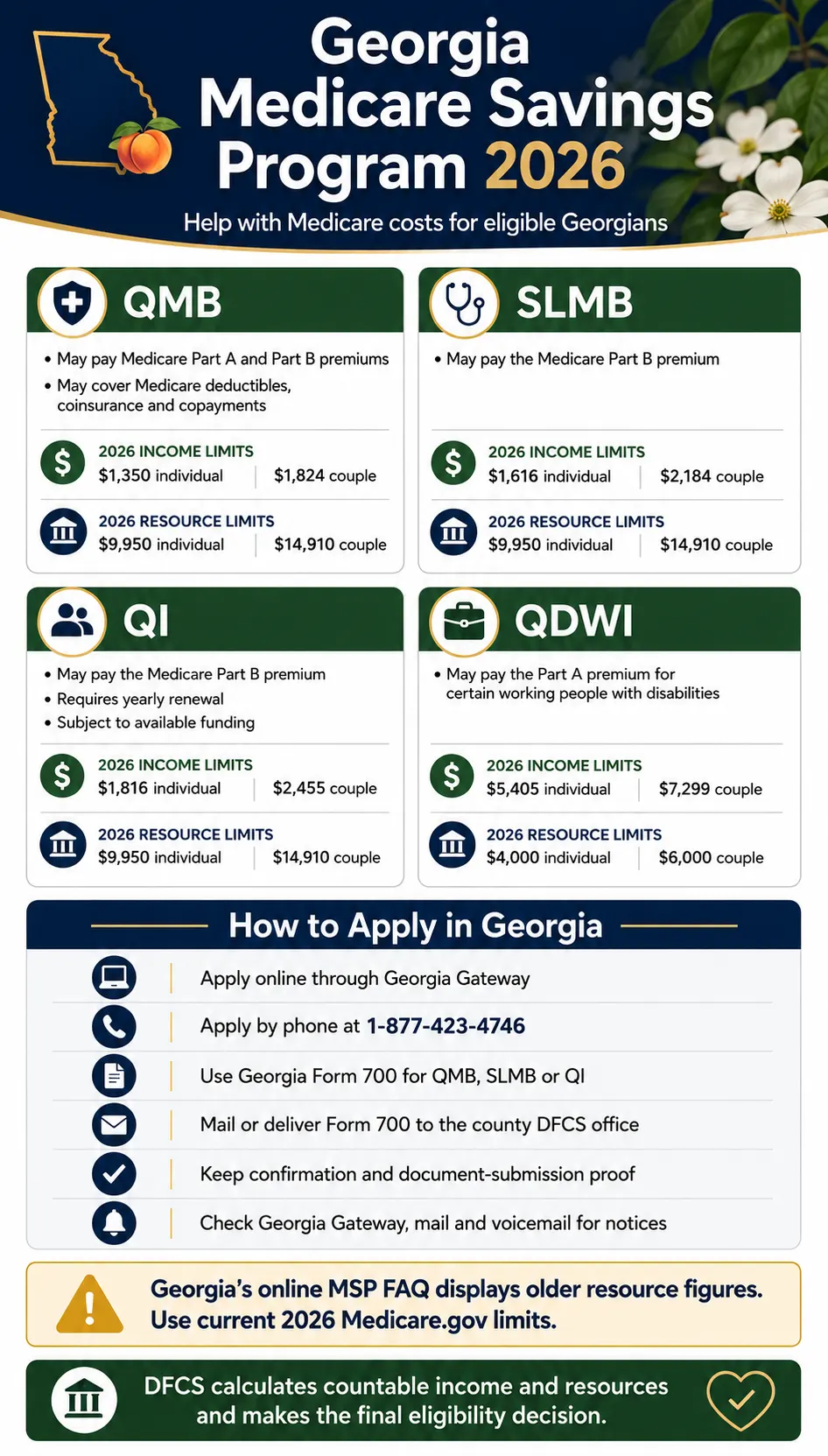
QMB may pay Part A and Part B premiums and Medicare-covered cost-sharing. SLMB and QI generally pay the Part B premium. QDWI may pay a Part A premium for certain working people with disabilities.
For 2026, the federal monthly screening limits are $1,350 for an individual under QMB, $1,616 under SLMB and $1,816 under QI. Georgia applies countable-income and resource rules before making the official decision.
Table of Contents
- What Georgia MSPs cover
- 2026 income and resource limits
- QMB, SLMB, QI and QDWI benefits
- Basic eligibility requirements
- Ways to apply in Georgia
- Apply through Georgia Gateway
- Apply by telephone
- Apply with Form 700
- Documents to prepare
- What happens after applying
- Denials and fair hearings
- Official help and contacts
- Frequently asked questions

What Is the Georgia Medicare Savings Program?
A Medicare Savings Program, or MSP, is a Medicaid-administered program that may help qualified Medicare beneficiaries pay certain Medicare expenses.
In Georgia, the Division of Family and Children Services, or DFCS, processes Medicaid and Medicare Savings Program eligibility. Georgia Gateway is the state’s online public-benefits portal.
Georgia may evaluate an applicant for:
- Qualified Medicare Beneficiary, or QMB
- Specified Low-Income Medicare Beneficiary, or SLMB
- Qualifying Individual, or QI-1
- Qualified Disabled and Working Individual, or QDWI
You do not need to select the final program before applying. Submit accurate information about Medicare, household members, income and resources. DFCS decides which category, if any, applies.
For general background, read our guide explaining what a Medicare Savings Program is. You can also use the Medicare Savings Programs information center.
Georgia Medicare Savings Program Limits for 2026
The following figures are the federal 2026 screening limits published by Medicare. Georgia performs the final calculation using countable income, resources and applicable exclusions.
| Program | Individual Monthly Income | Married Couple Monthly Income | Individual Resource Limit | Couple Resource Limit |
|---|---|---|---|---|
| QMB | $1,350 | $1,824 | $9,950 | $14,910 |
| SLMB | $1,616 | $2,184 | $9,950 | $14,910 |
| QI | $1,816 | $2,455 | $9,950 | $14,910 |
| QDWI | $5,405 | $7,299 | $4,000 | $6,000 |
Georgia’s online MSP FAQ displays older resource figures.
For a 2026 article, use the current Medicare.gov limits of $9,950 for one person and $14,910 for a married couple under QMB, SLMB and QI. The older figures on the Georgia FAQ should not be used as the 2026 screening standard.
Review the official Medicare Savings Program limits for 2026.
Our separate article explains how MSP income limits and countable-income rules work.
Gross Income May Differ From Countable Income
Do not assume that you are ineligible because gross Social Security, pension or wage income appears slightly above a screening amount.
Georgia may apply:
- General income exclusions
- Earned-income exclusions
- Spouse-related calculations
- Treatment rules for irregular or excluded payments
- Program-specific income rules
Form 700 asks applicants to report income before deductions such as taxes, insurance or Medicare premiums. Report the amount requested and allow DFCS to perform the official calculation.
What Resources May Georgia Count?
Form 700 asks about resources owned by the applicant, spouse or jointly with another person. These may include:
- Checking and savings accounts
- Certificates of deposit
- Cash and government bonds
- Stocks, bonds and investment accounts
- Individual retirement accounts and promissory notes
- Trust funds
- Life-insurance cash value
- Funeral plans and burial contracts
- Real estate other than the home in which you live
- Vehicles and other requested property
The home in which you live, one vehicle and certain burial or insurance arrangements may be excluded under applicable rules. Report what the form requests and allow DFCS to determine whether an exclusion applies.
Read our Medicare Savings Program resource limits guide.
What Does Each Georgia Medicare Savings Program Pay?
| Program | Main Benefit | Important Rule |
|---|---|---|
| QMB | May pay Part A and Part B premiums and Medicare-covered deductibles, coinsurance and copayments | Provides federal protection from improper Medicare cost-sharing bills |
| SLMB | May pay the Medicare Part B premium | Does not normally pay deductibles, coinsurance or copayments |
| QI | May pay the Medicare Part B premium | Requires annual renewal and is subject to available funding |
| QDWI | May pay a Medicare Part A premium for certain working people with disabilities | Does not pay the Part B premium or Medicare cost-sharing |
QMB Provides the Broadest Assistance
QMB may pay:
- The Medicare Part A premium if one is owed
- The Medicare Part B premium
- Medicare Part A and Part B deductibles
- Medicare coinsurance
- Medicare copayments for Medicare-covered services and items
Medicare providers and suppliers generally may not bill an active QMB beneficiary for Medicare Part A or Part B cost-sharing on Medicare-covered services.
See our detailed QMB Medicare Savings Program guide.
SLMB and QI Pay the Part B Premium
SLMB and QI generally pay the Medicare Part B premium but do not provide QMB’s broader protection from deductibles, coinsurance and copayments.
QI must be renewed every year. States approve QI applications according to available funding, with priority generally given to people who received QI during the previous year.
A person generally cannot receive QI while receiving other full Medicaid benefits, although another Medicaid or MSP category may apply.
QDWI Pays a Part A Premium
QDWI is a specialized program for certain working people with disabilities who lost Social Security disability cash benefits and premium-free Medicare Part A because they returned to work.
Georgia Form 700 specifically names QMB, SLMB and QI-1. Someone seeking QDWI should contact DFCS and request the correct application or screening instructions.
Our Medicare Savings Program types comparison explains all four categories.
How Much Could Part B Premium Assistance Save?
The standard Medicare Part B premium is $202.90 per month in 2026.
If an MSP pays the full standard premium for 12 covered months, potential premium assistance equals:
- $202.90 per month
- $2,434.80 over 12 months
The actual financial effect depends on the premium owed, the approved effective date and whether a late-enrollment penalty or income-related premium adjustment applies.
CMS publishes current amounts in its 2026 Medicare Part A and Part B costs fact sheet.
Basic Georgia Medicare Savings Program Eligibility
DFCS generally reviews whether the applicant:
- Lives in Georgia
- Is a United States citizen or meets an applicable qualified-immigrant rule
- Has Medicare Part A or is eligible to enroll when required
- Meets the relevant countable-income standard
- Meets the applicable resource standard
- Provides requested identity, Medicare and financial information
- Meets any program-specific requirement
Part A and Part B enrollment rules differ by program. Medicare states that SLMB and QI require both Part A and Part B. QMB may help with a Part A premium when the applicant does not receive premium-free Part A.
How to Apply for a Medicare Savings Program in Georgia
Georgia provides several official application routes:
- Apply online through Georgia Gateway
- Submit a Medicaid application by telephone
- Complete Georgia Medicaid/Medicare Savings Form 700
- Mail or deliver the form to the county DFCS office
- Visit a county DFCS office
- Ask Georgia SHIP for free application counseling
| Application Route | Best For |
|---|---|
| Georgia Gateway | Applicants who can enter information and upload documents online |
| Telephone application | Applicants who need help filing a Medicaid or MSP request by phone |
| Form 700 | Applicants primarily seeking QMB, SLMB or QI assistance on paper |
| County DFCS office | Applicants needing local submission instructions or case-specific assistance |
Option 1: Apply Online Through Georgia Gateway
Use the official Georgia Gateway benefits portal.
Georgia Gateway allows applicants to apply for, manage and renew eligible public benefits. It may also be used to view application information, notices, document requests and case updates.
Step 1: Start a Medical-Assistance Application
Select the option to apply for benefits and begin the medical-assistance or Medicaid portion of the application.
The portal may not always display a separate button labeled Medicare Savings Program. Clearly report Medicare coverage and complete all income and resource questions.
Step 2: Enter Applicant and Household Information
Be prepared to provide:
- Legal name and date of birth
- Social Security number when required
- Physical and mailing addresses
- Marital status
- Spouse information when applicable
- Citizenship or immigration information when requested
- Medicare coverage and other health insurance
Step 3: Report Medicare Coverage
Enter Medicare Part A, Part B and Part D information accurately, including Medicare numbers and effective dates when requested.
When a comments field is available, a clear statement is:
“I have Medicare and want to apply for a Medicare Savings Program, including QMB, SLMB or QI.”
Step 4: Report Gross Income
Report every requested income source, including:
- Social Security retirement or disability benefits
- Supplemental Security Income when requested
- Railroad Retirement
- Veterans benefits
- Pensions and retirement payments
- Employment earnings
- Self-employment income
- Rental income
- Annuity or trust payments
- Other regular payments
Do not report only the smaller amount deposited after the Part B premium was deducted when the application asks for gross Social Security income.
Step 5: Report Resources
Report every requested account or property, including jointly owned resources. Explain unusual deposits, disputed ownership or money belonging to another person when uploading statements.
Step 6: Upload Documents
Upload clear, complete copies. Common records include:
- Medicare card
- Social Security benefit statement
- Pension or annuity statement
- Recent pay stubs
- Complete bank statements
- Investment or retirement-account statements
- Life-insurance or burial-fund records
- Proof of Georgia residence
- Other health-insurance information
- Authorized-representative documents
Step 7: Review and Submit
Review names, Medicare numbers, addresses, income figures, account balances and signatures before submitting.
Save or print:
- The confirmation page
- Application or tracking number
- Submission date
- List of uploaded documents
Continue checking Georgia Gateway and postal mail for interview notices, verification requests and decision letters.
Apply Through Georgia Gateway
Use the official state portal and save the confirmation after submitting.
Option 2: Apply by Telephone
Georgia’s official Medicaid application guidance states that residents may submit a Medicaid application by telephone through the Customer Contact Center.
DFCS Customer Contact Center: 1-877-423-4746
Georgia Relay: Dial 711
Tell the representative:
“I have Medicare and want to submit an application for a Medicare Savings Program.”
Before calling, prepare:
- Medicare card
- Social Security number
- Georgia address
- Social Security and pension amounts
- Employment income
- Approximate bank and investment balances
- Spouse information when applicable
At the end of the call, confirm whether an application was officially filed. Record the date, confirmation number and any documents or signatures still required.
Option 3: Apply With Georgia Form 700
Georgia publishes a shorter paper application titled:
Georgia Application for Medicaid & Medicare Savings for Qualified Beneficiaries
Download the official Georgia Medicaid/Medicare Savings Form 700.
Form revision note:
The official form currently posted by Georgia is marked DHR 700, Revision 05/2011. Its older revision date does not make an unofficial replacement safer. Use the current official state-hosted form and check the DFCS forms page before filing.
Form 700 specifically covers:
- QMB
- SLMB
- QI-1
The form says a telephone interview may be required. It also explains that a DFCS Medicaid Specialist may request more information when the applicant appears eligible for full Medicaid coverage.
What Form 700 Asks About
Complete information about:
- Applicant and spouse identity
- Georgia county and residence
- Living arrangement
- Medicare Parts A, B and D
- Medicare numbers and effective dates
- Other health insurance
- Real estate other than the principal home
- Vehicles
- Bank accounts, investments, trusts and burial arrangements
- Life-insurance policies
- Income before deductions
- Unpaid medical bills
Signatures and Spouse Information
Complete the spouse sections when applicable. The applicant or authorized representative must sign and date the form. A spouse or representative signature may also be required by the form.
An unsigned application can delay the case. Add extra pages when needed and identify the applicant on each additional page.
Where to Mail Form 700
Georgia does not use one statewide Form 700 mailing address for every applicant.
The form directs applicants to mail or deliver it to the DFCS office serving the county where they live.
Use the official Georgia DFCS county office locator.
Before mailing:
- Confirm that the office serves your county
- Confirm the current mailing address
- Sign and date the form
- Attach readable copies of available records
- Keep a full application copy
- Use trackable mail when possible
- Keep the mailing receipt
Do not mail original Medicare cards, Social Security cards, passports or financial records unless DFCS specifically requires an original or certified copy.
Can Form 700 Be Faxed?
Fax arrangements can vary by office and case. DFCS states that a worker may provide a fax number when verification is needed.
Before faxing a new application:
- Call the county office.
- Confirm that it accepts new Form 700 applications by fax.
- Confirm the correct fax number.
- Ask whether supporting documents should be sent with the form.
- Keep the fax transmission report.
- Confirm that the complete application was received.
Documents to Prepare for a Georgia MSP Application
DFCS may verify some information electronically. The exact document request depends on the application and what the state can confirm.
Identity, Residence and Medicare Records
- Medicare card
- Social Security number or requested verification
- Government-issued identification when requested
- Proof of Georgia residence
- Citizenship or immigration records when applicable
- Other health-insurance cards or statements
Income Records
- Social Security benefit statement
- Pension or retirement statement
- Railroad Retirement record
- Veterans-benefit documentation
- Recent pay stubs
- Self-employment income and expense records
- Unemployment, disability or workers’ compensation records
- Proof of other regular income
Resource Records
- Complete checking and savings statements
- Certificates of deposit
- Investment and retirement-account statements
- Trust and promissory-note records
- Life-insurance information
- Burial-fund or funeral-plan records
- Information about other real estate
- Vehicle information when requested
Upload or copy complete statement pages. A screenshot that removes the account owner, statement date or account activity may not satisfy a verification request.
Georgia Gateway Is Not Georgia Access
The similar names can cause confusion.
| Website or Agency | Main Purpose |
|---|---|
| Georgia Gateway | Medicaid, Medicare Savings Programs and other state-administered public benefits |
| Georgia Access | Shopping for and enrolling in private marketplace health insurance |
| Medicare.gov | Federal Medicare coverage, costs, plans and benefits information |
| Social Security | Social Security benefits and federal Extra Help applications |
Georgia Gateway is the correct state portal for an online Medicare Savings Program application.
What Happens After You Apply?
DFCS may review:
- Medicare eligibility and enrollment
- Georgia residence
- Citizenship or eligible immigration status
- Countable income
- Countable resources
- Spouse and household information
- Program-specific requirements
A telephone interview may be required. DFCS may also request missing statements, updated income proof, explanations of deposits, signatures or additional Medicare information.
Watch:
- Georgia Gateway notices
- Postal mail
- Telephone calls and voicemail
- Email or text alerts linked to the account
Respond by the deadline printed on the notice. When a document is unavailable, contact DFCS before the deadline and ask whether another form of proof can be accepted.
When Do Georgia MSP Benefits Start?
Georgia’s official MSP FAQ states:
- QMB generally begins the month after the month of eligibility determination.
- SLMB, QI and QDWI may, in certain cases, be granted for up to three months before the application month.
Earlier-month assistance is not automatic. The applicant must have met the requirements during each month. The DFCS notice controls the approved program and effective date.
When Will the Part B Deduction Stop?
Approval may not change a Social Security payment immediately. Georgia, Medicare and Social Security must exchange and update eligibility information.
Keep the approval notice and compare:
- The approved MSP category
- The effective date
- Future Social Security or Railroad Retirement payments
- Medicare premium bills
- Any premium-adjustment or reimbursement notice
Contact DFCS when deductions continue beyond the effective period shown on the notice. Do not immediately submit a duplicate application unless Georgia instructs you to do so.
What to Do After QMB Approval
Show both Medicare and QMB or Medicaid documentation when receiving care.
If a provider bills Medicare-covered cost-sharing:
- Confirm that QMB was active on the date of service.
- Compare the bill with the Medicare Summary Notice.
- Tell the provider that you had active QMB.
- Ask the billing office to verify eligibility and remove prohibited cost-sharing.
- Contact Georgia SHIP or 1-800-MEDICARE if billing continues.
If prohibited cost-sharing was already paid, ask the provider whether a refund is due.
Extra Help With Prescription Drug Costs
People approved for QMB, SLMB or QI generally receive automatic eligibility for Medicare Extra Help with Part D prescription costs.
Extra Help may reduce:
- The Part D plan premium
- The Part D deductible
- Prescription copayments
- Coinsurance for covered drugs
- The Part D late-enrollment penalty while Extra Help remains active
Medicare states that QMB, SLMB and QI beneficiaries pay no more than $12.65 in 2026 for each covered drug, and some beneficiaries pay less.
Review the official Medicare Extra Help information.
Does the Georgia MSP Need to Be Renewed?
Yes. Medicaid and MSP eligibility is reviewed periodically, and QI must be renewed each year.
Georgia Gateway may be used to complete renewals when available. DFCS may request updated:
- Income records
- Bank and investment statements
- Spouse and household information
- Medicare information
- Georgia residence information
- Signatures or representative authorization
Keep your address and telephone number current. Georgia says Medicaid recipients should report relevant household changes within 10 days.
Use our Medicare Savings Program renewal guide.
What to Do if Georgia Denies the Application
Read the DFCS decision notice before submitting another application.
Check whether the decision involved:
- Income calculated above the limit
- Resources calculated above the limit
- A property or account classified incorrectly
- Missing bank or income records
- An unsigned form
- Missing spouse information
- Incorrect Medicare information
- A missed verification or interview deadline
- Review under the wrong eligibility category
Contact the county office and ask whether missing or inaccurate information can be corrected. Submit updated records and keep proof of delivery.
Form 700 confirms that applicants may request a fair hearing when they disagree with an agency decision. The exact deadline and submission instructions should appear on the decision notice.
Georgia has used a 30-day Medicaid appeal period in current public guidance, but the notice controlling your case should be followed. A shorter deadline may apply when a person asks to continue existing benefits while an appeal is pending.
Do not assume that a telephone call or new application automatically files a hearing request.
Our guide on what to do when a Medicare Savings Program application is denied provides a document-review checklist.
Does Limited MSP Assistance Cause Estate Recovery?
Federal Medicaid rules exclude Medicare cost-sharing paid for MSP beneficiaries from optional Medicaid estate recovery.
However, Form 700 also screens for broader Medicaid coverage. Nursing-facility care, home and community-based waiver services and other full Medicaid benefits can involve separate Georgia estate-recovery rules.
Do not assume that every Medicaid-funded benefit is treated the same as limited MSP premium or cost-sharing assistance.
Our guide comparing Medicare Savings Programs and full Medicaid explains this distinction.
Georgia Medicare Savings Program Help
| Help Needed | Official Resource |
|---|---|
| Apply online | Georgia Gateway |
| Paper MSP application | Georgia Form 700 |
| Telephone application, Gateway or case questions | DFCS: 1-877-423-4746 |
| Hearing, speech or communication assistance | Georgia Relay: 711 |
| Find a county DFCS office | DFCS county office locator |
| Free Medicare counseling | Georgia SHIP: 1-866-552-4464, Option 4 |
| Medicare or QMB billing questions | 1-800-MEDICARE or 1-800-633-4227 |
| Medicare TTY | 1-877-486-2048 |
Free Help Through Georgia SHIP
Georgia SHIP provides free and unbiased Medicare counseling. Counselors do not sell or solicit insurance.
Georgia SHIP may help with:
- QMB, SLMB and QI questions
- MSP application preparation
- Extra Help
- Medicare notices
- QMB billing protection
- Medicare Advantage and Medigap questions
Call 1-866-552-4464 and select Option 4, Monday through Friday from 8 a.m. to 5 p.m.
Georgia and Michigan Use Different MSP Application Systems
The MSP categories are federal, but states use different portals, forms and terminology.
Georgia uses Georgia Gateway, telephone Medicaid applications, Form 700 and county DFCS offices. Michigan uses MI Bridges, DCH-1426 and local MDHHS offices.
For the latest article in this state series, read Michigan Medicare Savings Program 2026 limits and application guidance.
Final Georgia MSP Application Checklist
- ☐ Used Georgia Gateway, telephone application, Form 700 or a county DFCS office
- ☐ Clearly reported Medicare Part A and Part B coverage
- ☐ Reported income before deductions when requested
- ☐ Reported spouse information when applicable
- ☐ Reported requested bank accounts and other resources
- ☐ Attached readable copies of available records
- ☐ Signed and dated the application
- ☐ Confirmed the correct county office or telephone filing
- ☐ Kept a complete application copy
- ☐ Saved the online, telephone, mail, fax or delivery confirmation
- ☐ Started checking Georgia Gateway, mail and voicemail for notices
Georgia Medicare Savings Program FAQs
What website should I use to apply in Georgia?
Use Georgia Gateway for an online Medicaid and Medicare Savings Program application. Clearly report that you have Medicare and want help paying Medicare costs.
Can I apply by telephone?
Yes. Georgia’s official Medicaid guidance states that residents may submit an application by telephone through DFCS at 1-877-423-4746. Confirm that an application was filed and ask what documents or signatures remain necessary.
Which paper application should I use?
Use the official Georgia Application for Medicaid and Medicare Savings for Qualified Beneficiaries, commonly called Form 700, for QMB, SLMB and QI-1.
Why is Form 700 dated 2011?
The official form currently posted by Georgia is marked Revision 05/2011. Use the state-hosted form unless DFCS publishes a replacement, and use current 2026 financial limits rather than old figures from outdated materials.
Where should I mail Form 700?
Mail or deliver Form 700 to the DFCS office serving your county of residence. Georgia does not use one statewide Form 700 mailing address for every applicant.
Do I need to choose QMB, SLMB or QI before applying?
No. Submit accurate Medicare, income, resource and household information. DFCS determines which MSP category may apply.
Should I apply if my gross income is slightly above the limit?
Yes. Georgia may exclude certain income or resources. Report gross amounts as requested and allow DFCS to calculate countable eligibility.
Does an MSP give me full Georgia Medicaid?
Not necessarily. QMB, SLMB and QI may provide limited Medicare cost assistance. Form 700 states that DFCS may contact an applicant for additional information when broader Medicaid eligibility appears possible.
Can Georgia pay earlier Part B premiums?
Georgia says SLMB, QI and QDWI may in some cases be granted for up to three months before the application month when all requirements were met. QMB generally begins the month after the eligibility determination.
Will the Part B deduction stop immediately?
Not always. Georgia, Medicare and Social Security must update their records. Keep the approval notice and contact DFCS if deductions continue beyond the approved period.
Does MSP approval include Extra Help?
QMB, SLMB and QI approval generally provides automatic eligibility for Medicare Extra Help with Part D prescription costs.
Can someone help me apply?
Yes. Form 700 allows another person to help or act on the applicant’s behalf. Georgia SHIP also provides free and unbiased counseling at 1-866-552-4464, Option 4.
Does Georgia MSP assistance need to be renewed?
Yes. Eligibility is reviewed periodically, and QI must be renewed every year. Respond to renewal notices and requests for updated income or resource information.
Final Takeaway
Georgia residents may apply through Georgia Gateway, by telephone, with Form 700 or through the DFCS office serving their county.
Do not reject yourself solely because gross income appears slightly above a screening amount or because you own a home. DFCS applies program-specific countable-income and resource rules.
Keep copies of the application and every document submitted. Save confirmation records and respond to interviews or verification requests before their deadlines.
Use an Official Georgia Application Route
Official applications are free. Georgia makes the final eligibility decision.