Washington Medicare Savings Program 2026: Income Limits
Washington Apple Health Medicare Assistance Guide
Washington Medicare Savings Program: 2026 Income Limits, Benefits and Application Steps
Washington’s Medicare Savings Programs may help eligible Medicare beneficiaries pay their Part B premium and, under QMB, Medicare-covered deductibles, coinsurance and copayments. Washington does not use an asset or resource test for MSP eligibility, but income and other program requirements still apply.
Reviewed for 2026 program standards. Final eligibility decisions are made by the Washington State Department of Social and Health Services.
Independent educational resource
This website is not Medicare, Medicaid, CMS, Washington Apple Health, DSHS or another government agency. It does not process or approve applications. Use official state forms and portals, and follow the deadlines and instructions printed on your current eligibility notice.
Quick Answer
Washington offers four Medicare Savings Programs through Washington Apple Health:
- QMB may pay Medicare Part A and Part B premiums and protect you from Medicare-covered deductibles, coinsurance and copayments.
- SLMB pays the Medicare Part B premium.
- QI-1 also pays the Medicare Part B premium.
- QDWI pays the Part A premium for a limited group of working people with disabilities.
The standard Medicare Part B premium is $202.90 per month in 2026. Approval for QMB, SLMB or QI-1 could therefore provide up to $2,434.80 in annual standard Part B premium assistance. Actual results can differ if a person has a late-enrollment penalty, income-related adjustment or another premium situation.
Table of Contents
Washington’s Medicare Savings Program can help eligible beneficiaries keep more of their Social Security payment by having the state pay certain Medicare costs. The amount of help depends on whether a person qualifies for QMB, SLMB, QI-1 or QDWI.
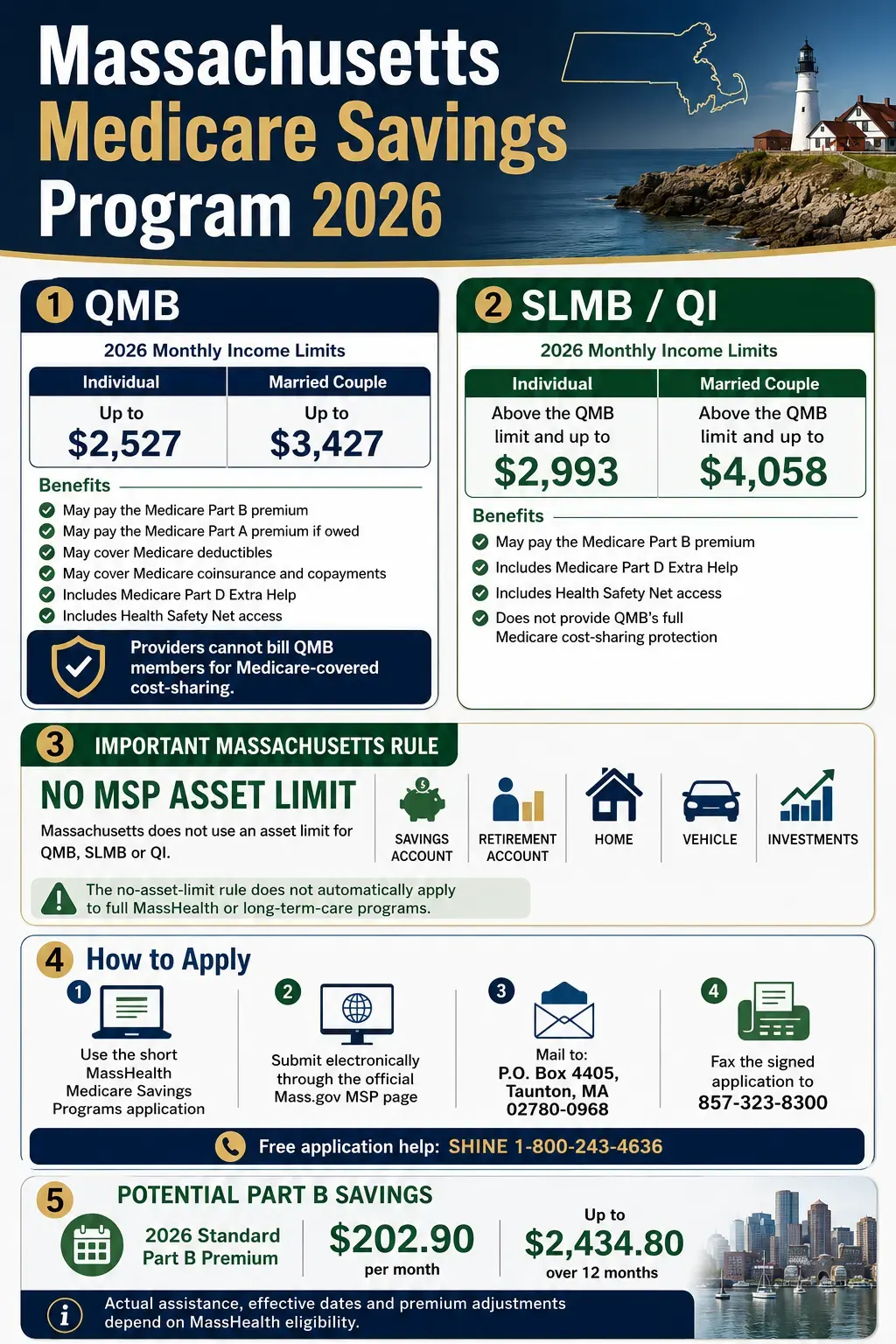
For a broader explanation of these assistance programs, visit our Medicare Savings Programs educational resource. State rules are not identical. For comparison, the latest guide covers the Medicare Savings Program in Massachusetts.

What Does Each Washington Medicare Savings Program Pay?
The Washington State Health Care Authority administers Medicare Savings Programs as part of Washington Apple Health. The state uses the following program categories and internal coverage codes.
| Program | Washington code | What it may pay |
|---|---|---|
| Qualified Medicare Beneficiary, QMB | S03 | Part A premium if owed, Part B premium, and Medicare-covered deductibles, coinsurance and copayments |
| Specified Low-Income Medicare Beneficiary, SLMB | S05 | Part B premium |
| Qualified Individual, QI-1 | S06 | Part B premium |
| Qualified Disabled and Working Individual, QDWI | S04 | Part A premium for certain working people with disabilities who meet the program requirements |
Washington’s rules generally place QMB at up to 110% of the federal poverty guideline, SLMB above 110% through 120%, QI-1 above 120% through 138%, and QDWI above 138% through 200%, subject to the other requirements for each program.
You can review the official Washington Health Care Authority Medicare Savings Program page for the state’s current benefit descriptions.
Important: QMB protection applies to Medicare-covered Part A and Part B cost sharing. It does not mean every health service, prescription, Medicare Advantage premium or Medigap premium is automatically free.
Washington Medicare Savings Program Income Limits for 2026
The following Washington monthly standards are effective April 1, 2026. The state’s published figures include the standard $20 household income disregard used in its MSP standards.
| Program | One person | Two-person household | MSP asset test |
|---|---|---|---|
| QMB | Up to $1,483 per month | Up to $2,004 per month | None |
| SLMB | Up to $1,616 per month | Up to $2,185 per month | None |
| QI-1 | Up to $1,855 per month | Up to $2,510 per month | None |
| QDWI | Up to $2,680 per month | Up to $3,628 per month | None |
These figures are useful for initial screening, but they are not a final eligibility decision. DSHS determines countable income, which may differ from the gross amount deposited into your bank account. Income exclusions, earned-income deductions, spousal deeming and household-size rules can affect the calculation.
Do not automatically abandon an application because gross income appears only slightly higher than a table amount. Ask DSHS or Washington SHIBA for a complete MSP screening.
For the state’s latest figures, check the official Washington income and resource standards. General background is also available in our guide to Medicare Savings Program income limits.
Why Washington’s Limits Differ From the National Medicare Chart
Medicare’s national table presents federal baseline limits and federal resource amounts. It also warns that states may use higher income limits or different resource rules.
Washington differs because it:
- Sets QMB income eligibility at up to 110% of the applicable federal poverty guideline.
- Uses a QI-1 limit of up to 138% of the federal poverty guideline.
- Includes the standard $20 household disregard in its published monthly figures.
- Does not use an asset or resource test for Medicare Savings Programs.
Washington applicants should therefore use the current state standards rather than assuming that a general national chart fully describes Washington eligibility.
Does Washington Have an MSP Asset or Resource Test?
No. Washington does not use an asset or resource test for Medicare Savings Program eligibility. An MSP-only applicant should not be required to verify bank-account balances, savings, investments, a home or a vehicle solely for the MSP determination.
What the no-asset rule means
Having money saved does not automatically disqualify you from Washington QMB, SLMB, QI-1 or QDWI. Income and other eligibility requirements still apply.
This no-resource rule is specific to the Medicare Savings Programs. Full Apple Health, long-term services and supports, medically needy coverage and other programs may use separate financial rules. Learn more in our general guide to Medicare Savings Program resource limits.
Who May Qualify in Washington?
You may qualify for a Washington Medicare Savings Program if you:
- Live in Washington.
- Are entitled to Medicare Part A or meet another eligibility pathway recognized by current Washington rules.
- Meet the applicable monthly countable-income limit.
- Meet applicable citizenship or qualified immigration-status requirements.
- Provide the information DSHS needs to determine eligibility.
A spouse’s income may be considered when a married applicant lives with their spouse. Washington uses more than one income-calculation method in certain household situations, so the final countable-income result may not be obvious from gross income alone.
QI-1 generally cannot be combined with full Medicaid coverage. QMB and SLMB may sometimes be received with another Apple Health category. DSHS should screen an applicant for the program that fits the person’s circumstances.
Our overview of who may qualify for a Medicare Savings Program explains the common federal requirements, while Washington makes the final state determination.
How to Apply Online Through Washington Connection
The online option for many Medicare beneficiaries is Washington Connection, the state benefits portal used for Medicare Savings Programs and other Classic Apple Health programs.
Online application steps
- Open Washington Connection and select Apply Now.
- Create an account or continue without an account if that option is available.
- Select the option for medical assistance.
- Enter your household, Medicare and income information.
- Upload requested documents if the system provides an upload option.
- In a comments field, you may write: “I have Medicare and want to be screened for QMB, SLMB and QI-1 Medicare Savings Program benefits.”
- Review the information carefully before submitting.
- Save the confirmation number or a copy of the confirmation page.
An online account may make it easier to review notices, renewal requests and document requests. However, do not delay an application solely because you are unable to create an online account. Other official application methods are available.
Ready to use the official state portal?
Washington Connection is operated for Washington state benefit applications. Approval is not guaranteed, and DSHS makes the final eligibility decision.
How to Apply by Phone
Call the DSHS Customer Service Contact Center at:
1-877-501-2233
Tell the representative:
“I have Medicare and want to apply for a Medicare Savings Program to help pay my Medicare premiums.”
You may also ask:
- Whether the application can be completed by phone.
- Which documents DSHS still needs.
- Whether an existing benefits case can be used.
- Where to send requested proof.
- Whether free interpreter or disability-access services are available.
- Whether you should also be screened for full Apple Health coverage.
Washington rules recognize a telephone application with a telephonic signature as an official application method. It is not merely a request for general information.
Extra Help applications may also start an MSP review
Effective under Washington’s current process, when a person submits a Medicare Part D Low-Income Subsidy application to the Social Security Administration, SSA may transmit the application data to Washington so the state can screen the person for an MSP without requiring a separate state application. DSHS may approve, deny or request additional information based on the available data.
Applicants should still read every DSHS letter and respond to requests by the date shown on the notice.
Which Washington Paper Application Should You Use?
Two forms commonly appear in Washington Medicare Savings Program instructions.
HCA 13-691: Application for Medicare Savings Programs
Use the current HCA 13-691 Medicare Savings Program application when you are mainly seeking help with Medicare premiums and Medicare cost sharing.
This shorter MSP-specific form requests information such as:
- Your name, address and household details.
- Social Security and Medicare information.
- Citizenship or immigration-status information.
- Medicare Part A and Part B coverage.
- Income received by you and your spouse.
- Your signature.
HCA 18-005: Aged, Blind, Disabled or Long-Term Care Application
Use the current HCA 18-005 application when you also want to be considered for broader aged, blind or disabled Apple Health coverage or long-term services and supports.
This form is longer because full Apple Health and long-term care programs may have financial and nonfinancial rules that do not apply to an MSP-only application.
For MSP-only help, HCA 13-691 is generally the clearer form. Call 1-877-501-2233 if you are uncertain which application fits your situation.
Form safety tip: Download the current form from the official Washington website immediately before applying. Form versions, mailing instructions and fax information can change.
How to Apply by Mail, Fax or in Person
Mail an MSP application
The current DSHS Medicare Savings Program instructions list:
DSHS Community Services Division
Customer Service Center
P.O. Box 11699
Tacoma, WA 98411-6699
Before mailing:
- Confirm the mailing address on the current application or official DSHS page.
- Sign and date the form.
- Keep a complete copy.
- Send copies of documents rather than your only originals.
- Write your client ID on supporting pages if you already have one.
- Consider tracked mail if you want delivery confirmation.
Fax an application or documents
The current DSHS fax number for MSP and Community Services Division applications is:
1-888-338-7410
Confirm the number on the current form before sending. Keep the fax confirmation showing the date, time and number of pages transmitted. Place your name and client ID on supporting pages when possible so DSHS can match separated pages to your case.
Apply in person
You may submit an application at a DSHS Community Services Office. Use the official DSHS office locator to find a nearby location.
Call before travelling when possible because office hours, walk-in availability and available services may change.
Helpful items to bring include:
- Your Medicare card.
- Photo identification, if available.
- Social Security or Railroad Retirement benefit letters.
- Pension or retirement statements.
- Recent pay stubs if you work.
- Existing DSHS or HCA notices.
- Immigration documents if requested for your case.
An office worker can accept the application, but another DSHS processing unit may complete the final eligibility decision.
Documents to Prepare
Because Washington has no MSP asset test, an MSP-only applicant should generally focus on Medicare eligibility, household information and income rather than bank-account balances.
Useful documents may include:
- Medicare card or Medicare entitlement letter.
- Social Security number.
- Information showing Washington residence.
- Social Security benefit verification.
- Pension, annuity or retirement statements.
- Recent pay stubs.
- Self-employment income records.
- Railroad Retirement or veterans benefit statements.
- Your spouse’s income information when applicable.
- Citizenship or immigration information when requested.
- Recent DSHS, HCA, Medicare or Social Security notices.
Do not unnecessarily delay filing because one supporting document is unavailable. Submit the application using the information you have, preserve proof of the filing date, and respond promptly if DSHS requests additional verification. The agency may deny or delay a case when required information is not provided by the notice deadline.
When Does Washington MSP Coverage Start?
Washington’s effective-date rules differ by program.
QMB start date
QMB generally begins on the first day of the month after QMB eligibility is determined. QMB is not generally backdated for months before the determination.
Applying promptly can therefore matter. Waiting to apply may mean losing potential months of future QMB premium and cost-sharing protection.
SLMB, QI-1 and QDWI retroactive eligibility
SLMB and QI-1 may be approved for up to three months before the certification period when the applicant met the program requirements during those months. QDWI may also receive up to three months of retroactive eligibility when its requirements were met.
Retroactive SLMB or QI-1 eligibility may lead to reimbursement of qualifying Part B premiums that were already deducted. A refund, amount and timing are not guaranteed. Medicare, Social Security and Washington must update and reconcile their records.
The current state rule is available in the Washington MSP certification-period guidance.
What Happens After You Apply?
DSHS processes applications based on the information it receives. An interview is not required for an MSP application or renewal, although the agency may contact you if information or verification is missing.
Watch for:
- Letters from DSHS or HCA.
- Notices in your Washington Connection account.
- Phone messages.
- Requests for verification.
- An approval or denial notice.
Respond by every deadline printed on a notice. Missing a document request may delay the decision or cause a denial even when the applicant might otherwise qualify.
Washington does not promise one exact processing period for every case. Processing time can depend on whether the application is complete, whether information can be verified and whether additional documents are required.
What if the Part B deduction continues after approval?
The Part B premium may continue to be deducted temporarily while Washington, Medicare and Social Security update their systems. Keep your approval notice and Social Security payment records.
If Part B premiums are still being deducted 60 to 90 days after MSP approval, contact the Washington HCA Medicare Buy-In Unit for premium-payment questions:
1-800-562-3022, extension 16129
This number is intended for Medicare premium-payment and buy-in issues. Eligibility questions should generally be directed to DSHS at 1-877-501-2233.
How Does Washington MSP Renewal Work?
Most Washington MSP cases are reviewed periodically. QMB, SLMB and QDWI generally use 12-month certification periods, while QI-1 follows a different certification rule. The most important practical step is to follow the renewal date and instructions printed on your current DSHS notice.
An MSP renewal can generally be completed through the method identified by DSHS, which may include:
- Washington Connection.
- A paper eligibility-review form.
- Telephone assistance through DSHS.
- In-person help at a Community Services Office.
No interview is normally required for an MSP renewal, but you must still submit the requested renewal information.
If Classic Apple Health or MSP coverage closes because a renewal was not completed, Washington rules may allow coverage to be reconsidered when the required information is received within the period specified by the agency. Act immediately and follow the exact instructions on the closure notice.
See our separate Medicare Savings Program renewal guide for a document checklist and common renewal mistakes.
What Should You Do if Washington Denies the Application?
Read the entire denial notice. Washington denial notices should explain the reason for the decision, the facts and rules used, missing information if applicable, and available hearing rights.
Take these steps:
- Check the reason. Determine whether DSHS counted the wrong income, used the wrong household size, missed an income exclusion or lacked a requested document.
- Submit missing information quickly. Washington may reconsider an application without requiring a new application if needed information is received within 30 days of the denial-notice date.
- Contact DSHS. Ask for an explanation of the countable-income calculation and the program for which you were screened.
- Request a hearing if necessary. A hearing request generally must be made within 90 days of the decision date.
- Follow the notice. The denial or termination letter contains the instructions that apply to your case.
If existing coverage is being terminated, suspended or reduced, requesting a hearing quickly may be necessary to seek continued coverage during the appeal. Washington’s continued-coverage deadline can be as early as the tenth day after the notice was sent or the last day of the month before the action takes effect.
Review the official Washington Apple Health appeal guidance. Our educational guide also explains common steps after a Medicare Savings Program denial.
Deadline warning: Do not rely on a general website deadline when your notice gives a specific date. Follow the current notice and submit an appeal promptly to protect your rights.
What if You Have QMB and Receive a Medical Bill?
Federal law prohibits Medicare providers and suppliers from billing a QMB beneficiary for Medicare Part A or Part B deductibles, coinsurance and copayments for Medicare-covered items and services. The beneficiary has no legal obligation to pay those protected amounts.
If a bill arrives:
- Check that QMB was active on the date of service.
- Call the provider’s billing office.
- Explain that you were enrolled in the Qualified Medicare Beneficiary program.
- Show your Medicare card and available ProviderOne, QMB or Medicare Summary Notice documentation.
- Ask the provider to correct the bill.
- Avoid agreeing to a payment plan for the disputed Medicare cost-sharing amount until the QMB issue is reviewed.
If the provider continues billing you, contact:
1-800-MEDICARE: 1-800-633-4227
TTY: 1-877-486-2048
Medicare can help confirm QMB status and explain the billing protection. If you already paid a protected amount, ask the provider and Medicare whether a refund or billing correction is required.
Learn more from the CMS QMB billing-protection guidance and our detailed QMB Medicare Savings Program guide.
Does MSP Approval Include Medicare Part D Extra Help?
People approved for QMB, SLMB or QI-1 generally qualify automatically for Extra Help, also called the Medicare Part D Low-Income Subsidy.
In 2026, Extra Help can provide:
- A $0 Part D deductible.
- A $0 premium for a qualifying Part D plan priced at or below the applicable benchmark amount.
- Copays of no more than $5.10 for each covered generic drug and $12.65 for each covered brand-name drug under the standard Extra Help amounts.
- $0 for covered drugs after total drug costs reach $2,100 in 2026.
Your exact premium and copays can depend on your Extra Help category, Medicaid status and the drug plan you select. A plan priced above the Extra Help benchmark may charge part of its premium.
QDWI by itself should not be assumed to provide automatic Extra Help. A QDWI beneficiary can ask SHIBA or Social Security whether a separate Extra Help application is appropriate.
Review the official Medicare Extra Help costs for 2026.
Is MSP-Only Coverage the Same as Full Apple Health?
No. Medicare Savings Programs are Medicaid benefits, but MSP-only approval does not necessarily provide the broader services available through full Washington Apple Health.
| Coverage type | General purpose |
|---|---|
| QMB-only | Medicare premium and Medicare-covered cost-sharing assistance |
| SLMB-only or QI-1 | Primarily Medicare Part B premium assistance |
| Full Apple Health plus QMB or SLMB | May provide broader Medicaid benefits in addition to Medicare cost assistance |
| Long-term care Apple Health | Uses separate medical, functional and financial requirements |
If you need dental services, nonemergency transportation, in-home care, nursing-facility coverage or other Medicaid services, ask DSHS whether you should also apply for full Apple Health or long-term services and supports.
Our MSP versus Medicaid comparison explains the difference in more detail.
Does Washington Recover MSP Benefits From an Estate?
Washington’s estate-recovery guidance states that estate recovery does not apply to people who received only Medicare Savings Program benefits and no other Apple Health coverage subject to recovery.
Other Apple Health programs, especially certain long-term care and home and community-based services, may have different estate-recovery rules. A person receiving both an MSP and another Apple Health program should not assume that every benefit is excluded from estate recovery.
For current details, review the official Washington estate-recovery guidance or request advice about your specific coverage.
Where Can You Get Official Help in Washington?
| Need | Official contact |
|---|---|
| Apply online | Washington Connection |
| Apply or ask about eligibility | DSHS: 1-877-501-2233 |
| MSP-specific paper application | HCA 13-691 |
| Full ABD or long-term care application | HCA 18-005 |
| Fax an MSP or CSD application | 1-888-338-7410, confirm on the current form |
| Find a local DSHS office | DSHS office locator |
| Free Medicare counseling | Washington SHIBA: 1-800-562-6900 |
| Part B premium-payment issue after approval | HCA Medicare Buy-In Unit: 1-800-562-3022, extension 16129 |
| QMB Medicare billing problem | 1-800-MEDICARE: 1-800-633-4227 |
| Medicare TTY | 1-877-486-2048 |
Washington SHIBA provides free, unbiased and confidential Medicare counseling. Its advisers can explain MSP eligibility, help you understand Medicare notices and connect you with local assistance.
Need help before applying?
Contact Washington SHIBA for free Medicare counseling or DSHS for an official eligibility application. Neither contact can guarantee approval before the state completes its review.
Frequently Asked Questions
Does Washington have an MSP asset limit?
No. Washington does not use an asset or resource test for Medicare Savings Programs. MSP-only applicants should not be required to verify resources such as bank-account balances.
What are the Washington QMB income limits for 2026?
Effective April 1, 2026, the published QMB limit is $1,483 per month for one person and $2,004 per month for a two-person household. These figures include the standard $20 household income disregard.
Can Washington MSP pay my Medicare Part B premium?
Yes. QMB, SLMB and QI-1 can pay the standard Medicare Part B premium when you qualify. The state makes the final eligibility decision.
Where do I apply online?
Apply through Washington Connection. Washington HCA and DSHS identify it as the online portal for Medicare Savings Program and Classic Apple Health applications.
Can I apply for Washington MSP by phone?
Yes. Call DSHS at 1-877-501-2233 and say that you want to apply for a Medicare Savings Program. Washington permits applications to be completed by telephone with a telephonic signature.
Is an eligibility interview required?
No interview is normally required for an MSP application or renewal. You must still submit the application or renewal information and provide any documents DSHS requests.
Can SLMB or QI-1 be approved retroactively?
Potentially. Washington may approve SLMB and QI-1 for up to three months before the certification period when all program requirements were met. QMB generally begins the month after eligibility is determined.
Does QMB cover doctor copays?
QMB protects beneficiaries from Medicare-covered Part A and Part B deductibles, coinsurance and copayments. Medicare providers may not bill a QMB member for those protected amounts.
Will Washington recover MSP benefits from my estate?
Washington states that estate recovery does not apply when a person received only Medicare Savings Program benefits. Other Apple Health programs, particularly certain long-term care services, may have different estate-recovery rules.
Is a Medicare Savings Program the same as full Apple Health?
No. An MSP is a specific Apple Health or Medicaid benefit that assists with Medicare costs. MSP-only approval does not automatically provide every medical or long-term care benefit available through full Apple Health.
Conclusion
Washington gives Medicare beneficiaries an important advantage because there is no asset test for its Medicare Savings Programs. Do not assume that owning a home, having a car or keeping money in savings makes you ineligible for MSP-only assistance.
If your monthly income is near the 2026 limit, submit an application and allow DSHS to calculate countable income under Washington’s rules. The simplest route for many applicants is Washington Connection. You may also apply by phone, use an official paper form, fax the application, mail it or visit a DSHS office.
If you want someone to explain the programs before you apply, contact Washington SHIBA at 1-800-562-6900. Its Medicare counseling is free, unbiased and confidential.
Apply through an official Washington channel
Review your income, gather available Medicare and income documents, and save proof of submission. Eligibility and effective dates are determined by DSHS.
Editorial disclaimer: This article provides general educational information and is not legal, financial or benefits advice. Program standards, forms and contact details may change. Check the current official form, state website and eligibility notice before acting. Washington DSHS makes the final eligibility decision.