West Virginia Medicare Savings Program 2026: WV PATH, Income Limits & How to Apply
West Virginia Medicare Cost Assistance Guide
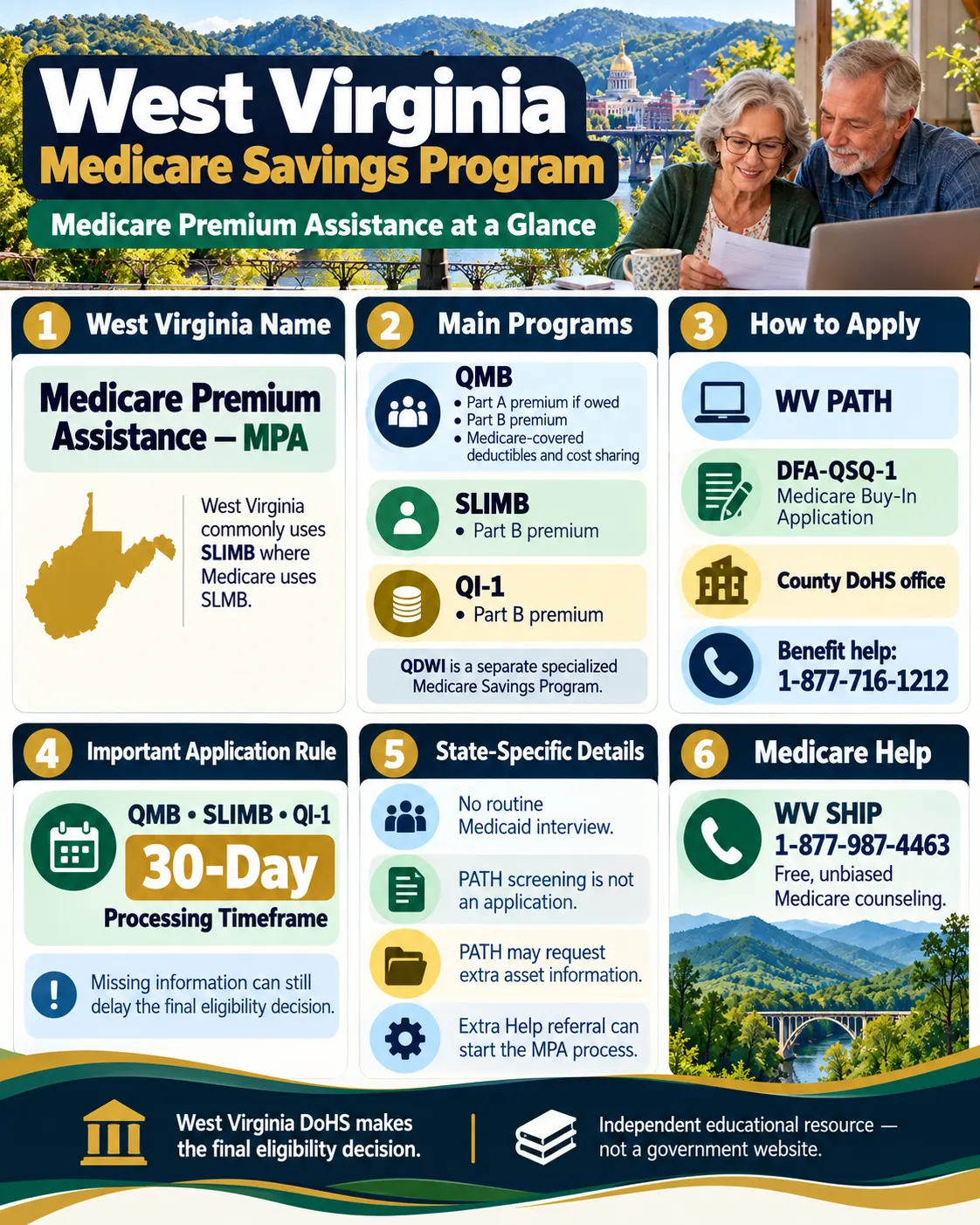
Medicare Savings Program West Virginia assistance is commonly called Medicare Premium Assistance (MPA) by the state. Depending on the program, eligible Medicare beneficiaries may receive help with Medicare premiums and, through QMB, Medicare-covered deductibles, coinsurance and copayments.
Last verified September 24, 2026, using current West Virginia DoHS/BMS, WV PATH, Medicare, CMS, Social Security and SHIP information. West Virginia DoHS makes the final eligibility decision.
Independent educational resource
This website is not Medicare, CMS, West Virginia Medicaid, the West Virginia Department of Human Services or another government agency. We do not process or approve applications. Income, resources, Medicare status and other eligibility requirements apply. DoHS makes the official Medicare Premium Assistance eligibility determination.
West Virginia Calls MSP “Medicare Premium Assistance”
West Virginia commonly uses Medicare Premium Assistance, or MPA, for its QMB, SLIMB and QI-1 programs.
The state also uses SLIMB where Medicare.gov usually uses SLMB. They refer to the same Specified Low-Income Medicare Beneficiary program.
Quick Answer
| What you need | West Virginia route |
|---|---|
| State program name | Medicare Premium Assistance (MPA) |
| Apply online | WV PATH |
| Focused paper form | DFA-QSQ-1, Rev. 9/25 |
| Benefit questions | 1-877-716-1212 |
| Client Services | 1-800-642-8589 |
| WV PATH technical help | 304-414-0047 |
| Free Medicare counseling | WV SHIP: 1-877-987-4463 |
| QMB/SLIMB/QI-1 processing standard | 30 days from the application date |
The standard Medicare Part B premium is $202.90 per month in 2026, while the annual Part B deductible is $283.
Table of Contents
- 2026 income and resource limits
- What each program pays
- How to apply
- Apply through WV PATH
- DFA-QSQ-1 application
- County DoHS office
- Phone help
- Home-visit accommodation
- Extra Help referral pathway
- Protecting the application date
- Interview rule
- Asset rules
- 30-day processing rule
- After approval
- Start dates and retroactivity
- Already have Medicaid?
- Extra Help
- Renewal
- QMB billing protection
- Denials and appeals
- Estate recovery
- FAQs

Medicare Savings Program West Virginia applicants have a few state-specific advantages worth knowing before they start. West Virginia offers both an online application through WV PATH and a short paper application specifically focused on Medicare Premium Assistance.
If you primarily need help paying Medicare costs, the short form can be simpler than completing a broader benefits application.
For general MSP information, visit MedicareSavingPrograms.com. Our most recently published state article covers the Medicare Savings Program in Georgia.
West Virginia Medicare Savings Program Limits for 2026
The main Medicare Savings Program screening figures for 2026 are:
| Program | Individual monthly income | Married couple | Resource limit | Main benefit |
|---|---|---|---|---|
| QMB | $1,350 | $1,824 | $9,950 / $14,910 | Part A premium if owed, Part B premium and Medicare-covered cost sharing |
| SLIMB / SLMB | $1,616 | $2,184 | $9,950 / $14,910 | Part B premium |
| QI-1 | $1,816 | $2,455 | $9,950 / $14,910 | Part B premium |
| QDWI | $5,405 | $7,299 | $4,000 / $6,000 | Part A premium for certain working people with disabilities |
Resource format: individual / married couple.
The QMB, SLMB and QI figures shown above already reflect the standard $20 general income exclusion used in Medicare’s public screening table.
That means you should not subtract $20 from your Social Security or other income yourself before completing the West Virginia application.
Report the actual amount requested and let DoHS determine what income counts.
If you are close to a limit, apply. Medicare specifically advises people not to assume they are ineligible from a quick chart because states apply income and resource rules when making the final determination.
See Medicare’s current MSP limits and our Medicare Savings Program income-limit guide.
A note about QDWI in West Virginia
QDWI is the fourth federal Medicare Savings Program and can help certain working people with disabilities pay the Medicare Part A premium.
West Virginia’s dedicated Medicare Premium Assistance webpage and short DFA-QSQ-1 form focus on QMB, SLIMB and QI-1.
If you believe QDWI applies to you, contact DoHS at 1-877-716-1212 and ask specifically how to file for the Qualified Disabled & Working Individual category rather than assuming the short QMB/SLIMB/QI-1 application is the correct form.
What Does West Virginia Medicare Premium Assistance Pay?
QMB: Qualified Medicare Beneficiary
QMB provides the broadest Medicare cost assistance.
It can help pay:
- The Medicare Part A premium if you owe one.
- The Medicare Part B premium.
- Medicare Part A and Part B deductibles.
- Coinsurance.
- Medicare-covered copayments.
QMB beneficiaries also have federal protection from being billed for Medicare-covered Part A and Part B cost sharing.
Read our QMB Medicare Savings Program guide.
SLIMB: Specified Low-Income Medicare Beneficiary
West Virginia commonly writes SLIMB. Medicare.gov usually writes SLMB.
The program pays the Medicare Part B premium.
At the standard 2026 Part B rate of $202.90 per month, that is $2,434.80 over 12 months for someone paying the standard premium for the full year.
QI-1: Qualifying Individual
QI-1 also pays the Medicare Part B premium but covers the higher income range above SLIMB.
QI has two important federal rules:
- Eligibility must be renewed each year.
- QI operates under an annual federal allotment and is generally handled on a first-come, first-served basis, with priority for qualifying prior-year recipients.
QI generally is not available to someone who qualifies for another Medicaid coverage category.
QDWI: Qualified Disabled & Working Individual
QDWI can help certain people with disabilities who returned to work and lost premium-free Medicare Part A because of their earnings.
It pays the Medicare Part A premium.
In 2026, the Part A premium can be $311 or $565 per month, depending on Medicare-covered work history.
How Do You Apply for the Medicare Savings Program in West Virginia?
West Virginia gives residents several practical application routes.
The two most important are:
- WV PATH for an online application.
- DFA-QSQ-1 when QMB, SLIMB or QI-1 Medicare cost assistance is the main goal.
The West Virginia Bureau for Medical Services describes the dedicated Medicare Premium Assistance application as the preferred application method when someone is applying specifically for QMB, SLMB or QI-1.
Review the official West Virginia Medicaid application guidance.
Option 1: Apply Online Through WV PATH
WV PATH is West Virginia’s official public-benefits portal.
The portal specifically lists Medicare Premium Assistance as a health-care program.
WV PATH application steps
- Open WV PATH.
- Choose Apply Now.
- Create an account or sign in.
- Complete the household questions.
- Select Medicare Premium Assistance.
- Enter your Medicare information.
- Report your income and spouse’s income when applicable.
- Complete the asset and resource questions shown.
- Review the application.
- Electronically sign it.
- Submit it.
- Save the confirmation and a PDF copy if available.
Screening is not an application
WV PATH also has a Screen for Assistance feature.
The screening tool can estimate which programs may fit your household, but West Virginia makes clear that the screening result is not an official eligibility determination.
You still have the right to apply even if the screening tool suggests you might not qualify.
If your income is near an MSP limit, continue to the actual application rather than stopping at the screen.
WV PATH may need additional asset information
This is an important West Virginia-specific detail.
The state’s Medicare Premium Assistance policy recognizes that a broader online application may not always collect every resource detail needed for the MSP asset test.
A worker may therefore request a DFA-SLA-S1 supplemental asset form or additional resource information.
If you already applied online and then receive a second request about checking accounts, savings, investments or property, that does not necessarily mean the first application disappeared.
The worker may simply be completing the Medicare Premium Assistance resource determination.
WV PATH technical support
PATH Help Desk: 304-414-0047
Email: [email protected]
Use technical support for login problems, account access, pages that will not load or application errors.
For eligibility, application status or denial questions, use DoHS instead.
Apply through West Virginia’s official portal
Choose Medicare Premium Assistance, submit the full application and save the confirmation. A benefit screening by itself does not establish an application.
Option 2: Apply With DFA-QSQ-1
If you already have Medicare and mainly want help paying Medicare costs, West Virginia’s short DFA-QSQ-1 is the application to know.
The current state-hosted form is:
Application for Medicare Buy-In Program — DFA-QSQ-1, Rev. 9/25
Download the current West Virginia DFA-QSQ-1.
Old agency branding on the form: the current Rev. 9/25 state-hosted PDF still displays the former Department of Health and Human Resources name in places. That does not by itself mean the form is obsolete. Use the current form linked from West Virginia’s official Medicaid site.
The form asks for information such as:
- Name and address.
- County of residence.
- Date of birth.
- Social Security number.
- Medicare number.
- Marital status and spouse information.
- Social Security income.
- Pension or retirement income.
- Employment income.
- Bank accounts and other assets.
- Other health insurance.
- Your signature.
The form asks about earlier Medicare premiums
The current DFA-QSQ-1 specifically asks whether you want help paying your Medicare premium for any of the previous three months.
That question is particularly relevant for SLIMB and QI-1, which can have prior-month eligibility when the program’s rules are met.
It does not mean QMB automatically covers three months before application.
Where do you submit DFA-QSQ-1?
Submit the application to the DoHS field office serving your county.
Use the current West Virginia DoHS field-office locator rather than copying an address from an old article.
County offices have their own mailing addresses, phone numbers and fax numbers.
You can mail the signed application to your county DoHS office.
Before mailing:
- Sign and date the form.
- Make a full copy.
- Confirm the current county address.
- Consider tracked mail for an important deadline.
- Keep the receipt.
Fax
West Virginia Medicaid policy recognizes applications submitted by fax or another electronic transmission.
There is not one universal statewide county fax number that should be printed for every MSP applicant.
Use the current fax number for the DoHS office handling your county and keep the transmission confirmation.
In person
You can also deliver the form to your county office.
If you do, ask whether the office can date-stamp your copy so you have proof of receipt.
Option 3: Apply Through a Local DoHS Office
You do not have to complete the process alone.
County DoHS offices handle Medicare Premium Assistance along with other Family Assistance programs.
When you contact the office, be specific.
Instead of saying:
“I need Medicaid.”
say:
“I have Medicare and want to apply for Medicare Premium Assistance — QMB, SLIMB or QI-1.”
If Medicare cost help is your main goal, ask about DFA-QSQ-1.
If you also need full Medicaid, SNAP, long-term-care Medicaid or another program, a broader WV PATH or Medicaid application may make more sense.
Option 4: Call DoHS for Application Help
For benefit and application questions, call:
1-877-716-1212
When you call, say that you want Medicare Premium Assistance and want to be screened for QMB, SLIMB and QI-1.
Useful questions include:
- Can I complete the application by phone in my situation?
- If not, can you tell me how to get DFA-QSQ-1?
- Which county office will process my case?
- Where should I send documents?
- What application date is showing in the system?
Can West Virginia Provide Application Help at Home?
Yes, in some circumstances.
West Virginia’s current Medicaid application page says that if a physical disability prevents you from going to the local office, you may ask for a staff member to visit your home and take the application.
Contact:
- Your local DoHS office, or
- Client Services: 1-800-642-8589.
This can be especially useful for a homebound Medicare beneficiary who cannot comfortably use WV PATH or travel to a county office.
An Extra Help Application Can Also Start the MSP Process
West Virginia has another important pathway that is easy to miss.
When someone applies through Social Security for Medicare Part D Extra Help and indicates interest in Medicare Savings Program assistance, Social Security can transmit the application information to the state.
West Virginia’s Medicare Premium Assistance policy says its eligibility system can issue a DFA-QSQ-1 when the state receives the LIS/MPA referral and the person is not already receiving MPA.
So if you recently applied for Extra Help through Social Security, do not automatically create several duplicate applications.
Call DoHS and ask:
“Has my Social Security Extra Help/LIS Medicare Premium Assistance referral been received?”
Do Not Wait for Every Document Before Filing
Waiting for one bank statement can cost time.
For QMB, SLIMB and QI-1, West Virginia policy treats the application date as the date DoHS receives the signed application with at least the applicant’s name and address, or the date the application is submitted through WV PATH.
That makes the original filing date important.
The practical approach is:
- Submit the signed application.
- Keep proof of the submission date.
- Watch for a verification request.
- Provide the requested documents by the deadline.
This does not mean you can ignore missing information. It means you should not unnecessarily delay filing an otherwise ready application because one supporting record has not arrived.
Does West Virginia Require an MSP Interview?
Normally, no formal Medicaid interview is required.
West Virginia’s Medicaid application policy states that there is no interview required for Medicaid coverage groups.
A worker can still contact you if more information is needed.
That phone call may simply be asking for:
- A Medicare number.
- A bank balance.
- A pension amount.
- A signature.
- Spouse information.
- Another verification item.
No formal interview does not mean no follow-up.
What Assets Matter for West Virginia Medicare Premium Assistance?
West Virginia still uses a resource test for the Medicare Savings Programs.
Countable resources can include money in:
- Checking accounts.
- Savings accounts.
- Cash.
- Stocks.
- Bonds.
- Certificates of deposit.
- Other countable investments or property.
Common federal MSP exclusions include:
- The home you live in.
- One vehicle.
- Household and personal belongings.
- A burial plot.
- Certain money set aside for burial expenses.
The current West Virginia DFA-QSQ-1 still asks about vehicles, the home and other property because DoHS needs enough information to determine which assets are excluded and which are countable.
Report what the form requests and let DoHS apply the exclusions.
Read our Medicare Savings Program resource-limit guide.
How Long Does West Virginia Take to Process an MSP Application?
West Virginia’s Medicare Premium Assistance policy gives QMB, SLIMB and QI-1 applications a 30-day processing timeframe beginning with the application date.
This is one of the most useful West Virginia-specific rules to know.
Thirty days is a processing standard, not an approval promise. Missing or conflicting information can still prevent DoHS from completing the eligibility determination.
If 30 days have passed
Do not immediately submit another application.
First:
- Check WV PATH.
- Open My Messages.
- Check your regular mail.
- Look for a verification request.
- Contact the county office.
- Call 1-877-716-1212 if necessary.
Ask:
“My Medicare Premium Assistance application was filed on [date]. Is it registered, and is DoHS waiting for anything from me?”
Keep Proof of Every Important Submission
Save:
- WV PATH confirmation pages.
- A PDF or printout of your application.
- A copy of DFA-QSQ-1.
- Fax confirmations.
- Mailing receipts.
- Documents you returned.
- DoHS notices.
If an office later says something is missing, you can identify exactly what was sent and when.
Read the Calculation if West Virginia Says You Are Over Income
A denial is more useful when you read the numbers behind it.
Check:
- The monthly income DoHS used.
- Whose income was counted.
- The resource total.
- Which MSP category was tested.
- The effective date.
Someone who does not fit QMB may still fit SLIMB or QI-1.
If a number does not match your records, ask DoHS to explain the countable-income or resource calculation rather than simply starting a duplicate application.
What Happens After West Virginia Approves MSP?
For QMB, SLIMB and QI-1, West Virginia uses Medicare’s state buy-in process to pay the applicable Medicare premium.
The approval date and the Social Security payment change may not happen at exactly the same time.
You could receive an approval notice and still see the $202.90 Part B premium deducted from your next Social Security payment.
That does not automatically mean the approval failed.
Keep your approval notice and check:
- Which program was approved.
- The effective date.
- Following Social Security deposits.
- Any separate reimbursement.
Can you get a refund of premiums already deducted?
Depending on the approved program and effective date, yes.
When state buy-in covers a month for which the Part B premium was already withheld, Social Security can refund the premium for that covered month.
See our Medicare Part B premium help guide.
QMB, SLIMB and QI-1 Have Different Start-Date Rules
QMB
West Virginia QMB is generally prospective.
Current policy provides that QMB begins the first day of the month following the month in which the QMB application is approved.
Ordinary three-month retroactive QMB coverage is not available.
SLIMB
SLIMB can be backdated up to three months before the application month when all eligibility requirements were met during those months.
QI-1
QI-1 can also have up to three months of prior-month eligibility when the requirements were met, but it cannot be backdated into a previous calendar year.
Use the actual DoHS approval notice. The program level and effective date determine which premiums or other Medicare costs are covered.
Already Have West Virginia Medicaid?
If you already receive West Virginia Medicaid when Medicare begins, do not automatically create a second benefits case.
QMB can coexist with full Medicaid when someone qualifies for both.
SLIMB can also coexist with some Medicaid eligibility situations, while QI generally cannot be received by a person eligible for another Medicaid benefit category.
Call DoHS and ask:
“Has my existing Medicaid case been evaluated for Medicare Premium Assistance now that I have Medicare?”
Does West Virginia MSP Include Medicare Part D Extra Help?
People who qualify for QMB, SLIMB or QI generally receive Medicare Part D Extra Help automatically.
In 2026, full Extra Help generally provides:
- $0 qualifying plan premium.
- $0 deductible.
- Up to $5.10 for a covered generic drug.
- Up to $12.65 for a covered brand-name drug.
- $0 for each covered drug after total drug costs reach $2,100.
If you also have full Medicaid and QMB, your prescription cost can be even lower.
Read Medicare’s current Extra Help guidance.
How Do You Renew West Virginia Medicare Premium Assistance?
West Virginia redetermines QMB, SLIMB and QI-1 eligibility every year.
The current policy schedule is:
- QMB: redetermination in the 12th month of eligibility.
- SLIMB: redetermination in the 12th month of eligibility.
- QI-1: redetermination is due in December each year.
West Virginia allows redeterminations to be completed through WV PATH or by paper.
WV PATH’s My Account section shows when a review is due and allows a member to start an available renewal.
To reduce the chance of losing MPA:
- Keep your mailing address current.
- Keep your phone number current.
- Check WV PATH messages.
- Open every DoHS notice.
- Complete the redetermination by the deadline.
- Keep proof of submission.
West Virginia continues to direct Medicaid members to use WV PATH for applications, eligibility reviews and reporting changes.
Read our Medicare Savings Program renewal guide.
What if QMB Is Approved but a Provider Bills You?
QMB beneficiaries have federal protection from being billed for Medicare-covered Part A and Part B cost sharing.
If you receive a bill:
- Check whether QMB was active on the date of service.
- Do not automatically pay the bill.
- Confirm Medicare covered the service.
- Call the provider’s billing office.
- Tell the office you are a QMB beneficiary.
- Provide your Medicare and West Virginia coverage information.
- Keep the bill and your Medicare Summary Notice.
- Contact WV SHIP or 1-800-MEDICARE if the billing continues.
QMB does not make non-Medicare-covered services automatically free. The reason for the bill still matters.
Free Medicare Help From WV SHIP
West Virginia’s State Health Insurance Assistance Program provides free, unbiased Medicare counseling.
1-877-987-4463
WV SHIP can help with:
- QMB, SLIMB and QI.
- Medicare Savings Program questions.
- Extra Help.
- Part D.
- Medicare Advantage.
- Medigap.
- Medicare claims.
- QMB billing problems.
Visit the West Virginia SHIP contact page.
SHIP does not approve Medicaid eligibility. DoHS does.
What if West Virginia Denies Your MSP Application?
Do not automatically submit the same application again.
Read the notice and identify the reason.
Common issues can include:
- Income calculated above the limit.
- Resources calculated above the limit.
- Missing information.
- Medicare information that could not be verified.
- Failure to return a requested item.
If income is the issue, ask:
“What monthly countable income did DoHS use?”
If resources are the issue, ask:
“Which resources did you count toward my Medicare Premium Assistance limit?”
If the figures do not match your records, ask for the calculation to be reviewed.
Can You Appeal a West Virginia MSP Decision?
Yes.
West Virginia Medicaid provides a fair-hearing process when someone:
- Disagrees with an eligibility decision.
- Believes an application was not handled within a reasonable period.
- Was not allowed to file an application.
- Believes the case was otherwise handled unfairly.
For eligibility appeals, current West Virginia Medicaid guidance directs the request through the member’s local county DoHS office.
The exact fair-hearing deadline and any deadline for continuing existing benefits should be printed on the decision notice.
Do not borrow an appeal deadline from a waiver or managed-care page. West Virginia publishes different timelines for different Medicaid actions. Follow the appeal instructions on your own MSP eligibility notice and act promptly if existing coverage is being ended.
The West Virginia Office of Inspector General’s Board of Review conducts hearings involving denials, terminations and other benefit disputes.
Read our Medicare Savings Program denial guide.
Report Changes to West Virginia DoHS
Keep your eligibility information current.
Report relevant changes such as:
- Address.
- Telephone number.
- Income.
- Employment.
- Household situation.
- Assets when applicable.
- Medicare status.
- Other health insurance.
The current DFA-QSQ-1 tells applicants to report listed changes within 10 days.
WV PATH can be used to report changes for active programs, or you can contact DoHS at 1-877-716-1212.
A notice mailed to an old address can turn a simple verification request into a closed case.
Does Estate Recovery Apply to West Virginia MSP Help?
Federal Medicaid rules protect Medicare Savings Program cost-sharing assistance from estate recovery.
This protection applies to MSP payments for Medicare premiums and Medicare cost sharing.
It does not mean that every other Medicaid benefit a person receives is exempt from West Virginia estate recovery.
West Virginia has separate estate-recovery rules for certain broader Medicaid services, including qualifying nursing-facility and home- and community-based long-term-care services.
If you receive both Medicare Premium Assistance and broader Medicaid coverage, keep those two rules separate.
10 West Virginia MSP Mistakes to Avoid
- Stopping after WV PATH screening. Screening is not an application.
- Searching only for “Medicare Savings Program.” West Virginia commonly calls it Medicare Premium Assistance.
- Missing the state’s SLIMB terminology. SLIMB is West Virginia’s spelling for the federal SLMB program.
- Using a broad Medicaid form when only Medicare cost help is needed. DFA-QSQ-1 is the state’s preferred focused route for QMB, SLIMB and QI-1.
- Using an old DFA-QSQ-1. The current state-hosted form is Rev. 9/25.
- Ignoring a supplemental asset request after applying through WV PATH. The MSP worker may still need additional resource information.
- Waiting until every document is perfect before filing. The application date matters.
- Assuming no interview means no follow-up. A worker may still contact you for information.
- Submitting another application immediately after 30 days. Check the existing case first.
- Assuming QMB, SLIMB and QI-1 have the same effective-date rules. They do not.
West Virginia Medicare Savings Program FAQs
What does West Virginia call its Medicare Savings Program?
West Virginia commonly calls QMB, SLIMB and QI-1 Medicare Premium Assistance, or MPA.
What are the 2026 West Virginia QMB limits?
The 2026 QMB screening limit is $1,350 per month for one person and $1,824 for a married couple, with resource limits of $9,950 and $14,910 respectively.
What are the 2026 West Virginia SLIMB limits?
The 2026 SLIMB or SLMB screening limit is $1,616 per month for one person and $2,184 for a married couple, with resource limits of $9,950 and $14,910.
What are the 2026 West Virginia QI-1 limits?
The 2026 QI-1 screening limit is $1,816 per month for one person and $2,455 for a married couple, with resource limits of $9,950 and $14,910.
Where do I apply online?
Use WV PATH. Select Medicare Premium Assistance when completing the application. The screening tool alone is not an official application or eligibility decision.
What paper form should I use for West Virginia MSP?
If you primarily need QMB, SLIMB or QI-1, use the current DFA-QSQ-1 Application for Medicare Buy-In Program, Rev. 9/25.
Where do I send DFA-QSQ-1?
Send, fax or deliver the form according to the current instructions for the DoHS field office serving your county. Use the official DoHS office locator to confirm current contact details.
Does West Virginia require an MSP interview?
Normally, no. West Virginia Medicaid policy says an interview is not required for Medicaid coverage groups, although a worker may contact you when additional information is needed.
How long should a West Virginia MSP application take?
West Virginia policy gives QMB, SLIMB and QI-1 applications a 30-day processing timeframe beginning with the application date. Missing information can still delay the final decision.
Is West Virginia QMB retroactive?
QMB is generally prospective and begins the month after approval. SLIMB can have up to three prior months of eligibility when the requirements were met, while QI-1 can also have limited retroactivity but not into the previous calendar year.
Can Social Security’s Extra Help application start a West Virginia MSP application?
Yes. If you apply for Extra Help and indicate interest in Medicare cost assistance, Social Security can send the application information to West Virginia. The state’s MPA process can then issue a DFA-QSQ-1 when appropriate.
Who do I call if WV PATH is not working?
Call the WV PATH Help Desk at 304-414-0047. For benefit or eligibility questions, contact DoHS at 1-877-716-1212 instead.
Who provides free Medicare help in West Virginia?
WV SHIP provides free, unbiased Medicare counseling at 1-877-987-4463. DoHS remains responsible for Medicare Premium Assistance eligibility.
Conclusion
West Virginia gives Medicare beneficiaries several practical ways to apply for help with Medicare costs.
If you want to apply online, use WV PATH. If your main goal is QMB, SLIMB or QI-1, West Virginia’s focused DFA-QSQ-1 Medicare Buy-In application is the paper form to know.
The state-specific details matter:
- West Virginia calls the programs Medicare Premium Assistance.
- The state commonly uses SLIMB instead of SLMB.
- WV PATH screening does not count as an application.
- The current DFA-QSQ-1 is Rev. 9/25.
- No routine Medicaid interview is required.
- QMB, SLIMB and QI-1 applications have a 30-day processing standard.
- SLIMB and QI-1 can have prior-month eligibility, while QMB generally does not.
- An Extra Help application can also trigger the state MSP application process.
- QMB, SLIMB and QI-1 are redetermined annually.
If your income or savings are close to the limit, submit the application and let DoHS determine your countable income and resources.
Use an official West Virginia application route
Submit the application and let DoHS determine which Medicare Premium Assistance category, if any, you qualify for. Eligibility is not guaranteed.
Editorial disclaimer: This article provides general educational information and is not legal, financial, medical or benefits advice. Income limits, resource limits, forms, office details and program procedures can change. Review current West Virginia DoHS/BMS instructions and your individual eligibility notice. DoHS makes the final eligibility determination.