Arizona Medicare Savings Program 2026: Limits & Apply
Arizona Medicare Savings Program 2026: Income Limits, Benefits, and How to Apply
Arizona’s Medicare Savings Programs may pay the Medicare Part B premium. QMB can also protect eligible beneficiaries from Medicare-covered deductibles, coinsurance and copayments.
Updated with AHCCCS income standards effective February 1, 2026
Independent educational resource: This website is not Medicare, AHCCCS, Health-e-Arizona Plus, Social Security or an insurance company. AHCCCS makes the final eligibility decision. Program approval, effective dates, premium adjustments and refunds are not guaranteed.
Quick Answer for Arizona Residents
Arizona administers three primary Medicare Savings Programs through AHCCCS: QMB, SLMB and QI-1.
QMB may pay Medicare Part A and Part B premiums and Medicare-covered cost-sharing. SLMB and QI-1 generally pay the Part B premium only.
Arizona does not apply a financial-resource test to QMB, SLMB or QI-1. Savings and investments should not prevent an otherwise eligible person from applying, although every application question must be answered accurately.
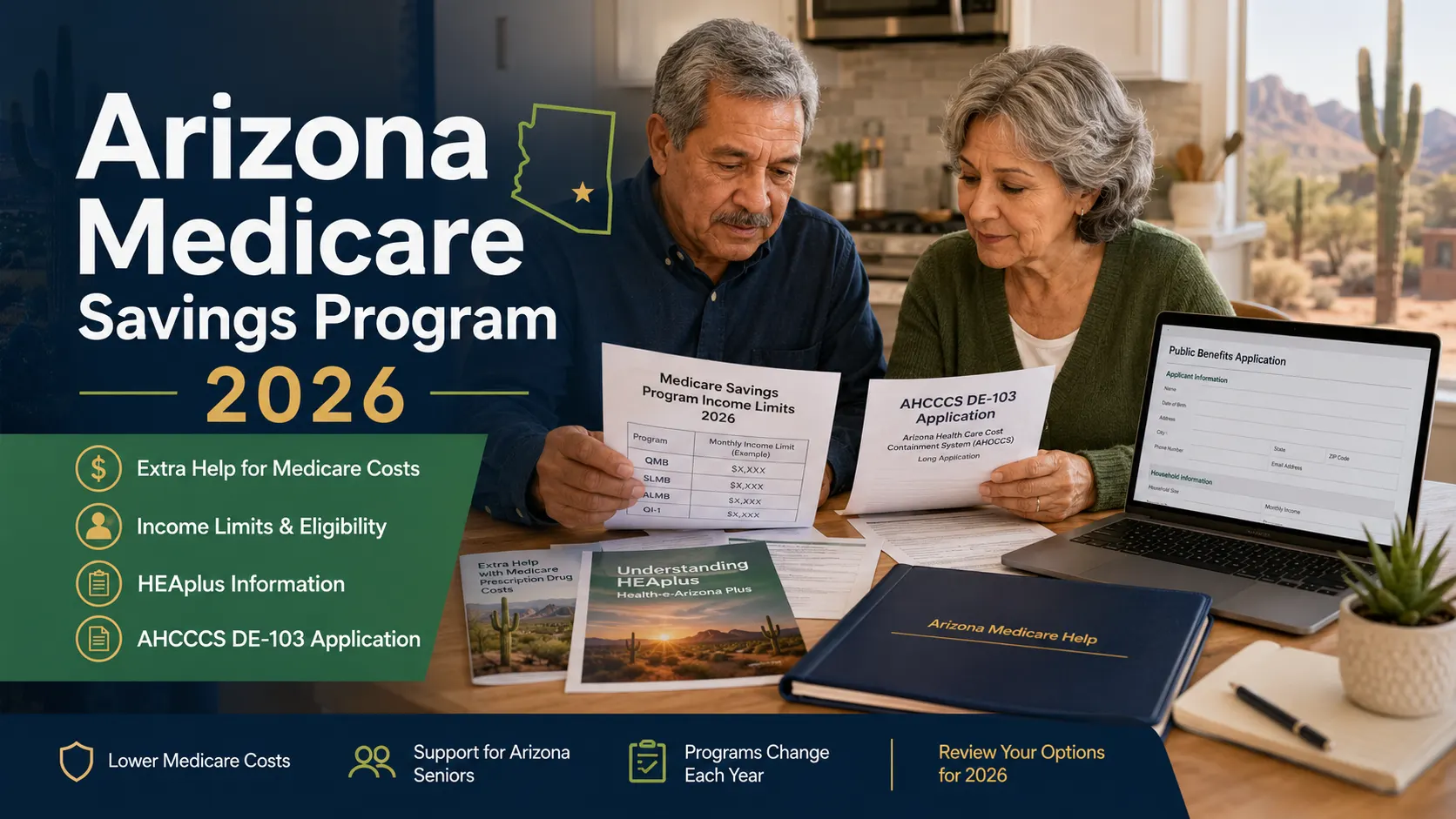
Apply online through Health-e-Arizona Plus or use the official AHCCCS DE-103 paper application. Free application help is available through HEAplus community assistors and Arizona SHIP.
Table of Contents
- Arizona MSP overview
- What QMB, SLMB and QI-1 pay
- 2026 income limits
- Arizona’s no-asset-test rule
- Basic eligibility requirements
- How to apply
- Health-e-Arizona Plus application
- DE-103 paper form
- Documents to prepare
- What happens after applying
- Effective dates and premium refunds
- Renewal and changes
- Denials and fair hearings
- Free official help
- Frequently asked questions
What Is the Arizona Medicare Savings Program?
Arizona’s Medicare Savings Programs are Medicaid-administered programs for people who are entitled to Medicare Part A and meet the applicable financial and nonfinancial rules.
The Arizona Health Care Cost Containment System, commonly called AHCCCS, determines eligibility. Arizona uses the following program names:
- Qualified Medicare Beneficiary, or QMB
- Specified Low-Income Medicare Beneficiary, or SLMB
- Qualified Individual-1, or QI-1
You do not need to select the correct program before submitting an application. Report Medicare coverage, household information and income accurately. AHCCCS evaluates the case under the appropriate category.
Arizona’s public MSP policy focuses on these three categories. A person looking for help with a premium-based Part A issue should explain the exact Medicare situation to AHCCCS or Arizona SHIP rather than assuming a different Medicaid program is the same as federal QDWI.
For a broader explanation, read what a Medicare Savings Program is and visit the Medicare Savings Programs information center.
What Each Arizona Medicare Savings Program Pays
| Program | What It May Pay | Important Rule |
|---|---|---|
| QMB | Part B premium, Part A premium when owed, and Medicare-covered deductibles, coinsurance and copayments | Provides federal protection from improper Medicare cost-sharing bills |
| SLMB | Medicare Part B premium | Does not pay ordinary Medicare deductibles, coinsurance or copayments |
| QI-1 | Medicare Part B premium | Cannot be combined with another Medicaid Title XIX category and must be renewed |
QMB Provides the Broadest Help
QMB may pay:
- The standard Medicare Part B premium
- A Medicare Part A premium when the beneficiary owes one
- Medicare Part A and Part B deductibles
- Medicare coinsurance
- Medicare copayments for Medicare-covered services and items
Medicare providers and suppliers generally cannot bill a QMB beneficiary for Medicare Part A or Part B cost-sharing on Medicare-covered services. This prohibition applies even when the provider does not participate in Medicaid.
If a provider sends an improper bill:
- Confirm that QMB was active on the date of service.
- Compare the bill with the Medicare Summary Notice.
- Tell the billing office that federal QMB billing protection applies.
- Show the approval notice or other proof of QMB status.
- Call Arizona SHIP or 1-800-MEDICARE if the provider does not correct the bill.
QMB protection does not automatically cover services that Medicare itself excludes, optional upgrades, unrelated insurance premiums or charges incurred outside the QMB effective period.
Read our full QMB Medicare Savings Program guide.
SLMB and QI-1 Pay the Part B Premium
SLMB and QI-1 are premium-assistance categories. They generally do not pay Medicare deductibles, coinsurance or copayments.
Arizona policy allows a person who has Medicare Part A and otherwise qualifies for SLMB or QI-1 to be approved even when Part B is not yet active. The beneficiary may then choose whether to enroll in Part B. Anyone using this route should understand that the person becomes responsible for the Part B premium if MSP eligibility later ends.
QI-1 cannot be approved when the applicant qualifies for another Medicaid Title XIX program. AHCCCS should evaluate whether QMB, SLMB or another AHCCCS category is more appropriate.
How Much Could the Program Save in 2026?
The standard Medicare Part B premium is $202.90 per month in 2026.
If Arizona pays the full standard premium for 12 covered months, the potential premium assistance is:
- $202.90 per covered month
- $2,434.80 over 12 covered months
This is potential assistance, not guaranteed cash income. The actual value depends on the approved program, effective date, Medicare enrollment status, premium amount and federal record-update timing.
Review the official CMS 2026 Medicare premium information.
Arizona Medicare Savings Program Income Limits for 2026
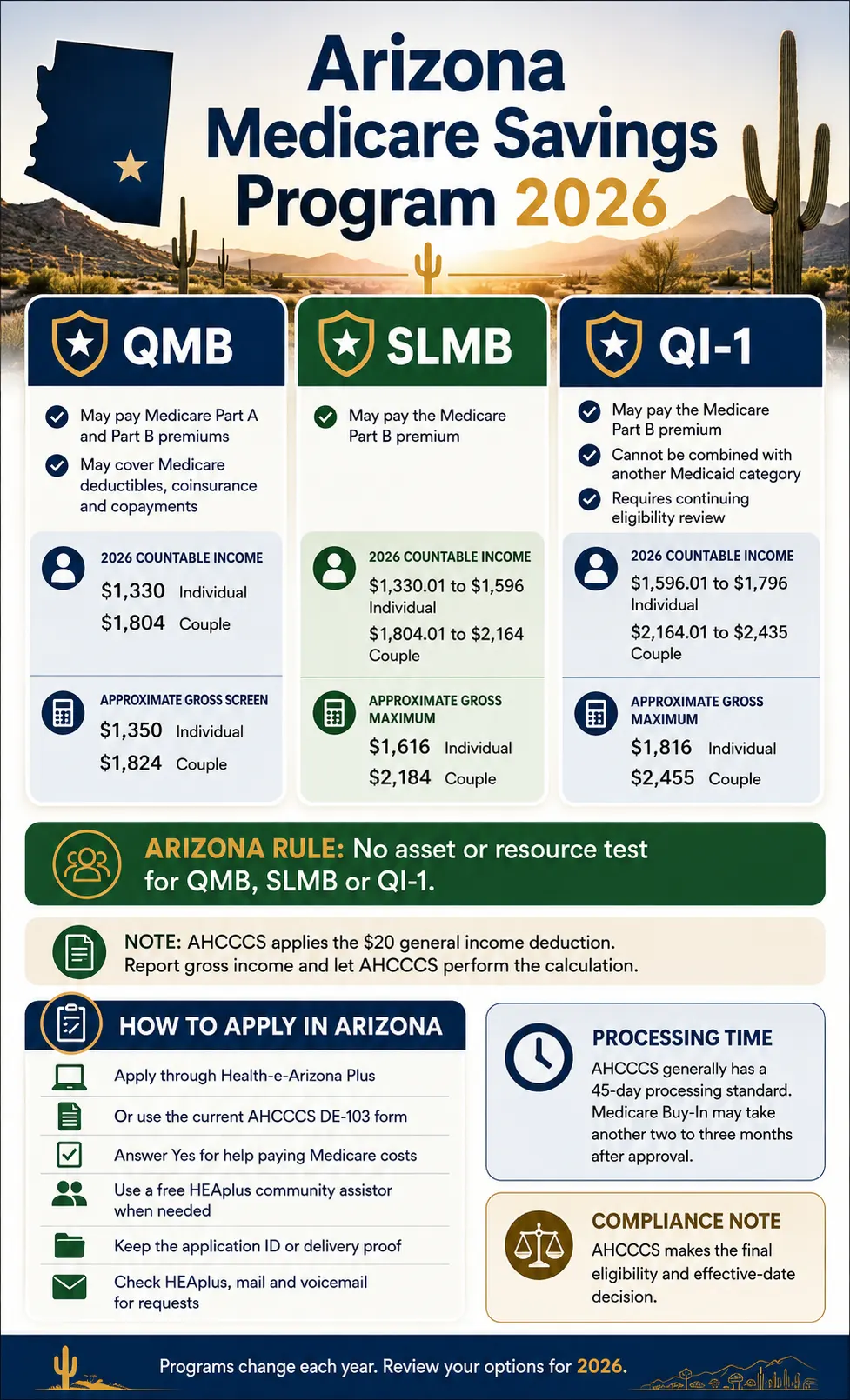
Arizona publishes countable-income standards effective February 1, 2026. AHCCCS applies the permitted deductions before comparing income with these standards.
| Program | Individual Countable Income | Couple Countable Income |
|---|---|---|
| QMB | Up to $1,330 per month | Up to $1,804 per month |
| SLMB | $1,330.01 to $1,596 | $1,804.01 to $2,164 |
| QI-1 | $1,596.01 to $1,796 | $2,164.01 to $2,435 |
Practical Gross-Income Screening Amounts
AHCCCS policy subtracts a standard $20 general income deduction when calculating MSP eligibility. For a household whose income is primarily Social Security or another unearned source, the following figures can be useful as an initial gross-income screen:
| Program | Approximate Individual Gross Screen | Approximate Couple Gross Screen |
|---|---|---|
| QMB | Up to about $1,350 | Up to about $1,824 |
| SLMB | About $1,350.01 to $1,616 | About $1,824.01 to $2,184 |
| QI-1 | About $1,616.01 to $1,816 | About $2,184.01 to $2,455 |
Do not subtract the $20 yourself on the application.
Report the gross income requested by the form or portal. AHCCCS applies the general deduction, earned-income deductions and any other permitted exclusions during eligibility processing.
Applicants with wages may receive additional deductions, including a work-expense deduction and exclusion of part of remaining earned income. The correct result can depend on income type, spouse information and household circumstances.
Apply when income is close to a limit. Only AHCCCS can calculate official countable income.
Our separate guide explains how Medicare Savings Program income limits work.
Does Arizona Have an MSP Asset or Resource Limit?
Arizona does not apply a resource limit to QMB, SLMB or QI-1.
AHCCCS eligibility policy identifies a valid application, Arizona residence, Social Security number, citizenship or qualified immigration status, Medicare Part A entitlement and income as the main MSP eligibility conditions. It does not list a financial-resource test for these three programs.
This makes Arizona different from states that use the standard federal MSP resource limits.
A person should not avoid applying merely because the person owns:
- A checking or savings account
- A certificate of deposit
- Stocks, bonds or mutual funds
- A retirement account
- A home or vehicle
The no-asset-test rule applies to Arizona’s QMB, SLMB and QI-1 categories. It should not be assumed to apply to ALTCS, long-term care, full AHCCCS categories or other assistance programs, which can use different financial rules.
Applicants must still answer all questions honestly and provide any information AHCCCS requests.
Basic Arizona MSP Eligibility Requirements
AHCCCS generally reviews whether the applicant:
- Submitted a valid application
- Lives in Arizona
- Has or has applied for a Social Security number
- Is a United States citizen or qualifying noncitizen
- Is entitled to Medicare Part A
- Meets the program’s countable-income standard
- Cooperates with additional QMB requirements when applicable
There is no separate requirement that every MSP applicant be age 65, blind or disabled. A younger Medicare beneficiary may qualify when the person has Medicare Part A and meets the other rules.
What if You Must Pay for Medicare Part A?
A person who must pay a Part A premium may be able to apply for conditional Part A enrollment through Social Security and then apply for QMB. Under conditional enrollment, Part A becomes effective only if QMB is approved.
This is a specialized procedure. Contact Social Security, AHCCCS or Arizona SHIP before paying a private company for help.
How to Apply for the Arizona Medicare Savings Program
Arizona offers three main application paths:
| Method | Official Route | Best For |
|---|---|---|
| Online | Health-e-Arizona Plus | Applicants who can complete forms and upload documents electronically |
| Paper | AHCCCS Form DE-103 | Applicants who prefer a printed application or need another person to help |
| Free assisted application | HEAplus Community Assistor Search | Applicants needing computer, language or document-upload help |
Do not select ALTCS unless you also want to apply for Arizona’s long-term care program. ALTCS is not another name for a Medicare Savings Program.
Option 1: Apply Online Through Health-e-Arizona Plus
Health-e-Arizona Plus, also called HEAplus, is the state’s online benefits portal.
Step 1: Create or Access the Account
Open Health-e-Arizona Plus and follow the current instructions for an individual or family account.
Save the username, password, email address and security information.
Step 2: Start a Medical-Assistance Application
Select the option to apply for public benefits or Medical Assistance. The portal may not present a large button labeled Medicare Savings Program at the beginning.
When asked whether the applicant wants help paying Medicare costs, answer Yes.
Step 3: Report Medicare Coverage
Enter:
- Medicare number
- Part A status and start date
- Part B status and start date
- Other health-insurance information
- Premium information when requested
If a comments field is available, write:
“I have Medicare and want to be screened for QMB, SLMB, QI-1 and any other help with Medicare costs for which I qualify.”
Step 4: Report Gross Income
Report all requested income, including:
- Social Security retirement or disability benefits
- Railroad Retirement
- Pensions and annuities
- Employment earnings
- Self-employment income
- Veterans benefits
- Interest, dividends and other regular payments
Use the amount requested by the portal. A Social Security bank deposit can be lower than the gross benefit because Medicare premiums or other deductions were taken out.
Example: If the gross Social Security benefit is $1,500 but only $1,297.10 reaches the bank after a $202.90 Part B deduction, follow the application field and provide the benefit statement showing the gross amount and deduction.
Step 5: Upload Requested Documents
HEAplus may verify information electronically. When proof is required, upload complete, readable images or PDF files.
Check that each page:
- Is right-side up
- Shows the applicant’s name
- Shows the statement or document date
- Is not cropped at the edges
- Is connected to the correct application or person
- Is submitted before the notice deadline
Step 6: Sign, Submit and Save Proof
Review Medicare information, income, household details and contact information before signing electronically.
Save:
- The application ID
- The confirmation page
- The submission date
- A list of uploaded documents
Continue checking the HEAplus account, postal mail and voicemail.
Apply Online Through HEAplus
Report Medicare coverage and request help paying Medicare costs.
Option 2: Apply With AHCCCS Form DE-103
The official paper application is:
AHCCCS Form DE-103
Application for AHCCCS Health Insurance and Medicare Savings Programs
Download the current official DE-103 application.
Check the revision and address before submitting.
AHCCCS can revise forms and submission details without notice. Use the PDF linked from the official AHCCCS application page, not an older saved form or a third-party copy.
How to Complete DE-103
- Read and retain the instruction pages.
- Complete every application page required by the current form.
- Answer Yes when asked whether you want help paying Medicare costs.
- Answer the separate AHCCCS Medical Assistance question according to whether you also want broader Medicaid screening.
- Report applicant and spouse information when applicable.
- Report gross Social Security, pension, employment and other income.
- Enter Medicare information exactly as shown on the Medicare card.
- Attach extra pages when more space is required.
- Sign and date the application.
- Keep a complete copy.
Selecting both Medical Assistance and Medicare-cost help allows AHCCCS to consider broader coverage when appropriate. QI-1 cannot be combined with another Medicaid category, but AHCCCS should determine whether another program applies.
Where to Mail DE-103
The DE-103 version reviewed for this guide directs applicants to AHCCCS Medical Assistance Specialty Programs at:
AHCCCS Medical Assistance Specialty Programs (MA-SP)
150 N. 18th Ave.
2nd Floor, MD 15022
Phoenix, AZ 85007
Confirm this address on the current live DE-103 before mailing. A newer revision controls if AHCCCS changes the form.
Mail copies, not original Medicare cards, Social Security cards, passports, immigration records or income documents. Consider trackable mail and keep the receipt.
Where to Fax DE-103
The DE-103 submission fax listed for AHCCCS MA-SP is:
602-258-4619
Confirm the fax number on the current official form before sending sensitive documents.
Use a cover sheet with the applicant’s name, date of birth, telephone number, page count and the words Medicare Savings Program Application. Keep the transmission report and confirm that all pages were received.
DE-103 Application Help
For questions about DE-103 or the AHCCCS Medical Assistance Specialty Programs process, the current application materials list:
- 602-417-5010, option 5
- 1-800-528-0142 for toll-free assistance
Option 3: Use a Free HEAplus Community Assistor
A trained community assistor can help an applicant:
- Create or access a HEAplus account
- Complete the online application
- Understand which documents are needed
- Upload verification documents
- Correct incomplete information
- Respond to AHCCCS requests
Use the official HEAplus Community Assistor Search. Application assistance should be free.
Documents and Information to Prepare
AHCCCS may verify some information electronically. The exact request depends on the application and available records.
Identity, Residence and Medicare
- Medicare card
- Social Security number or proof of application for one
- Date of birth
- Arizona residential and mailing addresses
- Citizenship or qualified-immigration documents when requested
- Other health-insurance cards or premium statements
Income Records
- Social Security benefit statement
- Pension or annuity statement
- Railroad Retirement documentation
- Veterans-benefit documentation
- Recent pay stubs
- Self-employment income and expense records
- Proof of other regular income
Representative Documents
When another person is helping, AHCCCS may require an authorized-representative form, guardianship order, power-of-attorney document or other proof of authority.
Do not delay the initial filing only because one verification document is missing. Arizona allows an application date to be preserved with basic identifying information, although the application must be properly signed before benefits can be approved.
What Happens After You Apply?
AHCCCS may:
- Approve the application
- Send a Request for Information
- Deny the application and explain the reason
Check:
- The HEAplus account
- Postal mail
- Email and text alerts connected with the account
- Telephone calls and voicemail
Return requested proof by the deadline. If a document cannot be obtained, contact AHCCCS before the deadline and ask what alternative proof may be accepted.
How Long Does Processing Take?
Arizona’s general processing standard for MSP and most other non-disability medical-assistance applications is 45 calendar days from the application date.
The period may be extended in limited circumstances, such as when required proof is pending or the applicant receives an approved extension to submit documentation.
A processing standard is not an approval guarantee. Keep confirmation and follow up when the deadline passes without a decision.
Effective Dates, Buy-In and Premium Repayment
QMB Is Prospective
Arizona QMB eligibility begins with the month following the month in which AHCCCS determines QMB eligibility. QMB is not approved as ordinary retroactive coverage for months before the determination.
SLMB and QI-1 Can Have Earlier Buy-In Months
Arizona procedures allow SLMB and QI-1 buy-in requests for qualifying earlier months. The number of months depends on the application date, approval date, eligibility in each month and federal processing rules.
Do not assume every prior premium deduction will be repaid. The eligibility notice and accepted Medicare buy-in dates control.
Why the Part B Deduction May Continue
After AHCCCS approval, Arizona sends a Medicare buy-in request to the federal Centers for Medicare and Medicaid Services. The process commonly takes about two to three months.
During that period, Social Security may continue deducting the Part B premium.
After the buy-in is accepted, Social Security generally repays premiums deducted after the effective AHCCCS buy-in request. Repayment may appear in a regular Social Security payment or as a separate payment.
Keep the approval notice and compare its effective date with Social Security statements. Contact AHCCCS when the premium deduction continues beyond the expected processing period.
Extra Help With Prescription Drug Costs
People approved for QMB, SLMB or QI-1 receive automatic eligibility for Medicare Part D Extra Help.
In 2026, Extra Help generally provides:
- A $0 qualifying Part D plan premium
- A $0 Part D deductible
- Up to $5.10 for a covered generic drug
- Up to $12.65 for a covered brand-name drug
- $0 for covered drugs after total drug costs reach $2,100
Someone with full Medicaid and QMB may qualify for a lower prescription limit.
Review the official Medicare Extra Help guide.
Renewal and Reporting Changes
AHCCCS periodically reviews continuing eligibility. QI-1 must be renewed and is subject to available federal funding.
HEAplus may allow a beneficiary to:
- Complete a renewal
- Upload updated documents
- Report an address change
- Report income or household changes
- Review notices
Keep contact information current. Respond to a renewal notice even when income did not change.
Read our Medicare Savings Program renewal guide.
What to Do if AHCCCS Denies the Application
Read the denial notice before filing another application.
Check whether the decision involved:
- Income calculated incorrectly
- Failure to apply the appropriate deduction
- Missing Medicare Part A information
- A missing signature
- Unverified citizenship or immigration status
- A missed document deadline
- Review under the wrong MSP category
- Incorrect spouse or household information
The notice should explain the decision, effective date, calculation and deadline for requesting a fair hearing.
Follow the instructions and deadline in the actual notice. A telephone complaint or duplicate application may not preserve fair-hearing rights.
HEAplus may offer an online fair-hearing request option. Arizona SHIP can help explain the notice, but AHCCCS and the hearing authority decide the case.
Use our checklist for a denied Medicare Savings Program application.
Where to Get Free Help in Arizona
| Help Needed | Official Resource |
|---|---|
| Online application or case management | Health-e-Arizona Plus |
| HEAplus account, portal or upload help | 1-855-432-7587 |
| Official paper application | AHCCCS DE-103 |
| DE-103 or MA-SP application help | 602-417-5010, option 5 or 1-800-528-0142 |
| Free assisted online application | HEAplus Community Assistor Search |
| Free Medicare counseling | Arizona SHIP: 1-800-432-4040 |
| Medicare or improper QMB billing | 1-800-MEDICARE, 1-800-633-4227 |
| Medicare TTY | 1-877-486-2048 |
Arizona SHIP
Arizona SHIP provides free, confidential and objective Medicare counseling. Counselors can help explain:
- QMB, SLMB and QI-1
- The Arizona application process
- Medicare Part D Extra Help
- QMB billing protection
- Medicare notices and coverage questions
SHIP counselors do not sell Medicare insurance plans and do not make AHCCCS eligibility decisions.
Arizona and Virginia Use Different MSP Systems
The federal program names are similar across states, but application portals, forms and financial rules can differ.
Arizona uses AHCCCS, Health-e-Arizona Plus and Form DE-103, and it does not apply a resource test to QMB, SLMB or QI-1. Virginia uses Cardinal Care, CommonHelp and Appendix D and publishes its own state-specific QDWI limit.
Read the latest article in this series: Virginia Medicare Savings Program 2026 application guide.
Final Arizona MSP Application Checklist
- ☐ Used Health-e-Arizona Plus or the current official DE-103
- ☐ Requested help paying Medicare costs
- ☐ Reported Medicare Part A and Part B information accurately
- ☐ Reported gross income as requested
- ☐ Did not subtract the $20 deduction personally
- ☐ Included spouse information when required
- ☐ Attached readable copies of available records
- ☐ Signed and dated the application
- ☐ Confirmed the current mailing address or fax number
- ☐ Kept a complete copy
- ☐ Saved the online, mail or fax confirmation
- ☐ Started checking HEAplus, mail and voicemail for notices
Arizona Medicare Savings Program FAQs
Which Medicare Savings Programs does Arizona offer?
Arizona’s primary MSP categories are QMB, SLMB and QI-1. AHCCCS determines which category applies after reviewing the application.
What are Arizona’s 2026 countable-income limits?
QMB is up to $1,330 for one person or $1,804 for a couple. SLMB is $1,330.01 to $1,596 or $1,804.01 to $2,164. QI-1 is $1,596.01 to $1,796 or $2,164.01 to $2,435.
Why are Medicare.gov screening limits $20 higher?
AHCCCS applies a standard $20 general income deduction before comparing countable income with Arizona’s standards. Applicants should report gross income and allow AHCCCS to perform the calculation.
Does Arizona have an MSP asset limit?
Arizona does not apply a resource test to QMB, SLMB or QI-1. The rule does not automatically extend to ALTCS or every other AHCCCS program.
Where do I apply online?
Apply through Health-e-Arizona Plus. Start a Medical Assistance application and answer Yes when asked whether you want help paying Medicare costs.
Which paper form should I use?
Use the current official AHCCCS DE-103 application for AHCCCS Health Insurance and Medicare Savings Programs. Check the revision and submission details on the live PDF.
Can I fax DE-103?
The reviewed DE-103 instructions list AHCCCS MA-SP fax 602-258-4619. Confirm the number on the current form, send every required page and keep the transmission report.
How long does an Arizona MSP application take?
Arizona’s general processing standard is 45 calendar days, although unresolved verification or permitted extensions may delay a final decision.
Will the Part B deduction stop immediately?
Not always. AHCCCS states that the federal Medicare buy-in process commonly takes two to three months after approval.
Can Social Security repay premiums deducted after approval?
After an accepted buy-in, Social Security generally repays premiums deducted after the effective AHCCCS buy-in request. The amount and timing depend on the accepted coverage dates.
Does QMB protect me from Medicare copays?
Yes, for Medicare-covered services during an active QMB period. Providers generally cannot bill QMB beneficiaries for Medicare Part A or Part B deductibles, coinsurance or copayments.
Can I receive QI-1 and full AHCCCS at the same time?
No. QI-1 is not available when a person qualifies for another Medicaid Title XIX category. AHCCCS should evaluate whether another category, including QMB or SLMB, applies.
Does approval include Medicare Extra Help?
QMB, SLMB and QI-1 approval provides automatic eligibility for Medicare Part D Extra Help.
Where can I get free application help?
Call HEAplus at 1-855-432-7587, use a HEAplus community assistor or contact Arizona SHIP at 1-800-432-4040.
Apply Through an Official Arizona Route
Arizona’s lack of an MSP resource test makes it especially important not to self-deny because of savings. Income type and deductions can also change the calculation.
Use Health-e-Arizona Plus, submit the current DE-103 or obtain free assistance from an official community assistor.
Keep proof of submission and respond promptly to AHCCCS notices.
Start an Arizona MSP Application
AHCCCS makes the final eligibility decision. Official applications and state-supported assistance are free.