Kentucky Medicare Savings Program 2026: kynect & MAP-205
Kentucky Medicare Cost Assistance Guide
Kentucky Medicare Savings Program 2026: kynect, MAP-205 and Income Limits
Kentucky Medicare Savings Programs may help eligible Medicare beneficiaries pay the Part B premium. QMB may also cover eligible Medicare Part A premiums and Medicare-covered deductibles, coinsurance and copayments.
Reviewed August 4, 2026, using current Kentucky CHFS, DCBS, Kentucky administrative regulations, Medicare, CMS and Social Security information. Kentucky DCBS makes the final eligibility decision.
Independent educational resource
This website is not Medicare, CMS, Kentucky Medicaid, kynect, DCBS or another government agency. It does not process or approve applications. Use official Kentucky forms and follow the deadlines and instructions printed on your current eligibility notice.
Quick Answer
Kentucky offers four Medicare Savings Program categories:
- QMB may pay Medicare Part A and Part B premiums and Medicare-covered deductibles, coinsurance and copayments.
- SLMB pays the Medicare Part B premium.
- QI or QI-1 also pays the Part B premium for people in a higher income range.
- QDWI pays the Part A premium for certain working people with disabilities.
The standard Medicare Part B premium is $202.90 per month in 2026. Receiving a full year of standard Part B premium assistance could provide up to $2,434.80 in annual help. Actual savings depend on the premium owed and approved coverage period.
You may apply online through kynect, by telephone through DCBS, with the MAP-205 paper application, by fax or in person at a local DCBS office.
Current-Year Limit Warning
Some Kentucky public webpages may still display older dollar examples. Use the 2026 screening limits in this guide and let DCBS calculate your official countable income and resources.
Table of Contents
- 2026 income limits
- Resource limits
- What each program pays
- Who may qualify
- Apply through kynect
- Apply by phone
- MAP-205 application
- Mail or deliver the form
- Fax the application
- Apply in person
- Get kynector help
- Documents to prepare
- After applying
- Coverage start dates
- Annual renewal
- Denial and appeal
- QMB billing protection
- Part D Extra Help
- Free official help
- FAQs
Paying Medicare premiums should not force you to choose between healthcare and everyday needs. Kentucky’s Medicare Savings Program may provide financial breathing room by reducing costs taken from a monthly Social Security payment.
Many people assume they will not qualify because their income appears slightly too high, they own a home or they have money in a bank account. Those facts do not always prevent eligibility. Kentucky uses countable-income and resource rules, and several property exclusions may apply.
For general program information, visit our Medicare Savings Programs educational resource. State rules differ significantly. The latest state guide explains the Alabama Medicare Savings Program and its no-asset rule for QMB, SLMB and QI-1.

Kentucky Medicare Savings Program Income Limits for 2026
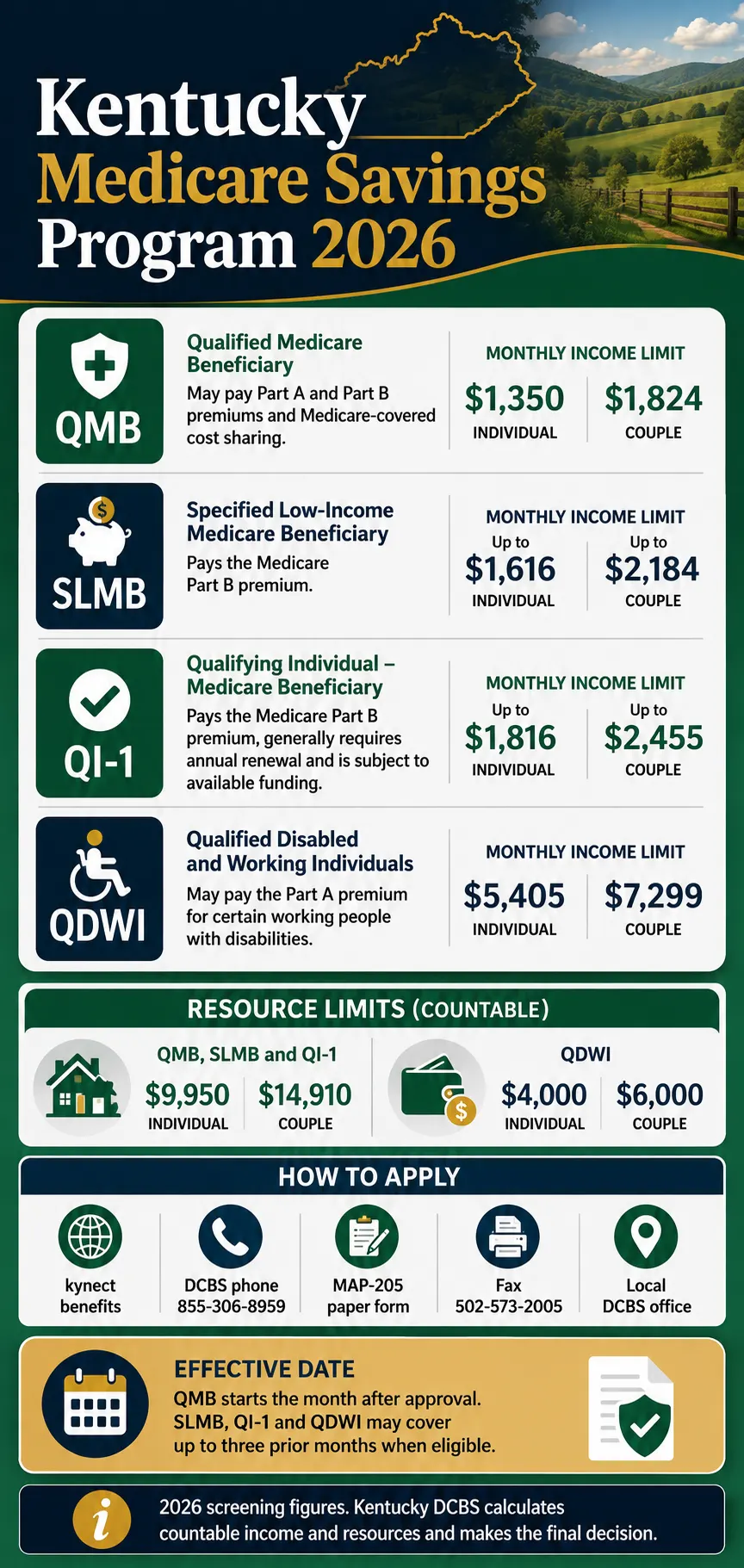
Kentucky applies Medicare Savings Program income standards through its Medicaid eligibility rules. The following table uses the current 2026 federal MSP screening amounts applicable to Kentucky.
| Program | Individual monthly income | Married couple monthly income | Main benefit |
|---|---|---|---|
| QMB | Up to $1,350 | Up to $1,824 | Part A and Part B premiums and protected Medicare cost sharing |
| SLMB | Over the QMB limit through $1,616 | Over the QMB limit through $2,184 | Medicare Part B premium |
| QI or QI-1 | Over the SLMB limit through $1,816 | Over the SLMB limit through $2,455 | Medicare Part B premium |
| QDWI | Up to $5,405 | Up to $7,299 | Part A premium for certain working people with disabilities |
The published amounts are screening limits. They do not mean that DCBS will approve or deny an application by comparing one gross-income number with the table.
The 2026 figures include the standard $20 monthly general income exclusion. Other earned-income exclusions and Medicaid budgeting rules may also affect countable income.
Someone who works may have gross monthly earnings above a published limit but lower countable income after permitted exclusions are applied.
Apply when close to a limit: Do not withdraw or avoid an application because income is a few dollars over a chart. Ask DCBS to calculate the official countable amount.
Review the official Medicare 2026 MSP screening limits and our detailed guide to Medicare Savings Program income limits.
Kentucky Medicare Savings Program Resource Limits for 2026
| Program | Individual | Married couple |
|---|---|---|
| QMB, SLMB and QI-1 | $9,950 | $14,910 |
| QDWI | $4,000 | $6,000 |
Kentucky regulations link QMB, SLMB and QI-1 eligibility to MSP resource standards. Kentucky has not eliminated the resource test in the way some other states have.
Resources that may count include:
- Checking and savings accounts.
- Cash.
- Certificates of deposit.
- Stocks and bonds.
- Certain annuities.
- Trust interests.
- Certain retirement or investment accounts.
- Cash value in certain life-insurance policies.
Resources that may be excluded include:
- The home where you live.
- One vehicle used for transportation.
- Household goods and personal belongings.
- Certain burial plots.
- Certain burial funds and life-insurance amounts under applicable rules.
The published limits generally do not include the additional burial-fund exclusion that may apply when an applicant expects to use part of their resources for burial expenses.
Do not decide for yourself that an account, annuity, trust or insurance policy automatically counts. Ownership, availability, value and restrictions can affect how DCBS treats it.
Read our Medicare Savings Program resource-limit guide.
What Does Each Kentucky Medicare Savings Program Pay?
| Program | What it may pay | Important rule |
|---|---|---|
| QMB | Part A premium if owed, Part B premium, deductibles, coinsurance and copayments for Medicare-covered care | Providers generally cannot bill the beneficiary for protected Medicare cost sharing |
| SLMB | Medicare Part B premium | Does not normally pay Medicare deductibles or copayments |
| QI or QI-1 | Medicare Part B premium | Cannot generally be combined with another Medicaid eligibility category and is subject to annual funding |
| QDWI | Medicare Part A premium | For a limited group of working people under age 65 with disabilities |
QMB: Premium and Medicare cost-sharing assistance
QMB provides the most comprehensive Medicare Savings Program help.
It may pay:
- The Medicare Part A premium when one is owed.
- The Medicare Part B premium.
- Medicare Part A and Part B deductibles.
- Medicare coinsurance.
- Medicare copayments for Medicare-covered services and items.
Kentucky Medicaid treats payment made for covered QMB Medicare deductibles and coinsurance as payment in full under its provider rules.
SLMB: Part B premium assistance
SLMB pays the Medicare Part B premium. It generally does not pay Medicare deductibles, coinsurance or doctor copayments.
Its primary value is stopping the monthly premium deduction and potentially reimbursing eligible premiums deducted for approved prior months.
QI-1: Higher-income Part B premium assistance
QI-1 also pays the Medicare Part B premium for people whose countable income is above the SLMB range.
Kentucky regulations state that QI-1:
- Is limited by the available federal allotment.
- Is handled on a first-come, first-served basis.
- Gives preference in later years to people who received QI-1 during the previous year.
- May end if the federal QI allotment is no longer available.
QI-1 generally cannot be combined with another full Medicaid eligibility category.
QDWI: Part A premium assistance
QDWI may pay the Medicare Part A premium for certain people who:
- Are under age 65.
- Continue to meet the applicable disability requirement.
- Returned to work.
- Lost premium-free Medicare Part A because of work activity.
- Meet QDWI income and resource limits.
- Are not otherwise eligible for Medicaid.
Ask DCBS to screen for QDWI specifically when these facts apply.
Who May Qualify in Kentucky?
You may qualify for a Kentucky Medicare Savings Program if you:
- Live in Kentucky.
- Have or can establish the Medicare entitlement required for the applicable category.
- Meet the program’s countable-income requirements.
- Meet the applicable resource limit.
- Meet citizenship or qualified immigration-status rules.
- Provide the information DCBS needs to make an eligibility decision.
Kentucky’s public MSP screening page begins by asking whether an applicant has Medicare Part A. SLMB and QI also generally require Medicare Part B.
If you are eligible for Medicare Part A but did not enroll because you cannot afford the premium, contact Social Security and ask about applying for actual or conditional Part A.
A spouse’s income and resources may affect eligibility when a married applicant lives with their spouse.
You do not need to identify the correct category before applying. Ask DCBS to screen you for QMB, SLMB, QI-1, QDWI and any other Medicaid assistance for which you may qualify.
See our guide explaining who may qualify for a Medicare Savings Program.
Are Kentucky MSP rules statewide?
Yes. Kentucky Medicaid establishes statewide eligibility standards. DCBS processes applications in all 120 counties.
The same core financial standards apply whether you live in Louisville, Lexington, Bowling Green, Owensboro, Covington, Frankfort or a rural county. Your local DCBS office and caseworker may differ by county.
How to Apply Online Through kynect Benefits
The fastest application method for many residents is the official kynect benefits portal.
kynect benefits can be used to:
- Apply for Medicaid and other Kentucky benefit programs.
- Return to an unfinished application.
- Upload verification documents.
- View notices and messages.
- Manage an existing benefits case.
- Report changes.
- Complete an annual renewal.
Online application steps
- Open kynect benefits.
- Create a Kentucky Online Gateway account or sign in.
- Choose the option to apply for benefits.
- Select health coverage or Medicaid assistance.
- Enter household and spouse information when applicable.
- Report Medicare Part A and Part B coverage.
- Enter income and resource information.
- Upload available proof.
- Review every page for missing answers.
- Submit the application.
- Save or print the confirmation number.
When the application provides a comment or explanation field, you may write:
“I have Medicare and want to be screened for QMB, SLMB, QI-1, QDWI and any other Medicare Savings Program or Medicaid category for which I qualify.”
Creating an account does not submit an application by itself. Continue until kynect confirms successful submission.
Apply through Kentucky’s official benefits portal
Save the confirmation number and check both kynect and regular mail for requests from DCBS.
How to Apply by Phone Through DCBS
Call Kentucky DCBS at:
855-306-8959
Current DCBS Family Support call-line hours are generally Monday through Friday, 8 a.m. to 4:30 p.m. Eastern Time. Saturday call hours ended after June 29, 2026.
Hearing-impaired applicants may call:
800-648-6056
Kentucky permits Medicaid applications to be completed by phone. Tell the representative:
“I have Medicare and need help paying my Medicare Part B premium. Please screen me for QMB, SLMB, QI-1 and any other Medicaid assistance for which I qualify.”
During the call:
- Record the date and time.
- Write down the representative’s name.
- Ask for an application or case number.
- Confirm which documents DCBS needs.
- Ask how documents should be submitted.
- Repeat important instructions to confirm that you understood them.
How to Apply With the MAP-205 Paper Application
Kentucky’s paper form is called MAP-205: Application for Medicaid or Medicare Savings Programs.
Download the current official form:
Download the Kentucky MAP-205 application
The application allows you to request:
- Medicare Savings Program assistance.
- Regular Medicaid.
- Spend Down.
- Waiver Medicaid.
- Long-term care Medicaid.
Check the Medicare Savings Program option when your primary goal is help with Medicare premiums or Medicare cost sharing.
How to complete MAP-205
- Enter your identifying and contact information.
- Select Medicare Savings Program.
- Include spouse information when required.
- Report Medicare coverage.
- Report household income.
- Complete the applicable resource sections.
- Include copies of requested documents.
- Read the rights and responsibilities.
- Sign and date the application.
- Keep a complete copy.
Do not mail original Medicare cards, Social Security cards, bank statements or identification documents. Submit clear copies unless DCBS specifically asks to inspect an original.
Form safety tip: Download MAP-205 from the official Kentucky website immediately before applying. Submission instructions may be updated.
Where to Mail or Deliver MAP-205
MAP-205 directs applicants to the DCBS office serving the county where they live.
Use the official Kentucky DCBS Local Office Search to find the correct location and contact details.
Before mailing:
- Confirm that the office serves your county.
- Confirm the current mailing address.
- Sign and date the application.
- Keep a full copy.
- Keep copies of supporting documents.
- Write down the mailing date.
- Consider using a mailing method that provides tracking.
You may also take the form to the local office. Ask for a date-stamped copy or written receipt.
Kentucky DCBS also lists the following address for returning verification and other Family Support documents:
DCBS Family Support
P.O. Box 2104
Frankfort, KY 40602
Because application and verification destinations may differ, use the current MAP-205 instructions or call DCBS before mailing the initial application to a central address.
How to Fax the Kentucky Application
Current Kentucky CHFS enrollment guidance lists the following statewide application fax:
502-573-2005
Some older copies or instructions may show an additional fax number. Use the current CHFS application page or call DCBS before relying on an older number.
Use a fax cover page containing:
- The applicant’s full name.
- Date of birth.
- Telephone number.
- Application or case number when available.
- The total number of pages.
Fax every page of the signed application and supporting documents. Keep the successful transmission report.
Check that:
- The report shows the correct fax number.
- The transmission status is successful.
- The correct number of pages was transmitted.
- The pages are readable and properly oriented.
How to Apply in Person at a DCBS Office
Kentucky has DCBS Family Support offices serving all 120 counties.
In-person help may be useful when:
- You cannot use kynect.
- You need help completing MAP-205.
- You want to submit documents directly.
- You received a notice you do not understand.
- You need help choosing between MSP, regular Medicaid, Spend Down, waiver services or long-term care Medicaid.
- An authorized representative is helping you apply.
Current Family Support office hours are generally Monday through Friday, 8 a.m. to 4:30 p.m. Eastern Time. Call the local office before travelling to confirm hours, location and appointment requirements.
Bring copies of documents and ask for proof that the application was received.
Get Free Application Help From a kynector
Kentucky has trained application helpers known as kynectors.
A kynector may help you:
- Create a kynect account.
- Begin a benefits application.
- Enter household information.
- Upload documents.
- Understand kynect notices.
- Identify other benefit programs that may be available.
Use the local-help tools available through the kynect website to locate assistance.
A kynector helps with the benefits application. For Medicare plan questions, QMB billing problems, Part D coverage or Medicare claims, contact Kentucky SHIP.
What Documents and Information Should You Prepare?
MAP-205 and kynect request household, Medicare, income and resource information.
Depending on your circumstances, prepare:
- Your Medicare card.
- Social Security number.
- Kentucky home and mailing addresses.
- Social Security benefit or award letter.
- Pension, retirement or annuity statements.
- Recent wage information.
- Self-employment records.
- Bank statements.
- Investment information.
- Trust or annuity information.
- Information about property other than the home where you live.
- Life-insurance information when requested.
- Other health-insurance premiums.
- Spouse information when married.
- Authorized-representative documentation when someone is acting for you.
DCBS may not require every document from every applicant.
Do not delay filing for several weeks because one record is missing. Submit the signed application and available proof, then respond promptly to the verification request.
When uploading or faxing bank statements, include every requested page. A page that appears blank may still contain an account number, page count or legal disclosure needed to show that the statement is complete.
What Happens After You Apply?
DCBS reviews Medicare status, income, resources, Kentucky residence and other eligibility requirements.
Watch for:
- Letters from DCBS.
- kynect account messages.
- Requests for missing information.
- Document deadlines.
- Interview or clarification requests.
- Approval notices.
- Denial notices.
- Benefit effective dates.
Respond to each request by the deadline printed on the notice. Failure to provide sufficient information or attend a required appointment can result in denial.
Kentucky does not provide a clear MSP-specific guaranteed processing period on its main public program page. Processing time depends on whether DCBS has enough information to make a decision.
Call 855-306-8959 when:
- You need to confirm that the application was received.
- A document does not appear in kynect.
- The agency requested information you cannot obtain.
- You have not received an eligibility notice.
When Do Kentucky MSP Benefits Begin?
QMB effective date
Kentucky QMB eligibility begins in the month after the month in which eligibility is approved.
QMB is not retroactive and does not begin during the approval month.
For example, if DCBS approves QMB in April, QMB generally begins May 1.
SLMB, QI-1 and QDWI retroactive coverage
Kentucky regulations allow SLMB, QI-1 and QDWI benefits to begin as early as the third month before the application month when all technical and financial requirements were met during those months.
The approval notice should state the covered month or months.
When will the Part B deduction stop?
Approval does not always change the next Social Security payment immediately.
Kentucky Medicaid must report the approval through the Medicare buy-in process. Medicare and Social Security then update their payment records.
After the update:
- The Part B premium deduction may stop.
- The Social Security payment may increase.
- Eligible premiums deducted for approved months may be reimbursed.
A refund amount and delivery date are not guaranteed. Keep your approval notice, Social Security payment records and bank statements.
Contact DCBS or Kentucky SHIP if the deduction continues longer than expected.
How Does Kentucky MSP Renewal Work?
Kentucky Medicaid eligibility is generally redetermined every 12 months. Eligibility may also be reviewed when DCBS receives information about a change in circumstances.
You are responsible for reporting a change that may affect eligibility within the timeframe required by Kentucky Medicaid rules.
To protect coverage:
- Keep your home and mailing addresses current.
- Keep your phone number and email current.
- Open all DCBS and Kentucky Medicaid mail.
- Check kynect regularly.
- Complete a renewal by the stated deadline.
- Upload or return requested proof.
- Keep confirmation that the renewal was submitted.
QI-1 beneficiaries should pay particular attention to yearly renewal because QI funding is provided through an annual federal allotment.
You may manage renewal through kynect or call DCBS at 855-306-8959.
Read our Medicare Savings Program renewal guide.
What Should You Do if Kentucky Denies the Application?
Kentucky must provide written notice when it denies a Medicaid eligibility application. The notice should include:
- The reason for denial.
- The applicable Kentucky regulation.
- Information about the right to an administrative hearing.
Common denial reasons include:
- Income calculated above the applicable limit.
- Resources calculated above the limit.
- Missing verification.
- Conflicting information that was not clarified.
- A missed interview or appointment.
- An unsigned application.
- DCBS being unable to locate the applicant.
Take these steps:
- Read the entire decision. Identify the specific reason and calculation.
- Call DCBS. Ask how income and resources were counted.
- Submit missing or corrected proof. Include your case number.
- Request a hearing when appropriate. Follow the exact instructions on the notice.
- Keep proof. Save uploads, fax records, mailing receipts and hearing-request documents.
A Kentucky Medicaid eligibility hearing request generally must be received or postmarked within 30 days of the denial or discontinuance notice.
An additional 30 days may be allowed when the designated hearing agency finds good cause for the delay.
Follow the exact date and method printed on your current notice. A different or earlier deadline may affect whether existing benefits continue while an appeal is pending.
For general Medicaid appeals information, contact the Kentucky Appeals and Complaints Branch:
502-564-9444
Review the official Kentucky Medicaid appeals information and our Medicare Savings Program denial guide.
Appeal deadline warning: Do not wait until every supporting document has been collected when the hearing deadline is approaching. Submit the hearing request on time and provide additional evidence as instructed.
What if You Have QMB and Receive a Medical Bill?
Federal law prohibits Medicare providers and suppliers from billing a QMB beneficiary for Medicare Part A or Part B deductibles, coinsurance and copayments for Medicare-covered services and items.
The protection applies even when the provider does not accept Kentucky Medicaid.
If you receive a bill:
- Do not ignore it.
- Confirm that QMB was active on the date of service.
- Check whether Medicare covered the service.
- Call the provider’s billing office.
- Explain that you have QMB through Kentucky Medicaid.
- Provide Medicare and Medicaid or QMB information.
- Ask the office to correct the account and stop collection activity.
- Contact Kentucky SHIP or Medicare if billing continues.
1-800-MEDICARE: 1-800-633-4227
Medicare TTY: 1-877-486-2048
If you already paid prohibited QMB cost sharing, ask the provider to review whether a refund is required.
QMB does not make every service free. You may still owe for non-covered services, permitted prescription charges or care Medicare properly denied.
Review the official CMS QMB billing-protection guidance and our QMB Medicare Savings Program guide.
Does Kentucky MSP Approval Include Medicare Part D Extra Help?
People approved for QMB, SLMB or QI-1 generally qualify automatically for Medicare Part D Extra Help.
In 2026, Extra Help can provide:
- A $0 premium for a qualifying Part D plan priced at or below the applicable benchmark.
- A $0 Part D deductible.
- Copays of no more than $5.10 for each covered generic drug.
- Copays of no more than $12.65 for each covered brand-name drug.
- $0 for covered drugs after total drug costs reach $2,100 in 2026.
- No Part D late-enrollment penalty while receiving Extra Help.
A person receiving full Medicaid and QMB may have a lower maximum prescription copay.
A Part D plan priced above the applicable Extra Help benchmark may charge part of its premium.
QDWI by itself should not be assumed to provide automatic Extra Help. Ask Kentucky SHIP or Social Security whether a separate application is appropriate.
Review the official Medicare Extra Help costs for 2026.
Can a Social Security Extra Help application start an MSP review?
When a beneficiary applies for Part D Extra Help through Social Security, the application information can be sent to the state for Medicare Savings Program screening unless the applicant asks Social Security not to transmit it.
Kentucky may still require additional information. Watch for a DCBS notice and respond by the deadline.
Is MSP-Only Assistance the Same as Full Kentucky Medicaid?
No. Kentucky describes Medicare Savings Programs as partial financial assistance for certain Medicare beneficiaries who are not entitled to the full Medicaid benefit package.
| Coverage type | General purpose |
|---|---|
| QMB-only | Medicare premiums and protected Medicare cost sharing |
| SLMB or QI-1 | Medicare Part B premium assistance |
| Full Kentucky Medicaid | May provide broader medical benefits under separate eligibility rules |
| Spend Down | Time-limited Medicaid eligibility after qualifying medical expenses offset excess income |
| Long-term care or waiver Medicaid | Uses additional medical, functional and financial requirements |
If you need broader Medicaid coverage, Spend Down, home and community-based services or nursing-facility coverage, select the appropriate MAP-205 options and ask DCBS to evaluate every relevant category.
Read our Medicare Savings Program versus Medicaid comparison.
Does Kentucky Estate Recovery Apply to MSP Benefits?
Kentucky estate recovery primarily concerns payments made during periods of institutionalization or certain home and community-based waiver services.
Federal Medicaid policy prohibits states from recovering Medicare cost-sharing payments made for Medicare Savings Program beneficiaries.
Kentucky’s estate-recovery regulation may include related Medicare premiums among recoverable costs when they were paid during a covered institutional or waiver period.
This means someone receiving only MSP assistance may have a different estate-recovery situation from someone receiving QMB together with nursing-home, waiver or other full Medicaid services.
Do not make estate-planning decisions based on a general article. Review:
Where Can You Get Free Official Help in Kentucky?
| What you need | Official contact |
|---|---|
| Apply or manage benefits online | kynect benefits |
| Apply by phone or ask about a case | DCBS: 855-306-8959 |
| Hearing-impaired assistance | 800-648-6056 |
| Paper application | MAP-205 application |
| Find a local DCBS office | DCBS Local Office Search |
| Fax a Medicaid application | 502-573-2005 |
| Free Medicare and MSP counseling | Kentucky SHIP: 1-877-293-7447, option 2 |
| Kentucky Medicaid Member Services | 855-459-6328 |
| Eligibility appeal information | 502-564-9444 |
| Medicare or QMB billing questions | 1-800-MEDICARE: 1-800-633-4227 |
| Medicare TTY | 1-877-486-2048 |
| Community assistance | Dial 2-1-1 |
Kentucky SHIP provides free Medicare counseling to older adults, people with disabilities, families and caregivers.
SHIP counselors may help with:
- Medicare Savings Program questions.
- QMB billing problems.
- Medicare Part D Extra Help.
- Medicare Advantage.
- Medicare Supplement insurance.
- Part D drug coverage.
- Medicare notices and claims.
SHIP does not sell insurance and does not make the Medicaid eligibility decision.
Need free help before applying?
Contact Kentucky SHIP for Medicare counseling, a kynector for application assistance or DCBS for an official eligibility application. Approval cannot be guaranteed before DCBS completes its review.
Common Kentucky Application Mistakes
Using outdated income figures
Some Kentucky webpages may display older examples. Use current 2026 figures and allow DCBS to perform the official calculation.
Assuming a home or car disqualifies you
The primary home and one vehicle are generally excluded from the MSP resource calculation.
Choosing only one MSP category
You do not need to decide whether QMB, SLMB or QI applies. Ask DCBS to screen every category.
Sending an unsigned MAP-205
Review the signature and date sections before mailing, faxing or delivering the application.
Using an older fax number
Current CHFS application guidance lists 502-573-2005. Confirm current submission details before relying on an older form copy.
Missing a verification deadline
Check kynect and regular mail. A missing bank statement, income record or Medicare document can delay or prevent approval.
Expecting the Part B deduction to stop immediately
Kentucky Medicaid, Medicare and Social Security must update separate systems. Keep the approval notice and monitor later Social Security payments.
Kentucky Medicare Savings Program FAQs
What is the Medicare Savings Program in Kentucky?
It is Kentucky Medicaid assistance that may pay Medicare premiums and, under QMB, Medicare-covered deductibles, coinsurance and copayments for qualifying beneficiaries.
What are Kentucky’s 2026 MSP income limits?
The 2026 screening limits are $1,350 individual and $1,824 couple for QMB; $1,616 and $2,184 for SLMB; $1,816 and $2,455 for QI; and $5,405 and $7,299 for QDWI. DCBS calculates countable income.
What are Kentucky’s 2026 MSP resource limits?
QMB, SLMB and QI use limits of $9,950 for one person and $14,910 for a married couple. QDWI uses $4,000 and $6,000.
Where can I apply online?
Apply through the official kynect benefits portal. Save the confirmation number and check kynect and regular mail after submitting.
Can I apply by phone?
Yes. Call Kentucky DCBS at 855-306-8959 and ask to apply for Medicaid and Medicare Savings Program assistance.
Which paper application should I use?
Use MAP-205, Application for Medicaid or Medicare Savings Programs. Select Medicare Savings Program when that is the assistance you need.
Where should I mail MAP-205?
Mail or deliver it to the DCBS office serving your county unless the current application gives different instructions. Use the official DCBS office search and confirm the address.
Can I fax MAP-205?
Current Kentucky CHFS application guidance lists 502-573-2005. Keep the successful fax transmission report and confirm current instructions before using an older number.
Does QMB pay Medicare copayments?
QMB may pay Medicare-covered deductibles, coinsurance and copayments. Medicare providers generally cannot bill QMB beneficiaries for those protected amounts.
Can Kentucky QMB cover earlier months?
No. Kentucky QMB generally begins the month after approval and is not retroactive. SLMB, QI-1 and QDWI may cover up to three prior months when all requirements were met.
How long do I have to appeal a Kentucky Medicaid denial?
A Medicaid eligibility hearing request generally must be received or postmarked within 30 days of the denial notice. Follow the exact deadline printed on your notice.
Does MSP approval help with prescription costs?
People approved for QMB, SLMB or QI-1 generally qualify automatically for Medicare Part D Extra Help.
Who can help me apply for free?
A kynector can assist with a Kentucky benefits application. Kentucky SHIP provides free Medicare counseling at 1-877-293-7447, option 2.
Conclusion
If the Medicare Part B premium is leaving less money for groceries, utilities, prescriptions and other monthly needs, submit an application instead of assuming you will not qualify.
Use kynect benefits to apply online, call DCBS at 855-306-8959, or complete the MAP-205 application.
For a paper submission, confirm the DCBS office serving your county. Current statewide application guidance lists fax number 502-573-2005.
Apply even if your income or resources appear close to the limit. Kentucky DCBS must apply the official countable-income and resource rules.
Approval may stop the monthly Part B premium deduction, provide Medicare Part D Extra Help and, under QMB, protect you from Medicare-covered deductibles, coinsurance and copayments.
Apply through an official Kentucky channel
Gather your available Medicare, income and resource information, submit the application and keep proof. Kentucky DCBS determines eligibility and the approved coverage period.
Editorial disclaimer: This article provides general educational information and is not legal, financial or benefits advice. Income limits, resource rules, forms, contacts and application procedures may change. Check the current official Kentucky application, CHFS website and DCBS eligibility notice before acting. Kentucky DCBS makes the final eligibility decision.