Kansas Medicare Savings Program 2026: Income Limits, KanCare Application, QMB, LMB & ELMB
Kansas Medicare Cost Assistance Guide
Kansas Medicare Savings Program 2026: Income Limits, Benefits and How to Apply
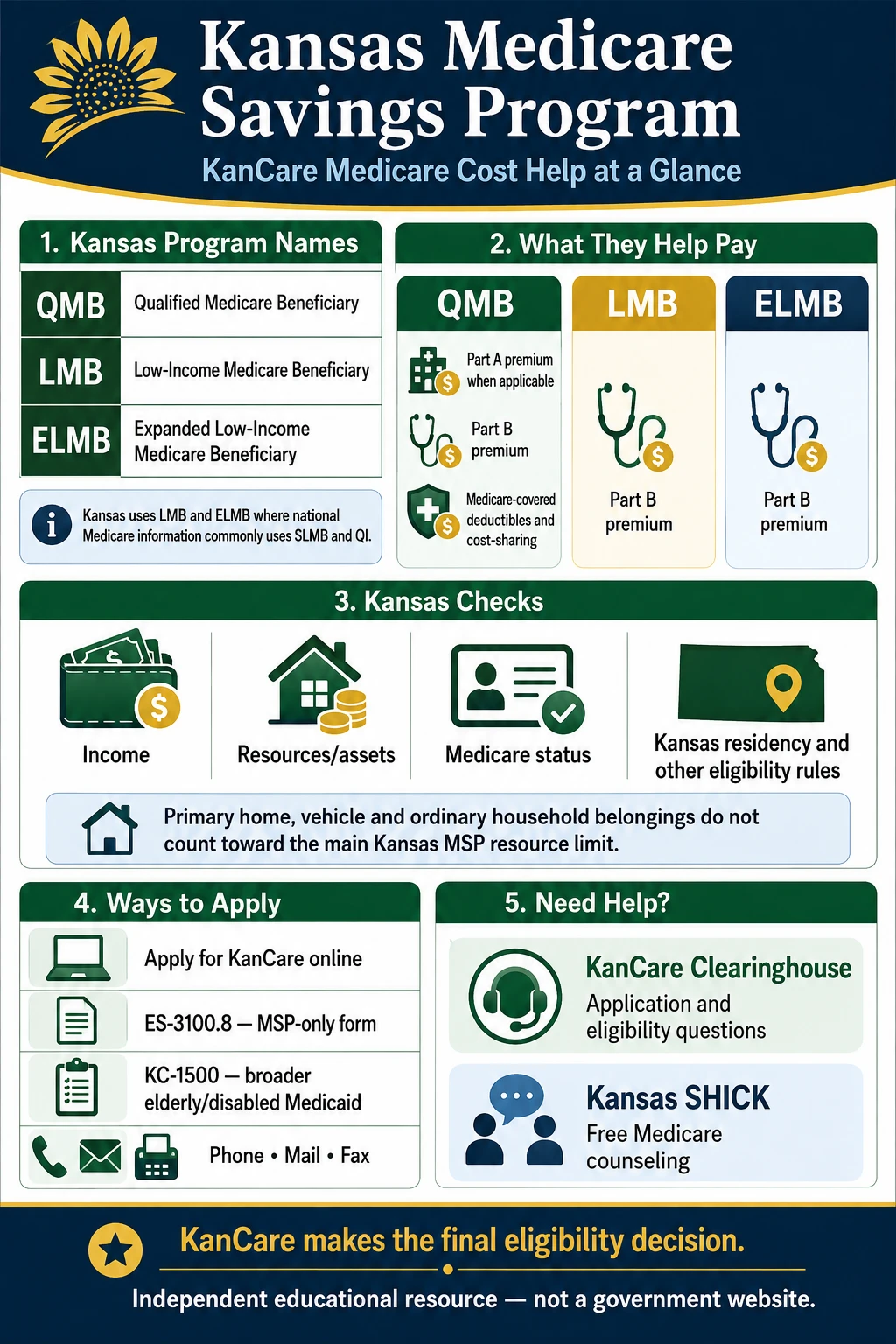
Kansas Medicare Savings Programs may help eligible people with Medicare pay premiums and other Medicare costs. Kansas uses the names QMB, LMB and ELMB for its three main MSP levels, and applications are handled through KanCare rather than Medicare.gov.
Last verified August 29, 2026, using current KanCare, Kansas Medicaid, Kansas SHICK, Medicare, SSA and CMS information. KanCare makes the final eligibility decision.
Kansas Terminology to Know
QMB means Qualified Medicare Beneficiary.
LMB means Low-Income Medicare Beneficiary. It corresponds to the program Medicare usually calls SLMB.
ELMB means Expanded Low-Income Medicare Beneficiary. It corresponds to the higher Part B-premium-help tier Medicare generally calls QI.
Quick Answer
| Need | Kansas route |
|---|---|
| Apply online | Medical Consumer Self-Service / Apply for KanCare |
| MSP-only paper application | ES-3100.8 |
| Broader elderly/disabled Medicaid | KC-1500 |
| Application help | KanCare Clearinghouse: 1-800-792-4884 |
| Mail MSP paperwork | KanCare Clearinghouse, PO Box 3599, Topeka, KS 66601-9738 |
| Current E&D/MSP fax | 1-844-264-6285 |
| Free Medicare counseling | Kansas SHICK: 1-800-860-5260 |
The standard Medicare Part B premium is $202.90 per month in 2026, or $2,434.80 over 12 months. The 2026 Part B deductible is $283.

Kansas Medicare Savings Programs can help people with Medicare keep more of their monthly income by reducing Medicare premiums and, for QMB, certain Medicare deductibles and cost-sharing.
If you are new to these programs, our Medicare Savings Programs educational resource explains how MSP assistance works nationally. For comparison with another state, the most recently published guide covers the Utah Medicare Savings Program and Medicare Cost-Sharing process.
Who Runs the Kansas Medicare Savings Program?
KanCare is Kansas’s Medicaid program. Medicare Savings Program applications and eligibility communications go through the KanCare Clearinghouse, while the Kansas Department of Health and Environment’s Division of Health Care Finance oversees the state’s Medicaid program.
The financial rules are statewide. A qualifying resident uses the same Kansas MSP framework whether living in Wichita, Topeka, Kansas City, Dodge City or a rural county.
KanCare’s official application page currently lists the Medical Consumer Self-Service Portal, the ES-3100.8 Medicare Savings Program application, the KC-2700 Medicare Savings Program brochure and the broader KC-1500 elderly and disabled application.
Kansas Medicare Savings Program Income Limits for 2026
Kansas’s April 2026 MSP brochure lists three main Medicare Savings Program levels: QMB, LMB and ELMB.
| Kansas program | Individual monthly income | Married couple monthly income | Resource limit | Main Medicare help |
|---|---|---|---|---|
| QMB | $1,330 | $1,804 | $9,950 / $14,910 | Part A premium when applicable, Part B premium and Medicare-covered cost-sharing |
| LMB Kansas name corresponding to SLMB |
$1,596 | $2,164 | $9,950 / $14,910 | Part B premium |
| ELMB Kansas name corresponding to QI |
$1,796 | $2,435 | $9,950 / $14,910 | Part B premium |
Resource format: individual / married couple.
These figures come from Kansas’s current April 2026 Medicare Savings Program brochure. KanCare specifically tells people to apply even when income or resources appear above the chart because eligibility calculations can include exclusions.
Why Does Medicare.gov Show Slightly Higher Income Limits?
You may notice that the national Medicare chart shows $1,350/$1,824 for QMB, $1,616/$2,184 for SLMB and $1,816/$2,455 for QI in 2026.
Kansas’s state brochure instead shows $1,330/$1,804, $1,596/$2,164 and $1,796/$2,435. The national screening figures incorporate the general $20 monthly income exclusion used in federal MSP screening.
This does not mean Kansas is necessarily denying everyone whose gross income falls between the two figures. Do not subtract $20 yourself. Report the income KanCare asks for and allow the state to determine countable income.
You can compare the Kansas table with the official Medicare Savings Program limits and our broader Medicare Savings Program income-limit guide.
What About Kansas QWD and the Federal QDWI Program?
Kansas’s main MSP brochure focuses on QMB, LMB and ELMB, but Kansas Medicaid materials also recognize a more specialized category called Qualified Working Disabled, or QWD. This corresponds to the federal Qualified Disabled & Working Individual, or QDWI, category.
QWD/QDWI is for certain people with disabilities who returned to work and lost premium-free Medicare Part A because of earnings. It can help pay the Medicare Part A premium.
Kansas’s April 2026 general medical-assistance fact sheet lists a $2,660 monthly base income figure for a single QWD applicant. The national Medicare and SSA QDWI screening figures are much higher — $5,405 for one person and $7,299 for a married couple — because those federal screening figures incorporate substantial earned-income exclusions. Federal QDWI resource limits are $4,000 for one person and $6,000 for a couple.
What Do Kansas Medicare Savings Programs Offer?
QMB
May pay the Part B premium, Part A premium when owed, and Medicare-covered deductibles, coinsurance and copayments. QMB also provides federal billing protection.
LMB
Helps pay the Medicare Part B premium. It does not provide QMB’s broader Medicare deductibles and cost-sharing protection.
ELMB
Helps pay the Medicare Part B premium for people in the higher income tier. ELMB corresponds to the federal QI category.
QWD
May help pay the Part A premium for certain working people with disabilities who lost premium-free Part A because they returned to work.
QMB, LMB and ELMB eligibility also generally results in automatic eligibility for Medicare Part D Extra Help. That is the mechanism that lowers Part D prescription costs; it should not be confused with QMB itself paying every Part D expense.
For a broader comparison, see our QMB, SLMB, QI and QDWI comparison and Medicare Savings Program vs. full Medicaid guide.
Why Part B premium help matters in 2026
The standard Medicare Part B premium is $202.90 per month in 2026, or $2,434.80 over 12 months. The annual Part B deductible is $283.
CMS confirms these figures in its 2026 Medicare Parts A and B premium and deductible fact sheet.
What Counts Toward the Kansas MSP Resource Limit?
Kansas’s current MSP material lists countable resources such as:
- Checking accounts.
- Savings accounts.
- Certificates of deposit.
- Stocks.
- Bonds.
For QMB, LMB and ELMB screening, Kansas says not to count your primary residence, vehicle or ordinary household belongings toward the MSP resource limit.
Kansas SHICK guidance also says the resource calculation does not include up to $1,500 per person in designated funeral or burial funds.
Do not hide or omit an account simply because you believe it is excluded. Report the resources requested on the application and let KanCare apply the exclusions.
Read our Medicare Savings Program resource-limit guide for more context.
How Do You Apply for a Kansas Medicare Savings Program?
KanCare accepts Medicare Savings Program applications through several routes. You generally do not need to decide for yourself whether QMB, LMB or ELMB is the correct level before applying.
The current Kansas MSP brochure lists online filing, a short MSP paper application, mail, fax and telephone assistance.
Start with an official Kansas application route
Use the official Medical Consumer Self-Service Portal for online filing or review KanCare’s application page for current paper forms and submission instructions.
Option 1: Apply Online Through KanCare
Use Apply for KanCare to access the Medical Consumer Self-Service Portal.
The current KanCare application page identifies the portal as the online application route for elderly and disabled medical programs.
Online application steps
- Open the Medical Consumer Self-Service Portal.
- Create an account or sign in.
- Start the medical-assistance application.
- Enter Medicare information carefully.
- Report Social Security, pension, wages and other requested income.
- Complete the property and resource questions.
- Review the application for missing information.
- Submit it and save the confirmation.
- Upload requested proof through the secure portal when instructed.
- Continue checking the portal and regular mail for KanCare notices.
Do not leave Medicare coverage off the application
Medicare coverage is central to MSP eligibility. Enter Medicare information accurately and use the same identifying information shown in your Medicare and Social Security records.
Kansas also has a specialized policy for some people with Medicare Part B immunosuppressive drug coverage, or Part B-ID. Kansas extended QMB, LMB and ELMB eligibility to qualifying Part B-ID beneficiaries even though these beneficiaries do not have regular Part A entitlement. This is a specialized rule, so ask KanCare to screen the case rather than assuming you are excluded.
Portal messages require a login
If KanCare sends a text or email saying you have a new message, the alert may not include the actual details. Sign in to the portal to read the message.
A short notification can be important if it relates to missing proof or a deadline.
Option 2: Apply With the Short ES-3100.8 MSP Form
If you need Medicare Savings Program assistance only, Kansas currently lists the ES-3100.8 Medicare Savings Program Application/Redetermination.
The four-page form is specifically designed for:
- QMB.
- LMB.
- ELMB.
The form asks for contact information, spouse information, Medicare coverage, income, resources, other health insurance and representative information.
Complete and sign the form
Complete the entire form. Attach additional pages if you need more room and provide copies of requested documentation where appropriate.
Do not forget the signature. ES-3100.8 states that the application is not complete until it is signed.
Where to mail the Kansas MSP application
KanCare Clearinghouse
PO Box 3599
Topeka, KS 66601-9738
Current Kansas MSP fax
1-844-264-6285
Option 3: Request a Paper Application by Phone
You do not have to print the form yourself.
Call the KanCare Clearinghouse at 1-800-792-4884 and ask for a Medicare Savings Program application.
TTY: 1-800-792-4292
Kansas’s current MSP brochure says interpreter services are available and that applicants may request an application in another language.
Telephone assistance can also be useful when you are unsure which application fits your situation.
Option 4: Use KC-1500 When You Need More Than MSP
The short ES-3100.8 form is intended for the Medicare Savings Program categories listed on that form. If you also need broader elderly or disability-related Medicaid coverage, use the appropriate broader application.
KanCare lists the KC-1500 Medical Assistance Application for the Elderly and Persons with Disabilities for applicants who may need coverage involving:
- Age 65 or older and broader Medicaid.
- Disability.
- Blindness.
- Home and Community-Based Services.
- Nursing-facility care.
- Institutional care.
- Other elderly or disabled Medicaid coverage.
Review the current KanCare application list before downloading a form.
A practical Kansas form-selection rule
Only seeking QMB/LMB/ELMB?
Start with ES-3100.8 or the online KanCare route.
Need MSP plus full elderly/disabled Medicaid, HCBS or nursing-facility coverage?
Use the broader KC-1500 route or ask KanCare which application is required.
If nursing-home or in-home care is needed
KanCare specifically tells elderly and disabled applicants seeking long-term services to answer the application question asking whether the person needs help with nursing-home costs or in-home care.
Do not leave that question unanswered when long-term-care services are part of the request.
Send Supporting Documents Correctly
KanCare may ask for verification after an application is submitted. Depending on the program and information reported, proof may involve:
- Social Security, pension, wage or other income information.
- Self-employment records or tax information when applicable.
- Bank, investment and other resource information.
- Property information.
- Health-insurance information.
- Medical expenses when relevant to the benefit category.
- Shelter or other information when requested on the applicable Medicaid application.
Ways to submit proof
Online: Upload documents through the Medical Consumer Self-Service Portal when that option is available for the case.
Fax: For Elderly & Disabled/MSP documents, current KanCare guidance uses 1-844-264-6285.
Mail:
KanCare Clearinghouse
PO Box 3599
Topeka, KS 66601
KanCare’s current FAQ tells applicants to include their name and case number on documents sent separately. When responding to a mailed verification request, include the notice if KanCare instructs you to do so.
Keep proof that you sent it
- Keep the fax confirmation when faxing.
- Save an upload confirmation or screenshot when submitting online.
- Keep a copy of anything mailed and consider a mailing method that provides tracking.
- Save every KanCare notice with the application records.
If a Spouse, Adult Child or Caregiver Is Helping
The MSP application allows an applicant to identify another person who will help manage the medical-assistance case.
KanCare also has formal authorization procedures for representatives and facilitators. If a family member will regularly speak with KanCare, submit documents or act on the applicant’s behalf, complete the appropriate authorization rather than relying only on informal telephone permission.
Keep copies of the authorization with the applicant’s MSP records.
What Happens After You Apply?
KanCare may approve the application, request additional verification, ask for clarification or send a denial notice.
Watch:
- Regular mail.
- The Medical Consumer Self-Service Portal.
- Email or text alerts connected to your account.
- Verification deadlines.
- The final eligibility notice.
KanCare has published a general processing framework of up to about 45 calendar days for many medical-assistance applications, while cases involving a pending disability determination can require a different timeframe. This is not a promise that every MSP case will be completed on an exact day.
If the application approaches that point without a decision, contact the KanCare Clearinghouse at 1-800-792-4884 before submitting a duplicate application. Ask whether the application was received, what filing date is recorded and whether verification is missing.
KanCare’s current fair-hearing guidance also says an eligibility hearing may be requested when the application process is delayed.
When Does Kansas MSP Coverage Start, and Can It Cover Prior Months?
Effective-date rules depend on the Medicare Savings Program category.
QMB: Kansas policy generally makes QMB effective in the month following the month the eligibility action is completed. QMB normally does not provide retroactive coverage for earlier months, although Kansas policy contains limited technical exceptions.
LMB and ELMB: Kansas policy can allow prior medical eligibility when the applicant met the program rules in qualifying prior months. Kansas has specific processing instructions for the ES-3100.8 MSP-only application.
Requests that enter Kansas through another pathway, including some Medicare Part D Extra Help/MIPPA referrals, can have different prior-month rules.
Get Free Medicare Help From Kansas SHICK
1-800-860-5260
SHICK stands for Senior Health Insurance Counseling for Kansas. It is Kansas’s State Health Insurance Assistance Program, or SHIP.
SHICK provides free Medicare counseling and can help people understand:
- Medicare Savings Programs.
- QMB, LMB and ELMB.
- Medicare premiums.
- Part D and Extra Help.
- Medicare Advantage.
- Medicare Supplement coverage.
- Medicare billing problems.
Visit the official Kansas SHICK information.
SHICK can explain Medicare and help with applications, but KanCare makes the MSP eligibility decision.
Kansas MSP and Medicare Part D Extra Help
People who qualify for QMB, LMB/SLMB or ELMB/QI generally qualify automatically for Medicare Part D Extra Help.
In 2026, Extra Help generally provides:
- $0 plan premium when the applicable benchmark requirements are met.
- $0 Part D deductible.
- Up to $5.10 for each covered generic drug.
- Up to $12.65 for each covered brand-name drug.
- $0 for covered drugs after total drug costs reach the applicable 2026 catastrophic threshold of $2,100.
Read Medicare’s current Extra Help information.
If Extra Help does not appear after MSP approval, keep the KanCare approval notice and contact the Part D plan, SHICK or Medicare.
What if Your Part B Premium Is Still Being Deducted?
Do not assume an MSP approval failed simply because the first Social Security payment after approval still shows a Medicare Part B deduction. State, Medicare and Social Security records can take time to coordinate.
Check:
- Which MSP level was approved.
- The effective date on the KanCare notice.
- Whether Part B premium assistance is included.
- Whether KanCare is still requesting proof.
- Later Social Security payments.
- Any separate premium reimbursement or adjustment.
For eligibility and effective-date questions, contact the KanCare Clearinghouse. For Medicare-side troubleshooting, Kansas SHICK can help.
See our guide to Medicare Part B premium help.
If You Have QMB and Receive a Medicare Bill
QMB provides important federal billing protection for Medicare-covered Part A and Part B cost-sharing.
If a provider sends a deductible, coinsurance or copayment bill for a Medicare-covered service received while QMB was active:
- Do not automatically assume the bill is valid.
- Confirm QMB was active on the service date.
- Confirm Medicare covered the service or item.
- Contact the provider’s billing office.
- Tell the office you had QMB.
- Provide the appropriate Medicare and Kansas coverage information.
- Ask the provider to verify QMB status and correct protected cost-sharing.
- Keep the bill and Medicare Summary Notice.
- Contact SHICK or 1-800-MEDICARE if the billing problem continues.
Federal rules generally prohibit Medicare providers and suppliers from billing QMB beneficiaries for Medicare-covered Part A or Part B deductibles, coinsurance and copayments. Limited Medicaid copayments may still apply in some circumstances, and QMB does not make non-Medicare-covered services automatically free.
Read our QMB Medicare Savings Program guide.
How Does Kansas MSP Renewal Work?
Medicare Savings Program eligibility is reviewed periodically. KanCare says households are notified when it is time to complete a review, and reviews can now be completed through the Medical Consumer Self-Service Portal when available.
KanCare’s current renewal guidance says a household that must return a review form may receive it about 60 days before the due date.
To reduce the risk of a coverage gap:
- Keep your mailing address and contact information current.
- Open every KanCare review notice.
- Complete the review by the date shown.
- Provide requested income and resource information.
- Return missing verification by the deadline.
- Save proof that the review was submitted.
- Read the final eligibility notice carefully.
Beginning July 1, 2025, Kansas changed its reconsideration policy for late Medicaid reviews. A late review can be treated as a new application, and backdated coverage is not automatic. Follow the current notice rather than assuming a late renewal will restore every missed month.
Review the current KanCare reconsideration policy guidance and our Medicare Savings Program renewal guide.
What if KanCare Denies or Ends Medicare Savings Program Coverage?
Read the complete eligibility notice before responding. A denial or closure can result from reasons such as missing verification, an unsigned form, income or resources above the applicable standard, incomplete information or failure to complete a review.
If you disagree:
- Compare the decision with the application and documents you submitted.
- Call the KanCare Clearinghouse at 1-800-792-4884 and ask how the eligibility decision was calculated.
- Ask whether missing or corrected information can still be submitted.
- If you still disagree, follow the fair-hearing instructions on the notice.
- Keep copies of the notice, hearing request and supporting records.
Kansas eligibility fair-hearing deadline
KanCare’s current eligibility fair-hearing page states that a request must generally be filed within 33 calendar days from the date on the eligibility notice.
A request concerning an eligibility decision can be made by telephone or in writing. KanCare lists:
Eligibility hearing phone: 1-800-792-4884
TTY: 1-800-792-4292
Fax: 785-296-4848
Office of Administrative Hearings
1020 S. Kansas Ave.
Topeka, KS 66612
Use the official KanCare eligibility fair-hearing guidance and our Medicare Savings Program denial guide.
If the KanCare Problem Still Is Not Resolved
For ordinary applications, missing documents and eligibility questions, start with the KanCare Clearinghouse.
If a KanCare issue continues after normal channels have been tried, the KanCare Ombudsman Office can help applicants and members understand coverage, access and rights.
1-855-643-8180
Relay: 711
Visit the official KanCare Ombudsman contact page.
Does Estate Recovery Apply to Kansas MSP?
The ES-3100.8 Medicare Savings Program application specifically states that Estate Recovery does not apply to QMB, LMB or ELMB.
Kansas’s current MSP brochure also tells applicants that the state will not take their home or assets because they are enrolled in MSP.
This statement applies to the MSP coverage described here. It should not be generalized to every type of Medicaid coverage.
A person who also receives full Medicaid, nursing-facility benefits, HCBS or other Medicaid services can be subject to different estate-recovery rules. Review the person’s actual coverage before drawing conclusions about estate recovery.
Kansas MSP Mistakes That Can Cause Delay or Confusion
Using only the national program names
When speaking with KanCare, know that Kansas uses LMB and ELMB rather than relying only on the national SLMB and QI labels.
Self-denying from gross income
Kansas specifically encourages people near the limits to apply. Income-counting rules and exclusions can affect eligibility.
Using the old fax printed on ES-3100.8
The older PDF still displays 1-800-498-1255. Current Kansas guidance uses 1-844-264-6285 for Elderly & Disabled/MSP paperwork.
Using the MSP-only form for broader Medicaid
Use KC-1500 or the appropriate broader application when full elderly/disabled Medicaid, HCBS or nursing-facility assistance is also needed.
Forgetting to sign the paper application
ES-3100.8 states that the application is not complete until it is signed.
Leaving resource questions blank
Kansas has an MSP resource test. Report requested accounts and resources even if you believe an exclusion applies.
Ignoring a portal message or verification notice
A text or email may only tell you that a new portal message exists. Sign in and read the actual notice.
Submitting a second application too quickly
If processing seems slow, first call the Clearinghouse and confirm the status, filing date and missing information.
Failing to report changes
The ES-3100.8 rights and responsibilities require applicants or members to report changes that may affect eligibility, including relevant changes in income, resources, address or living arrangements, within the timeframe stated by Kansas. The form currently states 10 days.
Paying a QMB cost-sharing bill without checking it
QMB beneficiaries have federal billing protections for Medicare-covered deductibles, coinsurance and copayments.
Kansas Medicare Savings Program Contacts
| Need | Kansas contact or resource |
|---|---|
| Apply online | Apply for KanCare |
| Forms and application guidance | KanCare Apply Now page |
| Application/status questions | KanCare Clearinghouse: 1-800-792-4884 |
| TTY | 1-800-792-4292 |
| Current E&D/MSP fax | 1-844-264-6285 |
| KanCare Clearinghouse, PO Box 3599, Topeka, KS 66601-9738 | |
| Free Medicare counseling | Kansas SHICK: 1-800-860-5260 |
| KanCare Ombudsman | 1-855-643-8180; Relay 711 |
| Eligibility fair-hearing fax | 785-296-4848 |
Continue Your Research
Compare Kansas with the recently published Utah Medicare Savings Program guide.
You can also review who may qualify for a Medicare Savings Program, the national MSP income-limit guide and the resource-limit guide.
Kansas Medicare Savings Program FAQs
What are the Kansas Medicare Savings Program income limits for 2026?
Kansas’s April 2026 MSP brochure lists $1,330/$1,804 for QMB, $1,596/$2,164 for LMB and $1,796/$2,435 for ELMB for an individual/married couple. KanCare applies its income-counting rules when determining eligibility.
Does Kansas have an MSP asset limit?
Yes. Kansas lists resource limits of $9,950 for one person and $14,910 for a married couple for QMB, LMB and ELMB. The primary residence, vehicle and ordinary household items are not counted in the state’s MSP screening.
Why are the Medicare.gov income limits $20 higher?
The national Medicare screening figures include a general $20 monthly income exclusion. Kansas’s brochure publishes the underlying state income figures. Report actual income and let KanCare calculate the amount that counts.
What are LMB and ELMB in Kansas?
LMB is Kansas’s Low-Income Medicare Beneficiary program and corresponds to the program usually called SLMB nationally. ELMB is Expanded Low-Income Medicare Beneficiary and corresponds to the higher QI premium-assistance tier.
What is the correct Kansas MSP application?
Use ES-3100.8 when applying only for QMB, LMB or ELMB, or apply through the Medical Consumer Self-Service Portal. If broader elderly or disabled Medicaid, HCBS or nursing-facility assistance is also needed, use the KC-1500 route or ask KanCare which application is required.
What is the current Kansas MSP fax number?
Current KanCare instructions use 1-844-264-6285 for Elderly & Disabled/Medicare Savings Program applications and documents. The August 2022 ES-3100.8 PDF still prints an older fax number, so follow current KanCare instructions or your latest notice.
Does Kansas have QDWI?
Kansas Medicaid materials recognize a specialized Qualified Working Disabled, or QWD, category corresponding to federal QDWI. It may help pay the Part A premium for certain working people with disabilities who lost premium-free Part A because they returned to work.
Does Kansas MSP include Extra Help?
People who qualify for QMB, LMB/SLMB or ELMB/QI generally qualify automatically for Medicare Part D Extra Help, which can reduce prescription-plan premiums, deductibles and copayments.
How long do I have to appeal a Kansas MSP eligibility decision?
KanCare’s current eligibility fair-hearing guidance says the hearing request generally must be filed within 33 calendar days from the date on the eligibility notice. A shorter deadline applies if you want existing coverage continued while the hearing is pending.
Does estate recovery apply to Kansas MSP?
The Kansas ES-3100.8 application states that estate recovery does not apply to QMB, LMB or ELMB. Other types of Medicaid coverage can have different estate-recovery rules.
Who can help me apply for a Kansas Medicare Savings Program?
Call the KanCare Clearinghouse at 1-800-792-4884 for application and eligibility help. For free Medicare counseling and MSP assistance, call Kansas SHICK at 1-800-860-5260.
Conclusion
Kansas Medicare Savings Program applications become much easier to navigate once you know the state’s terminology and choose the correct application route.
Use the Medical Consumer Self-Service Portal for online filing. Use ES-3100.8 when you only need QMB, LMB or ELMB. Use the broader KC-1500 route when the case also involves elderly or disabled Medicaid, HCBS or nursing-facility assistance.
For paper MSP submissions, current Kansas instructions use the KanCare Clearinghouse, PO Box 3599, Topeka, KS 66601-9738 and 1-844-264-6285 for Elderly & Disabled/MSP fax submissions.
Do not rule yourself out because your income is close to a table. Report income and resources accurately and let KanCare determine what counts. Keep proof of submission, respond to verification requests, complete renewals on time and read the final eligibility notice carefully.
Think you may qualify for Medicare cost help?
Use an official Kansas application route and let KanCare calculate your income, resources and applicable program. Eligibility is not guaranteed.
Editorial disclaimer: This article provides general educational information and is not legal, financial, medical or benefits advice. Eligibility rules, income limits, resource limits, forms and procedures can change. Review current KanCare instructions and your individual eligibility notice. Kansas makes the final eligibility determination.